Nichols N1A review – the antidote to dull heavy hybrid supercars
Turbocharging, hybridisation, noise regulations – for all their power and performance, modern supercars are sanitised compared to the Nichols N1A
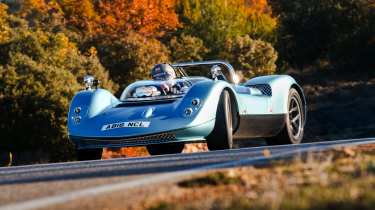
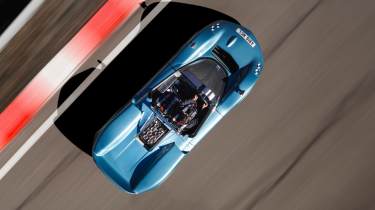
Concoct a recipe for the most exciting road-legal sports car you can imagine and you might just come up with the Nichols N1A. Smaller than a Lotus Elise and weighing less than 900kg, it is powered by a mid-mounted 7-litre V8 good for 700bhp. Manual, rear-wheel drive and wrapped in curvaceous composite bodywork harking back to an age before huge spoilers and the obsession with downforce, it embodies the analogue dream.
How did the project come about and who’s behind it? As with the origins of most small sports car companies, an idea existed in the head of its founder for many years before the dream became reality. In the case of Brit John Minett, that idea was to capture the spirit of a mid-1960s Can‑Am car, specifically the McLaren M1A, and recreate it as a car fit for road and track driving.
Rather than build a straight replica, Minett’s vision was to contemporise its design, dimensions, construction and dynamics using modern materials and methods, while preserving its explosive essence with a target weight of comfortably less than a ton while being powered by a ruddy great V8.

A time-served automotive consultant with decades of experience, Minett found a highly qualified collaborator and co-founder in noted F1 engineer and designer Steve Nichols. Principal architect of McLaren’s sensational MP4/4, which famously won 15 of the 16 races in the 1988 season in the hands of Alain Prost and Ayrton Senna, Nichols brought a special blend of capability and kudos to the project, one which sees him in the role of technical director alongside CEO Minett.

As you might imagine, the journey has not been straightforward. Rewind a couple of decades and the pair could have been breathing new life into one of the UK’s best-loved sports car brands, Minett having got tantalisingly close to a successful merchant-bank-backed acquisition of TVR from Nikolai Smolensky. The plan had been to improve the Tuscan and Sagaris before making an all-new car, but after Smolensky scuppered the deal, Minett and Nichols had to regroup.
For a while they still harboured a desire to build a car in the vein of a TVR. But when the company was eventually sold to Les Edgar and his fellow investors, Minett – believing TVR would soon be back in business – decided it was time to move on and instead crystallise the idea of a reimagined Can‑Am car.

Initial thoughts led them to consider reviving Elva, as the brand had direct and authentic connections to McLaren’s earliest days. It was also dormant, available and came with far less baggage than TVR, but in the end, and after some telling market research, Minett and Nichols decided it would require too much of a history lesson to communicate its significance. And so, in a perfect case of something being hidden in plain sight, Nichols Cars was born.
Unlike many sports car start-ups, where the deeper you dig the less convincing it seems, with Nichols Cars the more layers you peel back the more interesting and impressive it becomes. At every stage, quietly brilliant people have been engaged to execute key aspects of the car, with most coming from a network of suppliers and individuals that Minett and Nichols have worked with over the decades.
In addition to the founding pair, the roster of senior personnel is steeped in success. Director of operations Mark Hannawin worked as Ayrton Senna’s mechanic at Lotus and McLaren before switching to become a test and development driver on the McLaren F1 supercar project. Sales and marketing director Keith Holland is also ex-McLaren, having worked on the F1 team before transferring to a programme management role within McLaren Automotive.
Perhaps the best example of how thoroughly the company has approached the N1A is its bespoke aluminium and carbonfibre chassis, the result of co-operation between Nichols Cars and a brilliant engineer by the equally brilliant name of Bob Mustard. A leading exponent of extruded and bonded aluminium construction, having introduced the concept to Lotus where it went on to form the basis of the S1 Elise, Mustard is former technical director at Lotus chassis supplier Hydro Aluminium and MD of the company’s production facility in the UK. Since then, his own company, Stalcom, has become a leader in the design and manufacture of lightweight, low-volume chassis structures.

Though the N1A is inspired by McLaren’s famous Can‑Am racers, Steve Nichols’ connection with the MP4/4 means there’s also more than a pinch of F1 pedigree; something celebrated by the ‘Icon 88’ edition with which Nichols Cars is launching the N1A. Limited to 15 cars – each one commemorating one of the MP4/4’s famous 15 wins in the 1988 season – each Icon 88 is built to the same ultimate spec. At £500,000 plus taxes it’s in serious supercar territory and aimed squarely at UHNW collectors craving a credible outlier with an emphasis on raw thrills.
The shape of the N1A was very clearly driven by Minett’s love for the M1A, but it shares nothing from the original McLaren. Wider and longer to accommodate modern 19-inch front and 20-inch rear wheels and cleverly sculpted to cancel lift without the need for wings and spoilers, it has been refined in the MIRA wind tunnel with help from Ben Wood. Founder and technical director of aerodynamic design consultants Dynamique, Wood is former chief aerodynamicist at Mercedes Grand Prix, with Ferrari, Arrows, Tyrrell, Prost and Jaguar also on his extensive CV.

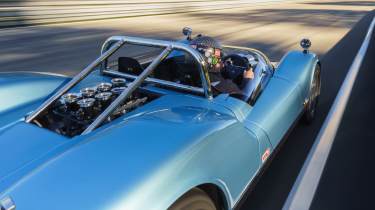
The car we’re testing is Nichols’ development car. It too is built to Icon 88 spec, starting with its hand-built 7-litre Chevrolet V8. Dry-sumped and running with Jenvey throttle bodies and open trumpets, it is the antithesis of modern, whisper-quiet combustion engines. It is the beating heart of the N1A, not to mention a sight for sore eyes with its intake system displayed for all to see.
Nichols Cars entrusts the specification, integration and build of its engines to another pair of names steeped in motorsport experience. David Wood, who looks after powertrain integration, is best known for the design of the Group B Metro 6R4’s magnificent 3-litre 24-valve V6 and its subsequent twin-turbocharged applications in the Jaguar XJ220 supercar and TWR XJR‑11. He then moved to Cosworth to work on F1 engine design before leaving to start his own consultancy business.
The hand assembly of Nichols’ Chevy LS-based engines is entrusted to Dick Langford, who can trace his career back to the height of F1’s Cosworth DFV era. His business – Langford Performance Engineering – is one of the world’s most highly respected historic race engine builders, with expertise in everything from a 1960s Coventry-Climax to a late-1990s Cosworth V10 screamer.
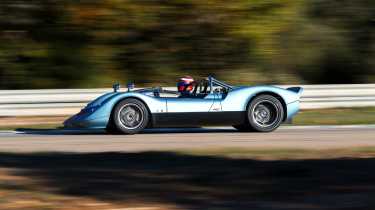
I meet the main players at the Circuit du Grand Sambuc. One of those hidden gems in the middle of France, the privately owned track (an hour from Marseilles) used to be the place F1 teams would come to test their setups for the Monaco Grand Prix. Some of you might recognise it from the recent YouTube film of Max Verstappen testing the Mustang GTD with Chris Harris. It’s a superb place; lots of elevation change, a long curving straight, big braking areas, technical chicanes and a couple of Code Brown blind crests.
Nichols Cars are here to put in some test and development miles, trying new carbon brakes and a variety of spring/damper combinations. The car is being looked after by Will Baker and his team from Atelier Special Vehicles.
Responsible for this final prototype N1A’s build and development, they are busy buttoning it up for the afternoon sessions. Also here is Nichols development driver Bart Horsten, a young (23) Australian racer who also serves as one of the Aston Martin F1 team’s simulator drivers. Wise beyond his years, Horsten’s methodical approach is impressive, but can’t disguise his enthusiasm for the N1A’s purity and animalistic performance.
I’ve been fortunate to track-test a number of Can‑Am cars over the years; the wildest was a Shadow Mk1 (google it and be gobsmacked), the most fearsome an iconic and demonic 917/30. However, none was more special than Bruce McLaren’s M6A‑1. McLaren’s first monocoque design and the very car in which he won the 1967 Can‑Am Championship – the first of five back-to-back titles for the marque that bore his name – it is one of the most significant and extraordinary cars I’ve ever experienced.
The N1A might take direct inspiration from McLaren’s M1A, but as that was a tubeframe car there’s arguably a closer connection to the M6A and its advanced (for the time) monocoque. Semantics aside, the N1A looks sensational in the winter sunshine. It’s small and classically beautiful, but don’t be fooled; it’s as serious as a balled fist.
You don’t need to have been born in the Can‑Am era to appreciate the magnitude of its performance potential. A lesson in raw physics, do the maths with its vital stats and you’ll arrive at a very similar power-to-weight ratio to the Ferrari F80. Sticks of TNT pack less of a punch.
Getting into the N1A is easier than you might think. The cut-down door is more than a token gesture to ingress, swinging open like the top half of a stable door, revealing a pontoon sill. In the old Can‑Am car, each sill was broad enough to contain a 25-gallon fuel tank with just a thin sheet of alloy for protection. In the N1A they’re a structural feature in double-skinned carbonfibre for greatly improved side-impact protection.
You don’t so much step into the N1A’s cockpit as up and over the sill, bracing yourself on the rollover hoop with your left arm as you swing your left leg in, followed by the right. It feels wrong to say, but it’s easiest to plant both feet on the seat and shuffle yourself down, legs sliding into the footwell until your hips, ribs and shoulders are settled between the bolsters of the driver’s seat.

Customers will be given the option of having a custom seat made – using 3D scan data – by Real Design, suppliers to many F1 and WEC teams. This would really lock you in like a component of the car, but it makes sense for this development car to use a more conventional carbon-shelled seat to suit a wider range of drivers.
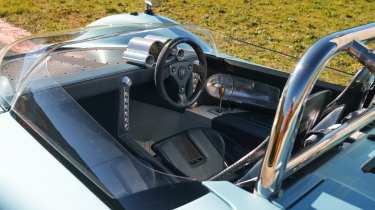
Once settled, the view is fabulous. It’s so pure and pared-back, but with real drama and spectacle. The front wheelarches rise like mountains ahead of you. Topped by round bullet mirrors, they accentuate the low-slung seating position and remind how the bodywork shrink-wraps around the mechanical package beneath.
The moulded Perspex windscreen swoops up the valley between the wings, serving as a shield from the slipstream and a display case for the billet machined instrument housing. It’s as close to an authentic Can‑Am experience as you’ll find.
The pedals – mounted in a beautiful race pedal box – are well spaced and reassuringly firm, and the steering wheel is nicely old-school: perfectly round, with a minimum of switches (a pair of green buttons for the indicators, central horn push and a blue button to flash the lights), it suits the N1A perfectly.
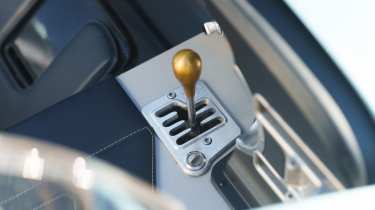
Another highlight is the gearshifter, which is topped by a fabulous, anodised knob similar in shape to that fitted to Ayrton Senna’s MP4/4. Sprouting from the right-hand sill, the lever operates a six-speed manual transmission. A dry run through the open gate reveals a slick and strangely familiar shift. Which makes sense when I’m told it’s the same gearbox as in an Audi R8 V10, albeit with a revised final drive to suit the LS7 engine, which doesn’t rev as high as the Audi unit.
There are currently two engine maps. Fittingly you push the button marked ‘11’ to turn the N1A up to the full 700bhp, with the lower setting roughly halving the output and softening the throttle response. Traction control and ABS (both motorsport systems) are in progress, but we run with neither for our test. Likewise, power steering is in the pipeline but absent from this car. Good job I’m in prime physical condition. Ahem.
Knowing there’s 700bhp purely at the command of your right foot (yes, of course I turned it straight to 11) certainly focuses the mind. In truth it’s daft to run in that mode until there’s some heat in the tyres and brakes, so I quickly knock it back to the lower power level. All things are relative, though, for this still equates to around the same power-to-weight ratio as a new 992 GT3.
Getting to know the N1A is a hugely satisfying process. The clutch and gearshift are modestly weighty but feelsome and well-matched, so it’s easy to settle into a relaxed groove. The sense of potency is immediately apparent, a small squeeze of the throttle in a high gear delivering a wonderful elastic surge as the LS7 flexes its muscles. The steering is hefty at parking speeds, but once out of the paddock it’s less of a workout as speed builds, though you still need strong forearms in the tighter corners.
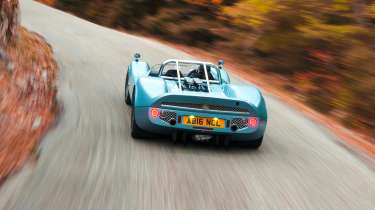
With some warmth in the Michelin rubber (Pilot Sport Cup 2s) and a bit of familiarity with the N1A’s controls, it’s time to turn it back up to 11. The transformation is huge, the engine becoming an all-consuming presence and the throttle something to treat with respect.
The exhaust is silenced, but the soundtrack is far from muffled thanks to those trumpets and throttle bodies, which create a fabulous induction noise under load. Under heavy braking the V8 rumbles like war drums, blip-shifts adding further crackles and pops on the overrun.

I get to try a couple of different spring/damper combinations during the test. The first is firm and precise – a little too firm for Sambuc’s bumpy straight – with a surprisingly neutral balance. We then try a slightly softer setup that feels more settled on the straight and has better feel in the corners, with a greater sense of rotation on turn-in and more to lean on mid-corner. It’s an impressive demonstration of how responsive the N1A is to setup changes. Not that this should come as a surprise given the modernity of the structure and Steve Nichols’ vast experience.
The beauty of the N1A is that although it owes its inspiration to one of the most hardcore race cars of all time, it has always been designed with road driving in mind. Quite how much is debatable given that it has no roof, but with the sun shining and a break in the track testing, it doesn’t take much to persuade the Nichols guys to let me take it out on the road.
With crash helmet replaced by sunglasses, the N1A takes things up another level. The cockpit is a brilliant place to be, exposed enough to heighten your senses but snug enough to feel like you’re hunkered down out of the elements. Few cars deliver quite such an intense experience from the moment you climb in.
As you might imagine, if the performance felt mighty on track it is absolutely wild on the road. Where modern supercars only really come alive at high speeds but still insulate you from the action, the N1A has you beaming from walking pace.
It takes a good while before you pluck up the courage to hoof it in a low(ish) gear, moist palms given a quick wipe on your jeans before you have one last glance in the mirror and gun it. The way it gets from where you are to where you’re looking is simply breathtaking, the car catapulted forwards by the sheer brute force of that epic V8.
Beyond the ability to instantly flood your system with adrenaline, the N1A makes a surprisingly civilised road car. It has a very impressive sense of integrity, with tremendous rigidity and a complete absence of squeaks or rattles. Fit and finish are first rate and the driving position is spot-on. There’s some buffeting once you’re above 50mph, but nothing a snug-fitting hat wouldn’t sort.

Distortions that made it tricky to look through the curved bubble screen at Circuit de Sambuc are less of an issue on the road, where the variety of corners is endless and your level of commitment much reduced. In short, while you’re not going to take the N1A on a touring holiday, an early morning blast on your favourite roads, or even just a leisurely drive to the pub on a summer’s evening would be magical.
The first customer car is set to be delivered in early spring, with others – including for the first US customer, who ordered a car from Nichols after seeing the N1A at last year’s Pebble Beach event – following soon after. Beyond that, in addition to the run of 15 Icon 88 editions, Nichols will be broadening the N1A proposition with a choice of engine options ranging from a more standard Chevy LS crate engine right up to an evolution of the full-on 7-litre engine that should be good for as much as 730bhp.
At a time when supercars are becoming more sanitised, controlled by computers and dependent upon downforce, the N1A’s wild and wilfully analogue approach is hugely appealing. Factor in the people behind it, the quality of its execution and the way it combines old-school shock and awe with modern advancements, and you have a truly unique car. One that stands as testament to the determination of those who have made it happen and promises an unforgettable driving experience for those who dare to look beyond the usual suspects.
Specs
| Engine | V8, 7008cc |
|---|---|
| Power | 703bhp @ 6500rpm |
| Torque | 600lb ft @ 5200rpm (est) |
| Weight | <900kg (dry) (c790bhp/ton) |
| 0-62mph | c3.5sec (est) |
| Top speed | 180mph-plus (est) |
| Basic price | £500,000 plus taxes (Icon 88 edition) |