No, you can’t drive the ‘flying’ Tesla Roadster on the road, or buy one…
The demo for the revived Tesla Roadster was certainly awe inspiring, but don’t start planning your flight routes to work just yet
Almost a whole decade since its initial announcement and after the most tumultuous, and controversial launch in automotive history, the second-generation Tesla Roadster is finally here. Or at least it’s been revealed, again, now in a completely different form to the car previewed in 2017, ahead of its new proposed production date of 2028 – given CEO Elon Musk once said this car would hit the road eight years earlier, we’ll believe it when we see it.
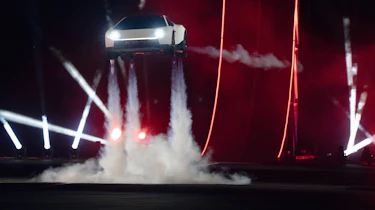
Seeing it to believe it is certainly something that can be applied to its live-streamed reveal. As if the event location at a SpaceX rocket testing facility in McGregor, Texas, wasn’t enough of a hint, this car comes with tech derived from rockets that, in the case of this demonstration, allow it to fly. Yes, really.
> Tesla Roadster (Mk1, 2008 - 2012) review – the original electric sports car
Tesla Roadster Mk2: the ‘rocket’ thrusters
The system responsible utilises the same ‘cold gas thruster’ technology found in SpaceX rockets, with bursts of ultra-high pressure air used to reorientate the vehicle in space via ten separate nozzles. Of course, you need somewhere to store that high pressure air, so Tesla says it has packed ‘every usable void’ in the car with a pair of carbonfibre overwrapped pressure vessels, the tried-and-tested method for storing gas at such a high pressure – in the case of the Roadster, that means you have one just inches behind your head. Musk did say this was '...not a safety optimised car’ after all.
In 2024, Bugatti-Rimac CEO Mate Rimac responded to the suggestion that Tesla would employ this rocket-derived tech: ‘...it is possible with thrusters. We did the simulation. Problem is, you release the air in 2-3 seconds and then you have a lot of dead weight that you are carrying around (tanks, compressor, valves, nozzles etc.).’ He went on to say that such an acceleration figure could also be achieved through the use of fans as we’ve seen in the McMurtry Spéirling, but added that ‘the tyres would be overloaded very fast with any kind of car with “normal supercar” weight’. Rimac concluded that ‘thrusters are really the only way to go. But bring a lot of downsides as well.’
Tesla says these thrusters can produce a total of 80kN of thrust, and while we can’t verify that claim, that would give it the same power as an F-16 Fighting Falcon fighter jet without afterburner, albeit in bursts. The consequence of standing in the way of one of these thrusters would be undesirable to say the least, and even if you’re nearby, you’ll need to wear hearing protection – gas exits the nozzles at beyond the speed of sound.
Performance, top speed and 0-60mph
If this all sounds a little far-fetched for a road-going passenger car, you’d be right. You can’t use the ‘flight-capable’ Tesla Roadster on the road, or share it with passengers. Sold as one of three variants, the Roadster ‘Rocket’ has a single seat, is not approved for road use and can’t even be readily purchased like the other variants in the lineup. To get one, you’ll need to be selected specifically by Tesla, as it’s invite-only – for those that get lucky, a sub-0.59sec 0-60mph time and top speed in excess of 230mph are what Tesla says you’ll unlock – Musk did add that he wants to target ‘halfway to the speed of sound,’ to which his colleagues on stage gave a puzzled look.
At the other end of the scale is the ‘entry-level’ Roadster Performance, which is ‘road-ready’, has two seats, active aerodynamics and is capable of a still-ludicrous <1.6sec 0-60mph time, according to Tesla. No top speed has been disclosed. The third and final variant is the limited-run Roadster ‘Thrust’, giving you two seats, the same features as the Performance model and a dedicated cold gas thruster for acceleration only – the result is a sub-1sec 0-62mph time when at the drag strip.
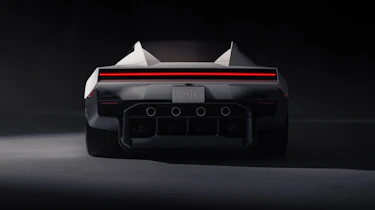
Tesla focused solely on the gas thruster and suction system of the Roadster in this initial event, revealing no information about its electric powertrain beyond a quoted 300-mile range (under half the 620 quoted at the Roadster’s 2017 reveal). We do know that it has a full ‘by-wire’ steering, brake and throttle system though, with a tagline of the 'best of the last human-driven cars' ensuring a focus on feedback and engagement. Magnesium, titanium and carbonfibre is said to have been used to lower mass, the sticky Pirelli Trofeo RS is the tyre of choice, and it has inboard suspension too, with height adjustable depending on the drive mode.
The fan suction system
Earlier this year we reported on a patent granted to Tesla for an ‘electric fan car’, and we can see exactly where this technology has gone in this car too. The demonstration began with the Roadster driving up a ramp, and into a completely inverted position, proving it’s capable of generating enough downforce at a standstill to support its own weight – around 1700kg is the target, and the 600-litre COPVs hold up to 250kg of air alone. This is technology similar to the kind seen on Britain’s record-breaking McMurtry Spéirling and the GMA T.50 hypercar, but unlike McMurtry, Tesla’s patent specifies fans aren’t used in conjunction with a skirt beneath the car.
The suction feature for added downforce works in conjunction with the aerodynamic downforce of the active aero elements, most notably the wing, to pull the car into the ground and allow for a up to 2G of lateral acceleration and an improvement in traction for longitudinal acceleration and braking. On stage, Musk also confirmed that the system would ‘open up’ at the front and rear at higher speeds to allow for more flow under the car, unlocking that high top speed. All three variants of the new Tesla Roadster are said to come with this feature.
Design and interior
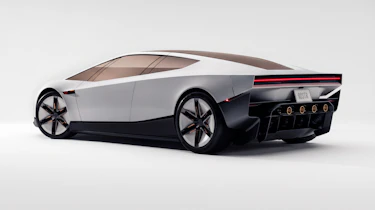
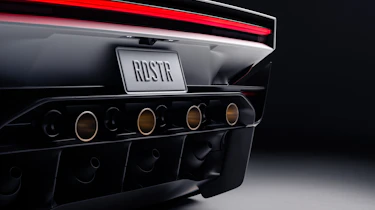
This is very clearly not anything like the Roadster shown back in 2017, with its design completely thrown out and replaced with this geometric, angular design said to be have been inspired by the F-35 stealth fighter, James Bond’s Lotus Esprit and to our eyes, very clearly the divisive Cybertruck too.
Despite its extreme performance-enhancing hardware, surfaces have been kept clean and clutter-free, painted in aerospace-inspired Ano white paint and with even the headlights discreetly tucked away. The full-width lightbar continues the minimalist theme beneath the huge moveable rear wing, with four huge air outlets for the fan system nestled within the complex diffuser along with thruster nozzles.
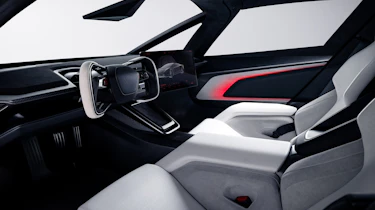
The Roadster revealed in 2017 was said to seat four people, but Tesla has stuck to a two-seat configuration in everything but the single-seat ‘Rocket’ model. It’s just as minimalist as you’d expect though, with a bare, low dashboard, central rectangular display and, new to this car, two additional ‘forward’ displays for vital information. The heavily bolstered seats are fixed to the chassis for improved packaging, like in a Ford GT, and the yoke-style steering wheel (only to be found on the left-hand side) drives a steer-by-wire system. If you’re wondering what makes it a Roadster, it has a couple of discrete removable roof panels.
Price and availability
Standing on stage six years since the new Roadster was initially supposed to enter production, Elon Musk says 'we enter production in 2028. Actually, for real.' Which markets it will be available in its yet to be confirmed but we do know it’ll be available in left-hand drive only, and that the range-topping ‘flying’ Rocket model will not be road legal.
Pricing hasn’t been disclosed, but buyers are required to stump up a £5000 deposit for the Performance and limited-run Thrust variants, before sending an additional £45,000 and £245,000 within 10 days. Whether the deposit and that sum equate to the total price of the car is yet to be seen, but it’s highly unlikely the Roadster Performance will cost a total of just £50,000…