Toyota Supra (A90, 2019 - 2024) – too 'BMW' or was the hate undeserved?
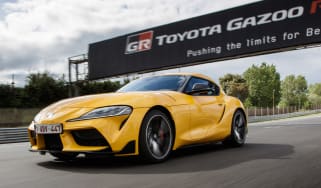
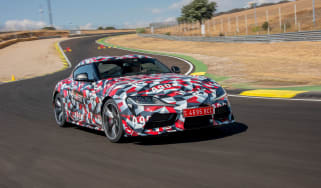
Toyota’s iconic coupe returned in 2019 but with German rather than Japanese bones. The grief it got as a result never went away, whether deserved or not…
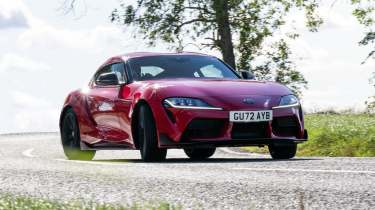
The A90 Toyota Supra is no longer on sale in the UK, its short five-year tenure ending in 2024, with our shores denied the prospect of the tantalising, tarted-up 429bhp Final Edition. The A90 Supra didn’t have an easy time of it at any point throughout its life, its existence and the discourse around it seemingly haunted by its platform twin, the BMW Z4.
Like many high-performance Japanese cars, the A90 Supra’s journey from ideation to realisation began with a few false starts, before a long and drawn-out gestation gave an expectant market a car that struggled to live up to their expectations. Rumours of the Supra’s return were always humming in the background since the A80’s discontinuation in the 2000s.

They gathered steam with the FT-HS concept of 2007 (that car actually previewed what would become the GT86) and then reached critical mass with the introduction of the American Calty studio-designed FT-1. It was the themes (if not the lusty supercar proportions and astonishing interior) of the latter that would eventually be draped over BMW underpinnings to create the A90 Supra.
Die-hard JDM fans and keyboard commentators couldn’t just be thankful that we had a Supra at all, instead consistently dismissing it as a Bavarian in a Japanese frock. Was this dismissal reductive or deserved? evo has spent plenty of time in Supras of all flavours, from the first B58 six-cylinder cars, to the four-cylinder entry-level model, to the manual that promised to be the model’s saviour. Here’s our ultimate verdict.
Engines, gearbox and performance
- Strong engine options are a little too ‘BMW’ in character
- ZF eight-speed is a fine transmission, if not very interactive for a sports car
- 335bhp six with the ZF box feels brisk, 0-62mph in 4.3sec
More reviews
Toyota diversified the range with an entry-level four-cylinder engine option and a bespoke six-speed manual transmission option for the six. Given that BMW co-developed the GR Supra, and that it was actually assembled by the European automotive industry’s Austrian fixer Magna Steyr, it comes as no surprise to see both engine options came from BMW’s engine catalogue.
The four-cylinder is BMW’s well-known B48, a modular turbocharged unit that’s found across the BMW range and a few Morgans. Peak power is a relatively unstressed 254bhp at 5000rpm (the same unit makes 302bhp in some BMW models), but torque is very strong by comparison, with 295lb ft peaking between 1550 and 4400rpm. In that figure we can also see a manifestation of the engine’s character, which isn’t naturally conducive to an application in a sports car. In other words, while having plenty of shove in the lower half of the rev range, it falls away as they rise, leaving the final 2000rpm climb to the 6200rpm red line a largely redundant exercise.
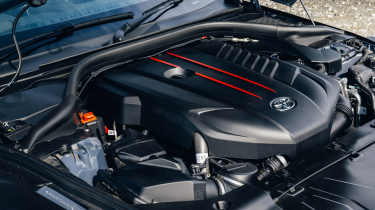
The larger 3-litre in-line six is BMW’s B58 unit used over an even wider range of BMW models, from the Z4 and 3-series right up to the 8-series, and even in the Morgan Plus Six. In the Supra it made 335bhp from 5000 to 6500rpm, and 369lb ft from 1600 to 4500rpm. Overseas versions got a more potent variant with 382bhp, though the internet would have you believe the Supra is conservatively quoted in Europe anyway, so who’s really counting? The engine uses variable valve control and variable camshaft timing, a single twin-scroll turbocharger, and direct injection.
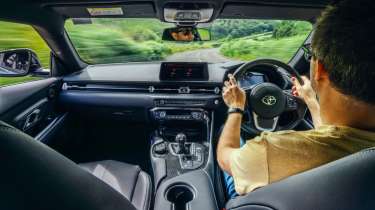
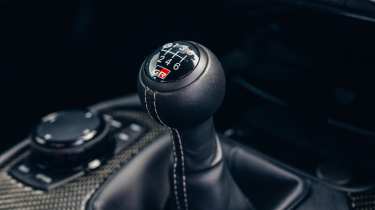
The transmission is an eight-speed automatic. Yep, the ubiquitous ZF unit, and controlled via a redesigned lever in the cabin. The manual is a six-speed unit, but rather than an off-the-shelf transmission from BMW or another supplier, Toyota has opted for a bespoke gearbox that’s been designed with feel, response and engagement at the centre of its deliverables.
The way it goes about achieving that speed feels… well, quite BMW-like. There are worse engines to listen to than the 3.0’s straight-six, but the engine and transmission’s character is quite laid-back compared to Porsche’s 4-litre flat-six and Audi’s turbocharged five-cylinder in the TT RS (now also dearly departed).
Toyota has worked to give the car some aural character, and in the sportier driving modes there are the obligatory crackles when backing off the throttle. And seat-of-the-pants it feels comfortably as quick as the 4.3sec 0-62mph time suggests (or 4.6sec for the manual version), punching hard from very few revs and the acceleration never really tailing off until you bump into the limiter. It responds well in-gear too, taking off with the merest hint of throttle input.
Perhaps it’s a symptom of the low-set driving position or the minimal glass area but it seems to accentuate the car’s performance too – there’s a proper muscle car vibe. The transmission is one of several areas the car feels short on interaction as, good though the ZF is, it’s not as sharp as the dual-clutch ’boxes offered elsewhere, and the process of switching the car into sport mode, knocking the gear shifter into manual and then changing down half a dozen gears just to wake everything up feels neither efficient nor fun, or interactive.
This is where the manual gearbox version comes in – the extra engagement instilled by needing to stoke the engine yourself makes a big difference day-to-day, with a robust and positive shift quality. The gearbox uses a unique set of ZF internals and Toyota has honed the feel across the gate and into gears; this is no slap-dash installation, and it shows. The clutch pedal action is intuitive too, while Toyota’s iMT auto-blip function has been integrated into downshifts.
The entry-level 2.0 model’s performance on paper is impressive, with 62mph reached in just 5.2sec, but that’s about where the 2.0’s performance good points end. As it is in most other applications, the B48 just doesn’t make a very good fist at being a sports car engine. Its low-down torque negates it having any enthusiasm to reach the red line, and while the engine is responsive, you find yourself driving it like a diesel, relying on the torque and short-shifting up the transmission to keep it in its usable (rather than sweet) spot. All Supras have a 155mph top speed.
Ride and handling
- Supra never quite wakes up to be the sports car you hope for
- Four-cylinder has sweeter handling due to reduced weight at the nose
- Damping is mature; the Supra is actually a solid GT car
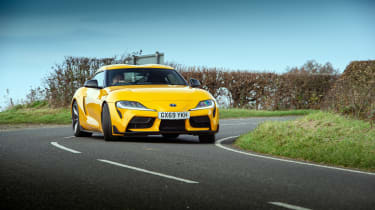
Front-engined, rear-drive, and low-slung – the Supra is the traditional sports car layout, and Toyota claims the centre of gravity is low, too. Throw in a decent hit of power to the rear wheels and you have the makings of an entertaining driver’s car, and to a degree that’s exactly what you get. We had good reason to be optimistic that the BMW/Toyota deal (hydrogen technology in exchange for a viable six-cylinder rear-drive sports car platform) would yield a car worthy of the Supra badge: torsionally stiffer than the Lexus LFA, with a lower centre of gravity than the GT86.
Toyota fundamentally led the development programme which explains why both the Supra and Z4 have such a short wheelbase and wide track – something out of kilter with the BMW’s evolutionary progression. Toyota also says the two companies went their own way with chassis development once the basics – MacPherson struts up front, five-link rear, electrically assisted rack and pinion – had been decided upon. The Supra runs either 18- or 19-inch wheels front and rear, and the dampers are adaptive on both engine options with a revised calibration following the recent updates.
Despite its small dimensions, the fact it shares so many of its underpinnings with fundamentally larger BMW models means its kerb weight isn’t as light as it might have been. Four-cylinder models weigh in from 1395kg, with the manual-equipped six-cylinder weighing 1502kg; and that's despite a series of minor weight-saving measures Toyota latterly introduced.
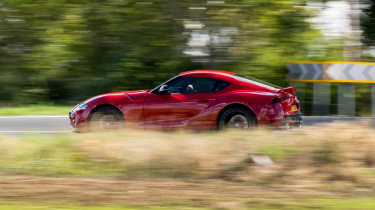
If the drivetrain feels BMW-like, then there’s definitely a different character to the chassis. It starts with the steering, which is lighter than that of equivalent BMWs, with less of that ‘gloopy’ feeling that pervades many of the German brand’s cars. The response is good, too, and there’s fairly natural weighting as you wind on lock, but one thing missing, at least at road-going speeds, is any real information. This improves on a circuit – it’s clearly a steering set-up that responds well when there’s some load going through it – but does leave the Supra’s front end feeling slightly aloof on the road.
You won’t have to worry too much as it’s not a car short of front-end bite. You can occasionally feel the car’s weight, usually when a quick direction change is required, but there’s plenty of grip to exploit and good mid-corner balance. On dry roads at least the Supra feels progressive on the throttle, though the BMW six’s rapid build-up of torque means on greasy or wetter surfaces it’s not difficult to break traction, something the steering is quick enough to deal with.
One of the more surprising aspects of the Supra’s dynamics is its mature ride quality, which takes the edge off sharper bumps but offers plenty of control over larger undulations. The structure feels particularly stiff too, so (not unlike recent BMWs) there’s a real sense of integrity to the car, and supportive, comfortable seats and a cabin relatively well-insulated from road and wind noise makes the Supra an adept cruiser as well as an accomplished handler.

Unfortunately when you really begin to exercise the chassis, it doesn’t respond with so much clarity, as you feel like you’re constantly having to manage the weight and momentum of the six-cylinder up front. This could be due to its mass, but also feels like there could and should be more control across the front axle. This is where the supple ride and impressive isolation shows its compromise as it feels like there's more sparkle and edge yet to be unlocked in the chassis. And when combined with the McPherson strut front suspension that generally doesn’t have the controllability of a more expensive double-wishbone set-up, it makes for a vagueness around the front end that doesn’t instil masses of confidence. This is then added to by the rear end’s sometimes snappy nature when putting power on – a natural reaction of having a relatively short wheelbase and wide stance.
The four-cylinder actually fixes some of this front-end vagueness, with less weight and taller sidewalls on the standard 18-inch wheels that make the whole car feel pointier and more agile. It’s not night and day, but with less mass to control, and less power coming out of the powertrain to worry about balancing at the rear, it makes for a more satisfying car to drive.
All we’d have asked for is an extra level of interaction – more talkative steering and a more engaging power plant and transmission. And when lined up against the Alpine A110 and Porsche 718 Cayman, those elements really matter.
Toyota GR Supra four-cylinder
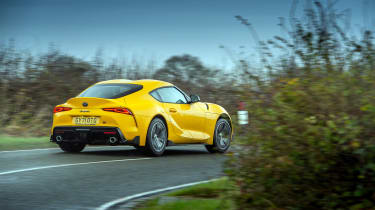
'Once rolling, one of the first things that strikes you is how much more rounded the ride is and how much better the rear axle in particular copes with sharp bumps. This is in part down to the taller tyre sidewalls, and so too is the welcome slowing down of the steering response just off-centre. In the wet, fast steering and limited low-speed traction makes the 2-litre Supra require fast reactions when at the limit. In fact it seems to gain grip and traction with speed and proves remarkably poised and comfortable on a bit of opposite lock.
'So, the four-cylinder car feels better at low speed, but it too is well balanced and biddable. It feels a little less precise and engaging when pushed, but there’s decent grip and pressing the Sport button firms up the dampers usefully, gives the engine more voice and adds weight to the steering. However, there’s not much feel through the wheel to work with, and while the chassis is responsive there’s a rather elastic quality to its feel.' – John Barker, evo editor-at-large, who tested the Supra 2.0 on the road in the UK.
Interior and tech
- The most outwardly 'BMW' bit is where you're always sat...
- But that does mean reasonably quality and a sensible, functional UI
- Driving position feels special, like a proper GT/sports car
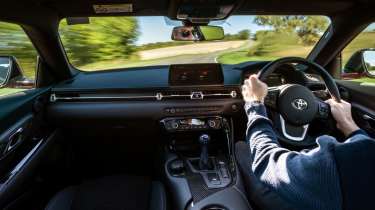
Stepping into the Supra undoubtedly feels special. The seating position is low-slung, with a dramatic view out through the pillar-box windscreen and over its long, curvaceous bonnet. It feels like you’re sitting over the rear axle, too, which is always an interesting attribute, while quality levels feel high.
It doesn’t half feel gloomy though. If the Supra is a Japanese car with German underpinnings, built in Austria, its interior design is equally confused, with a combination of shapes and elements that look sort of familiar, but with a definite Japanese overtone. Models built from 2022 onwards were made available with a beige colour theme, but overall the design is smart, straight-laced, and if anything a little dull, and too keen on the ‘stitching in plastic’ habit BMW and Toyota are guilty of falling into.
It’s not long before you start playing ‘spot the BMW bits’, either. The steering wheel is based on one of BMW’s older designs, but comes with an overly large steering boss and a thinner rim. The gear selector has the same BMW base with a different casing, and the minor switchgear and central infotainment screen are straight out of the parts bin, too. Toyota redesigned the Supra's centre console to accommodate the shifter in 2022's Supra manual, which gives the cabin a slightly more bespoke touch.
The overall shape of the dashboard is pleasing enough, and the instrument cluster is more unique. We’ve found its tachometer needle a little difficult to see, but otherwise it’s all clear enough. The seats are great, too, both supportive (particularly in the standard car with grippy Alcantara) and comfortable. There’s very little to complain about here in terms of tech or interfaces. The iDrive-style controller is effective, the shortcut buttons useful, and the menus easy to navigate. It's all starting to feel its age given BMW systems have moved on quite a way since the Supra but by the same token, it's pleasing for its relative pixel poverty. For that matter, physical controls for the heating and ventilation are a beautiful thing.
MPG and running costs
Big performance no longer comes with the consumption penalties it used to, at least not on paper. With a WLTP combined figure of 34.8mpg the Supra promises decent cruising economy, and it largely reaches those targets in day-to-day driving. The 2-litre engine should be even more efficient than that at a cruise when not being plumbed for its performance.
In the UK the Supra got a healthy five-year, 100,000-mile warranty. With Toyota's Relax scheme, a car that's been serviced with main dealers all its life is eligible for warranty extensions, up to ten years of age, meaning Toyota will warranty even the earliest 2019 Supras, if maintained correctly, until 2029.
Replacement tyres aren't exactly cheap; a front pair of 255-section Michelin Pilot Sport 4 S's will come in at over £430, fully fitted and delivered from Blackcircles. A pair of wider 275 rears tips over £600.
Used Toyota Supra – prices and checkpoints
While our four-star rating indicates that the Supra is good, it’s also indicative of how it doesn’t offer any truly outstanding characteristics that elevate it into the realms of the very best. With hindsight, though, while we craved something with more edge, something more overtly Japanese, the A90 GR Supra wasn’t a bad car. It wasn’t the most precise or scintillating sports car, it wasn’t an all-out tyre-shredding muscle car, it wasn’t a luxurious GT car, but it was a pleasing combination of all three and had its own unique place in a sports car market that, at the time, offered plenty of choice.
The Supra is now off-sale in the UK. When it was available, it was offered in a single Pro grade in both four- and six-cylinder forms. The base 2.0 Pro was £50,545, making it significantly more expensive than the GR86, which cost £32,495 before going off sale. The GR Supra 3.0 Pro cost £58,580.
The GR Supra doesn't have the sparkling powertrain of the Porsche Cayman GTS 4.0, the agility of an Alpine A110, nor the balance of its smaller GR86 sibling, all now also discontinued. Nonetheless there’s still plenty of appeal in this most distinctive of sports cars. All the same, by our reckoning, it was a car that was never allowed to reach and reveal its full potential.
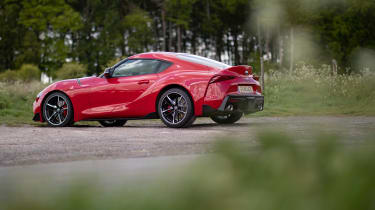
As mentioned above, Toyota gave the Supra a gentle set-up change later in its life, with a focus on improving precision by firming up the anti-roll bar bushings, recalibrating the adaptive dampers and rear differential, and amending the stability and traction control systems. The tweaks came alongside a six-speed manual option that was made available latterly only on the 3.0 variant, with new forged 19-inch wheels thrown in for good measure.
All GR Supras got LED headlights, a limited-slip differential, a suite of safety systems, adaptive cruise and an 8.8-inch media screen. The 3.0 model, meanwhile, added a set of 19-inch wheels, a JBL stereo upgrade, a head-up display and wireless phone charging pad on top.
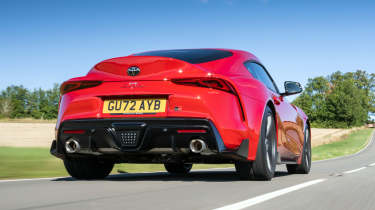
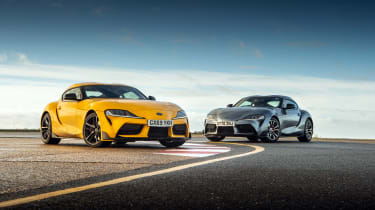
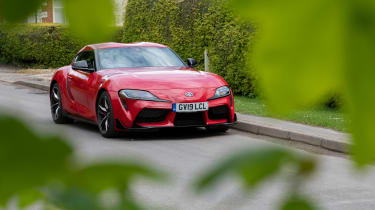
Two solid colours were offered (Lightning Yellow and Prominence Red, the latter for an extra £650), and it’s nice to see a manufacturer offering bright shades. Opting for metallic white, black, grey or blue adds £740 to the base price. A beige interior colour option made from lighter seat fabrics also gave the interior a boost as part of the 2022 update.
The earliest Toyota Supras from 2019 have now come down to the £30k mark and below, at least with a few miles on them. This kind of price, along with the peace of mind of the Toyota ownership and aftercare experience, should have many detractors reconsidering their stance on this controversial coupe. Now in its first few retirement years, a used-like-new Supra could be a great value sports coupe.
As a Japanese sports car, the Supra is a car you can expect to have been driven hard, so an immaculate service history should be a minimum requirement – especially as Toyota’s Relax scheme means that any Supra with a full dealer history can have its warranty extended beyond the standard three years, until the car is up to ten years old.
You’re going to want a car that’s got good life left in its tyres (both in terms of wear and age) and brakes. You’ll also want to be extra diligent in terms of looking for accident damage.
Toyota GR Supra specs
| Toyota GR Supra 2.0 | Toyota GR Supra 3.0 | Toyota GR Supra 3.0 manual | |
|---|---|---|---|
| Engine | In-line 4-cyl, 1998cc, turbo | In-line 6-cyl, 2998cc, turbocharged | In-line 6-cyl, 2998cc, turbocharged |
| Power | 254bhp @ 5000rpm | 335bhp @ 5000-6500rpm | 335bhp @ 5000-6500rpm |
| Torque | 295lb ft @ 1550-4400rpm | 369lb ft @ 1600-4500rpm | 369lb ft @ 1600-4500rpm |
| Weight | 1395kg | 1540kg | 1502kg |
| Power-to-weight | 185bhp/ton | 221bhp/ton | 227bhp/ton |
| 0-62mph | 5.2sec | 4.3sec | 4.6sec |
| Top speed | 155mph (limited) | 155mph (limited) | 155mph (limited |
| Basic price (new) | £46k+ | £55k+ | £55k+ |