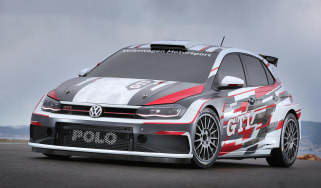
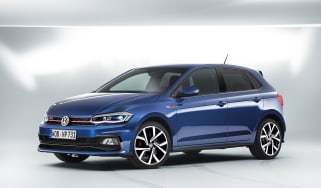
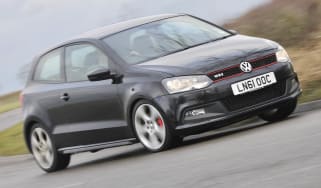
Volkswagen Polo GTI (Mk6, 2017 - 2026) review – a hot hatch we won't miss
The Polo GTI was Volkswagen’s smallest hot hatch and one of the last holdouts in its segment, but now it too has met its end
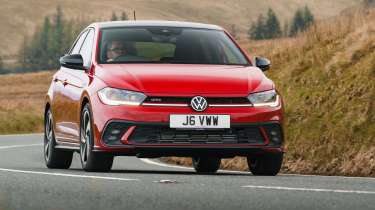
The Volkswagen Polo GTI never had a turn as a star performing hot hatch, always being overshadowed by its brilliant big brother the Golf GTI and never being the thrillseeker’s choice in its hot supermini segment. Over the years it’s pretty much always served only as a range topper, rather than an outright thriller, with Renault Sport, then Ford’s Fiesta ST, Peugeot’s 208 GTI, Mini’s Cooper S and latterly, the Hyundai i20 N taking the lead.
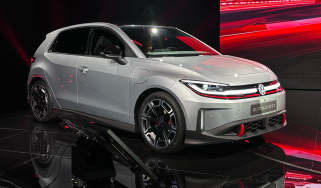
For a few years it remained one of the only models left in its segment, with each and every one of its talented rivals receiving the axe. Now though, the Polo GTI has seen the same fate, with its replacement set to come only in electric form with the ID. Polo GTI later this year. Did the model claw back some kudos in its final form, or is its retirement for the better?
> Volkswagen ID. Polo GTI – VW’s small hot hatch will keep the name you know
Engine, gearbox and 0-62mph
- De-tuned Golf GTI engine produces 204bhp and 236lb ft
- 0-62mph in 6.5sec on the way to a 150mph top speed
- Electronically adjustable dampers and steering weight
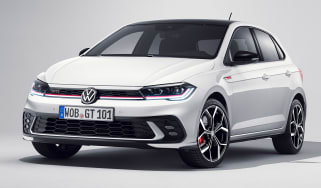
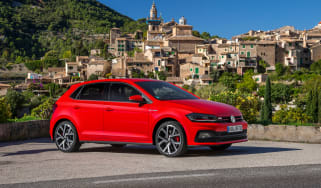
Unlike the previous-generation car, which offered both the 1.4 twin-charged four-cylinder engine (which sounded much better on paper than it was in reality) and later a 1.8-litre TSI engine, this GTI features the well-proven, torque-rich EA888 from the Golf GTI. The Polo's sole transmission is a seven-speed DSG dual-clutch gearbox with undersized, button-like paddles mounted behind the steering wheel. The dampers are two-way adjustable with Sport and Normal settings, while ride height overall is 15mm lower compared to a standard Polo.
More reviews
Reviews
- 2018 VW Polo GTI review – a polished performer, but it lacks flair
- Volkswagen Polo GTI mk5 (2009 - 2017) review - minature GTI has the power but can it deliver fun?
- Volkswagen Polo GTI review - minature GTI has the power but can it deliver fun?
- Volkswagen Polo R-line review - price, specs and 0-60 time
- Volkswagen Polo Blue GT review - price, specs and 0-60 time
- Superchips Volkswagen Polo GTI review - price, specs and 0-60 time
Sport mode also sharpens throttle response, leans out traction control interference and adds weight to the steering, with Individual mode allowing you to combine sport powertrain settings with the softer chassis setting and vice versa. The ‘XDS’ differential attempts to mimic an LSD using software to brake the inside front wheel in cornering.
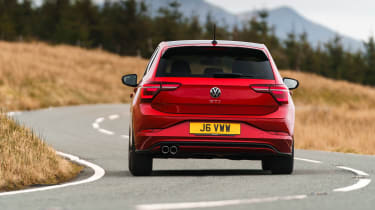
Producing 204bhp between 4400 and 6000rpm (up 7bhp), and 236lb ft of torque from 1500 to 4500rpm – strong enough figures for the segment as was when it arrived, though a little down now compared to the 228bhp, 280lb ft Mini JCW. The 0-62mph sprint takes a claimed 6.5sec – a 0.2sec improvement on the pre-facelift model but down again on the current JCW Mini by 0.4sec – on the way to a 149mph top speed.
Performance, ride and handling
- Adjustable dampers don’t give a control/ride sweet spot
- Engine does the numbers but isn’t eager
- Not playful like a Fiesta ST or Hyundai i20 N
The hope with this Polo GTI with its 200bhp and slight proportions was for a modern day rebirth of the Mk5 Golf GTI. It turned out to not quite be the case. Initial impressions are good. There’s some generally well sorted control weights – the steering is initially light, but wakes up as speeds rise, and the throttle and brake pedal response is certainly sharper than in a mainstream supermini, but things don’t really get much better from here.
The flat torque curve of the 2-litre turbocharged engine means it feels a little breathless and lacking any real enthusiasm for the upper third of the rev range. There's healthy punch in the mid range there and even a bit of parp from the exhaust, but this isn’t an engine that revels in being plumbed for its performance, which is quite out of character for what you’d expect of the motor in a small hot hatch. Fingers can be pointed at the gearing, which is too long between second and fourth. As a result, the engine feels flexible, rather than enthusiastic. Effective, but not very GTI.
The transmission feels typical VW, with an inherent slickness to gear changes and good response from the paddles in most scenarios, if not much of a sense of theatre. It’s almost purely functional, with none of the pomp and circumstance that you’ll find in the Golf, even when pressing on. The effect is it feels like a parts bin swap in, VW’s vast collection of components, rather than being one specifically engineered for this application. This is far from an original thought but for enthusiastic driving, you constantly find yourself wishing it had a manual.
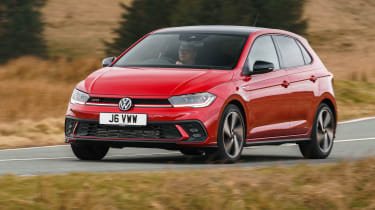
Kickdown in automatic mode is underwhelming too with manual downshifts occasionally slower than we'd like. Town driving is not the transmission’s forte, as the GTI will often lurch between gears and hesitate when pulling away, but wind it up at speed and the DSG responds just fine.
Like a Golf, it covers ground quickly, with an almost clinical precision. And therein lies the problem. Once you’ve tackled a few corners you’ve pretty much got the measure of the Polo. The damping across the two modes rarely hit the mark, normal improving ride quality but sacrificing control and sport tying down the Polo GTI but making it easily agitated by the road’s topography. On just the right road with the right surface, there are flashes of potential in the Polo GTI but these moments are fleeting – there over a hundred-yard stretch, gone the next.
The steering is quick and precise, but there’s only the bare minimum of feedback, while that chassis doesn’t want to get expressive. Lifting the throttle will tighten the car’s line and trail braking will see it overstep from a neutral to oversteer attitude. But you don’t get the sense it’s comfortable doing this, more that it’s simply subject to physics, the setup its maker has given it and the agitative whims of its pilot. There’s no sense of the puppy-like agility you get in the Hyundai i20 N or Ford Fiesta ST.
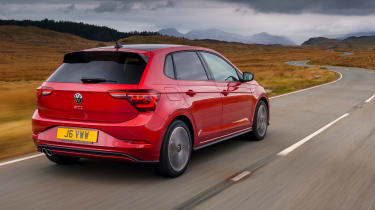
The XDS ‘differential’ is also no substitute for the real thing. With the ESP in its halfway house Sport setting (you can’t turn the systems off completely) the inside wheel simply spins power away out of slower turns. Selecting Sport sharpens the throttle, and adds artificial weight to the steering, but the Polo’s benign character remains. It’s an effective way of getting from A to B quickly, but not a thrilling one.
Take things easy and the GTI is a normal Polo, which means it’s refined, roomy and easy to drive – few superminis are as simple to live with. But when all you want is a normal Polo, some of the GTI-ness gets in the way, particularly when it comes to the ride. The car fidgets and hops over small imperfections and only really settles down on the smooth, longer-frequency bumps normally found on motorways. It’s the kind of ride that will have passengers frowning at you, thinking you’re going quicker than you are, to have the car bumping and thumping its way along in such a way. If not the kind of ride that makes you simply want to stop the car and get out, as in the Mini John Cooper Works.
Driver’s note
‘Driving the new Fabia 130, I found myself wondering if it could have done with the Polo GTI’s two-stage dampers. Later reacquaintance with the Volkswagen affirmed the answer is ‘no’. The ride never settles in Normal, while in Sport you never get the control you’ll find in the very best small hot hatches.’ – Ethan Jupp, evo web editor
MPG and running costs
Volkswagen’s claim is the Polo GTI is good for 41.5mpg overall, which is actually conservative by comparison to what the car will tell you it’s doing. You’ll get mid-40s over a week of town and motorway driving and potentially more on a long, docile run.
The EA888 engine is otherwise well established, and has proven to be decently reliable, though there are reports of issues with the thermostat housing and water pump. It’s also lightly stressed given its lowly 204bhp state of tune by comparison to a 326bhp Golf R.
The DSG can be problematic too, as clutches are considered wear and tear items and do need replacing. How long they’ll last does vary though, and, like many dual-clutch gearboxes or the old-school single-clutch semi-automatics, depends vastly on driving style. Actuators and hydraulic pumps can also fail, and while this is less common, any time a dual-clutch transmission case needs to be cracked the repair bills are often high and sometimes excruciating.
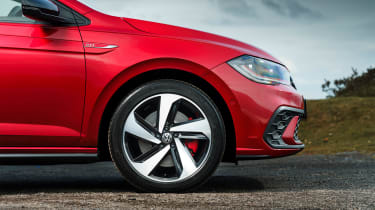
In terms of consumables, life shouldn’t be too tough in a Polo GTI. The front tyre is a modest 215-section and the brake discs are neither drilled nor grooved, and are diminutive in size.
Interior and tech
- Analogue wheel controls good…
- … digital climate controls not-so good
- Quality as you’d expect from VW – satisfyingly solid
Little if anything changed with the Polo’s mid-life update in 2022. As a consequence, if you’ve spent any time in an Alpine A290, it’ll feel a bit dated. Some things are better ‘dated’ though, including the steering wheel which has proper buttons back in place of the capacitative touch panels that mired the early Mk8 Golfs. Unfortunately the capacitative controls for the climate, similar to those found across the pre-facelift Golf, are frustrating to use and pointlessly complex compared to the old units. The digital display is decidedly last-gen but, at least, familiar and relatively intuitive, especially on a wheel with proper buttons.
The interior otherwise feels well screwed together, even if the cabin’s materials really are the bare minimum of acceptable. The GTI bits are crucial to lifting its ambiance, as the tartan seats and red stitching, augmented with elements such as the giant slab of red plastic stretched across the dashboard, help lift the interior.
The seats offer a reasonable level of lateral support without resorting to restrictive, supersized bolsters, but we'd like to be able to sit lower. While your experience may vary, I also experienced some lower back discomfort on longer drives, with not quite enough support in certain areas. When optioning yours, avoid the micro-suede option, as these seats are swapped out for the basic chairs found in other Polo models.
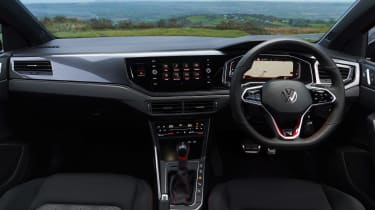
It would be nice to have some more substantial paddleshifters behind the wheel, even if the lack of theatre mirrors the transmission’s own. While hardly a deal breaker, a lack of certain niceties such as wireless phone charging and a heated steering wheel does put the GTI a step behind more up-to-date alternatives. Certain interior elements also don't appear to have been developed with the care we'd expect, with wireless Apple CarPlay repeatedly losing signal during our time with the car, and the sound system lacklustre, especially considering its Beats branding.
In typical VW style, though, all the touchpoints are almost perfect. The driving position is good overall, with plenty of adjustment in the steering. The high-mounted infotainment system is also placed in exactly the right position, close to the driver’s eyeline and without looking like an afterthought, as is the case with most floating screens.
Price, rivals and buying guide
Like all cars, new prices for the Polo GTI did grow considerably in its final years, but not as much as you’d think. In 2021 the Polo GTI started from £28,905, while in its final form you’d have paid a minimum of £31,415. Our test car with a few options was £33,620, which included heated seats (£355), ‘Faro’ alloy wheels (£575) and a rear-view camera (£380).
Rivals are few but do exist – Mini’s John Cooper Works hatch remains with petrol power but rides even more aggressively than the Polo, to an almost unacceptable extent. Skoda’s recently-released Fabia 130 isn’t far off price wise at £29,995 but is 30bhp and some suspension tech down on the Polo, though it might be the one we’d have of two. The real answer? Go used and get a Ford Fiesta ST or Hyundai i20 N.
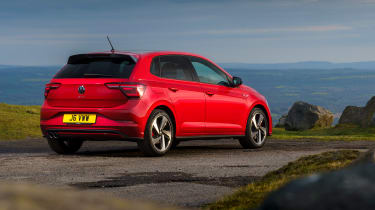
Speaking of used, this generation of Polo GTI has been with us since 2017 now, so there’s a whole used market to consider when looking at one. As of the time of writing, dog-eared pre-facelift examples with plenty of miles are dangerously close to the £10,000 mark. Facelifts (2022 onwards) with under 40,000 miles can be had for under £20,000, but whether or not its discontinuation will have any impact on these numbers is yet to be seen.
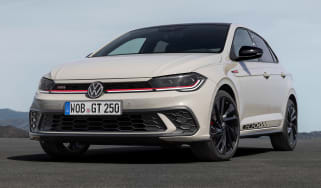
In 2023 Volkswagen introduced the Polo GTI Edition 25, celebrating 25 years since the Polo GTI’s 1998 introduction, replete with a subtle livery, Adelaide alloy wheels and ‘25’ badging. It’ll set you back upwards of £25,000 in the used market.
Things to look out for? Well, it’s a small hot hatch, so in spite of its reserved appearance and driving experience, it’s likely many will have been driven hard, so check for comprehensive service history. As above, look out for issues with brittle plastics in the cooling system and be sure the DSG is in good health. Life in the tyres and brakes, as well as the tyres being a reputable brand and an acceptable age, will indicate well if the car’s been cared for.