2027 Alpine A110: inside details on France's next answer to the Porsche Cayman
The countdown is on for the reveal of the next Alpine A110, which is set to arrive with electric but be ready for petrol. We have all the details
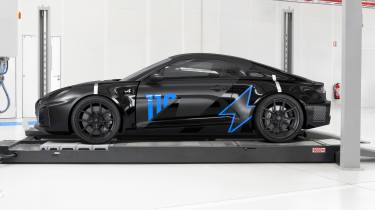
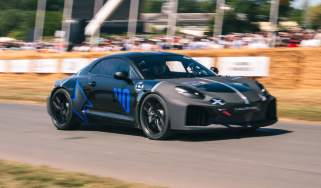
Alpine’s next A110 sports car is set for arrival before the year is out. We’ve seen the APP platform that will form its basis but now we know when we’ll see the first mules. The next A110 will make its debut in prototype-form at the 2026 Goodwood Festival of Speed.
Lessons learned from the car that relaunched the brand to such critical acclaim will inform a completely new strategy – one that will involve global saleability and numerous variants, based on an all-new aluminium platform that can take a variety of powertrain types and be versatile enough to form the basis of a wider family of sports cars. Here’s everything we know.
> The Alpine A110 is dead: Iconic sports car ends production after nine years
When will we see the next Alpine A110?
News of the electric A110 first materialised in 2022 amidst the announcement from Alpine’s CEO at the time, Luca de Meo, that it was to go EV-only. A 2024 launch for an electrified A110 was initially proposed at the project’s infancy. That has been pushed on as plans for the car have evolved, with new CEO Philippe Krief subtly steering it in a more powertrain-agnostic developmental direction.
After the coupe is revealed, we don’t expect the roll to stop – subsequent derivatives are likely to follow in the years leading up to the end of the decade. In terms of design, word is of delicate proportions similar to those of the current car, with design language developed from that first seen on the Alpenglow hypercar concepts. Our first look at the new platform that will underpin it came from Renault Group’s strategy day – we can believe the sleek low-slung design will be retained.
2027 Alpine A110: powertrains and platform
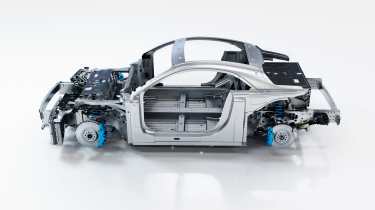
The naked, rolling chassis of the next Alpine sports car sits in the centre of the styling studio at the Renault Technocentre, the company’s huge R&D site near Paris. At a glance, it could be the chassis of the current A110 – the aluminium construction and roofline are similar. The big difference is that it will be an EV, one that we ought to enjoy. Alpine CEO Philippe Krief says it will be ‘the world’s first EV sports car’. Krief, the French-born ex-Ferrari chief technology officer, whose impressive back catalogue includes the 458 Speciale and Alfa Giulia, adds: ‘We know what to do. We will be the first. We are in conquest mode.’ Porsche is clearly in Alpine’s sights.
The chassis is called APP – Alpine Performance Platform – and as well as underpinning the new A110 it will also be the basis of a range of Alpine EVs, including a convertible A110 and, in long-wheelbase form, a four-seat coupe and four-seat convertible.
What will make the new A110 the first EV sports car? The look of the previous A110 will be carried over, but it doesn’t end there: the car will still be relatively light, it will also feature the same weight distribution as its predecessor and, in base form, be rear-wheel drive, with sophisticated torque vectoring enhancing its ability.
The outgoing A110 that was launched in 2018 weighed just 1100kg. The target weight for the A110 EV is around 1400kg, which is about the same as the most recent six-cylinder Porsche Caymans, so not a bad place to be in EV terms. The 300kg increase is not all down to the change in powertrain. As is the way with EVs, there is a general upscaling: the new model will be taller, wider and longer, and while the previous A110 was available with modest 17-inch wheels, the chassis on display is on 20-inch items, with hefty brake discs behind.
2027 Alpine A110: ready for a combustion and hybrid powertrains
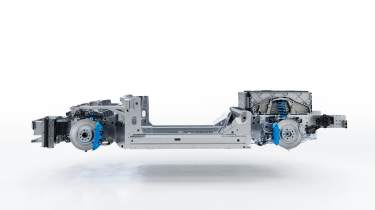
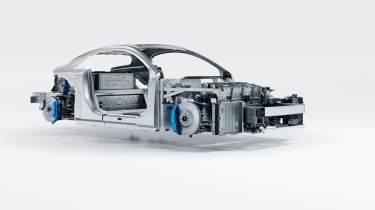
The overall construction of the APP is still largely in aluminium, but while the chassis of the outgoing A110 was predominantly bonded and riveted aluminium extrusions, just like an Elise, the APP has an extruded centre section but with low pressure die cast (LPDC) front and rear subframes. These thin-wall, aluminium castings are used partly for the strength needed for the increased weight and partly to deliver the flexibility to install a pure ICE or hybrid powertrain. The new platform has been futureproofed, then, but Alpine states that being able to accommodate both drivetrain types has not compromised its performance as an EV.
To endow the A110 EV with similar dynamics to the petrol model, Alpine has made the decision to split its battery packs, with a large one over the rear axle and a smaller one above the front axle for the same 40:60 weight distribution. In the four-seat coupe and convertible, the battery will be in a single unit, mounted beneath the floor in the typical ‘skateboard’ style. The front and rear suspensions are by double aluminium wishbones once more, though the mounting of the spring/damper units at the front has changed to allow for front driveshafts, permitting four-wheel-drive EV or hybrid ICE configurations.
The new A110’s 800V electric architecture uses cylindrical cell batteries, double-stacked in the rear battery pack. Compared with 400V architecture, 800V allows faster charging; the addition of cooling will allow the A110 to charge from 10 to 80 per cent in just 15 minutes, says Alpine, while also ensuring there is no derate when delivering sustained maximum performance on a racetrack, for instance.
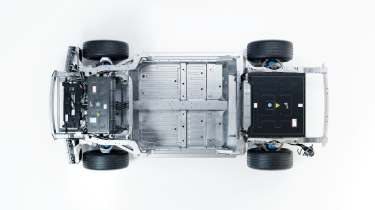
Beneath the rear battery pack are twin motors, which will be controlled by Alpine Active Torque Vectoring and which, together with four-wheel steer, are promised to help deliver class-leading dynamics. The new A110 is already lapping the Nürburgring digitally on the company’s new state-of-the-art, VI Grade driving simulator, which Alpine says has allowed the company to skip the costly first prototype stage and knock about six months off the development schedule too. The first teaser reveal of the new A110 is at the Goodwood Festival of Speed, with a further reveal scheduled for the Paris motor show in October before the car goes on sale in 2027.
Whether Alpine makes pure ICE or hybrid versions of the new A110 depends on a number of factors, says Jean-Pascal Dauce, Alpine’s technology and heritage communications manager, but he cautions that the chances are slim. Although the UK and Germany have become good markets for Alpine, France remains far and away its biggest – the majority of the 110-off, super-expensive A110 Ultimes were sold in France. There would have to be a big demand for an ICE version in France to make it a viable project, he says, and working against that are France’s punitive taxes on new cars deemed too polluting or heavy.
Currently, the malus écologique (environmental penalty) tax is levied on new cars that emit over 108g of CO₂ per km or weigh more than 1500kg, so while the weight tax would not apply to an ICE A110, the CO₂ fine certainly would. For a car like the outgoing A110 GTS, which emits 159g/km, the malus currently stands at nearly €8000. It ramps up quickly, too – peaking at €80,000 for 192g/km or over – and the limits keep falling. ‘Who can say what the threshold or the fine will be in 2028 or beyond?’ asks Dauce.
This is especially disappointing given that Renault has a stake in Horse, the powertrain company that’s doing good business supplying ICE powertrains to car makers that turned off their own ICE supply a little too hastily. A new A110 with the Horse twin-turbo V6 in the back and tipping the scales at 1250kg? Sounds very much like a car from the Alpine back catalogue, the underrated A610.
While a new ICE A110 may be unlikely, it’s worth considering that Alpine’s road car plans have three facets: Everyday Extraordinary, Icons and Special Projects. Everyday Extraordinary encompasses Alpine’s version of the new Renault 5, the A290, and also the Macan Electric-rivalling A390. This is an important part of the company’s strategy as it helps to raise awareness of the brand, and it’s also meant that Alpine sales are up massively year-on-year. The second facet, Icons, is what we would think of as core Alpine. These will be cars based on the APP: the new coupe and convertible A110 EVs and four-seater coupe and convertible models.
The third facet, Special Projects, is the most intriguing. The first model to fall under this banner was the A110 Ultime; the next has been hinted at by the Alpenglow concept, the hydrogen-fuelled, biturbo V6, LMP-style hypercar. CEO Krief sees a place in the market for an Alpine above the A110 Ultime and below supercars like the Ferrari 296 GTB. He says an Alpine inspired by the Dino and built around the new platform would perfectly align with the company’s values and demonstrate ‘the power of lightness’. We can’t wait to find out if Alpine can pull it off.
Next Alpine A110: What versions will there be?
APP is very much a big picture underpinning, not just forming the basis of the next two-seat A110 coupe but any sports car Alpine wishes to turn its attention to.
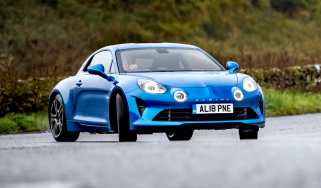
The current A110, launched in 2018, has only ever been available as a two-seater coupe powered by a 1.8-litre turbocharged four-cylinder engine mated to a seven-speed (six-speed in R Ultime-form) double-clutch gearbox driving the rear wheels and was not homologated for sale in the US, or easy to adapt for say, a convertible.
Not so the new platform, which has been designed to form the basis of the new A110 coupe, but also leave options open for a convertible and wider, longer four-seat sports car models, as Krief told us: ‘We are working on the brand new platform, APP, Alpine Performance Platform. Out of which we’ll have all the new sports cars from Alpine, the first of which will be A110.
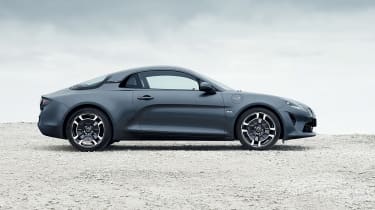
‘Today the A110 cannot go into the US easily, it’s not easy to do a Spider. The new platform is a lot more modular for that – ready for the US if the time comes.
‘There’s modularity in length and width also, to have a convertible, to have two-seater or 2+2. When you start from scratch, you try to think of the maximum possibilities. Our small engineering team of 230 people are fully dedicated to APP.’
As for whether these will all be called A110, or whether there will be other derivations, we’ve been given the steer that there will be multiple distinct models based on APP. The three pillars get their own end numbers: 90 on A290 and A390, the everyday cars and 10 on the icon cars. A110 is the smallest, so A210 or A310 aren’t unreasonable guesses as to the name of Alpine’s forthcoming 911 rival set to join the A110 in the lineup.
Will there be another Alpine A110 R and A110 Ultime?
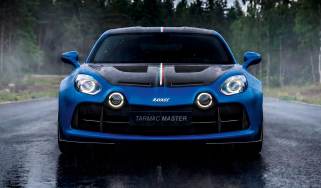
The scope of APP’s versatility will be pushed the furthest under the new special projects arm, the first product of which was the A110 Ultime. We should expect to see more special projects, including successors to the A110 R and A110 Ultime but also more ambitious models.
With Krief’s background at Ferrari, he has experience of delivering high-horsepower cars with aluminium core structures and he’s revealed to us, an Alpine supercar and hypercar are part of the special projects plan all being well.