Ravage Alpine A110: France's perfect sports car made even more perfect
French company Ravage's Alpine A110 takes inspiration from 1970s A110 Group 4 rally cars. Where better to drive them than the stunning Col de Turini
We sit in silence at the summit of the Col de Turini. Too late for tourists but too soon for snow, the place is eerily deserted, hushed apart from the rustle of windblown pine trees, the güiro-like rasp of a passing crow and the gentle tick-tick-tick of cooling brakes and powertrain after a suitably attacking charge up from the valley floor.
The Turini lives a double life, today’s tranquillity in stark contrast to its rabble-rousing reputation as the most iconic stage of the Monte Carlo Rally and occasional lung-bursting leg of the Tour de France. Whether it’s thronged with rowdy bobble-hatted fans lighting flares and honking airhorns, or Lycra lovers clanging cowbells and throwing smoke-bombs, this place knows how to party. No wonder it’s a bucket list destination for drivers and cyclists alike.
We’re here to meet Benoît Tallec, recently departed head of design at McLaren (and senior design manager at Mercedes-Benz before that) and now CEO and co‑founder of Ravage Automobile. He, too, is familiar with living a dual existence, for since 2019 until just a few months ago he has been juggling the demands of his high-pressure design career with his equally all-consuming side-hustle.
Now free to focus solely on the venture, Tallec can tell the full story of Ravage and the somewhat mysterious wide-body Alpine A110 that bears its name. To help with that process, Tallec has arranged for us to experience two Ravage A110 Group 4s in differing specifications. Both are customer cars. In an age when vapourware renderings of overhyped but undercooked restomod concepts generate far more attention than they deserve, this is a refreshing change. One rooted in passion and built on many years of hard work.
To truly understand Ravage and its origins you need to rewind. Not to 2019 but back to 2010. For it was then that Tallec met with an engineer – known only to us as Vincent. At this time Tallec was at Mercedes-Benz, Vincent working on R&D in the chassis development team at Renault. Both were participating in a driving tour in the Austrian Alps, Tallec in his Ferrari 308 GT4, Vincent in his F355. The pair became firm friends and remained in regular contact.
More reviews
Group tests
- Lotus Emira Turbo SE v Alpine A110 GTS – two of the last surviving mid-engined sports cars
- Alpine A290 v Alpine A110 – how much DNA do they really share?
In-depth reviews
- Alpine A110 review – the sports car Lotus should be building
- Alpine A110 R Ultime review – Ferrari money for a four-cylinder, but it might be worth it
Reviews
Fast-forward to 2015-16 and two things led them to a momentous decision. Tallec takes up the tale: ‘We were both excited by the upcoming Alpine A110. We could see its potential and felt inspired by what it represented. We were both well into our careers, but we were also looking at the new European regulations and saying to ourselves that OEM will soon have to make shitty cars. It was at this point we had our vision for Ravage, which was basically to find a way of continuing to provide car enthusiasts with what they want.’
As for the name, Ravage comes from a book of the same title. Written in 1943 by French author René Barjavel, it describes the world of 2052, in which a highly technically advanced civilisation – wholly dependent upon industrial food production and autonomous electrified flying vehicles – collapses when electricity suddenly disappears. In the mayhem that follows, Paris descends into chaos and only those who reject technology and reconnect with the old analogue ways learn to survive.
Thankfully, Tallec’s interpretation of Ravage is less rooted in mid-century dystopian science fiction and more on the premise that driving pleasure relies upon preserving purity and should celebrate the physical and emotional connection derived from operating finely tuned analogue machines.
As such, the A110 was the perfect muse. For starters it was French – something important to our protagonists, who felt their country was under-represented on the contemporary enthusiast car scene. It was also modern, singular in concept and inherently brilliant, at a time when such qualities were rapidly being impacted by the creeping spectre of legislation.
For Vincent (who didn’t come to the Col de Turini but chatted to us about his early involvement in the project over the phone) it was a case of the right car at the right time: ‘There was no crossover between my work with Renault and the A110, I just admired it from a distance. But I knew very well the guy working on the project, so I knew what it was. Here you had this stylish French car, which was extremely light and compact compared to everything else at the time. Benoît and I loved it, but still felt there was something more we could do. Something wider and a little crazier; an homage to the old rally car but also true to the base car.’

‘We had no business plan,’ interjects Tallec. ‘We had a long-term vision for Ravage, but the Alpine provided us with the chance to make a proof of concept. Our idea was to try and do at least one car. We knew someone who was buying an early Premiere Edition car. We had a quick chat with him to explain the concept and he immediately said yes, at which point we began the design and development.’
It should be said that Tallec and Vincent’s employers were aware of the nascent Ravage project and were okay with them working on it in their spare time, but still the ultra-professional pair were at pains to ensure there was no conflict. Nevertheless, with their level of skill and experience this was not your typical independent low-key self-funded start-up, as Tallec explains: ‘We had mega support from our network of industry colleagues. For example, we were so blessed to have [automotive and naval designer] Hermidas Atabeyki helping us to do a full-size clay model. He gave us time and resources for free.
‘An OEM would easily take six to eight months on the clay, but of course it was an after-work activity for us, so we had to do it in record time! I provided them with a rough digital 3D model from which they built the basic shape. Then they needed me to spend a week with them to refine the surfaces. By this stage I was based in Japan. Atabeyki is in Paris…
‘I took a week’s holiday and flew to France, then spent eight, nine, ten hours a day, working the clay in the studio, every day for the whole week, knowing that this was my only shot. Anyway, we got it done. The clay phase was a must; you see so many what I call “Instagram cars” that are just renders, but when you eventually see them in the flesh, they are less sexy, less interesting. You can’t beat working at full-scale on the physical surfaces.’
That first car was completed and delivered in 2020, some two years after approaching the customer, and though very much below the radar, Ravage was attracting interest from other Alpine owners. Good news but also a problem, for although they’d been a significant investment, the moulds to make the first wide-body carbon panels were made from glassfibre and not suitable for making more than two or three body sets.
Unwilling to compromise, and knowing they would need to invest in more robust tooling if they were to progress, Tallec took the momentous decision to redesign the car to address all the lessons learned on the first iteration. Using his digital modelling contacts to create the new reshaped surfaces, this new data informed a full set of carbonfibre body moulds made at great expense.
This process took another 18 months or so, but it meant body panels could be made with a high level of accuracy so the fitment process would be methodical, consistent and efficient. With orders being taken, Tallec needed to find someone who could build the cars to the highest standards. The solution came in the form of O‑ONE, a top-level classic car restoration and historic race car preparation business based 30 miles west of Paris. It’s here, in a dedicated Ravage workspace, that O‑ONE assembles each Group 4 A110, a process that takes between two and three months depending on the level of personalisation.
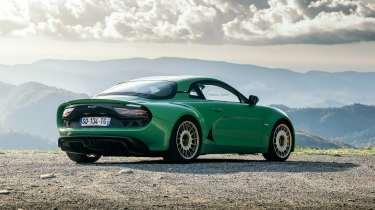
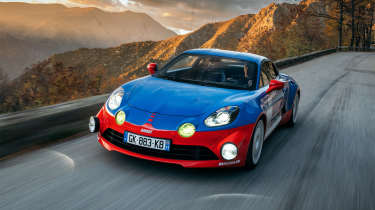
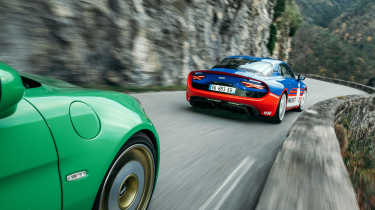
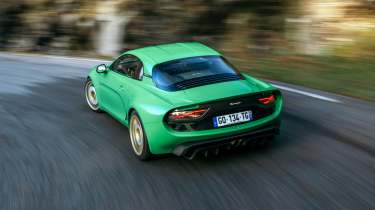
On the evidence of the examples before us, the results are staggeringly good. Some 38mm wider at the front and 76mm at the rear, the Ravage Group 4 has a magnificent physique. More muscular without gaining bulk, it gives the previously svelte A110 a broad stance and serious presence. Pretty much everything has changed, but the effect is harmonious and respectful of the original design, so no one element screams for attention. It’s a stunner.
Neatly integrated ducts, intakes and sizeable rear diffuser add function and intrigue. Likewise, the oversize light pods, which are a cool nod to Alpine’s heroes of the Monte Carlo Rally. Filling those swollen arches are a gorgeous set of bespoke forged alloys wheels designed by Ravage and made by OZ Racing. Immaculately designed by Tallec and built to the highest motorsport standards, they combine striking style with robust strength.
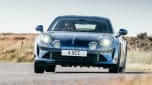
The two cars at our disposal neatly illustrate the scope of Ravage’s transformative services. The green car (Vert Jardin, in case you’re curious) is the entry-level Ravage offering; that’s to say Group 4 bodywork, wheels/tyres and suspension package and a Stage 1 engine tune (more on which later), with the added option of Cibié light pods and visible carbonfibre on the rear panel. Without those last two options that package costs €105,570 (including VAT), plus the value of the base car, which can be any A110.
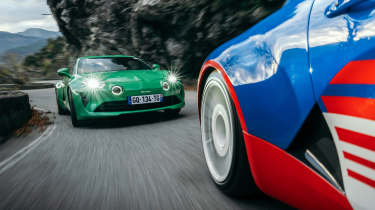
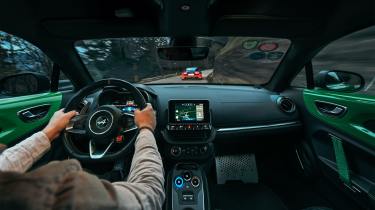
The blue, red and white car goes much further. Mechanically there’s a Stage 3 engine conversion that lifts power to 338bhp and lifts the Group 4 conversion price to €130,948. Taking advantage of Ravage’s Design Sur Mesure personalisation service, the owner requested custom paintwork that pays homage to the 1987 Philips-liveried Renault 5 Superproduction circuit racer driven to championship victory by Érik Comas. This required a complex graphic design study followed by a phenomenal paint job (no decals!) at a cost of €41,900. Completing the transformation is a €12,000 fully bespoke interior with redesigned seats and full retrim inspired by the wild interior of the original Renault 5 Turbo 1. It’s a truly spectacular thing.
As for the way they drive, it all comes back to the foundational work done by Vincent. ‘It was crucial for us that we avoid just buying in aftermarket parts,’ says Tallec ‘Where we could design and make our own parts, we would do it. This began with the tyre selection. I had good experience with Michelin product at Renault, so we knocked on their door, explained the project and immediately began deciding on optimal wheel and tyre dimensions. We knew the torque we ultimately wanted to have from the engine, so the width of the rear tyre – 265/35 ZR18 – was chosen to align with this. The front – 215/40 ZR18 – was then selected to achieve balance. And, because we think like OEM, we knew we had to keep the same rolling diameter to keep all the ABS and ESC systems working.’
In parallel Vincent decided on two-way adjustable coilover dampers from KW, valved to Ravage’s spec with adjustable ride height along with bump and rebound settings. He also reached out to his network to find an engine development engineer – ‘A very, very good guy who used to work at Renault and knew the engine inside-out’ – who began work on three stages of development.
The first was an ECU reflash, which achieved 296bhp (same as the Alpine S) and almost 40lb ft more torque than the base car at 273lb ft. The second was to go with a sports catalyst and remove the particle filter, which yielded 319bhp and 276lb ft. Stage 3 – known as the Group 4 Evo – was more serious and involved carefully reworking the turbo with a re-machined standard housing and new turbine rather than swapping it for a bigger one, to keep the same gas flow characteristics to match the factory cylinder head. The result? An impressive 338bhp and 286lb ft.
But what about the gearbox, I hear you ask. According to Vincent, it’s bulletproof so long as you keep it cool (Ravage fits an extra gearbox cooler to Stage 2 and 3 cars) and don’t overstress it with excessive torque. This informed the shape of the Stage 3 engine’s torque delivery, which peaks at higher rpm and remains within manufacturer limits for the transmission. Likewise, the extra bhp arrives at higher revs, so the engine feels much more aggressive between 5000 and 6000rpm where the stock engine tails off.
If you’re going to drive a Ravage Group 4 A110, the Col de Turini is as good as it gets. The backdrop for Alpine’s remarkable 1-2-3 finishes on both the 1971 and ’73 Monte Carlo Rallies with the A110 Berlinette, it is where the legend of the Dieppe-built cars was forged, and a spiritual home for Alpines old and new. As if to prove the point, as we’re heading up the mountain a perfect little Berlinette passes us in the opposite direction. We spin around and give chase, eventually catching it at some temporary traffic lights in a village midway down. Having jumped out and knocked on the side window, photographer Parrott deploys his best pidgin French. After some quizzical looks and Del Boy Trotter-style Franglais, we're soon grabbing some shots and ‘chatting’ as best we can. ‘Bonnet de douche, Rodney!’
The green car is closest to standard in terms of powertrain, so whilst you are immediately aware of the extra torque delivering stronger in-gear pull and impressive punch out of the many uphill hairpins, it’s the chassis changes that are most interesting. It always takes a while to dial yourself in to driving an Alpine, simply because it’s so much lighter than other modern cars, but once acclimatised you just feel more and more at home. There’s a whiff of A110 R about the Group 4, in so much as you expect it to be harder and more combative than it is. While it looks beefy, there’s real suppleness combined with sharper turn-in and a more four-square feel from that wider track.
There’s a fraction more weight to the steering, too, which helps with connection, and the broader footprint and wider tyres keep things more neutral than the narrower, softer, standard Alpine A110. It’s less playful at lower speeds, which some might miss, but the greater sense of grip and poise means you can push harder. On the faster, more flowing valley roads it feels beautifully direct and precise, threading between the trees with a delightful economy of effort.
The Philips car is a much fiercer creature. Whether you’re in it or following it, the engine dominates the experience far more than with any A110, at least anything this side of an A110 R Ultime. It’s far more vocal, cackling and popping through its Devil exhaust, waspish turbo spooling under full throttle and building boost in a more old-school way than the polite, linear manner of the green car. Thankfully you don’t get the resonance of the solid-mounted Ultime, so it doesn’t go to full road-racer extremes, despite what the paint job might suggest.
I’d love to try a Group 4 fitted with the Stage 2 kit, for this might be the sweet spot between the mild but effective Stage 1 and the wild and effusive Stage 3. Then again, every time I glance back at the Philips car, or indeed hear Benoît blatting up and down the mountain, I can’t help thinking I’d regret not going the full Monte, so to speak. Rest assured whichever level you choose, Ravage morphs the A110 from sweet sports car to small but sexy supercar.
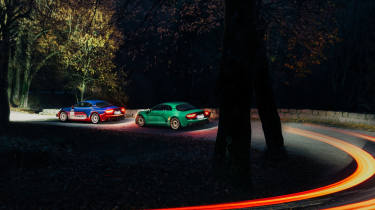
In something of an homage to the Monte’s famous ‘Night of the Long Knives’ – so-called because of the dagger-shaped beams of light that pierced the darkness on the Col de Turini night stage – we stay late on the mountain to set up a final static shot. The cars look absolutely in their element, Cibié light pods illuminating the winding road ahead. It’s an evocative end to a memorable few days.
Self-funded, self-motivated ventures like this are the hardest to bring to fruition, yet this compelling vision of a contemporary A110 Group 4 didn’t just stumble into production. Rather it was realised in an impressively calculating manner that exudes the precision and rigour of an OEM programme. Just as Tallec’s design dazzles, so the foundational engineering work led by Vincent ensures the dynamics back it up. The combined effect is outstanding: amplified character and capability but suffering no distortion of Alpine’s aesthetics or engineering philosophy, and no unwanted mutation of its dynamic DNA.
The Ravage Group 4 shines with individualism and the confidence of expression that comes from an independent passion project. One delivered by a dedicated team of like-minded enthusiasts with a desire to make something special. It would have been all too easy to ruin the sublime A110. So kudos to this enigmatic band of Ravagistes for making a great car even greater.
| Ravage A110 Group 4 Stage 1 | Ravage A110 Group 4 Stage 3 | |
|---|---|---|
| Engine | In-line 4-cyl, 1798cc, turbocharged | In-line 4-cyl, 1798cc, turbocharged |
| Power | 296bhp @ 5500rpm | 338bhp @ 6200rpm |
| Torque | 273lb ft @ 2400-5500rpm | 286lb ft @ 3000-6200rpm |
| Weight | c1090kg (c276bhp/ton) | c1090kg (c315bhp/ton) |
| 0-62mph | c4.0sec (est) | c3.8sec (est) |
| Top speed | c170mph | c175mph |
| Price | €105,570 (plus donor car) | €130,948 (plus donor car) |