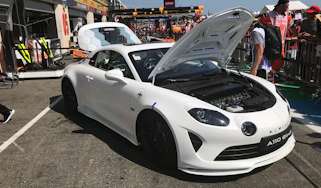
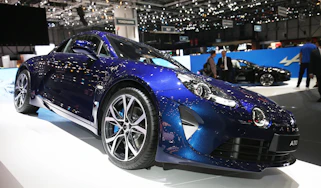
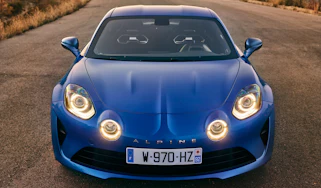
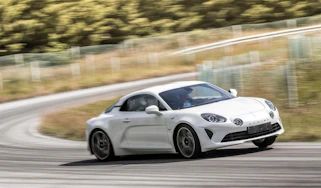
Alpine A110 review – the sports car Lotus should be building
The Alpine A110 goes off sale next year, and with its replacement being electric – and potentially offered as a hybrid – it’ll go out as the last of its kind, and an all-time great sports car
evo verdict
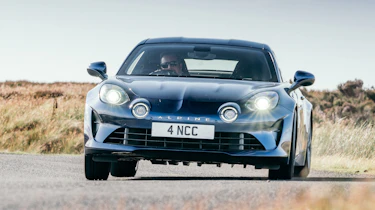
Yes, it would be nice if it had a manual gearbox and a more characterful engine, but no matter: the A110 is a magical car. In many ways it feels like it should wear a Lotus badge – more so in fact than Hethel’s own Emira – with its focus centred on low mass, simplicity and a wholly road-centred approach to its dynamics. The more extreme versions are exciting in their own way, particularly the A110 R, but the base car is a captivating driving machine of the kind we may never see again. We’ll miss it once it’s gone.
Background and model range
The A110 has been a fixture in the sports car class for nearly a decade, having transcended a troubled birth to become a new standard of excellence thanks in large part to its trend-bucking lightness, deftness and satisfying fluidity. That it continues to exist at all in 2026, in a world where Lotus builds EVs weighing over two tons and where the latest BMW M5 weighs as much as a Range Rover, is a bit of a miracle. It’s an icon in its own right, and with production ending next year to make way for an electric (and potentially hybrid) replacement, now is as good a time as any to celebrate it.
Born from an initial collaboration between Renault and Caterham (then owned by Tony Fernandes), and driven by the enthusiasm of then Renault COO Carlos Tavares, the reborn A110 was besieged with setbacks before it could turn a wheel: the partnership with Caterham ended predominantly because the latter didn’t have enough money to continue with the project. Renault went it alone and somehow the A110 emerged from the chaos and made it to showrooms – and reminded us just how special a small, lightweight, thoughtfully designed sports car can be.
More reviews
The base car was and remains brilliant, but the A110 range has steadily evolved with new versions since it launched. The first was the more hardcore A110 S, introduced in 2019 with a 47bhp bump to 296bhp, as well as a stiffer chassis. The Légende GT-spec A110 followed, first with the standard engine and a more luxurious interior, then upgraded in 2021 to offer the softer chassis in combination with the more powerful A110 S powertrain. Arguably, this was the arrival of the first true sweet spot in the A110 range, marrying the best chassis with welcome extra potency.
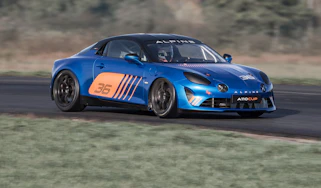
In 2022, Alpine rationalised the range, into A110 (the basic car), A110 GT (softer chassis plus the more powerful engine) and kept the A110 S at the top. Both the GT and the A110 S received nominal bumps in power, too. Numerous special editions based on these models kept things interesting but in 2022, our attention was firmly focused on the A110 R. A proper Cayman GT4 rival, the A110 R was the most track-focused version yet, with 34kg shaved off, more extreme aero, carbon wheels and Sabelt carbon seats, if not any more power.
As the end of production approaches, the A110 range has been restructured again. The base car remains, but above this sits a more powerful GTS to cover the A110 GT and A110 S remits. Then comes the A110 R, with a new Ultime version sitting at the top of the tree with a complete tip-to-toe mechanical overhaul, from its engine to transmission, chassis, aero and suspension. It might cost as much as a supercar but it's intoxicating – one of our favourite A110 vairants.
Engine, gearbox and technical highlights
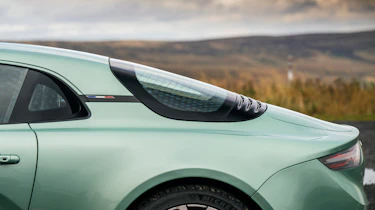
The A110 is powered by a 1.8-litre four-cylinder engine with a single turbocharger and direct injection. It’s the same unit that’s used in the last Mégane RS and is none the worse for it, producing 249bhp in base spec, 296bhp in the GTS and R and a full 345bhp in the Ultime. Torque is limited on account of the transmission, which is 236lb ft for the base car and 251lb ft for GTS and R, with the Ultime getting an upgraded six-speed dual-clutch in place of the standard seven-speeder to release a healthy 310lb ft.
Underpinning the Alpine is a light and strong aluminium structure, while the same material is used for the body panels, all of which helps the Alpine tip the scales at 1103kg in base form. Weight distribution is, according to Alpine, 44 per cent to the front and 56 per cent to the rear, while weight saving has even extended to the rear calipers including an integrated handbrake unit. The car’s pure ethos is also reflected in its suspension, which features unequal-length wishbones front and rear, coil springs and passive dampers – Alpine’s engineers wanted to avoid complexity so adaptive items were dismissed.
Given its low mass, it’s no surprise to find that the A110 is a quick little car, with the 0-62mph sprint taking a claimed 4.5sec, four-tenths quicker than a base Cayman when fitted with a PDK transmission. When we tested the car we managed a best of 4.6sec to 60mph, which is a strong result given that all our assessments are run two up and with a full tank of fuel. Yet it’s the A110’s elastic mid-range acceleration that really impresses, the combination of almost lag-free turbo torque and relatively short gearing helping the Alpine set a scorching in-gear pace.
The GTS’s considerable bump in power takes these figures to 4.2sec for the 0-62mph time and a raised top speed of 170mph. It's a shame that the A110 R doesn't have any extra power than the S to compliment its more capable chassis, but its slightly trimmer kerb weight of 1082kg and stickier Cup 2 tyres cut its 0-62mph time down to 3.9sec. It's faster than the S flat out, too, with its more efficient aero raising the top speed to 177mph. The Ultime is quicker still with a 3.8sec 0-62mph sprint, with an unchanged top speed.
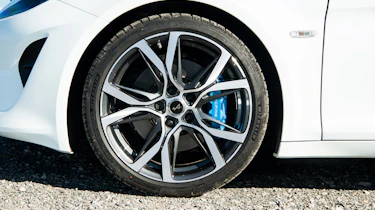
The GTS derives its sportier chassis tune from the A110 S, and gets 18-inch ‘GT Race’ wheels wrapped in Michelin Cup 2 tyres as an option. An A110 R-style aero kit is available too. The full-fat R, meanwhile, gets track-oriented suspension with ZF dampers that feature 20 clicks of combined bump/rebound adjustment. The R also features Eibach springs which are 10 per cent stiffer and new bump stops, along with stiffer anti-roll bars. The setup sits 10mm lower than that of the A110 S, but can be dropped by an additional 10mm for the track. The changes combine with a lower 1082kg kerb weight, more powerful aero and sticky Cup 2 tyres to make the R more capable on track.
But not as capable as the A110 Ultime. This is Alpine’s answer to the Porsche Cayman GT4 RS, with a more extreme carbon aero pack than the R that increases downforce by 160kg at 177mph. The dampers are adjustable Ohlins TTX units, with AP Racing brakes replacing the R’s Brembos and 18- and 19-inch front and rear forged alloys coming as standard, which are even lighter than the R’s carbon items. The transformation goes deeper still, with engine mounts derived from the A110 GT4 race car, motorsport-spec bushings and a new rear subframe to accommodate the upgraded transmission. It’s a no holes barred effort to send the A110 out on a high.
Driver’s note
‘When the ’90s gave us the Lotus Elise, who’d have thought it would be almost 20 years before there’d be another genuine road car that would uphold the same virtues? There’s a little bit of Lotus in the Alpine A110: not only in its aluminium-intensive structure but also because many ex-Hethel engineers worked on the project.’ – James Taylor, evo Deputy Editor, who tested the Alpine A110 on the road in the UK
Performance, ride and handling
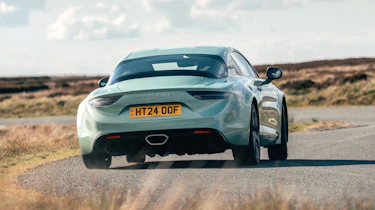
The A110 has always felt different to everything else, for all the right reasons. It’s hard to think of another modern sports car that’s so delicate across the ground and so pure in its engineering. It feels more like an old Lotus than an Emira does. Its minimal mass and soft suspension give a wonderful three-dimensional feel – you can hustle it, but it prefers to be caressed along, taking the line of least resistance. The Alpine manages the unique trick of both floating just above the surface and being intimately keyed into it at the same time.
The steering is light, delicate and accurate, but delivers genuine feel through the rim once you put load into the tyres. You can place the A110 to the nearest millimetre through most bends and have total faith in the front end because the turn-in response is so crisp, without being hyper-reactive. The lightness of the steering is initially a bit of a shock, given weighty set-ups are all the rage in performance cars right now, but the way it wriggles in your hands, gently following the contours of the road, is a refreshing characteristic.
The trade-off is that once you’ve gained confidence to muscle the A110 through corners at speed, the body control starts to unwind – it’s still biddable and fun, but less nailed-on precise than a Cayman, with an unsettling corkscrewing motion through undulations at speed. Stiffer versions like the S take a slightly different route, adding more weight and precision to the steering, whilst reducing body roll for calmer high-speed direction changes. While not exactly worse to drive, the S somehow feels a little more generic, like the A110’s unique driving appeal is diluted.
If the Alpine’s power figures sound a little bit feeble, it’s worth remembering the relative lack of mass they have to motivate – these are surprisingly rapid little cars, and show off some pretty impressive numbers on their digital driver’s displays. Despite its humble origins the engine has plenty of character too, responding crisply and quickly to the throttle, its rasping exhaust note egging you on. Ramping up the driver modes (there’s Normal, Sport and Track) adds some extra fruitiness to the soundtrack, with the pops and crackles on the overrun being particularly entertaining and the overall sound a mix of rasping induction noise and growling exhaust.
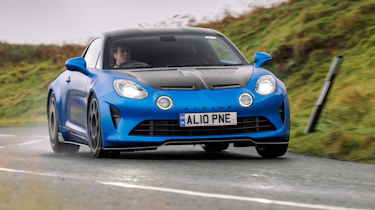
The seven-speed gearbox is a willing and capable sidekick, although it’s not quite as impressive as the engine itself. There’s nothing intrinsically wrong with it (it shifts swiftly and smoothly enough), it’s simply that the twin-clutch unit isn’t quite as incisive as it could be. Quick getaways are achieved by slipping the clutches, while there’s a similar feeling on fast changes, giving the impression that performance is being fractionally sapped. Still, you get a nice blip on downchanges, while it’s relatively painless when left to its own devices. It’s responsive enough in Sport mode too, encouraging you to drive in this mode more often than not.
Despite being no quicker than the A110 S, the harder, lower, bewinged A110 R is a different animal altogether, with a much higher level of track performance. Yet it still makes for a thrilling, tactile and surprisingly absorbent road car. Plotting a line from apex to apex, the R feels precise and darty like a kart, a just-right blend of power and grip. While you can’t use a surfeit of horsepower to manipulate the car like you can in a BMW M2, and the instant thrill of dramatic straight-line acceleration isn’t part of its repertoire, the A110 R is a deeply satisfying car to drive. There’s an almost meditative feeling to getting into a flow with it, and it rectifies the base car's lack of fine damping control.
Driver’s note
‘It looks as good as it ever did, and it’s so different from everything else around it. It takes a bit of adjustment to drive, because its dynamics are such a contrast to any other contemporary car. But you quickly get used to how it likes to be driven. It’s just nice to be in something that’s light and supple.’ – Richard Meaden, evo contributor, who tested the Alpine A110 on the road in the UK
MPG and running costs
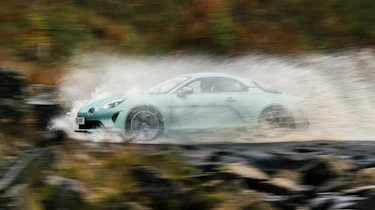
Given its impressive performance potential the Alpine actually delivers surprising frugality, and that’s largely down to its lack of mass. According to its own claims the A110 emits just 150g/km of CO2 and will return 42.8mpg on the updated WLTP cycle. This is a figure that’s easily achievable when driving gently, even creeping up to 37mpg on a steady throttle, but drive the Alpine as it wants to be driven and the official figures are pretty much bang-on. Ironically, the hardcore A110 R could prove more efficient than an aero-equipped S, given that it's lighter and generates less drag.
Another benefit of the Alpine’s low weight is that it’ll be kinder to consumables, such as tyres and brakes, which is especially good news if you plan on taking your A110 on track. The 18-inch rubber on the standard car is a reasonable size, too. Of course, if you use the car on track you'll accelerate tyre and brake wear, but nowhere near to the extent of something heavier and more powerful. Just be sure to budget for pricier Michelin Cup 2 rubber (and potentially ruinous carbonfibre wheel kerb damage) if you have an A110 R...
With low wear rates comes cheaper servicing costs, with only routine fluid changes likely for most scheduled maintenance. And because most of the oily bits are shared with run-of-the-mill Renaults you can expect prices to be reasonable.
Interior and technology
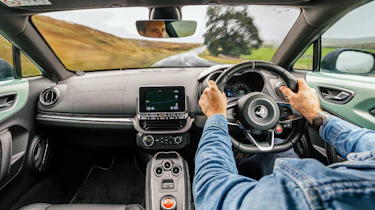
Despite its relatively tiny dimensions the A110 doesn’t feel small or cramped. Previous Alpine MD Michael van der Sande is a towering 6-feet 7-inches tall and the car was designed to make sure even he fits inside, so for anyone of regular proportions there is plenty of room in which to operate.
You’ll recognise a few components from Clio and Mégane parts bins – including the door handles inside and out, the plastic key card (concealed in a nice leather case for the Alpine) and Renault’s ubiquitous plastic block of audio controls on the steering column. But even so, the A110’s cabin is a deeply appealing environment: you sit nice and low in the lightweight bucket seats, their bolsters trimmed like a vintage leather jacket. You feel the aluminium door’s light weight as you swing it shut via its leather pull, and you can touch the speakers’ paper cones with your fingers, with only minimal plastic strips to protect them. The mantra of light weight runs through every component. But the resultant whole is comfortable, refined, easy company.
Ahead of the driver is a TFT dial pack that changes its visual theme dependent on whether you’ve selected Normal, Sport or Track modes – each can be accessed using a button on one of the steering wheel spokes. Other driver aids include the Alpine Telematics function, which allows you to record and store lap times and performance data, plus it also delivers a number of real-time displays for parameters such as turbocharger pressure, various fluid temperatures and power and torque delivery. The A110 R has the same tech and cabin layout but a more extreme ambience thanks to one-piece carbonfibre Sabelt seats, harnesses and fabric door pulls.
While the cabin is roomy, there's not a great deal of luggage space in either of the small luggage compartments. The rear boot will just about hold a carry-on-sized bag, while the ‘frunk’ might be more suitable for soft luggage as it’s more of a tray than a compartment. There are at least some extra storage bins in the cabin, notably one on the bulkhead between the seats that’s big enough for 500ml bottles and the like. The R is slightly more frustrating to use every day thanks to its blanked-off rear window, but it's still usable for more committed owners.
Long-term test – 7000 miles in an Alpine A110
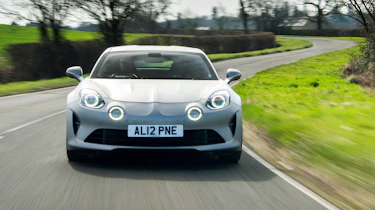
‘’I’m just going out for a drive.’ This has pretty much been my catchphrase for the last six months as any opportunity to drive our A110 has been grabbed with both hands – for an hour, maybe two, sometimes several.
‘Such is the allure of the Alpine. No matter how often or for how long I drove it, I never grew tired of the way it handled whatever road was put in front of it. Where so many modern performance cars hammer and bully their way along a road, making jagged, aggressive progress, the A110 would simply flow.
‘The uncommon suppleness to its ride made it a maestro of extracting the maximum enjoyment from less-than-perfect surfaces. Never did I feel like I ought to be making my way to a trackday to experience this car at its best. Direction changes, meanwhile, would be delivered with a genuine lack of inertia, eliminating the need for super-quick steering and hyped‑up responses to generate a sense of agility and excitement. And then there was the roll – remember roll? – that gently grew and receded mid-corner to tell you exactly how hard you were pushing, but without ever feeling like it was the enemy of your progress. I could go on. And on…
‘But we already knew the Alpine is a great driver’s car. What this long-term test really revealed was that it is a great driver’s car that you can also use every day. And there’s no ‘if you’re suitably determined’ proviso to that. I averaged nearly 1200 miles a month in ours and not once when I had to travel anywhere in it did I feel it was a drag to get behind its wheel. There was no awkward ingress and egress (it may be a low car, but the door aperture is nice and large), no echoey, spartan interior, no flimsy bits of trim, no awkward outward visibility, no recalcitrant low-speed behaviour, no edgy wet-weather handling, no feeble headlights – whatever the journey, whatever the conditions, you could just get in and drive.
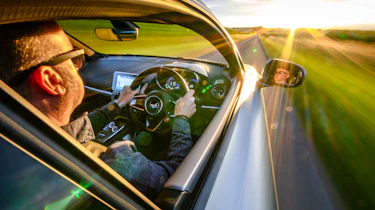
‘The A110 doesn’t feel like it has been excessively compromised in order to fulfil its lightweight remit, then. Especially so in our car’s £64,807 Légende GT 2021 spec, which added niceties such as heated seats, an upgraded stereo and a rear parking camera alongside the 288bhp 1.8-litre four and uprated brakes from the A110 S. Yet still it tipped the scales at a mere 1134kg. (Incidentally, this special edition’s combination of standard suspension and S engine, which from 2022 has an extra 8bhp, is now available in a permanent member of the range: the A110 GT.)
‘What simplicity there was in the A110 only added to its appeal. There was no befuddling introduction to this car. Just press the start button, prod D for Drive and away you went. Maybe you’d push the Sport button on the steering wheel later for a keener throttle response and more pops from the exhaust, but that was it. There were no interfering safety features to disable every time you got in, no damper modes to endlessly cycle through in search of the best one. Heck, even the heater controls used a couple of proper physical dials rather than some infernal virtual buttons on a touchscreen.
‘OK, so even in upgraded form the stereo was more a means to stave off boredom on a dull route than to sonically impress, but it did the job. The satnav was properly shonky, mind, being unintuitive to use and having a habit of randomly going silent for a while despite not being muted. (Facelifted cars get an improved nav system and are also Apple CarPlay and Android Auto compatible).
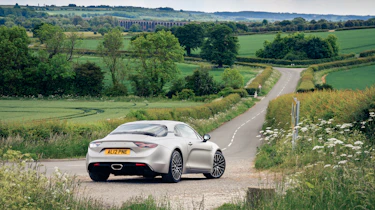
‘Boot space could be an issue if you like to carry large objects, but I never had trouble fitting a ‘big shop’ in the car, and with a 50-litre Boot-bag strapped to the rear bootlid a week-long holiday for two proved no problem. For smaller, day-to-day items, Alpine’s own storage case – a lidded leather receptacle that attaches to the bulkhead between the seatbacks – proved essential, as there’s no glovebox or enclosed central cubby. Shame you have to pay £468 to get it.
‘On the subject of costs, the first service – scheduled for 12,000 miles or, as in this case, one year – was due just a few days after the car left us. Depending on the chosen Alpine dealer this would have cost around £400, give or take. With 11,300 on the clock there was 5mm of tread left on the front Michelin Pilot Sport 4s and 3mm on the rears, so the latter would soon need replacing, at around £150 each. Otherwise the only running cost was fuel, and I should point out that our 31.7mpg overall average included a significant proportion of enthusiastically driven miles. Driven steadily, 40mpg or more was easily achievable.
‘But the temptation to take the more interesting route was always there with the A110, for that simple, unadulterated joy of driving something light, something that wasn’t overburdened with tech or unnecessary kit, but which also wasn’t stripped back to the point of being a weekend toy. It was, essentially, my perfect car. In fact it’s hard to imagine I’ll ever run another long-termer that will topple it. Although if one day I’m proved wrong, you certainly won’t hear me complaining.’ – Ian Eveleigh, evo managing editor.
| Date acquired | February 2022 |
|---|---|
| Duration of test | 6 months |
| Total test mileage | 7015 |
| Overall mpg | 31.7 |
| Costs | £109.95 (Boot‑bag) |
| Purchase price | £64,807 |
| Value today | c£45,000 |
Price, rivals and buying options
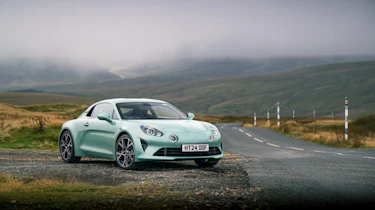
The A110 has gradually become more expensive over the years, but not quite to the extent of its rivals, making it look like something of a low-key bargain in 2026. The base model starts at £55,160 – not bad considering the amount of bespoke engineering that’s gone into the project. Prices rise sharply from there, with the GTS starting from £69,890. Then there's the A110 R, which thanks to its extensive use of carbonfibre, adjustable suspension hardware and extreme aero costs an eye-watering £106,490.
That's a huge sum, especially when you consider that the R offers the same 296bhp as the A110 GTS. The Ultime takes pricing to another level at an eyewatering £235,000, but does come with extensive modifications, including a power bump, chassis upgrades and a new gearbox.
With Porsche’s brilliant 718 Cayman being taken off sale the A110 has one fewer rival to contend with, but there are tempting alternatives out there. For a more usable sports coupe there’s the £69,930 BMW M2 – an ultimately less indulgent driver’s car than the Alpine but mighty fast and entertaining, with the bonus of rear seats, modern tech and a decent-sized boot. The Lotus Emira is a more direct rival but comes at a significantly higher starting price (£79,500) and isn’t as deft or fluid to drive – in truth, it feels less like a Lotus than the A110 does.
Ford’s Mustang is a left-field choice – by no means as dynamically impressive as the A110 but packing a magnetic character all of its own, with a naturally-aspirated V8 and a manual gearbox. While we’re here, hot hatchback options such as the Audi RS3, Mercedes-AMG A45 S and the brilliant FL5-generation Honda Civic Type R also float around the A110’s price point.
The Alpine is by no means poorly equipped for its outlay. One shouldn’t sniff at a low-volume, specially developed aluminium chassis with double wishbones at each corner for a start, but the company does understand that under-the-skin stuff only goes so far. Even in basic form trim you get LED headlights and tail lamps, 18-inch alloy wheels, lightweight (and gorgeous) Sabelt one-piece bucket seats, selectable driving modes and a 7-inch touchscreen infotainment set-up.