Audi Q7 review - Ride and handling
Better to drive and plenty of tech, but still behind rivals

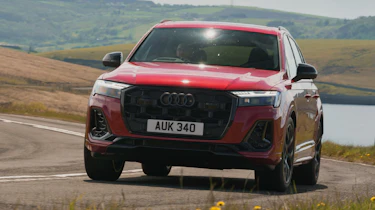
All Q7s now come with the adaptive air suspension, which was an option lower down the range when the car launched. Initially, the Q7 doesn’t feel quite as wafty and detached as expected, picking up minor imperfections through town and making the car feel a little less cosseting than some of its rivals. Thankfully over bigger obstacles like speed humps the Q7 is much happier, soaking them up with aplomb. The Comfort setting in the Driver Select menus doesn’t seem to be worth bothering with as the secondary ride isn’t appreciably better and the steering merely becomes overly light.
At nearly two metres wide and over five metres long the Q7 is a car of intimidating proportions. However, select Dynamic mode, throw the Q7 down a decently sized A- or B-road and it can surprise you with its relative composure. You can stroke along at a comfortable pace, though start to ask more of it and it will fall over itself. The added weight of the plug-in element in the TFSI e-hybrid is far from invisible either, the car leaning that bit more, the sidewalls of the tyres flexing that bit more, to contain it.
Higher-spec cars and indeed the SQ7, can be had with 48-volt motorised anti-roll bars as well as the rear-wheel-steering, to prop up this big family SUV with more composure and agility. Still, these aren’t silver bullets to turn a Q7 or SQ7 into a Cairngorm-crushing sports car. Grip from the quattro four-wheel drive is mighty and the standard torque split is an encouraging 40:60 front to rear with up to 85 percent available at the rear axle if necessary.
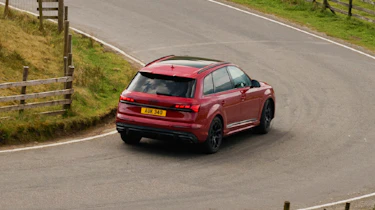
It will be persuaded to lose grip at either axle; if you’re clumsy it will wallow into understeer and with stabs of power it will give a flourish of oversteer. Most of the time, the Q7 just wants to grip, go and not be pressed too hard. It might be quick, effective and amazingly agile, but even the SQ7 doesn’t offer much in the way of involvement or adjustability. And why would it? This is the car with which to tow your GT3 RS to the track, not replace it altogether.
Still, the BMW X5 and Porsche Cayenne show greater aptitude as driver’s SUVs, if such an oxymoron can be said to exist. They’re generally faster, more composed and more engaging, even if that’s missing the point of an SUV. The X5 M for instance, became an almost intolerable road car in its pursuit of grip and performance. Because you can’t force these cars to be what they’re not. As such, there’s a refreshing and appealing honesty to the outgoing Q7’s gait and fitness for its most obvious purpose.