Bugatti F.K.P. Hommage: 20 years later, Bugatti facelifts the Veyron
One-of-one special Bugatti Solitaire customer car reimagines the Veyron for the 2020s, and gives it 60 per cent more power
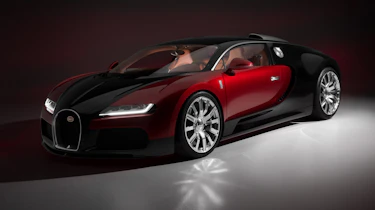
The Bugatti F.K.P. Hommage is a one-off tribute to both the original Veyron and to the late Ferdinand Karl Piëch (hence its initials), the formidable VW Group leader whose single-minded approach brought the Veyron, and modern-era Bugatti, into being – and ushered in a new hypercar genre in the process.
It’s been created as part of Bugatti’s recently introduced Solitaire programme, which builds unique one-of-one commissions for special clients. The FKP Hommage is the second Solitaire Bugatti so far, following 2025’s Broulliard, a W16 hypercar named after Ettore Bugatti’s favourite horse. Bugatti (now Bugatti Rimac, of course, following Rimac Group taking a majority stake in 2021) won’t disclose Solitaire cars’ prices but given that the 99-off Bugatti Mistral is priced at more than £5m per car, we can assume the one-off F.K.P. Hommage has cost its owner a pretty penny.
> Bugatti Mistral review – behind the wheel of the £5m W16 swansong
Bugatti Rimac’s director of design Frank Heyl shows us around the car in a private studio in rural Germany, under wraps ahead of its public debut. The machine here is, in fact, a very detailed full-scale model: the real car is still being built and will be completed shortly. The Veyron/Piëch homage idea came from the client but aligns neatly with Bugatti, since it has recently celebrated the Veyron’s 20th anniversary.
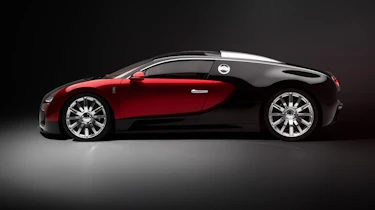
From a distance, the F.K.P. Hommage looks very similar to that original car but in reality every element is different. Beneath the carbonfibre skin it’s built upon the Chiron platform, and adopts the 8-litre, quad-turbo W16 engine from the Chiron Super Sport, with 1578bhp. This will be one of the last Bugattis to be powered by the W16, since the engine has now entered its final production run in the Mistral.
The first Veyron customer car was red and black, so the same scheme has been chosen for the Hommage. The black sections are not painted but exposed carbon fibre with a special tint, while a silver aluminium base coat underneath the red-tinted clear coat gives extra depth, appearing almost black where the body surfacing tucks under into shadow, yet lustrous red under light. Panel gaps and the precise creases in the bodywork, along the wings and shoulder line for example, are tighter than was possible back in the noughties.
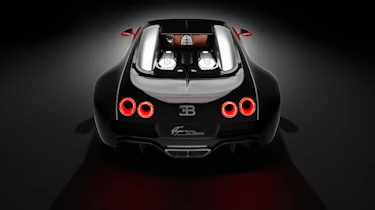
Heyl has been with Bugatti since 2008. Shortly after joining, he was asked to design a Veyron facelift, which never became a production reality. In a neat twist of fate, the Hommage allows many elements of his design to see the light of day. And lights are a key feature. At the front, L-shaped daytime running graphics flow smoothly into the wings. Whereas the original Veyron’s headlights appeared slightly downturned from certain angles, giving it something of a hangdog expression, the Hommage’s horizontal treatment gives it a more defiant countenance. At the rear, ‘light-tunnels,’ with light guides arranged in a circular pattern around a hollow centre take the place of the original circular tail-lights. They’re a technology that wasn’t available when the Veyron was created, and instantly make the rear appear more contemporary.
‘It’s a mix between ideas that were on the table then, and technology that has been made possible since,’ Heyl explains. The traditional horseshoe grille, machined from solid, has a more three-dimensional treatment too, flowing into the surrounding bodywork.
The original Veyron exterior design was by Jozef Kabaň, together with then-chief designer Hartmut Warkuß. Heyl explains that its Bauhaus-influenced geometric shapes and stance were a departure from typical wedgy supercar treatments. Whereas most supercars have the sense of charging forwards, the Veyron has a more imperious stance, almost appearing to be leaning backward slightly: ‘It’s almost a noble posture,’ is how he describes it, and he’s worked to echo that stance in the F.K.P. Hommage. ‘For me, the two most important things [in exterior car design] are the proportions and the body posture,’ he says as we walk around the car.
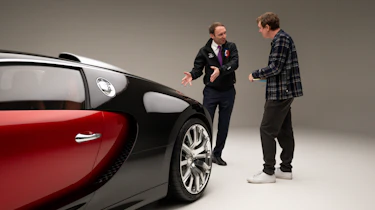
Much of the Chiron’s package is similar to the Veyron with similar hard points, he explains, making it possible to design a car with very similar proportions. The Hommage’s shape has undergone extensive CFD simulation for aerodynamics, and thermodynamics too: since it now has nearly 600bhp more than the original Veyron, there’s a greater amount of air to take in and process to feed and cool the Hommage’s innards.
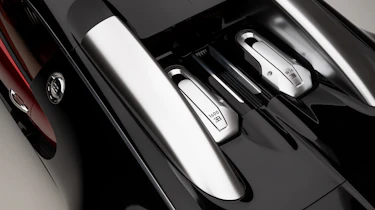
As before, the W16 is fed by the distinctive roof-mounted ducts above the occupants’ heads. It still has a ‘speed key,’ as per the original Veyron and Chiron, to unlock its full potential top speed. In that mode the ride height lowers, to reduce drag: ‘So low you can barely get your foot underneath the sill,’ Heyl says.
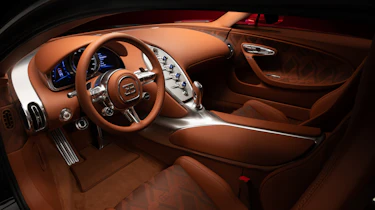
The interior is inspired by the tan/aluminium cockpit on the original Veyron EB 18.4 concept car shown at the 1999 Tokyo motor show. The Hommage incorporates custom-woven fabrics, a new customisation option Bugatti recently introduced with the Tourbillon. Speaking of which, the Hommage incorporates a custom-made 43mm Audemars Piguet Royal Oak Tourbillon automatic watch in the centre of the dash (itself worth an eye-watering sum of money). A powered self-winding mechanism via a rotating gondola means it can keep time even if the car is stored for weeks on end (providing it’s trickle-charged).
The surrounding centre console and transmission tunnel cover are machined from solid aluminium and finished in engine-turned polish, a reference to the original concept and in turn, vintage Bugattis’ straight-eight cylinder heads. The circular, Bauhaus-influenced steering wheel is a one-off too. That alone represents considerable cost.
Heyl says Bugatti’s Solitaire programme is in some ways a return to the marque’s coachbuilding roots. Back in the days of Ettore and Jean Bugatti in the 1920s and ’30s, bespoke bodywork over standard engine and chassis underpinnings were common projects. To resurrect that approach is a ‘no-brainer,’ he says, explaining that no more than two one-off Solitaire cars will be created per year. ‘Some years there may be only one; some years there may be none. Two is the maximum.’ Each will feature completely bespoke bodywork, interior details and elements personalised to their owners, over existing Bugatti powertrains and chassis architecture.
‘In the early 2000s, personalisation was less common,’ Heyl explains. ‘With the first Veyrons, we would have maybe 18 colours. As the demand for personalisation increased, so did labour intensity. Requests became so complex that we needed two production slots per car.’ For example, special /Vagues de Lumière/ paint schemes on certain Veyrons and Chirons required stripes to be taped and painted by hand, over countless hours. As a result, Bugatti’s approach has changed and the Solitaire programme is the ultimate extrapolation of a personalised Bugatti: a one-off custom-built car.
In a similar fashion, Ferrari has built one-off cars for clients over many years but in recent years has focused more on ‘few-off’ cars (such as the SP1/SP2 Monza and SP3 Daytona Icona models) than one-offs, with Maranello insiders explaining that a one-off project’s cost to resource, in terms of designers’ and engineers’ time and focus, for example, could in some circumstances be greater than the monetary gain. Bugatti’s positioning as a smaller, hypercar-concentrated outfit with many clients looking for the most personalised experience possible may make its Solitaire programme a smoother fit with its business model.
Many customers of ‘normal’ production Bugattis buy their cars as investments, with the potential to appreciate owing to prestige and rarity. Despite the multi-million sum each Solitaire car will command at commission, the programme currently has a greater number of applicants than it does confirmed customers.
In some ways, the Solitaire programme is also an evolution of the atelier customer experience established when Ferdinand Piëch rebuilt Bugatti’s original Molsheim base, after acquiring the brand in 1998. Though the Veyron would itself go on to cost its makers a huge deal of money and resource, it redrew technological boundaries and ushered in a new market segment. ‘Back when the Veyron was being designed, the thought of a million-dollar car was unheard of,’ Heyl adds. ‘Probably a Lamborghini Diablo was the fastest car in the world at the time.’ He adds: ‘None of this could have happened without Ferdinand Piëch. He would never let go of an idea – and if, after all options had been exhausted, it could not be done, then he would say: “Then we do it at the next opportunity.”’
Heyl tells us that in some ways the Veyron was a greatest hits package of Piëch’s career: ‘At Audi he established quattro drive, so it had to be four-wheel-drive. He was heavily involved in the double-clutch gearbox at Porsche, so it had to be a twin-clutch transmission. The VW Golf Mk3 VR6 has the same bank angle as the W16, with staggered cylinders to reduce the length of the engine, which gave the Veyron a small wheelbase for what it is, and allowed the gearbox to be packaged ahead of the rear wheels for better weight distribution.’
The clever configuration compressed what would have been a metre-long engine into 645mm. Piëch famously sketched the first layout for the W16 (originally devised as a W18) on the back of an envelope on board a bullet train in Japan. The W layout was a Piëch pet project, having championed the configuration across VW, Audi and Bentley brands with eight, 12 and, ultimately, 16 cylinders in the Bugatti.
The W16’s 1001ps (987bhp) power output was a target figure Piëch insisted upon (‘1001 horsepower like 1001 Nights,’ Heyl smiles), as was the mandate for a 400kph (248mph) top speed. That was a legacy from another of his greatest hits, the Le Mans-winning Porsche 917. ‘His goal with that car was to travel at 400kph on the Mulsanne Straight – “leave the corners to others – or make the car wide so they can’t get past,”’ Heyl says.
While the F.K.P. Hommage doesn’t have a stated top speed, with that aforementioned speed key and nearly 60 per cent more power than the original Veyron, plus 20 years of advances in aerodynamic knowledge, we can assume it’s at least as fast.
The F.K.P. Hommage retains the Chiron’s all-wheel-drive system, with a Haldex coupling at the front differential. Whereas the Veyron sat on 18-inch front and 20-inch rear wheels, the F.K.P. Hommage’s wheels have grown to 20 and 21 inches respectively, with the latest Michelin Pilot Sport Cup 2 tyres, as per the Mistral.
While it brings the original Veyron concept up to date, incorporating technology that wasn’t possible when it was first put into production, Heyl says he and his team have been careful to preserve the original car’s character. In the same way that cars are judged at concours events for being ‘period-correct,’ the F.K.P. Hommage is intended to be true to the style and ethos of a noughties car, with 2020s capability. In a way, it is the Veyron facelift that never was.
‘Sadly, he is not here to see this,’ Heyl says, ‘but as Ferdinand Piëch would have said: “So, gentlemen – at the next opportunity.” This is the next opportunity.’