Caterham 7 review – the sports car to make a Lotus look clumsy
Put simply, the Caterham 7 is one of the best driver’s cars money can buy, and it’s available in endless forms
There is no driving experience quite like a Seven. There are other minimal, bare-essentials sports cars, but there’s something utterly unique about the simplicity-to-the-max two-seater by Caterham.
All Sevens are pretty wonderful things, but the variants awarded five stars in The Knowledge are the Ford Duratec-engined 360, 420 and 620 models, along with the out-of-production Rover K-series and Ford Sigma-powered Supersport, Superlight R300 and R500.
> Caterham Project V is delayed, but a running prototype is finally here
In 2015, Caterham renamed its range according to each variant’s power-to-weight ratio, and offered a choice of two equipment packs: S for Street, with carpets, leather, windscreen and softer suspension, and R for Race, with limited-slip diff, race seats, lighter flywheel and other upgrades. First time I drove a Seven, it was the 1.6-litre 270S. And I didn’t quite get it. I’d read so much about the Seven’s magic that I expected it would be a life-changing experience when I finally got behind its tiny steering wheel, but a quick loop on some local roads wasn’t quite enough for it to get under my skin.
But when I had a 310S for several days – on road and on track, solo and with appreciative friends on board, feeling it communicate its limits or just ambling along slowly, letting the surroundings sink in – it all clicked. Some of my best driving experiences and memories since have been made in Sevens, and the ‘evo25’ 420R we ran for a long-term test in 2023-24 is one of my favourite road (and track) cars I’ve ever driven.
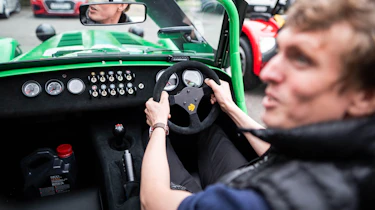
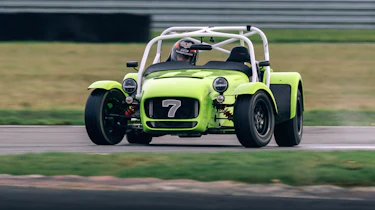
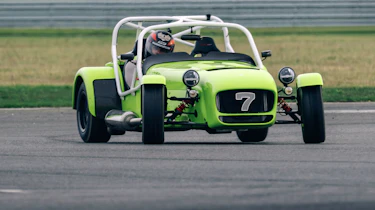
And the 420 Cup – the acid green car pictured here – is perhaps the most fun road-legal track car ever made. This is the hairiest model Caterham makes, short of its full-blown 420 race car, with a race-spec sequential gearbox and adjustable dampers. It’s lapped Anglesey faster than the Porsche 918 Spyder on evo’s leaderboard, yet its greatest strength is how unintimidating it is to drive. Getting back into its (heated!) carbon seats for this shoot is a reminder of just how quickly it puts you at ease. The gearbox is a joy – back to change up, forward to change down, and you can keep the throttle pinned on upshifts thanks to an ignition-cut function (similar to the one in the McLaren 675LT, in fact). The 210bhp 2-litre engine loves to rev, and with the adjustable dampers taking just a few seconds to twist by hand, you can play with it and dial in a setup that’s just so, which is part of the fun – but even left in its baseline setup this is still a brilliantly rewarding, balanced, malleable car to drive quickly. It’s fun to watch senior staff writers Sam Jenkins and Yousuf Ashraf experience the Cup for the first time, too, and see them falling under its spell.
More reviews
Group tests
- Ariel Atom 4R v Caterham Seven ‘evo25’: power-to-weight heroes go head-to-head
- Caterham Super Seven 600 v Super Seven 2000
Long term tests
- Living with this £40k Caterham Seven even makes the KFC drive-thru memorable
- Caterham Seven evo Edition revealed – bespoke 420R joins the Fast Fleet
Reviews
The same magic runs right through to less extreme Sevens, too. Robert Beke, Caterham’s UK territory manager, has seen all kinds of customers get into Sevens, from used cars in dealerships to custom factory builds, with all kinds of aims: Sunday drives or using the car on school runs; car club meets or trackdays. ‘I’ve had customers who have never been on a trackday, ever,’ he says. ‘They purchase a Seven and then in the first year, they do four, five days; in the second year, 20.’ He sees a split in customer behaviour: some keep a car for many years and struggle to part with it because of the memories they associate with it, and others chop and change Sevens frequently: ‘I know customers who over ten years have had more than ten Sevens.’
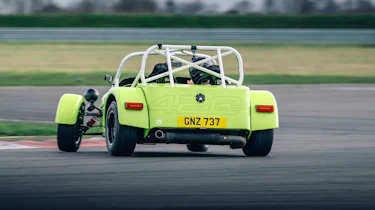
The 420 Cup is brilliant but, obviously, a little hardcore as a road car. The dampers can be softened for ride comfort but the racing gears are noisy and not everybody wants a roll-cage on the road. So, which Seven would we recommend as an all-rounder? Although the three-cylinder turbo Suzuki models are charming and the 1.6-litre versions and lower-powered 2-litre 360 are versatile, it’s hard to look past the 420R spec of our evo25 car. Beke agrees: ‘From a personal point of view, the 170R is fantastic, but if you go on a track you’ll probably want more power, and on a bigger track that might go for the 360 too. And if it’s an R, it doesn’t mean it can’t be specced with some comfortable bits, like leather seats instead of the racing seats, for example.’ A Seven with the R-spec flywheel, diff and suspension but full windscreen and weather protection is a real sweet spot.
> Caterham Horse prototype review – new turbo engine keeps the Seven alive
There are hundreds of thousands if not millions of spec permutations on Caterham’s online configurator, but one of the Seven’s strengths is that used cars can be easily upgraded with updated parts. ‘The most common thing we’ve seen in recent years is people fitting the rear LED lights to older Sevens, because it’s a relatively simple job to do at home, along with installing visual carbon components,’ Beke says. The adjustable dampers fitted to the 420 Cup are a popular upgrade, too. ‘The beauty of the Seven is that it hasn’t changed much in 30 years. You can go on the parts website and say “eenie, meenie, miney, moe” – they’ll all fit.’
Since 2000, Caterham has offered a wider SV chassis for drivers who find the regular S3 narrow chassis too cramped. There are two schools of thought on which to go for: one is that, if you can fit in a standard chassis, that’s the one to have: it feels like you’re wearing the car, particularly if you’re harnessed in, and there’s something about the proportions that looks and feels just right. But if you’re six-foot-plus tall or regularly carry a passenger, the SV’s extra interior space is helpful, and its roomier footwell makes heel-and-toeing (or just wearing shoes that are size 10 or bigger) much easier. The SV still handles beautifully, with great stability thanks to its broader footprint, while some drivers find the S3 a little more chuckable.
Engine and gearbox
- A choice of three strong engines
- Manual and sequential gearbox options only
- From 80bhp, all the way to 310bhp in the 620R
The choice here is wide but broadly revolves around three engine variants, a 660cc turbocharged Suzuki three-cylinder, and naturally-aspirated 1.6- and 2-litre Ford four-pots in various states of tune. There will also soon be a 1.3-litre turbocharged four-cylinder courtesy of Horse powertrains, producing 130bhp in HR13 tune.
A five-speed manual transmission is standard on most models with a six-speed manual standard on the 420 and a six-speed sequential on the 620R. The basic architecture means Caterham will only too happily fit a six-speed on all but the 160 though, and a limited-slip differential is available on all Sevens except the 160 – though the limited-run SuperSprint does include a limited-slip diff as standard equipment.
The entry-level engine in the Seven 160 comes from Suzuki. An unusual choice? Perhaps, but the diminutive K6A engine has been used in Suzuki’s cars for decades so it’s a proven design, and its tiny size and affordability make it a natural choice for the basic Seven. It produces 80bhp, which doesn’t sound like much these days but feels healthy enough in the Seven, giving 163bhp per ton. The SuperSprint features a tuned version of the unit making 95bhp.
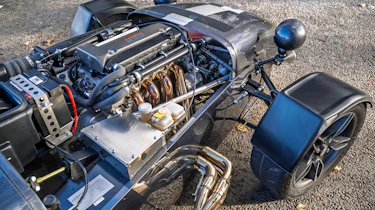
If you want proper power though, the rest of the range can provide it. Next up is a 1.6-litre Ford Sigma four-cylinder, making 135bhp in the Seven 270 and 152bhp in the Seven 310 and developing a suitably sporting blare as they race towards the red line. The 2-litre Ford Duratec-engined models are rampant, with 180bhp the entry-point in the Seven 360, rising to 210bhp in the Seven 420 (and £80k CSR Twenty, for that matter) and, fitted with a supercharger, 310bhp and 219lb ft of torque in the 620R.
Caterham fits the latter model with a six-speed sequential transmission – probably just as well, as while the Seven’s manual gearboxes are as tactile as transmissions get, we doubt our arms could move fast enough to change gear manually in the 620R.
Performance and 0-62 time
- 0-62mph times vary from 6.9 to 2.8sec
- Top speed from 122mph to 155mph
- No Caterham feels slow...
It’s always a good sign when the slowest car in the range can reach 60mph in under seven seconds, and the Seven 160 manages that in 6.9. Top speed is very much limited by 1950s aerodynamics (in all models, though it’s most apparent in those with the least urge), meaning the 160 can only reach 100mph – though to be fair, a hundred in a Caterham feels perfectly brisk.
The numbers climb quickly from there. In order of accelerative ability, the 270 hits 60mph in five seconds flat, the 310 in 4.9, the 360 in 4.8, the 420 in 3.8, the 620S in 3.4 and the sequential-’boxed 620R in 2.8sec. Top speed is 122mph for the 270, 127mph for the 310, 130mph for the 360, 136mph for the 420, 145mph for the 620S and 155mph for the mental 620R.
> Caterham CSR Twenty review – £80k for Caterham’s ultimate road car?
As with everything about the Seven, it’s the delivery and feel of that performance that matters as much as the numbers. The 160 is brisk, but stops well short of the terrifying pace of the fastest Sevens. The little Suzuki engine doesn’t have the throttle response of its stablemates even though its turbo is tiny, and it’s less keen to rev than the fours too, though a healthy mid-range means you can travel quickly enough without breaching the rougher reaches of the rev counter.
The Ford four-cylinders rise in excitement proportional to their on-paper numbers. The evo team is split on just which variant is most satisfying to use, but all share throttle response seemingly hard-wired to your brain, and a willingness to bat into the rev limiter in every gear. The 310 is undoubtedly the pick of the 1.6s, delivering seriously quick performance without it feeling overdone for public roads, and it emits an engagingly raucous note as you race through the gears.
The Duratec models are all seriously fast and by the time you get to the 620R there’s barely enough time to blink, so quickly do numbers show up on the speedometer. Even the 420 has an ungodly turn of pace, and after our old Fast Fleet long term 420R was fitted with a set of individual throttle bodies, it instantly became the best-sounding car on the fleet.
Ride and handling
- No-compromises focus on driver engagement
- Ultra-lightweight, ranging from 490kg to just 575kg
- Unassisted, ultra-communicative steering
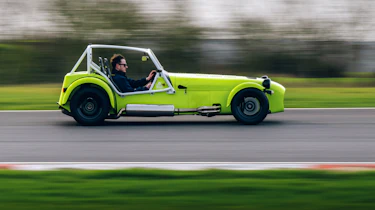
Light weight, a stiff spaceframe chassis, a front-mid engined layout, a low centre of gravity, rear-wheel drive… simply by looking at the car’s on-paper characteristics you know it’s going to be good, and true to form the Caterham remains one of the great drivers’ cars, decades after Colin Chapman first introduced the Lotus Seven way back in 1957.
That low weight influences virtually everything that makes the Seven great. Basic Seven 160s dip under the half-ton mark at 490kg and no other Seven weighs more than 575kg at the kerb. Even though the Seven is narrow by the standards of most cars, it’s wide for its height and combined with great front-to-rear balance and, if selected, sticky tyres, the car’s grip, ability to change direction and the space it gives you on the road are pretty much unrivalled among regular road cars.
You direct it through a quick, unassisted steering setup and a tiny wheel, meaning the smallest of movements have a large outcome and all but the tightest of turns can be dismissed with the flick of a wrist. The steering bombards you with feedback, but so tiny is the Seven’s frame that you feel as much about what the car is doing through the seat as you do from the wheel – and perched above the rear axle, you’re perfectly placed to detect changes in the car’s yaw. Only motorcyclists and single-seater racing drivers are granted more two-way communication between pilot and chassis.
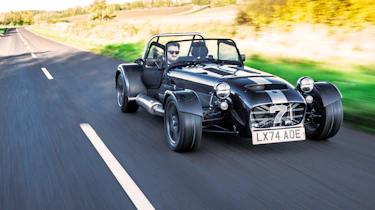
The Seven’s ultimate behaviour does depend on which model you go for, which gives the wide range of variants Caterham offers surprisingly different characteristics. The basic, live-axle 160 on its narrow tyres feels very much like driving a particularly well set-up classic, without the power to really excite the rear axle in the same way as its stablemates, but a wonderful front-to-rear balance and relatively low grip that lets you pull off tiny four-wheel drifts at satisfyingly sane speeds.
At the other end of the scale, Caterham’s R models on near-slick Avon tyres grip tenaciously but give you more options when it comes to altering your cornering line with the throttle. Models in between do a bit of both, so choosing the car that best suits your driving style requires little more than the right budget and deciding just how fast you want to travel.
The Seven’s ride quality is better than you’d expect, as the ultra-light chassis allows a softer spring rate than you’d normally require for such cornering performance. It’s never less than firm in any Seven, but the car’s small size means you always have the option of avoiding rougher sections of road altogether. Opt for the Cup’s adjustable dampers and you unlock a huge range of setup options, all the way down to ‘magic carpet’ soft should you want that.
Interior and tech
- It doesn't have much of one...
- Functional, but not designed for comfort
- Choice of chassis sizes gives buyers flexibility
There’s not much interior to speak of in a Seven, but the biggest concern you’ll probably have is whether you even fit. Caterham does offer different seat options and perhaps more pertinently, a large SV frame is still available for particularly tall drivers, but it’s certainly not a car for the broad.
Next, you’ll want the roof off. It’s handy that Caterham supplies one, but it makes getting in and out a considerable faff, it’s fiddly to erect or stow, it makes the cabin a claustrophobic place, doesn’t really make it a great deal more weatherproof, and frankly it looks a bit crap too. A better bet is the recently introduced ‘shower cap’ roof that leaves the rear of the car open but can be erected or lowered in a matter of seconds; unlike the full roof, which takes minutes and the skin off your knuckles. Ultimately, for wet weather driving we'd recommend a warm waterproof jacket and a healthy sense of adventure.
The doors are worth using if you intend to drive your Seven without a helmet, mostly because the car’s unique shape turns the interior space into a vacuum above a certain speed and actually makes it quite difficult to breathe.
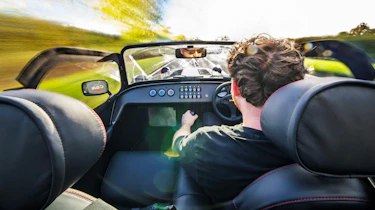
The rest of the Seven’s cabin is as simple as they come. You can option a heater and a heated windscreen as mild creature comforts, and if you’re in a racy mood then the fixed-back bucket seats with harnesses ramp up the race-car feel – though they do make getting in and out even more of a chore. The dashboard is pretty much a board (albeit made from carbonfibre in some models) with instruments strewn about its surface, and you’re hemmed in by the transmission tunnel to one side and the chassis to the other.
Pedal room is tight, but once you’ve got the knack they’re just right for heel-and-toe and their short actions complement the tight gearshift and rapid steering. And if you are the right shape for a Seven, then you might even find it surprisingly comfortable inside – though some of our testers complain about the lack of elbow room for changing gear and working the wheel.
Design
- Design almost unchanged since the '60s
- You're unlikely to miss one on the road...
- New bespoke options can add some real flair
‘Purposeful’ is perhaps the best description of the Seven’s styling. We think it looks great, but at the same time it’s fair to say it’s not a conventionally attractive car. Oddly, it doesn’t look as old as the 60 years of its basic design, but perhaps that’s down to the car’s gradual evolution – or perhaps we’re just so used to the way it looks that the styling has taken on a completely timeless quality, not unlike that of the Land Rover Defender or the overall shape of a Porsche 911.
That said, Caterham did offer a heavy rose-tinting package for your spectacles when it launched the Sprint and later the SuperSprint – stick an age-appropriate numberplate on either of these and it’ll take a connoisseur to realise they don’t hail from some time in the 1960s.
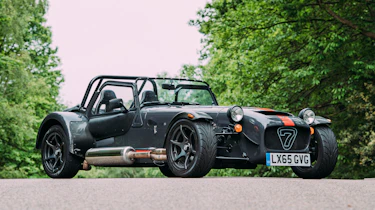
Other Sevens embrace modernity by way of fat tyres, aggressive alloy wheel designs, bright colour schemes and optional splashes of materials like carbonfibre. There’s certainly appeal in the design from a pure engineering standpoint too, as few vehicles short of an Ariel Atom give you such a clear look at their basic mechanicals.
And all Sevens stand out on the road, partly because they look hilarious among rows of bland hatchbacks and enormous SUVs, and partly because they’re still a relatively rare sight.
Living with it
Our Seven joins in Caterham’s 50th birthday bash – and we have a bash at racing its motorsport cousin
This might be one of the most special driving memories I’ll ever have below 40mph. It’s a golden-skies evening at Donington Park circuit. I’m driving the evo25 Seven, roof off. Just ahead of us is Caterham CEO Bob Laishley, in a Seven 420 Cup. Just to my right is ‘LegoCat’, the wild, bright yellow 620R on which Lego’s Caterham kit series was based.
And behind all of us, bathed in the setting sun as we roll to a halt at the finishing line to conclude a special parade lap, is a never-ending conga line of roughly 400 other Sevens, celebrating 50 years of the Caterham Seven – and, in our car’s case, 25 years of evo.
We’re at Donington Park for two reasons: one, to join in Caterham’s birthday celebrations (music, displays, hundreds of Sevens from every decade and a Sevens-only trackday in which we’ll be taking part in the evo25 car), and two, to meet our car’s racing cousin. Because the other element of Caterham’s birthday bash is racing. The company’s full range of championships will run throughout the weekend, from the absolute-beginners Academy series all the way up its racing ladder to the flagship Caterham Seven Championship UK: slick tyres, a sequential gearbox and seriously quick lap times. Terrifyingly, this weekend there’ll be another entrant on the grid: us. Or more specifically, me, hoping that the miles I’ve logged in the evo25 car on road and track will serve as homework for joining one of the most famously feisty one-make championships in the UK.
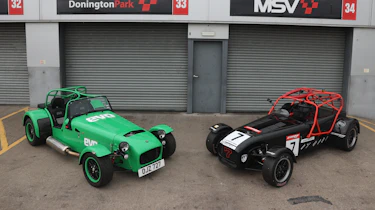
There really is a huge amount in common between our car and the UK Championship race car (the black and red car pictured here). They share, barring a few tiny detail differences, essentially the same engine: a 2-litre Ford Duratec-based unit in Caterham’s 420R tune. Essentially the same dampers, too, only they’re adjustable in our road car and fixed by regulations for the race car. The racer has a beefier roll-cage than our car’s road/track hybrid one, necessitating getting in through the roof. And in place of the five-speed manual H-pattern in our car, there’s a race-spec Sadev sequential gearbox.
You’re nestled low in the car, harnessed in and your wrists tethered to the harnesses by a short-ish strap too (intimidatingly, to stop an arm being flung outside of the car by the forces in a crash). Ahead of you, a race-spec digital display and the world’s widest central mirror, to give advance warning of incoming divebomb outbraking moves.
It’s one of the most fun vehicles of any description I’ve ever driven. The clutch is light, easy; it’s no more difficult to drive around the pitlane and paddock than the road car. Gearchanges are flat on the way up: don’t lift from the throttle, just give the sequential lever a strong, positive pull and it automatically cuts the ignition for a flat upshift. You do need the clutch on the way down, and a blip on the throttle to match the revs – if you can find the time. You’re not on the brakes for very long.
The grip the featherweight Seven generates on sticky slick tyres is enormous. Down the Craner Curves (taken flat in these cars) I feel like my head’s going to be pulled from my shoulders. We screw the headrest support (a foam-padded metal plate) out a bit further for the next session so I can push my head back into it and relieve some of the effort. The other thing that’s become clear is that a tow is crucial; with the Seven being such a draggy open-wheeled shape, the slipstream effect you get from other cars is like nothing else I’ve experienced. In qualifying, a tow can make the difference between a slow time and a competitive one.
All of the drivers are well aware of this, ducking into the pitlane if they sense a driver’s tucked into their slipstream during qualifying, while being savvy enough to find a car of their own to follow. I only manage to find one lap in another car’s tow in the entire session, and line up 15th out of 20 cars. Racing a Seven is clearly a specialised art, and Caterham subdivides the championship table into two classes: Pro for seasoned drivers and Am for those with less Seven-specific experience. I’m in the Am class, along with ten other drivers.
The three races that ensue are the most intense I’ve ever experienced. The slipstream effect means the field never really spreads out, and with the ability to run side by side more easily than in other racing cars, overtaking moves take two or three corners to complete. Racing is almost impossibly close, inches apart – or less at times. Although for fleeting moments I get into the top ten and run third in the Am class at one point, it’s not long before I’m shuffled down the field; make one mistake, or lose one position, and you’re quickly swallowed by the pack. In the first race I end up right at the back; in the next two I sharpen my elbows a little more and finish 15th and 14th after some of the most breathlessly exciting driving I’ve ever encountered.
Driving the evo25 car on track in Caterham’s Sevens-only trackday the next day I expected it to feel like a comedown after the slick-shod, sequential-geared racer. Yet it really was much, much closer than I expected, both in terms of excitement and pace. The shared DNA with the 420 race car is real and tangible, and makes the evo25 enormous fun. – James Taylor, evo issue 317
Price and rivals
There are very few rivals to the Caterham Seven, especially given Westfield’s uncertain future. New prices at the time of writing begin at £29,490 for the Seven 170, rising to £30,490 for the Seven 600, £40,990 for the Seven 200 and upwards from there to £58,490 for the Seven 620. There's even the £79,995 CSR Twenty special edition if you're really looking to burn some cash...
Sevens are famously averse to depreciation, with prices in something of a bubble. While pre-2000 cars dip under £12k, Suzuki and Rover-engined models start in the teens and low-mileage 420s top £30k. ‘I’m talking without bias here: the problem with the Seven is it’s kind of spoiled me for everything else,’ Beke says. ‘There’s nothing quite like it.’ There really isn’t. It’s not for everyone, and you may have grown sick of reading this, but you must try one, at least once – and if you can, drive it for as long as possible to let its magic get to work. No other car is quite the same afterwards.