Mercedes-AMG GT v Porsche 911: old rivals go head-to-head
The ultimate variants have already clashed, now it’s time for the real-world battle as Porsche 911 Carrera S meets Mercedes-AMG GT55. Soaking Cumbrian roads will provide a stern test
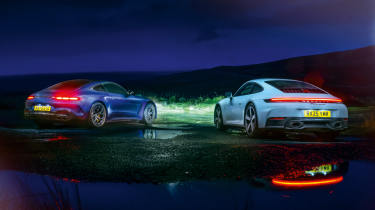
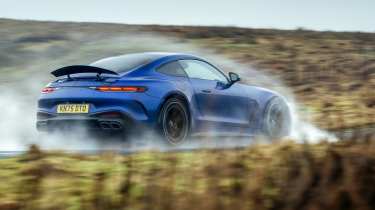
Welcome to Cumbria,’ says the sign. As much of it as I can make out in the mist, at least. Cumbria is not in a particularly welcoming mood today, thickening fog, horizontal rain and fast-running rivers of water criss-crossing the challenging moorland roads beneath the Porsche’s wheels on the way to this test’s muster point. More than a few battles have been fought on this ground in the past, from reivers, raiders and sheep rustlers to larger conflicts and sieges. Today’s skirmish between the Mercedes-AMG GT55 and the Porsche 911 Carrera S is going to be fought in particularly grim weather.
Like characters in ancient legend, the AMG GT and Porsche 911 have always been destined to cross swords. The original AMG GT launched in 2014 was conceived as the most direct 911 competitor Mercedes had ever produced, though it had a character of its own with long-bonnet proportions, bombastic V8 turbo power and underpinnings derived from the SLS supercar. This second-gen GT, launched in 2023, has morphed into a different animal, with all-wheel drive as standard on V8 models and the option of a second row of seats. This makes it a more well-rounded proposition than ever – and, in some ways, an even more direct 911 rival.
> Mercedes-AMG GT review – better than the original, but a match for the Porsche 911?
As with the 911 range, Mercedes has subdivided the GT model line into all manner of variants. Right now, at the top of the tree there’s the 805bhp plug-in hybrid GT63 S E Performance and, at the bottom, there’s the 2-litre, four-cylinder, 415bhp mild-hybrid GT43. In the middle, there’s the regular 63, and this: the lower-powered, lower-priced 55. Could it be the sweet spot of the range? Might the same be true of the 911 Carrera S? And which is the most convincing car all-round? If we can stay afloat, this test will give us some answers.
Like the GT63, the 55 is powered by AMG’s ubiquitous 4-litre, twin-turbo, hot-vee V8. However, whereas the GT63 has 577bhp and 590lb ft (and the GT63 Pro version 604bhp and 627lb ft), in the 55 the V8’s wick has been digitally turned down to 469bhp and 516lb ft. The price is turned down too, to a still-steep £142,200 (or £148,300 in the plusher Premium Plus trim, tested here). That’s nearly £37,000 more than the base GT43 but still around £21,000 less than the regular GT63.
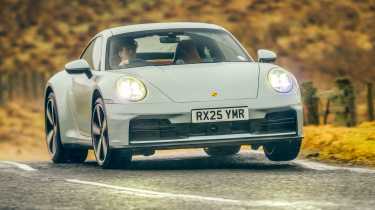
If the GT55 is the second rung on the AMG GT ladder, the Carrera S is the third in the 911 hierarchy. It costs £120,500 to the base 911 Carrera’s £103,700 and the Carrera T’s £115,400, while being around £17k less than the 534bhp hybrid Carrera GTS. The S is much more powerful than the Carrera and Carrera T, which share the 389bhp 3-litre twin-turbo flat-six. In the S, that engine is upgraded with the charge-air cooling system from the 992.1 Turbo and turbos from the 992.1 GTS, giving it a 473bhp peak. It’s a near-perfect match for the AMG GT55 on power but significantly less torquey, conceding 125lb ft to the AMG. On the flip side, it’s also nearly £22,000 cheaper.
I’m very happy to be behind the 911’s slim-rimmed steering wheel in this weather. These conditions ought to be the worst-case scenario in which to get to know a powerful rear-wheel-drive sports car, but the 911 puts you so intimately in touch with the road and gives such a clear picture of what each tyre is up to that you feel entirely at ease. Its Pirelli P Zeros are struggling a little for lateral grip and traction on this cold, sodden tarmac but their hold is lost and regained in such a predictable way that it’s never unnerving. Good all-round vision helps, and although the Gen 2 Carrera S is 44mm wider than the previous-generation Carrera, it still shrinks to fit the road. You always feel like you have space to play with.
From experience of driving the standard Carrera on similar roads in similar conditions, the S’s ride feels slightly more fractious, owing to its larger wheels (bigger in diameter by an inch, at 20/21 inches front/rear), but it’s still composed overall. All 992.2-gen 911s feature PASM adaptive dampers as standard and the Carrera S adopts damper hydraulics from the current GTS, with an S-specific retune. Toe-in geometry at the front has been adjusted and there’s a more direct steering ratio, which explains why the S feels keener to turn in than the more nose-led base Carrera. Porsche’s PTV+ (Porsche Torque Vectoring Plus) system, which combines inner-rear wheel braking with an electronic differential lock, helps too, and is standard on the S. Also helping justify the near £17,000 price hike over the Carrera are larger brakes (408mm front and 380mm rear discs, up from 350mm on both Carrera axles), and extra leather interior trim.
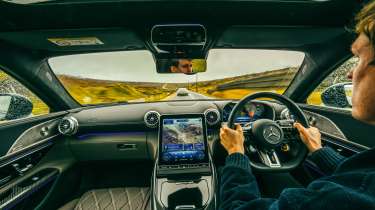
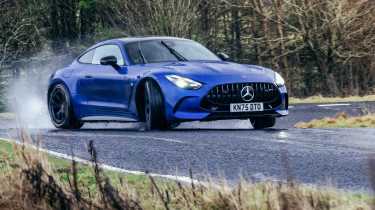
Based on this prologue in the Porsche, the AMG has its work cut out. But when I meet photographer Aston Parrott and senior staff writer Sam Jenkins at our rendezvous point, it looks ready to get to work. To my eyes it’s a handsome car in Spectral Blue paint, and purposeful too. Its interior is more expressive and overtly luxurious than the 911’s, although carbonfibre trim aside, it’s a little plasticky, and there are a few creaks and rattles when you’re on the move. There are occasional faint creaks from the 911 as well, but its interior is cleaner, less cluttered, more intuitive to use, and feels of higher quality too.
I’m unsure about the AMG’s big slab of touchscreen mid-dash; it feels more appropriate to a big exec saloon rather than a sports car. And it throws a lot of information at you. With the home screen on its default satnav display, I count 12 points of information on the central screen and more than 20 on the digital instrument panel behind the wheel – plus three displayed on the steering wheel itself. As with other AMGs, the wheel’s satellite switches have their own mini screens, which cycle through graphics as you change modes. The more time you spend in the GT, the more intuitive its interface becomes, but it demands an awful lot more eyes-off-road time than the Porsche. The 911’s single rotary dial on the steering wheel toggles through drive modes with each twist. So does one of the AMG’s wheel-mounted dials, although a further split-control switch opposite allows a more granular level of fiddling, to adjust damping level, exhaust noise, traction control level and more – or you can mix and match using the main touchscreen itself. The 911 doesn’t offer quite as much adjustment as the GT but you can still toggle two levels of damping, exhaust noise and stability control, and much more easily via old-fashioned buttons.
The Mercedes’ V8 has a nice repertoire of sounds, including an appropriate thunderclap from the exhausts on upshifts to match the weather, although its voice is artificially enhanced in the cabin via a microphone within the exhaust system. It may be 108bhp down on the GT63 but this is still a quick car with big torque available from small revs. Launch control is quite an event. Even in the pouring rain, all four Michelins hook up instantly and my stomach feels like it’s in a fast-accelerating lift heading to a lofty floor number in a tall building; except instead of plummeting to my shoes it’s pooled somewhere at the small of my back. The official 3.9 seconds to 62mph feels more than believable. Yet the Carrera S is even quicker on paper, despite half the driven wheels, three-quarters the torque, a 25 per cent reduction in cylinders and a whole litre less in displacement. It feels seriously quick in practice, too. Its 3-litre flat-six loves to rev – and makes a great sound while doing so, its howl every bit as enjoyable as the GT55’s bellow – and it has more of a sense of crescendo than the Mercedes, which has a flatter torque curve and a less varied tone as the revs rise.
The reduction in power between the GT63 and GT55 comes from tweaks to the boost pressure and engine management software. Sam reckons it’s tangible that the V8 is being artificially held back: ‘It feels really pokey and sharp low down, but at higher revs it feels like it reaches a limit and the boost tails off. And that makes it feel a bit… cheap in a way. Because you know what the engine is capable of in the 63. By contrast, the 911’s engine feels really free-revving all the time. Everything you touch in the 911’s cabin is more tactile, including the gearshift paddles, and that’s true of the way it handles, too. It’s constantly communicating, and so transparent compared with the AMG.’
The 911’s eight-speed dual-clutch gearbox is snappier than the AMG’s nine-speed auto. If you want a manual Carrera, the T is the only option, and Mercedes has never offered a manual GT. There is of course an AWD version of the 911 too, the Carrera 4S, which costs an extra £6500, but we’re in the rear-wheel-drive version here, not that rear-drive Carreras have ever struggled with one less driven axle. It certainly has less grip than the Mercedes – Michelin’s Pilot Sport S 5 boots emphatically win the tyre war here, summoning remarkable grip and traction despite the conditions – but despite that I initially feel less confident in the AMG. That’s partly because it takes up a lot of road. It’s 67mm wider and 186mm longer than the 911 and there’s something about the expansive bonnet area ahead which, as with the (even wider) original GT, makes it difficult to place the car on the road until you acclimatise. Where the 911 puts you in touch with each of its four corners, the Mercedes takes longer to shrink around you. Somehow it never quite stops feeling like a big car. And it’s certainly a big car in terms of weight, with a claimed figure of 1900kg (360kg more than the Porsche), which is pretty hefty for a non-hybrid 2+2 coupe, even if it does carry a V8, all-wheel drive and plenty of tech.
That includes four-wheel steer as standard, its presence obvious from the outset. It pivots the rears in the opposite direction to the fronts up to 62mph and in the same direction above that speed, boosting agility and stability. For an additional £1940 Porsche will fit your Carrera S with rear-wheel steering, but we don’t have it here. In some cars, rear-steer is so subtle you barely feel it, but that isn’t the case in the GT. You sense it in action immediately at T-junctions and in tight corners. Coupled with rather numb steering feel, exacerbated by the wheel’s chunky grips, it contributes to muddier feedback than is the case in the 911.
And that’s the Mercedes’ main issue: it’s not brilliant at letting you know what it’s up to. It’s not an easy, fluent conversationalist like the 911 and takes a while to build a rapport. The all-wheel-drive system can hinder feel as much as it helps traction; the GT is a predominantly rear-drive car but occasionally when it does lose traction (usually under provocation, since it’s naturally so grippy), up to 50 per cent of its total torque can be bundled to the front axle to help pull it straight. It’s a noticeable sensation, which can feel a little disconcerting and clumsy at times.
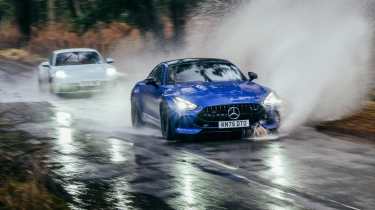
As with the GT63, it is possible to put the 55 into a purely rear-drive ‘Drift Mode’. It’s intended to be used only on a race track but it does make the AMG feel a more natural, intuitive sports car, and still stable and grippy, even in tricky conditions. It shows the level of talent inherent within the GT, and as hours and miles tick by I grow to trust the 55 and feel increasingly impressed by what it can do. The speed it can carry, and its ability to hold a line at speed, in challenging conditions over tricky cambers and surfaces, is truly remarkable.
When you’re not going for it, both cars are brilliant at simply covering ground. There’s more road noise in the Carrera S than the GT – a 911 bugbear – but it’s a refined, practical long-distance car overall. The +2 seats in the rear of both are best suited to bags, small children, or perhaps unusually flexible adults being given a very short-distance lift. They get an impromptu test when Aston has to squeeze in the back for in-car driving shots. Most of his feedback is unrepeatable but he reports that the back of the 911 is a slightly less agonising space to contort into than the AMG’s. He also finds the Mercedes’ ride bouncier than the 911’s, even in its softest setting, perhaps owing to its greater weight. That said, from the driver’s seat the GT’s ride and body control are impressive, particularly over crests. The 55 features the same Active Ride Control as the 63, with an interlinked hydraulic system to vary suspension stiffness and counter roll, replacing traditional anti-roll bars. Yet the 911, with adaptive dampers but otherwise conventional suspension (and MacPherson struts up front versus the Merc’s multi-link all-round arrangement), is notably composed, too.
Is the 55 the sweet spot in the GT range? It’s certainly a step on from the 2-litre GT43, which we tested recently (evo 339) and found peaky in its power delivery and patchy in traction (and thirsty on fuel, too). Having all the GT63’s capabilities only with less power, for £21k less, could feel like a good deal. But the fact that the two cars are effectively the same but one is shackled to produce less power somehow makes the 63 feel overpriced and the 55 feel stingily appointed. The 63 versions’ extra firepower does bring something extra to their driving experience and the 63 Pro and S E Performance remain the most engaging variants of this generation GT so far.
As for the Carrera S, it offers a convincing uplift in performance and agility over the Carrera, but the base car possesses most of the S’s strengths, and the rawer, manual-transmission Carrera T is even more fun and involving for less money. But this is a brilliant all-rounder, as easy to live with as the 911 comes and still very much capable of involving and thrilling its driver. Crucially, more so than the AMG GT.
As night falls under an additional cloak of fog, it seals victory for the Porsche. The more time you spend with the GT, the more its talents are revealed. It’s almost too good; its limits are so high that the fear factor in breaching them is heightened too. Whilst the 911 has less grip, it’s also less intimidating. Were this test in the dry, or were the Mercedes on less grippy rubber, the result would be the same. It’s the way these cars communicate that’s key. The Mercedes is objectively ‘better’ – it has more grip, more stability. But the 911 is more confidence-inspiring and more enjoyable. It’s lighter, less complex and places fewer layers between you and the road. And if you do crave more firepower and tech, the 573bhp hybrid Carrera GTS is still cheaper than the GT55.
It’s a convincing win for Porsche but not a complete slam dunk. With more time to get to know it, the AMG GT reveals more of its strengths. It is handsome, talented car. Maybe with a communications course to become less of a strong, silent type it could win hearts more convincingly.
Specs
| Mercedes-AMG GT55 | Porsche 911 Carrera S (992.2) | |
| Engine | V8, 3982cc, twin-turbo | Flat-six, 2981cc, twin-turbo |
| Power | 469bhp @ 6500rpm | 473bhp @ 6500rpm |
| Torque | 516lb ft @ 2250-4500rpm | 391lb ft @ 2200-6000rpm |
| Weight | 1900kg | 1540kg |
| Power-to-weight | 251bhp/ton | 312bhp/ton |
| Tyres as tested | Michelin Pilot Sport S 5 | Pirelli P Zero |
| 0-62mph | 3.9sec | 3.3sec |
| Top speed | 183mph | 191mph |
| Basic price | £142,200 | £120,500 |
This story was first featured in evo issue 344.