Ferrari's CEO on the Luce and bringing back the manual
'Looking at the past with the eyes of the future' is what lead Ferrari to create its new type of manual transmission

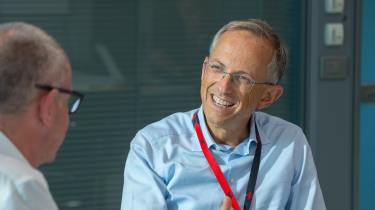
Never fall in love with the technology.’ For a man whose career is intrinsically linked to the technology sector, Benedetto Vigna is by no means a slave to the industry that propelled him to the role of Ferrari CEO in 2021. ‘When you fall in love with the technology rather than the product, you fail because you stop listening to the customer,’ he says. ‘You present to them this piece of technology you are really proud of and they say, “So what? What does it do for me?” If you can’t answer that, then the product is wrong.’
Vigna’s rise to the chief executive’s office within the ever-expanding Maranello site (the latest addition is a 32,000-square-metre educational hub, due to open in 2029 to give high school and university students a pathway into automotive technology) is not that of your traditional automotive CEO. His story isn’t one that took him from the factory floor to the boardroom, nor has he worked his way through the supply chain to eventually walk through the gates as an employee rather than a supplier.
After graduating as a physicist and gaining experience at CERN in Geneva, Vigna joined STMicroelectronics, leading a team that first developed the three-axis accelerometer originally used in car airbags. He further developed the tech by reducing its size, which meant Nintendo could use it in its Wii wireless hand controllers, while Apple employed it to allow your phone’s screen to rotate. Over the course of his career, Vigna has registered no fewer than 200 patents.
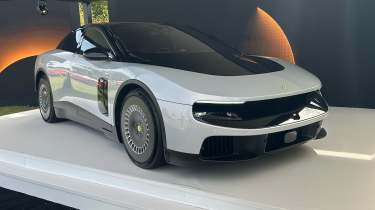
His appointment at Ferrari raised eyebrows, and some of the decisions taken since have done rather more than that. ‘Between May 25 and July 3, 2026, were the best 40 days of my working life,’ he says with a mischievous grin and more than a hint of a chuckle. ‘I could hear what they [commentators] were saying. I was reading what they were putting on social media. They were guessing what Ferrari was going to be doing in the future. Even my father, who I didn’t talk to much about this car, said, “Benedetto, are you only going to be building electric cars?” I said no, but who told you this? Everyone might have been saying it, but I never said we would [only build electric cars].
‘During Capital Markets Day on 16 June 2016, Ferrari said it would offer internal combustion, hybrid and electric. We have never said we would only do electric cars. The public can have a short memory; thankfully ours is longer.’
You’ve possibly worked out the significance of those dates: May 25 and July 3. The former was the day the world lost its mind with the reveal of the Luce EV. Forty days later, Ferrari invited the media back to Maranello to see the latest addition to the stable: the 12 Cilindri Manuale. And yes, the world had questions about this, too.
Vigna had pushed for a manual transmission because it was a request he was getting from customers, only to be told by the engineering team that such a development wasn’t possible. In 2025, the then chief marketing officer Enrico Galliera went on record to say that if customers wanted a manual Ferrari they should buy a classic. Vigna didn’t go out and buy a classic Ferrari, but he did drive the company’s own 275 GTB, which convinced him even more that Ferrari needed to offer a manual transmission once again.
‘Our customers wanted to replicate the experience of driving manual cars from their past,’ he explains, sleeves rolled up, jacket long dispensed with in the 40-degree heat that’s making the air-con work harder than a hire car whose occupants are late for a flight. ‘We interpreted their need – the emotional, tactile experience – rather than the specific mechanism [in this case a traditional mechanical gearbox], which we had previously deemed impossible and outdated.’
To bridge the gap between customers’ desires and the reality of modern engineering, Vigna applied his principle of looking at the past with the eyes of the future. ‘When you do an innovation, when you look at the past [and] you see it with the eyes of the future, then I think you have an interesting innovation. Your best innovations are when you merge the past with the future.’
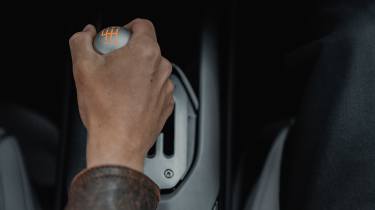
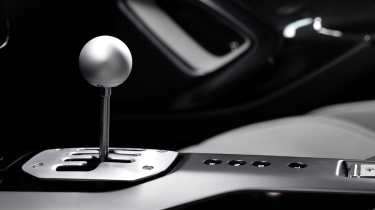
The result of this thinking is the 12 Cilindri’s manual gearbox. It takes the eight-speed DCT unit that has been fitted to the car since its launch and retains all the functionality of that transmission but minus the paddles behind the steering wheel. Instead there’s a redesigned transmission tunnel on which sits an H-pattern open gate and a lever with which to snick between the first six gears.
So far, so good… except that there is no physical connection between the manual shift and the DCT. It’s exclusively a by-wire setup. Or in the words of the internet, not a manual. ‘We broke down what it was the customer wanted: a physical act of changing gear,’ says Vigna. ‘How we presented this, they had little interest.’ He points out that drivers of older manual cars never asked how their manual gearbox worked, the materials used and the linkages required to go from the shift lever to the gearbox internals and driven axle, and that hasn’t changed today. ‘Steering, brake, throttle – it’s all by-wire, so the customer doesn’t question this technology. The Manuale is the next innovation.’
Vigna had told his engineers to look outside automotive for solutions, which is how Ferrari became involved in sailing and the development of the Hypersail ocean-racing yacht. ‘We developed a by-wire winch system for sails [above] and asked sailors to try it against their traditional winch with rods and gears. They didn’t notice the difference, or care. The by-wire winch did the same job, gave them the same sense of connection, and they could make the same adjustments as their traditional winch. But winch-by-wire is quicker, less complex and lighter. It does the same job as a winch from the past, but with technology from the future.
‘I like to say we have two eyes: the past and the future, and one brain to put it together.’ The 12 Cilindri Manuale utilises a clutch pedal – ‘this was a non-negotiable, we had to have a third pedal’ – while the interface the driver engages with is cast from aluminium in the company’s foundry, so the gate for the gearshift looks like an evolution of that from the last V12 manual Ferrari, the 599 GTB. In fact the 20 customers invited to try early prototypes of the new system weren’t told what they were actually engaging with.
‘We didn’t tell them if they weren’t using a manual transmission with a rod or a wire; when they finished driving the car their reaction was that the team are geniuses. “I have gone back 20, 30 years,” one of them said to me. He didn’t know he was driving a car with a by-wire transmission, but the connection he had was what he was expecting. It is what he wanted. Technology should be used as a tool, not a religion to define your products.’ Those 20 early drivers only discovered the transmission’s workings when the car was revealed.
Vigna argues that while we have access to many more tools than we did 20 years ago, the true driving force of progress remains the human element. He believes that effective innovation must prioritise the customer’s needs and how they interact with your product rather than the tools you have to hand to create it: ‘This is the only way you can reach the targets you set yourself and deliver what the client is expecting.’
Over-complicating processes, planning, design and development because there are tools available to do so, shouldn’t, in Vigna’s eyes, be the reason to do something. His avoidance of technological dogma has acted as a stabiliser in an era when the wider auto industry is being dragged into the red with high costs and low demand for products it was forced to create as it pivoted to electrification.
‘When customers tell me they want something, it is normally because someone else is already offering it. If we do the same we are not innovating, we are just copying. You have a period of time to bring a product to market, and you should spend most of that time getting the product right, then bring it to market as quickly as possible. If you spend too long thinking about the product and the same amount of time bringing it to market, then it’s no longer what the client wants – someone beats you or it’s no longer relevant.’
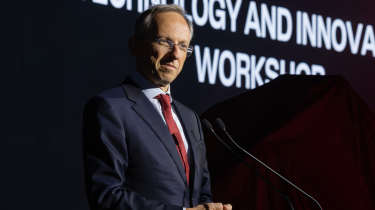
For a CEO with a background and career rooted in technology, Vigna is a big advocate of his teams – regardless of their level – working together and in person. ‘I tell my teams to use the time they have to spend on a project with people. Don’t look at screens; you need to observe reality through eyes, not just through a display. It’s vital for curiosity and creativity.’ Vigna’s office is screen-free, with books, artwork and models across the surfaces, his phone somewhere nearby, his wrist smartwatch-free.
While digital tools might appear efficient, Vigna does not believe they result in effective innovation. ‘Effective innovation is a kind of oxymoron; the work to solve a problem such as the Manuale only happens through collaborative discussions between internal teams, suppliers and clients.’
Customers still drive much of the agenda. ‘Why would we deliver a 2000hp car? Our clients aren’t asking for one,’ says Vigna at one point. And on Luce: ‘We have Luce customers that have only ever driven an electric car. For them, this is the car they have been waiting for.’ Our allotted 45 minutes with Vigna is over-running and the PR handlers are a little nervous – not because of the way the conversation is going, but because Ferrari chairman John Elkann is next door, ready to chair a board meeting where he and his CEO will plan Ferrari’s next period of innovation.