New Mercedes-Benz C400 electric review - the BMW i3 50 alternative
Mercedes’ new electric C-class trades dynamics for comfort and it's a better car for it

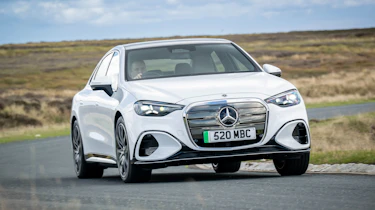
The world's oldest car manufacturer has learnt quickly from the mistakes it made with the EQE and EQS. Along with the new CLA there is now an all-new C-class electric, based on a new platform with new batteries and motors, wrapped in a new slippery next-generation body. We’ve driven it in C400 4Matic AMG Line Premium Plus trim costing a not insignificant £68,495. Yes, for a C-class. The world’s gone mad.
For that near seventy-grand price tag you not only get the most powerful version of Mercedes’s new C-class electric but four-wheel drive too. It means 489bhp and 590lb ft of torque, a 0-62mph time of four-seconds and a top speed of 130mph (these EVs can accelerate like a super saloon but they’ve got no stamina).
There are get two motors, one for the front axle and one for the rear with the latter featuring two speeds to improve efficiency. Talking of efficiency, Mercedes claims 452 miles if you stick with the aero-optimised front bumper and smaller wheels, or you’re down to 433 miles if you don’t. Both are WLTP figures and the most we saw after a handful of days driving was an average of 340 miles. Or in old money, similar to what we’d get from a 4-litre biturbo V8 C63.
What’s the new electric Mercedes C-class like to drive?
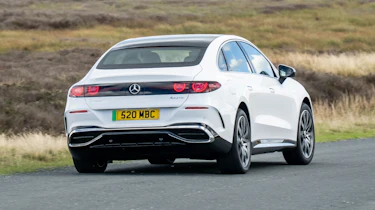
Despite its near 2500kg kerb weight it’s plenty fast enough but the C400’s strength is, like many of today’s latest electric cars, how its power and torque is evenly delivered and modulable. The throttle is progressive and linear, with momentum building at a rate you control. It makes for a small Benz that feels like an old-school big Benz wafting around with eight lazy cylinders up front.
Mid-range is its strongest attribute, akin to the biggest-capacity diesels as the C400 delivers its seamless torque instantly but without the uncomfortable kick in the kidneys some EV makers still think is a good thing. This measured delivery also means the C400 doesn’t fall short on an interesting stretch of road, it being easy to balance with the performance in sync with the car’s overall dynamic control and clearly communicated steering. It’s no M3, but it responds and reacts to your inputs to make for a very fluid car.
More reviews
The C400’s dual motor set-up (a less powerful single motor model is due later) provides plenty of traction for the majority of the time, with only a heavy foot out of junctions and roundabouts triggering the oh-so-sensitive and slightly clumsy traction control software. Under heavy braking you’ll need an emergency stop to trigger the ABS and if you’re a one-pedal driving advocate it will take little time to adjust to the C400’s regen, which can feel abrupt for the first few miles but you soon adjust your driving style to suit.
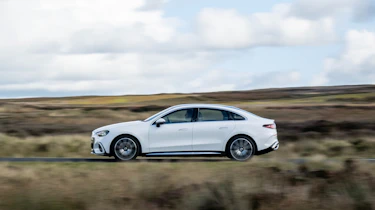
More impressive is how the C400 conducts itself on the road, especially so on the optional AIRMATIC air suspension and rear-axle steering. It’s expensive at £2500 but if you value body control with a velvet ride it’s worth every penny. It’s not only the quality of the ride though buy how the C400 feels and reacts to every input, the blend of body control and the platform’s inherent stiffness creating a suppleness to the damping that in turn eradicates any unnecessary float or movement through the car. It’s S-class levels of comfort.

It is not, however, aloof as a result. There’s poise on offer, tight steering that has a moving-through-fine-oil texture to it and a willingness that makes you push harder than your perception of the car would expect. It’s no fire-breathing, tyre-shredding C63 S, but find yourself on a road you enjoy and it will flow with an accuracy you’d expect from a six-cylinder BMW 3 series not necessarily an all-electric Mercedes. Push too hard and the electrics feel crude after the finesse of the chassis, clamping the car down and bringing progress to a sharper-than-expected halt. More work is required to smooth this out for any future pure-bred AMG models.
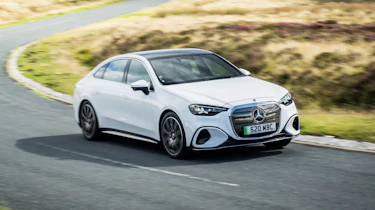
While the exterior is more conventional than MB’s first attempts at electric car design, it’s still a little OTT for some tastes. The large illuminated grille dominates the front and there’s still a lot of bodywork around the rear three-quarters giving the C-class quite a heavy-handed look. It’s also not a conventional three-box saloon design, with four-door coupe smoothness towards the rear. From some angles it works, providing a positive identity, from others there are hints of the EQE and EQS still hanging around.
Mercedes-Benz C-class electric interior
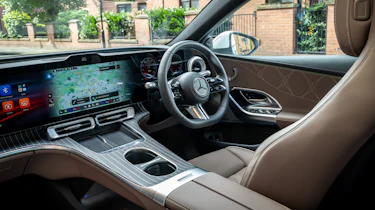
Its interior is more new-era Mercedes than old, and it’s not the success they were aiming for. Screens dominate, with a 39.1 inch MBUX Hyperscreen occupying the full width across the front seat passengers like a sports bar with wall-to-wall TVs showing stuff you couldn’t care less about when driving. Buttons are few and far between, with those for the lights hidden down by your right knee despite there being a more logical place for it between the steering wheel column and A-pillar as per previous models.
Accompanying that ride quality is a return to form for Mercedes ergonomics. You still sit a little too high even on the lowest seat setting, but you do feel sat in the car rather than on it. Look up and the panoramic roof floods the cockpit with natural light, but only after you’ve turned the ambient lighting off. As with the illuminated front grille you can turn the skylight off, too.
Being an electric car you pick up on different sounds to a combustion car, such as more tyre noise (far better isolated than many EVs) and wind noise, especially so around the mirrors. But it’s an interior you can spend every mile of its projected range in without feeling tired. Although the black open-pore finline ship’s deck wood trim is a little OTT for some tastes, it is still preferable to the cheap-looking piano black that’s still used too widely across the industry.
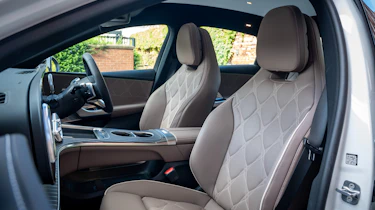
From experience, those screens can be largely ignored thanks to Mercedes’s voice control software that’s incredibly intuitive and easy to use and nearly foolproof regardless of the mumbled and fumbled requests you give it. The controls on the steering wheel remain too sensitive to the lightest of touches when your fingers brush them and rear seat foot space is tight and at odds with the rest of the room on offer behind the front passengers.
Overall, the C400 4Matic is so much better than either of Mercedes's early EV efforts it’s hard to imagine it’s from the same company. Remarkably refined, polished and comfortable, this is Mercedes at its best. It’s not the most exciting drive, but there’s nothing it does that jars and there’s clearly been a huge amount of engineering effort put into how the C-class electric conducts itself on the road. BMW’s new i3 has a dynamic advantage, but as a more luxurious, comfortable proposition, the Mercedes needs to be shortlisted.
Price and rivals
BMW’s new i3 is grabbing the headlines and in i3 50 M XDrive form, starts at £54,425 with a claimed range of between 450 and 567 miles from its 108kWh battery. Real world figures are closer to a still-impressive 400 miles in our experience.
Tesla’s Model 3 is getting long in the tooth but in Performance trim produces 460bhp and will cover a WLTP-certified 372 miles for £59,990. A Model 3 Premium Long Range starts at £49,990 and offers 410 miles in AWD form or 466 miles in RWD form.
Polestar's 2 might not be long for this world but stock vehicles are still available in the UK. Long Range Dual Motor models with a WLTP claim of 370 miles are available with £5,000 discounts direct from Polestar with prices starting from £48,210. Hyundai’s dual-motor Ioniq 6 with up to 369 miles of range starts from £43,270. The 641bhp Ioniq 6 N starts from £65,800 with a 302-mile WLTP claimed range, so expect closer to 200 miles in the real world.