BMW i3 50 review – a new benchmark for the electric saloon
The BMW i3 name is back, but now in a much more conventional form than before. It's quick, efficient and retains Munich's trademark dynamic character. Not much comes close.
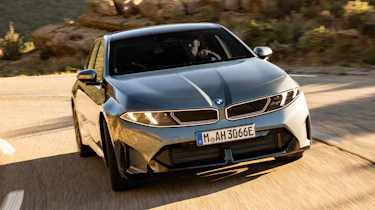
BMW’s commitment to electrification is epitomised by the fact that the next M3 will be launched first as an all-electric model with the ICE version coming later. Before then, we get BMW’s take on its first regular electric 3-series, in this instance the i3 50 xDrive, the current range-topper. I drove it after the M350 xDrive so I’d overcome the shock of the Neue Klasse interior with its weird, squarish steering wheel and radical Panoramic iDrive instrument display, both of which work well, surprisingly well in the case of the wheel.
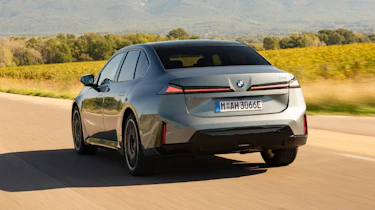
BMW is confident in its product with this new car, and that becomes clear before you’ve even stepped inside it. At the UK launch BMW parked it right next to the iconic E21 original from the ‘70s, a bold move to make given its compact dimensions and universally adored design, but it works. It looks a little tall from some angles and soft from the rear, but the sharp, horizontal graphic and dynamic bonnet creases mean this new car holds its own, and that extends to beyond the way it looks.
> New BMW 3-series review – powerful M350 shows BMW can still be brilliant
Powertrain and technical highlights
- Kerb weight of 2200kg is (much) more than the petrol car
- 469bhp eclipses that of the six-cylinder M350
- Up to 400kw charging is class-leading
More reviews
Externally, the ICE and BEV versions of the new 3-series appear remarkably similar, though they are on different platforms. The wheelbase of the i3 is longer, its roof height is 25mm higher, a small amount given that the battery pack is in the floor, an integral part of the structure, which improves rigidity and saves weight. Even so, the circa 2200kg i3 50 is a substantial 345kg heavier than the six-cylinder M350. For reference, that’s a match for the previous-generation electric BMW i4, and around 250kg more than the dual-motor Tesla Model 3 Performance.
There will be a sportier i3 ‘60’ with more power and the dynamic features of the M350, but the i3 50 xDrive proved quick and dynamic. It costs from £54,425 and offers an M350-beating 469bhp and 476lb ft of electric power, and a range of between 450 and 567 miles. The 108.7 kWh battery pack charges from zero to 100 per cent in 11 hours at 11kW, says BMW, but of course most UK homes are single-phase 7.6kW. At an ultra-fast, 400kW rapid charger, you can go from 10 to 80 per cent charge in 21mins.
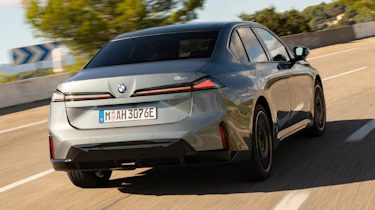
In our test on virtually every kind of road and in every sort of weather Britain has to offer, these range figures held up better than virtually any other EV on the market. This isn’t down to raw efficiency, though, as while our taxing high speed, low temperature motorway test resulted in a 3.7mi/kWh figure, very reasonable for the performance on offer (and around 1mi/kWh better than the previous i4 M60), a Tesla Model 3 will exceed the 4mi/kWh figure under the same conditions. Nevertheless, that huge battery pack and expertly calibrated range estimation software mean you’ll always get the estimated range on your dash – expect a real-world range of over 400 miles in the worst conditions, and towards the 560 miles claimed should you cover miles at lower speeds.
Performance, ride and handling
- Excellent refinement, with road and wind noise minimal
- Well-measured, progressive throttle responsive
- Quick from point-to-point, with great chassis balance
A consequence of a silent drivetrain is that general refinement comes under greater scrutiny. The i3 doesn’t disappoint, despite rolling on optional 245/40 R20 tyres (standard is 245/45 R19), the lack of road noise and suspension bump thump immediately impresses – there’s active noise cancellation which utilises the sound system too. The ride is smooth and refreshingly supple for a quick electric car and although the steering is a little light initially it weights up nicely with speed and the lack of wind noise at motorway speeds adds to the i3’s impressive refinement.
The throttle response is well calibrated too, with progressive response, which can be sharpened with the drive modes. Floor the throttle and it feels properly quick, quicker than the M350 all-out, though it’s not as quick in the benchmark sprint (0-62 takes 4.7sec) and it’s not going to be hassling the ICE versions on the autobahn because it’s limited to 124mph. You can call up an ‘engine sound’ but to me it sounds like an electrified train working hard to pick up speed with a slightly ethereal quality – after a short while it gets annoying. Happily, the sound of silence is pleasingly relaxing, particularly how the i3 rolls quietly over many surfaces.
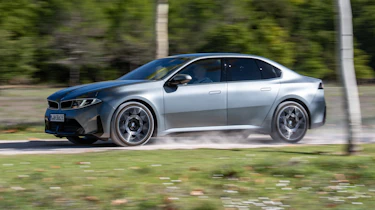
It’s xDrive, but drive is sent exclusively to the rear until the grip runs out. Like the M350, the i3 has a lovely chassis balance, with a willingness to turn and a natural feel though it lacks adaptive dampers and is shod with less sporty Bridgestone Turanzas. At one point on a challenging road we had a Hyundai i20 N filling the rearview mirror but the i3 didn’t hold it up in the corners, even the trickier sections, and when there was a straight, the breath-taking full-throttle acceleration gapped it impressively. Shame the seats are neither as comfortable or supportive as the M350’s.
Pull back on the stubby gear selector and you get strong regen braking allowing one-pedal driving on twisting roads. You can choose the level of regen in one of the menus or select ‘Adaptive’ which, with a route set in the nav, is remarkable. It ‘knows’ the road and will use regen to slow the car to the right degree for each corner. The oddest thing is approaching blind corners and knowing from the level of regen how tight it will be. A great mode for roads you don’t know, especially in difficult conditions. It’ll read the traffic in front of you to seamlessly increase regen accordingly, too, which makes stop start traffic less taxing than it would be otherwise.
Stump up some additional cash for the endless optional software packages on the i3 and you can unlock Motorway Assistant (£925 on the 50 xDrive), one of the first systems approved for hands-off motorway driving in the UK. We have little urge to let the car do the work for us, but observing just how polished it is boggles the mind – steering inputs are smooth and calculated, and it’ll confidently make lane changes itself once it recognises that you’ve checked the appropriate mirror. A speed cap of 70mph will make its use case limited for those keen to match the flow of traffic, but the execution proves just how sophisticated this package is.
The ‘Heart of Joy’ centralised control unit is the key ingredient here, developed entirely in-house from scratch when BMW couldn’t find an OEM willing to accept the challenge. It will come into its own in full-blooded performance applications like the incoming M3, but even in the i3, the instantaneous, frictionless communication between components give it a level of sophistication, both dynamically and in terms of everyday useability, that nothing on the market does. Everything from its imperceptible ‘soft-stop’ feature to the response of the central infotainment make it clear that this car is truly next generation.
Interior and tech
- Curious steering wheel design & minimal physical controls
- Great attention to detail, usability & ergonomics
- Panoramic iDrive and infotainment are class-leading
First seen in the iX3 SUV, the aforementioned Neue Klasse steering wheel certainly takes some time to get used to. It’s an awkward design with no clear top and bottom, unusual transparent touch pads on either side and capacitive buttons back lit only when the car feels you need to access that control – it looks odd, but in reality the system works well, with accidental button activation (as seen in the Mk8 Volkswagen Golf) yet to be experienced. The rest of the cabin gets a clean, horizontal look with minimal buttons everywhere except the door cards, where you get physical switches for the likes of window controls, mirrors and seats.
The star of the show is the Panoramic iDrive display, first seen in the iX3, with an ultra-slim, full-width display mounted right at the base of the windscreen. As much as it might seem it, this is not a gimmick, with its placement specifically designed to reduce eye strain through the reduction in eye focus distance from the road to the internal display – it really does work. There’s vital driving information in a fixed position behind the wheel as you’d expect, and everything from media information to wheel speed, battery temperature and even a choice of historic BMW Art Cars can be displayed on the rest of the available space through the use of customisable widgets.
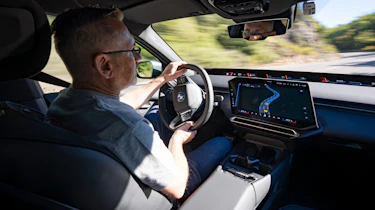
The central infotainment display is quick and responsive, with vital controls static for easy access, and the rest never more than a couple of touches away. There are a lot of settings to play around with, which can become a little overwhelming, but Amazon Alexa Plus integration means you can often bypass it all by asking the car to make the change for you. The activation command doesn’t work 100 per cent of the time, but it works reliably enough for you to give it a try for the occasional request. Small touches like a MagSafe wireless phone charger improve everyday useability no end, ensuring your phone stays in place and gains charge, as opposed to heating up to less-than-ideal temperatures.
Ride is perhaps best in class for comfort, but the seats are not. Adjustable bolsters mean the i3 will dramatically improve lateral support when you enable Sport mode, dropping them back when you’re not, but long-distance comfort leaves something to be desired – the ‘massage’ function is also one of the weakest on the market. Thankfully there’s a lot of manual adjustment for the steering wheel, which makes finding your ideal driving position a breeze.
Price, specs and rivals
Refined, dynamic and solidly built, the i3 is seriously impressive. I’ve not driven a huge number of BEVs but I have tried the Tesla Model S, Polestar 2 and Taycan Turbo S, and to me this i3 50 xDrive is the most appealing. Didn’t expect to be writing that. There’s an i3 40 xDrive with an 82.8 kWh battery, 374hp and up to 441 miles range for £47,925 but the i3 for drivers will be the upcoming i3 60, which will have more performance and the M350’s adaptive damping and variable steering ratio, and hopefully its seats too.
The Lotus Emeya and Porsche Taycan are larger cars at a different position in the market, with starting prices of £84,990 and £88,400 respectively. Despite this, neither offer the all-round polish of the BMW, and while the entry-level Lotus is five tenths quicker to 62mph, they both fall behind the i3 in terms of range too.
It sits below the BMW with a lower £37,990 starting price, but the Tesla Model 3's impressive specs make it a closer rival to the i3 than you might expect. The Long Range rear-wheel drive model achieves 466 miles of range on a charge for £44,990, which is impressive, but still 100 miles behind the i3 50 xDrive. It's no match for the BMW dynamically either, and while you can opt for the £59,990 Performance for considerably better numbers, range drops all the way down to 372 miles.
BMW i3 50 xDrive specs
| Engine | Dual-motor, all-wheel drive |
| Power | 469bhp |
| Torque | 476lb ft |
| Weight | 2200kg |
| 0-62mph | 4.7sec |
| Top speed | 124mph |
| Basic price | £53,425 |