Honda Prelude review – not the Civic Type R replacement we were hoping for
Honda's new Prelude has all the style a coupe needs but lacks the performance many will crave, yet it’s still enjoyable to drive and worthy of your consideration

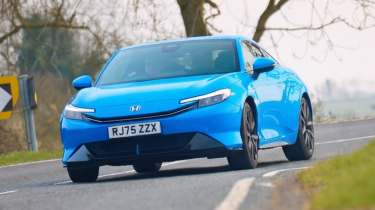
For something quite so inoffensive to look at, the new Honda Prelude has suffered the kind of internet vitriol last seen when the Beaver-toothed G82 BMW M4 first broke cover. In fact its handsome engineless glider-inspired looks are one of the few things about it where the general consensus is positive. What’s ired the masses is the 181bhp power figure – less than an entry-level hot hatch of 20 years ago – and the CVT transmission, while also being positioned not only as a £40,000 BMW 2-series rival, but as Honda’s new flagship to take the place of the Civic Type R.
We were worried too in the first instance and indeed, working out that this is not a worthy Type R replacement in the direct sense only takes a few yards. Put that billing out of your head though because, flawed though it may be, this is a nuanced and enjoyable machine, with appeal that reveals itself with extended exposure. It’s the opposite of the most focused of sports cars but with time you realise this light-touch coupé’s sweet and subtle road manners are in no way oversold by the elegant minimalist design, even if they are by Honda itself. Think of it more as something for an Audi TT owner to swap into now the German coupé is dead, than a true Honda halo.
Engine, gearbox and performance
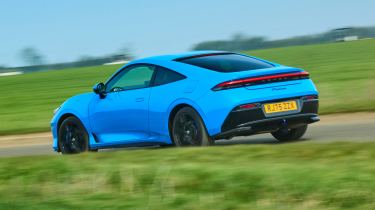
- 181bhp doesn’t sound or feel like much, 232lb ft is okay
- e-HEV powertrain pulls well low-down… not so well at speed
- S+ system simulates gears well but we miss manual tactility
More reviews
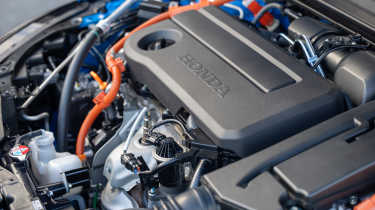
The new Prelude uses what Honda calls an e-HEV powertrain. This consists of a free-breathing 2-litre four-cylinder petrol engine combined with dual electric motors, the full system delivering peak outputs of 181bhp and 232lb ft to the front wheels. No, that doesn’t sound like a lot, nor the 0-62mph time of 8.2sec, nor the 116mph top speed. And quite often, it doesn’t feel like a lot either.
> Used Honda NSX (1999 - 2006) review: Japan's original supercar
The engine itself most often feeds the 1.1kWh 72-cell battery but can clutch in to be directly connected to the front wheels when full power is needed – this is what makes the Prelude a ‘full hybrid’ and not a range extender EV. When you really want to make progress, that’s a regular occurrence.
There are three basic driving modes - GT, Sport and Comfort - dictating powertrain, steering, suspension and engine sound parameters. Individual mode allows independent control of all. You can pretty much live in Sport for, unlike in more aggressive performance cars, there’s no appreciable loss of refinement in the Prelude’s most focused mode.
In some circumstances, the Prelude feels sprightly enough. That torque is available instantly thanks to the electric motor. This makes it feel lively and responsive, pulling well from a standstill or low speeds. There’s no turbo lag, or waiting for an engine to come on cam. Driven alongside a traditional, rev-hungry sports car like a Mazda MX-5 or a Toyota GT86, the Prelude will feel zippier from the off. The trade-off and result of the minnow-esque output is that, even though full power arrives as the torque curve wanes, the crescendo you’d get if it had more outright power, doesn’t ever really arrive.
For a proper drive you’ll also want to press the prominent ‘S+’ button – S+ is the new software that’s draped over the CVT hardware, to simulate an eight-speed transmission. The power percentage dial on the dash turns into a red rev counter and you can see which ‘gear’ you’ve selected with the aluminium paddles affixed to the steering wheel.
The system certainly gives you more control of the Prelude’s powertrain and appreciably improves engagement, the electric motor even sending a kick through the car with upshifts to give the effect of cog swapping. It’s a nice system, even if it’s not 100 per cent convincing. There’s also not a proper full manual mode where the car won’t ‘change gear’ for you.

The cumulative result is a car in which you naturally tend towards using the groundswell of electrified torque as seven-tenths flow. Maximum attack, using all the revs, even with the ‘gears’, feels a bit alien and a little abusive – strange in a Honda if you’re used to chasing 9000rpm in old Civic Type Rs or S2000s, or the muscular, rampant delivery of more recent turbocharged Type Rs.
Likewise the paddles and fake gearbox, effective though they are, aren’t in the same universe of tactility compared to Honda’s standard-setting manual transmissions. That the Prelude misses out on what was really Honda’s USP is a real shame and on tighter UK roads, it’s the absence of a manual that ire’s more than any perceived lack of performance.
Ride and handling
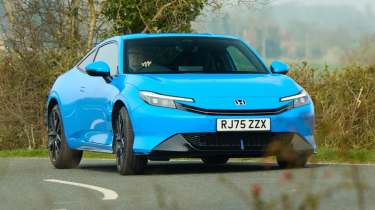
- Civic Type R-derived suspension and brakes
- Damping and balance make the Prelude feel sweet in the UK
- Responds best to smooth flowing inputs on tighter roads
The real joy to be found in the Prelude is in how it rides and handles. Under the skin it’s based on the Civic, with added strengthening in the side panels, though Honda kept the roof ‘flexible’ to maintain compliance. There is Civic Type R-derived suspension, including the dual-axis front struts and springs and adaptive dampers. They’re mounted with extra caster at the front, increasing negative camber the more lock you wind on but avoiding deflection at the straight ahead.
The damper housing is Civic Type R, with softer internals, which Honda reckons splits the difference between the normal Civic and the Type R in terms of compliance – the Prelude in ‘Sport’ should ride like a Type R in ‘Comfort’. The rear suspension is a multi-link set-up.
You feel the Type R-inspired hardware almost instantly. There’s a sophistication to how the Prelude bobs along an uneven street. It doesn’t isolate what’s happening beneath you, with every rise and fall of each wheel clearly expressed, but it’s communicative rather than uncompromising.
Pressing on, with the car switched to Sport, you relish the feeling as each of the four corners tenses and relaxes as vertical loads build and recede. It feels expensive and capable, comfortable and compliant yet controlled. There’s an almost Alpine-like sense of harnessing and honing natural roll characteristics to an end of a more communicative chassis, where most more serious performance cars try to eliminate it. This is a chassis that doesn’t need ill-advised speeds on the road to rouse into expression.
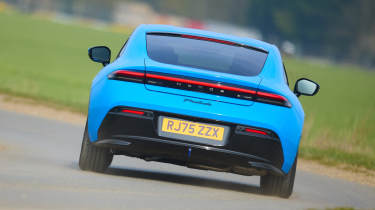
Sport mode does make the steering a tad heavier, without loading in any more feel. It’s not as razor sharp or weighty off the straight-ahead as ‘proper’ sports cars like Toyota’s GR86 or Mazda’s MX-5, but turn-in is keen and as advertised gets keener with added lock.

Carry too much speed into the heart of a corner and it will understeer but rarely untidily so. More often, on tighter turns it just digs in, the building camber working in tandem with the Active Handling Assist braking the inside wheel, to keep the car on-line. The battery’s mass, positioned behind the driver, almost helps to position it with attitude on turn in. Likewise over faster, sweeping corners and over crests, you can use the car’s natural balance and sometimes the brakes, activating the rear of the car into a pleasing neutral stance.
In these moments, on roads that might make larger, more serious sports and supercars feel like a prize tuna splashing around in a puddle, where the perceived power deficit is out of mind and you’re just relishing the Prelude’s delicacy, it's a honey. Even the Brembo brakes give confidence, with good modulation and a sturdy end to the pedal travel and little pollution in feel from the seven-setting(!) regenerative system.
Interior and tech
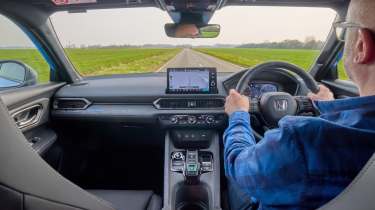
- Lots of Civic carryover, from design to material quality
- HMI feels a little old hat, manual climate controls are worth celebrating
- Driving position is nice enough, ADAS infuriating
Sharing its bones with a hatchback, the Prelude is easy to get in and out of in relative coupé terms. Once in, the environment is familiar from the Civic – the steering wheel carries over (lacking the red H of course) but now wears a pair of impressively tactile alloy paddles, heightening perceived quality straight away.
The vents are a slimmer shape but with the same toggles, and the central tunnel feels higher relative to the seating position, which is decent with a nice hip position and reasonable support, given how much less aggressive the GT-esque seats are than the Type R’s buckets. The rear ‘plus-two’ seat bench upholstery is a low point material quality-wise, likewise the tinny clunk the door makes as you shut it.
Where you’ll find a delectable alloy teardrop shifter in a Type R, a cluster of buttons and controls – drive, reverse and the parking brake of course and then to their left, prominent in an extruded blister of piano black trim, the S+ button, that gives you your ‘gears’. Below that, the switch for your drive modes.
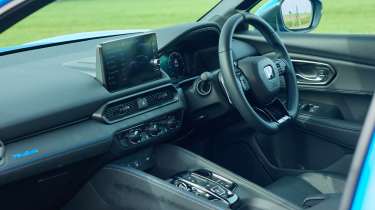
The Prelude’s infotainment screen is looking a little apologetic in today’s world (though Android Auto and Apple CarPlay work just as well as you’d hope). That said, it can afford to be, given the climate controls are thankfully still physical, with knobs and buttons to control blower strength, temperature and direction, as well as your seat heating.

Not so easy (or almost impossible) to work is the ADAS system, that’s hidden within several menus and with some features basically impossible to switch off… and certainly not on the move. It’s an overworker too, regularly bonging and shouting especially when it thinks you’re a millimetre on the way to leaving your lane.
The Prelude’s cabin is a mixed bag of highs and lows overall quality wise but is spacious, comfortable and even practical, the hatch lid revealing a well-sized boot. Just don’t transport adults in the back on the regular.
MPG and running costs
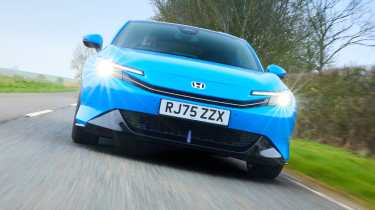
- Combined 54.3mpg claimed
- We saw c40mpg on a fast motorway run…
- … the average dropping to 30mpg after a day of spirited country driving
The lesser-discussed USP of this car is efficiency because of course, some buyers like the idea of having head-turning looks without exotic running costs. Honda’s WLTP-certified claim is that the Prelude will deliver an average of 54.3mpg, across a wide variety of driving.
Our testing in the UK mainly consisted of high-speed motorway and more aggressive countryside driving, using the engine a lot more than you would, say, bimbling around town. Even so, we saw c40mpg on a motorway run, which only dropped to a 30mpg average after a day of kicking its head in around the countryside. For reference, a 30mpg average in a Civic Type R requires a very light right foot indeed.
Price and rivals
Launching an all-new coupé in 2026 is a brave move. Nevermind discretionary cars with slender use cases, the day-to-day stuff simply isn’t selling in the volumes carmakers would like. So why isn’t Honda nervous about introducing the Prelude? Firstly, it doesn’t intend to sell that many, with Honda UK having plans to shift fewer than 1000 examples over the next two years.
Secondly, because these kinds of cars don’t trouble the sales charts, pickings are slim. We’d say serial Audi TT buyers looking for a new alternative now their beloved Golf based coupé has gone should look to the handsome Prelude with curiosity. At £40,995 it’s TT-alike in its pricing, though the Prelude’s performance is a little down. Honda says its main (though far from direct) ‘rival’ is BMW’s 220i, which is cheaper (£39,820) and more powerful (184bhp).
If Toyota’s GR86 was still on sale, there wouldn’t be much reason to buy a Prelude instead. It still is compared to used GR86s from £27,000, truth be told, though the Prelude’s full hatchback makes it more practical. We’d also suggest, if the Prelude’s efficiency and practicality aren’t essential, looking at a Mazda MX-5. It did tie a McLaren for podium honours in our Car of the Year test after all…
| Engine | In-line 4-cyl, 1993cc plus 135kW e-motor |
|---|---|
| Power | 181bhp |
| Torque | 232lb ft |
| Weight | 1480kg (124bhp/ton) |
| 0-62mph | 8.2sec |
| Top speed | 117mph |
| Basic price | £40,995 |
Frequently Asked Questions
The Honda Prelude is a very good car in terms of its driving dynamics and efficiency. It’s a very pleasant car to drive. It is not however the fastest or most focused of sports cars.