Hyundai i20 N (2021 - 2024) review – a cracking supermini cut down in its prime
The i20 N was an inspiring hot hatch from Hyundai’s performance division, agile, and with superb mid-corner traction to make it one of the greats
In a few short years, Hyundai N accomplished a launch-control-worthy 0-60 in terms of brand awareness: thanks largely to the stellar i30 N and Hyundai i20 N hot hatches, N cars have become cult-hero modern classics within their own lifetime. And the halo effect has been transformative for Hyundai’s wider image, too. This most beige of brands was suddenly a maker of all-time-great affordable performance cars (and it’s been able to leverage that appeal with more profitable N Line trim levels for its mainstream models, too).
Now it’s started again – not from square one, but by turning the page to a hefty new chapter. Petrol-powered N cars ended sales in Europe a couple of years ago as the N department pivoted to performance EVs, led by the (admittedly excellent) Ioniq 5 N, and more recently, the Ioniq 6 N saloon.
> Hyundai Ioniq 6 N review – has Hyundai beaten BMW M at its own game?
Even before its discontinuation in 2024, the i20 N sat in a field of only a few. Once a hotbed of some of the most engaging cars on sale, iconic names such as Peugeot, Renault, Citroën and Ford have vacated the segment, leaving only Volkswagen and arguably Toyota (as its GR Yaris rivals in terms of size, but not price or performance) at this entry point of the hot hatchback market.
In evo issue 318's 18-car hot hatch mega test, the i20 N achieved a very respectable fifth place overall, and this wasn't purely down to its low price. But we’ll point out that you could buy an i20 N for six grand less than the disappointing Mini JCW, or only a grand more than the 208 GT. The i20N showed it was possible to produce a fantastic hot hatch that isn’t on the wrong side of £30k.
More reviews
And glory be, these things are good. Along with the bigger i30 N and the Civic Type R, but more so even than the GR Yaris and AMG A45 we sent ahead of it into the top four, the little Hyundai feels right from your very first moments interacting with it. To take stock of Hyundai’s brief but bright stint as a master of the established hot hatch universe, we took the i20 N on a well-earned adventure, and on these roads it’s hard to shake the feeling it’s been cut down in its prime.
Engine, gearbox and technical highlights
- 1.6-litre turbocharged four-cylinder & manual transmission only
- Stiffened chassis with lowered ride height
- Customisable driver modes and reasonable economy, if you’re gentle
To create the i20’s engine, Hyundai started with one of its basic 1.6-litre turbocharged four-cylinder engines, giving it an overhaul with a reworked turbocharger and intercooler installation to make 201bhp and 203lb ft of torque. The unit features direct injection and a variable valve duration system, and delivers its peak torque from just 1750rpm. The only gearbox choice was a six-speed manual, with drive passing through a Torsen-style mechanical limited-slip differential.
The i20 N is five-door only, with a shell strengthened at the front subframe, at various weld points and via a brace in the luggage area. The clutch and transmission have been strengthened to cope with the increased loads (and the launch control software), while the chassis sits 40mm lower than a regular i20 with much stiffer springs and firmer dampers, plus reinforced suspension joints. Hyundai quotes a weight of 1190kg, a scant 3kg more than a Fiesta ST and 90kg down on the admittedly all-wheel-drive GR Yaris.
The modes: an N car hallmark. As well as the usual Eco, Normal and Sport, there’s a further, more aggressive N Mode and an N Custom mode where you can pick ’n’ mix settings for steering weight, engine map, stability control level and exhaust rowdiness. All are easily toggled by quick-flick shortcut buttons on the steering wheel (you can also easily toggle automatic rev-matching at a single button-press) then you preset your favourite combo. Sound familiar? A little like modern-era BMW M cars, in fact. No coincidence, of course.
It’s great at being a normal car, more refined than a small, lightweight car has any right to be (at 1190kg, its kerb weight is impressively scant by modern standards). It’s genuinely comfy on a long journey – far more so than a GR Yaris, or a Fiesta ST – and roomy as well. Reasonably frugal too, averaging mid-30s mpg figures, and often close to 40, compared with the thirstier i30 N’s mid-20s during my six months running both.
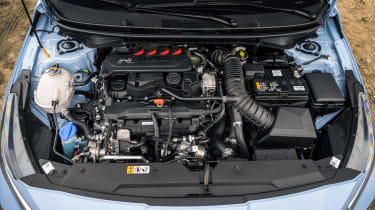
As also experienced in the i30 N, keep the car in one of its more boisterous driver modes and those pops and bangs also have a marked effect on overall MPG. Thankfully, its appetite for consumables will likely be less vicious thanks to that relatively low kerb weight.
General reliability of the i20 N is also certain to be good, as the trade-off of having a relatively uninteresting engine is the fact it will have gone through extensive iterations and testing. Being a supermini, other consumables such as the brake pads and discs should also fare well, unless track days are a frequent activity.
Performance, ride and handling
- Agile handling and immense overall grip
- Loud, characterful engine lacks top-end sparkle
- Driver-focused cabin balances comfort and practicality
The engine has the same crackling character and slightly nasal tone as the i30N’s, and the steering feels similar too, though its heft possibly feels less appropriate here than in the larger car – James remarks that while he concedes it’s a nit-pick, it makes the car feel heavier than it really is (which, as you’ll see from our figures, is the fourth-lightest here, and 220kg less than its larger sibling). You get used to it quickly though and there’s no faulting its accuracy or progression. Feedback could be better, but you actually don’t miss it that much.
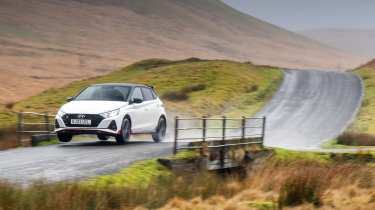
The limited-slip differential – standard-fit on UK-spec i20 Ns – hooks up nicely but there’s impressively little torque-steer. The i20 N’s tail can be quite mobile if you want it to be – particularly on track – but on the road, even in these conditions where the wipers are struggling to keep up with the rain, it’s largely stable and safe but always a giggle. Maybe it’s the psychological link with Hyundai’s vaguely i20-based WRC cars, but the i20 N feels like a rally car on these winding Welsh lanes, gravel rattling in the arches and one-corner, one-turn, no-correction steering inputs.
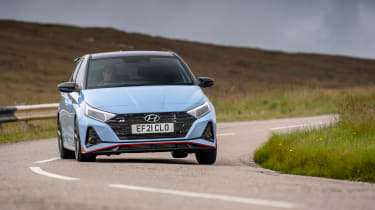
Mind you, it’s not quite one-corner, one-turn because you frequently find yourself fighting against bumps in the road: the i20 N’s MacPherson-front, torsion-beam-rear suspension (with stiffening measures versus a standard i20, to help the N change direction more eagerly) is a little on the unyielding side and it doesn’t breathe with the road like some hot hatches. Unlike its bigger, adaptively damped i30 N brother, it’s on passive dampers (the better to keep the i20 N affordable) but they feel like they get firmer as you ramp through the driving modes, as the steering becomes heavier and transmits more jolts through your arms.
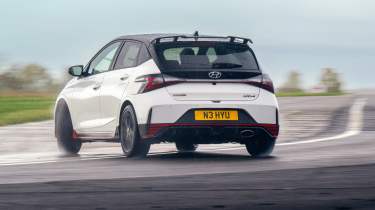
While not immune from the juddering understeer suffered by most cars during our photography on track, the i20 is far happier to move around than it is on the road, with a balance so precisely throttle-adjustable that you can pick your angle of rotation almost to the degree. The brakes feel good too, and are more than up to shedding the N’s modest weight stop after stop.
Both James and John experience more rev hang and slightly more lethargic throttle response than they have with i20Ns in the past, so we’re putting that down to a quirk of this car alone, and fairly trivial in the greater scheme of things. Now the i20N is no longer around, it may be a long time before the next wave of electric equivalents are anything like as fun or affordable...
Hyundai claims the i20 N will reach 62mph in 6.2sec and go on to a top speed of 143mph. This is 0.3 faster than the Fiesta ST, which will do the same sprint in 6.5sec, but it’ll top out 1mph ahead at 144mph. What the numbers don’t tell you about is the little Hyundai’s character.
In typical N fashion, it comes with turbocharger whistles, a rasp from the exhaust and plenty of pops and bangs. It’s very similar in character to the i30 N’s unit, and is more boisterous than the three-cylinder unit found in the Fiesta ST. However, when it comes to ultimate performance and response, the i20 N’s unit does lack that final ten per cent of sparkle. It doesn’t quite leap towards the red line with the enthusiasm that the best turbocharged fours do – we’re thinking of the now long-dead Peugeot 208 GTi by Peugeot Sport, or previous-generation 1.6-litre Fiesta ST.
This can be put down to the Hyundai using an engine that was never really designed to be so high-performance, instead being designed for use in Hyundai/Kia's more sedate models. As a result, underneath its raucous character, it just isn’t quite as scythe-sharp or reactive as Ford’s three-cylinder, let alone Toyota's. Yet as with the 2-litre Theta unit in the Hyundai i30 N it doesn’t destroy the experience, far from it in fact, but neither does it shine, or even just enhance the overall package. It’s definitely a supporting role in an otherwise brilliantly executed package.
The i20 N gets the basics right from the start. The seats are supportive, and thankfully not set too high. The steering wheel has a nice feel to it, and while there’s always a risk that digital instrumentation is over-elaborate just because it can be, in this instance it’s clear and attractive. Switch to the N mode and the rev counter gains prominence, but with oil and coolant temps equally easy to read. It’s a small touch, but it shows N understands what a driving enthusiast wants to know.
Even from the first few yards you can sense how taut the i20 N feels: solid of shell, and firm of suspension. In a modern world where many of the larger hot hatchbacks can feel like everyday luxury cars when so configured from the driver’s seat, the i20 N – much like the Fiesta ST, it must be said – makes no apology for being firm riding. In that regard it feels like a hot hatch from the old school, an effect amplified by its low weight and small size. It feels nimble and agile – a car you want to throw around right away, albeit one that details the complete picture of the road’s surface through to the cabin.
Switch to N mode and the car really comes to life, a flickering red flame effect around the rev counter signifying much sharper throttle response, more weight to the steering and the pops, growls and bangs of the exhaust. Soon I’m into Custom mode, tweaking it slightly by going back a step on the steering weight and switching off the ESP – it’s all very easy to achieve. The little 1.6-litre engine rips through the rev range, pulling from low revs with vigour but also building revs in a fizzy, boost-heavy way. The shift quality is direct, but allows very quick changes, while the brakes offer a nicely firm pedal feel.
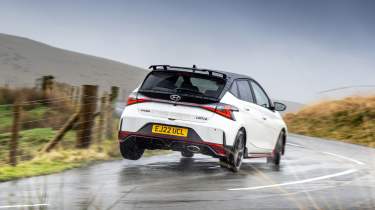
Brake hard for a 90-degree corner and turn in and the rear of the i20 steps out a few degrees but in a very predictable, controllable fashion, while the inside rear wheel hangs in the air. The car is now nicely turned in, ready for an application of power – except that the first time you do so doesn’t produce quite the effect you might be expecting. Instead of holding its line, or pushing wide under power, the diff drags the nose tighter into the corner and round. It’s an exhilarating feeling, because even if you feel you’re working right up to the limits of the chassis the car always seems to be able to generate more grip than you had imagined precisely at the point you want to get on the power.
The process is repeated all the way along a good B-road. The sheer amount of traction mid-corner that the i20 N can generate from its bespoke Pirelli P Zero tyres is startling, and on this early evidence seems to position the car as a true giant killer. Its power and performance are entirely adequate, but it’s the cornering speed that sets it apart. Of course, a hot hatch needs to be a lot more rounded than that, and while the i20 N is from a smaller class it doesn't feel cramped inside, and the cabin design and equipment sheet are very grown up. It’s a car that easily gets under your skin.
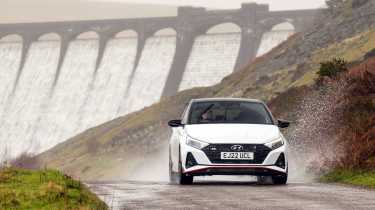
In evo Car of the Year 2021, the little Hyundai had some tough competition in exotics worth ten times its price, but it put up a good fight: ‘It’s just up for it all of the time,’ said Jethro. ‘I’d still say it felt good rather than great, but it grew in stature until I really, really started to love it.’ In a world of oversized and overpowered cars, the i20 N resonated with every judge. ‘There’s a real satisfaction in being able to wring every last drop of performance with barely anyone noticing, and the i20 N feels like it will do this forever,’ explained John.
The i20 N was the car to provide those moments where it would latch on to the tail of something bigger, faster, more exotic and wouldn’t let go. Its size helped, but so too its strong powertrain – not the most tuneful but hugely effective – and a chassis that was as fun as it was mature beyond its price point.
As Dickie explained: ‘There’s a lot to be said for enjoying a far greater proportion of what’s on offer more of the time.’ Why didn’t it finish higher than sixth overall? The N modes are still too complex to easily find the best of what’s on offer, and it lacks some precision and feedback, although we all felt that for a sub-£30k car the negatives were few and far between.
It’s not a perfect car, of course. Even in the lightest of its three weight settings, I find the power steering a little heavy for my tastes; its leaden feel actually makes the i20 N feel less nimble than it really is. And the engine feels a little leaden, too. Although the turbocharged 1.6 four has a 350-bar direct-injection pressure and a special ignition system for the i20 N, it’s a little lethargic in nature: a heavy flywheel means that revs take a moment to climb and likewise to die away. Drop out of the powerband and it can take a little while to get back into the turbocharged sweet spot, and sometimes upshifts are a little slurred, like a learner driver accidentally slipping the clutch, because the revs ‘hang’ a little. It doesn’t sound particularly inspiring either, even in the most vocal of the valved exhaust silencer’s three settings.
Design, interior and tech
- Materials are cheap, but touchpoint all solid
- Slick screens paired with physical controls
- Bold exterior design with distinctive N details
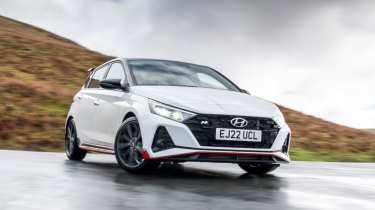
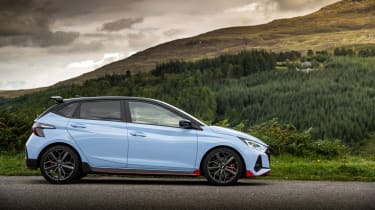
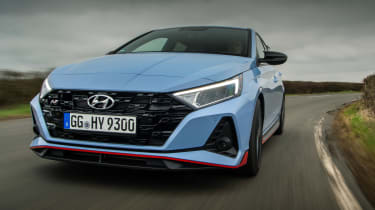
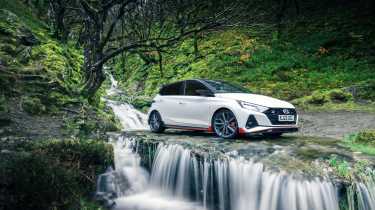
Visually, you won’t be hard-pressed to spot an i20 N – even when it’s not sporting the trademark Performance Blue colour. It comes with complex 18-inch wheels finished in anthracite grey, plus a sizable rear wing on top of the roof that’s much more aggressive than the integrated units of its main competitors.
The bumpers front and rear are completely redesigned, and feature aggressive lower splitter, skirt and rear diffuser-like inserts that are then further emphasised by chunky red stripes, or silver in the case of cars with the optional deep red paint finish. A clever design quirk is how the red stripes almost integrate the triangular rear fog lamp – a recurring graphic on most N models. Some paint finishes can be combined with a black pillar and roof arrangement, giving the N even more visual distinction from its lesser siblings, but however specced there will never be any mistaking this for a standard model.

It’s positively luxurious in terms of standard equipment inside: heated seats and steering wheel; parking sensors and reversing camera; du jour digital dials and a more user-friendly touchscreen than most – although later models such as this one have frustrating touch-sensitive surfaces in place of buttons next to the screen, meaning more eyes-off-road time than with earlier cars. Big-car kit in a supermini space.
The graphics on the instrument screen are a bit puerile – rendered carbonfibre in Sport mode, and animated fire crackling around the tacho when you select N Mode – but this is a car with a sense of fun, and goodness knows that’s not a bad thing. A host of performance data can be displayed on the main screen and the instrument panel, from throttle opening and brake pressure to individual temperatures for coolant, oil and the engine itself. The latter in particular shows it’s been engineered by people who care about driving.
The cabin is clearly built down to a price but it’s easy on the eye, and scratchy out-of-reach plastics don’t matter when all the touch-points are spot on. Steering wheel: round, chunky but not BMW-thick, clear buttons for the driving modes and rev-matching function. Gearknob: spherical, as it should be, and attached to a slick mechanism. Proper handbrake. Great seats. Clear, albeit TFT, dials.
Price, specs and rivals
Sadly, this is a class that’s seen a decline in numbers over recent years, as the increasing weight of cars in general and the move to purchasing more expensive, more powerful cars on finance has bitten hard into the smaller hot hatchback’s territory. While the i20 N has now been axed entirely, it came in a single high-specification inclusive of all its high-spec chassis elements in its final iteration, with only an uprated BOSE sound system and the various colour options able to be specified on top.
As a result of its unique package, used prices have been unusually reluctant to drop since it went off sale. You’ll still pay from around £16,000 for the very cheapest non-cat examples, and just a hair from its original £26,530 list price for those with just a few thousand miles on the clock. Also now discontinued, the Mk8 Ford Fiesta ST in its most desirable ST-3 trim is available for similar money.
The i20 N’s key rival was the Fiesta ST, but while the Volkswagen’s Polo GTI is still available at £31,415, it’s rather flat and uninteresting to drive. Nor is it more comfortable, better built or more desirable than its rivals. Unlike the Ford and Hyundai, which feel lavished with care and attention in their development, the VW feels like a distinct afterthought. If it wasn’t, VW has bigger issues to deal with.
Toyota’s GR Yaris is a similar size to comparable superminis, but is a more serious machine both in terms of performance and price. Entry-level models now come in at around £46,195, and don’t expect to go into a Toyota dealership and walk out with a new GR Yaris that week. Compounding the supply chain issues surrounding the whole industry, the GR Yaris itself is also limited by its hand-built nature in the off-site factory space that was once used to assemble the Lexus LFA.
Hyundai i20 N specs
| Engine | In-line 4-cyl, 1591cc, turbocharged |
| Power | 201bhp @ 5500rpm |
| Torque | 203lb ft @ 1750-4500rpm |
| Weight | 1190kg |
| Power-to-weight | 172bhp/ton |
| 0-62mph | 6.2sec |
| Top speed | 143mph |
| Price new | £26,530 |
| Price today (2026) | From £16,000 |