Jaguar Type 01: Everything you need to know about the British brand’s critical new car
Jaguar has revealed its controversial Type 01 electric car, we talk to the people responsible for its creation and ask

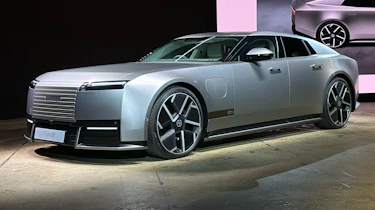
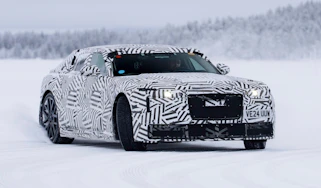
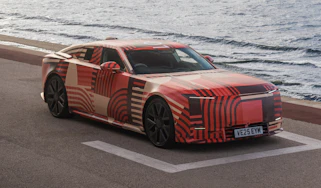
The covers are off, the ticker tape has been cleared away and now the Jaguar Type 01 is out in the open and being prepared for delivery to the first customers in Q2 2027. But how did we get here? Why is the Type 01 the car it is and why does it look the way it does? evo has followed the story of this pivotal – and controversial – car from early in its story. From design concepts to driving prototypes and being present at the car’s global reveal in New York, the Type 01 story is like few others.
How, then, do you solve a problem like Jaguar, the perennial underperformer not only within JLR but also within the market sectors it competed in? The premium-volume space is not for the faint-hearted, and regardless of the cars it produced and the standard they were developed to (often better than their rivals), Jaguar just couldn’t cut it. The barrier to success was seemingly impenetrable; the cost to keep trying unsustainable.
So what to do? ‘Carrying on as we were wasn’t an option,’ Jaguar’s managing director, Rawdon Glover, explained to evo nearly two years ago when the world lost its collective you-know-what over the Type 00 concept. And a few weeks before 00 became Type 01 ahead of its global reveal this month, the answer was no different: ‘We had created some brilliant products, some were best in class, but the competitiveness in that sector was too much for Jaguar to cut through. We had some success but not enough.
‘When we had to make a decision as to what was next for Jaguar – what cars we would make, which sectors to compete in – we could have carried on as we were or rip up the rulebook and give Jaguar a fresh start. The former was never an option if Jaguar was to survive.’
People still liked Jaguar. They liked what it stood for and they liked the cars. The only issue was that they didn’t buy them, certainly not in the volumes a modern car company requires to turn a profit and survive.
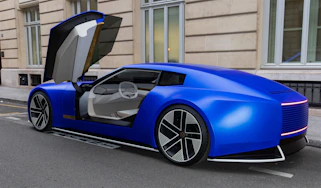
‘Project Pantera’ was given the green light five years ago, when the decision was taken that a reinvention of Jaguar was the only viable option. From that point, JLR’s design department was split into three teams. ‘Between them they had to present a minimum of three designs, and there were certain body styles they had to include so we could understand the breadth and depth of the direction,’ explained Glover. ‘I vividly remember the first time I walked into the design garden and saw the new design direction. It was just “Wow!” It stops you in your tracks and I think that’s the appeal. But it does take time to get used to it and to get used to being around it.’
Get used to it we must, Jaguar fans and those new to the brand alike. It’s no secret that new blood is what Jaguar is primarily after; people that haven't owned an example before or had much interest in the brand. Some probably hadn’t heard of Jaguar until they made global headlines with its rebrand. And if Type 01 isn’t for them, two additional models will be added to the family in due course: an SUV and a sporting-brake estate variant.
Early signs are positive, with Jaguar claiming that more than 50,000 people have registered interest in the car before orders open early next year, with close to 80 per cent new to the brand. Mind you, expressions of interest are one thing, cars leaving dealers are quite another. We’ll know soon enough if Jaguar’s gamble will pay off. For now, here’s everything there is to know about the car.
Why Type 01 looks the way it does
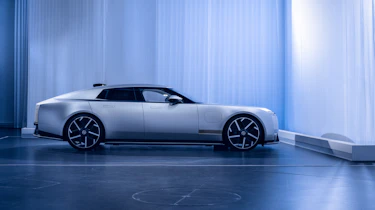
From 18 contenders, the design selected is now a 5.2-metre-long, 1.4-metre-tall four-door GT car that will seat four and carry them for a claimed 320 miles courtesy of its 120kWh battery, with three e-motors producing a combined 1015bhp and 1007lb ft.
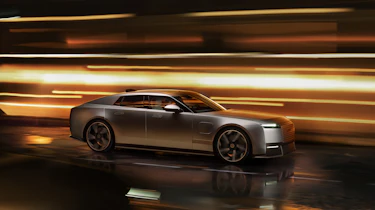
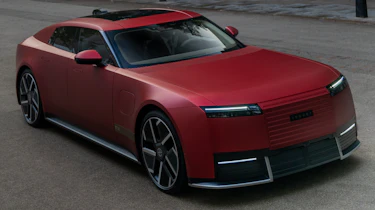
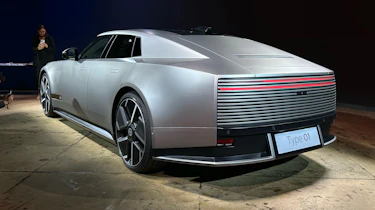
It may not be finished in the concept’s controversial pink – the matt silver paint finish is the same colour the winning design was presented in – but Type 01 is no less striking in the metal (73 per cent of which is aluminium). There will be no mistaking it for anything else. From the front, its headlights are pushed to each corner and exaggerate the car’s width, while the towering proportions of the high bonnet-line and deep not-really-a-grille are unapologetically imposing. Whether you feel it looks like a Jaguar is subjective, but what isn’t in question is the presence Type 01 commands.
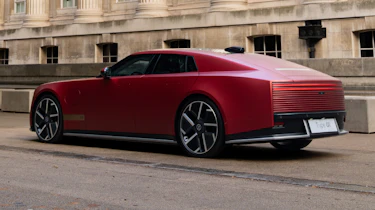
Its broad shoulders carry a lot of body beneath them, and the roofline squeezes the glasshouse into the car’s waist, which continues unbroken to the rear. Like the Polestar 4, the Type 01 has no rear window.
Engineering challenges overcome
Transforming the winning design into a production car was one of the biggest undertakings by JLR. With nothing to build on or borrow from, the new Jaguar is a genuine clean-sheet design. ‘This is one of the very few in a generation that is,’ says Jon Darlington, architecture chief engineer. He says it was a case of ‘here’s a line; can you make a car from it?’ That line being the silhouette of the Type 00.
A Jaguar veteran with some 30 years at the company, Darlington has worked on many all-new Jaguars during his career. ‘I was the vehicle engineering manager on the XE, but even that came with constraints: “You’ve got to take the fight to the [BMW] 3-series. You’ve got to carry over this engine, you’ve got to carry this commodity,” et cetera. So yes, that car was the first model off a new architecture, but as a team you had things that dictated the direction you went in. This car was really different.’
Just as its design took an all-bets-are-off approach, the engineering that underpins Type 01 was equally a case of ‘do what you need to do’ rather than be constrained by market sector targets. ‘I was invited to come and have a look at the car, and it was really interesting because we knew something was happening in the wider business with Jaguar, but it was a really well-kept secret, because they wanted to give their team that freedom,’ continues Darlington.
‘You walk around it and you go, okay, this is really different. And then you ask that initial question: how constrained are we? And I got the answer straight back: “It’s got to look like that, and it’s a Jaguar. Full stop. Everything else is free – a clean sheet of paper. There are no constraints.” When pushed further, the JLR board were insistent: “We’re invested in making this, and we’ll do what we need to do.”’
Power, performance, and weight
Underpinning the body, which started life under Gerry McGovern’s control over the design team, is an all-new platform called JEA, standing for Jaguar Electric Architecture (an SUV and a crossover-type version will come later). Apparently, despite speaking to other – unnamed – OEMs, there was nothing suitable for Jaguar to use to create the car it wanted. What the team didn’t want was a conventional electric car ‘skateboard’ platform, because not only would it have added 200mm to the height of the roofline, but the interior space and design would have been compromised.
The Type 01’s battery, therefore, is made up of five packs, each featuring 200 cells that measure just 120mm in height. It runs almost the full width and length of the car, with a ‘foot garage’ incorporated in the rear footwell and the space where the exhaust would normally be utilised for battery and motor packaging.
Andrew Ellis, propulsion manager, had a core set of targets to achieve: 1000bhp, the capability to accelerate from 100kph to 180kph (62mph to 112mph) in 4 seconds to meet what Jaguar terms ‘performance in reserve’, and a 400-mile range. To achieve these targets, there’s a pair of electric drive units (EDUs) on the rear axle producing 888bhp and a single motor on the front axle to complete the 1015bhp total. Power is split 30:70 front to rear, with the rear motors deactivated when cruising and the front used to maintain cruising speeds. This alone adds up to 18 miles to the range and is one of the 350 patents Jaguar has applied for on Type 01.
The most significant, according to Darlington, is the ‘tri-apex node’, a structural element that’s positioned ahead of the front bulkhead. Capable of withstanding a 26-ton impact, it allowed for the optimum positioning of the battery and front EDU, adding up to 70 miles of range because it allowed the battery to stretch beyond the bulkhead, while also providing 50:50 weight distribution and reducing the bodywork height by 100mm. The high-voltage junction box acts as a strut-brace, with the high-voltage cables replaced by CAN bus connectors, saving weight, improving packaging, and all working towards maximising range.
That said, and despite all the new tech, the Type 01 still weighs in the region of 2.9 tonnes, weight remaining the electric car’s nemesis. Responsible for creating a car that manages and masks that mass was James Hazlehurst, vehicle dynamics manager, who like engineering director Matt Becker is ex-Lotus. Contrary to the common perception that an electric car is developed and defined by the algorithms running its software, with Type 01 the hardware came first, and the process involved 700,000 miles of testing as well as 20,000 hours of sim work.
‘We didn’t do anything different with how we developed this car than we would any other car,’ he says. ‘We needed to get the core elements right first – how it rides, the steering, the braking and how it deploys its performance. Only then did we develop the software-defined hardware to finesse the car.
‘Having such a stiff structure allowed us to soften the suspension [Type 01 uses twin-valve active dampers and air springs, with double wishbones at the front and integral links at the rear], which gives you a much wider remit when it comes to damper tuning. We have 22mm more wheel travel than any previous Jaguar.’ It will, by the sounds of it, be a Jaguar that rides, steers and engages like the very best of the company’s back-catalogue and makes the most of the technology available to it.
Interior and technology
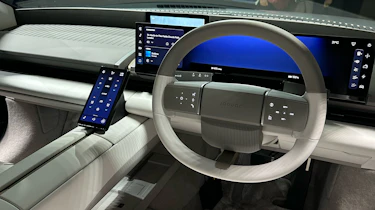
It makes another clean break from any previous Jaguar with the interior treatment. Leather and walnut are banished, materials that are soft on the eye – and whichever part of your anatomy touches them – are very much in. There are screens, of course, one of which is a 7-inch smartphone-style display that sits on the central console to control entertainment, HVAC and the like and is a refreshing change from yet another MacBook Pro screen being screwed to the dash.
There are no speakers in the doors, but there are 13 in a sound bar that runs the width of the car along the base of the windscreen, plus active noise-cancelling technology in the headrests. Nvidia chips power an AI voice control system. Remarkably, there’s 1km less wiring than in any previous Jaguar and 40 per cent fewer ECUs, with the ones that have been fitted providing three and half times the processing power.
Price and rivals
How do you solve a problem like Jaguar? You create a car that draws a line in the sand and puts everything you have done before behind it, courts controversy and makes a statement. In many ways, it’s a car for these times.
The Type 01 may not appear to have any obvious rivals – Rolls-Royce’s Spectre costs twice as much – but Porsche’s Taycan, Audi’s e-tron GT, Lotus’s Emeya and Polestar’s 5, while very much more conventional in terms of looks, are in the same ballpark when it comes to price: Jaguar is expecting the average selling price to be £125,000, though it will start closer to £100,000. Those cars are also closely matched on performance, but they can’t compete in terms of design and innovation due to the underpinnings they share with other models within their respective ownership groups. There’s a great deal going for the Jaguar – and an equal amount resting on it. We will soon know if the problem of Jaguar has been solved.
The thrill of driving in your inbox: sign-up to the free evo email newsletter