Renault Mégane RS (2017-2022) review – engine, gearbox and technical highlights
The RS’s basic powertrain is shared with the Alpine A110 and is as enthusiastic as it is there


The Mégane’s 1.8-litre turbocharged four-cylinder engine is the same unit as found in the middle of the Alpine A110, as is the dual-clutch transmission. But rather than making do with the base A110’s 249bhp and 236lb ft of torque, the hot hatch gets a bump to the A110S’s 296bhp as well as 310lb ft. The extra power is liberated thanks to alterations to the cylinder head courtesy of Renault’s Formula 1 powertrain engineers, a faster reacting twin-scroll turbocharger, mirror coating on the cylinder bores and a higher capacity, dual-intake induction.
The six-speed dual-clutch EDC transmission is unobtrusive, if a little dim-witted at slow speeds when left in automatic mode, but switch to manual mode and the changes speed right up, especially when in Sport or Race mode. The paddles themselves are column-mounted and made of metal, but also a little short on account of the retro stereo controller Renault still fits to all its cars. Gear changes themselves can sometimes feel a little clunky compared to those of the slickest VAG units or a modern eight-speed automatic, but it is very responsive and suits the RS’s more focused character.
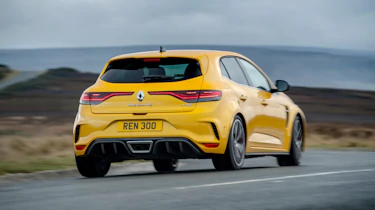
When not in the sportiest setting, the dual-clutch ’box changes up automatically as it hits the red line, which can be frustrating if it coincides with your own request for an upshift, or if you’re about to hit the brakes and don’t want one. The old six-speed manual has been ditched entirely in the UK, but while in most cases we’d bemoan its removal the shift of the old car was notchy at best.
The Mégane’s exhaust includes some refreshingly simple technology to create different volumes depending on how you’re driving. Rather than resorting to heavy valves and actuators, the pressure and speed of the exhaust gases change the way it sounds – as the revs rise and the engine expels more gases, the longer silencer tube in the back box is automatically bypassed.
Unlike most of its rivals – notably the Hyundai i30N Performance – the Renault Sport Mégane does not have adaptive dampers. They aren’t even an option like they are on the Golf GTI and R. Instead, the Mégane has passive dampers, but rather than being devoid of any state-of-the-art technology, each unit has inbuilt hydraulic bump-stops that make the extremes of the suspension movement far less abrupt than with conventional rubber stops.