McLaren 720S (2017 - 2024) review – hypercar performance for BMW M5 money
The McLaren 720S was so good when new in 2017 it’d still land a few punches in group tests today. Better still, they’re now half price
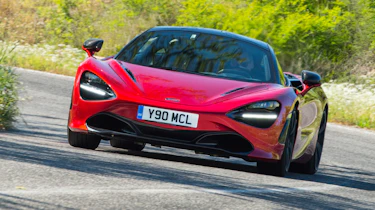
Some 15 years ago McLaren launched the MP4-12C. Technically impressive and very, very quick, the one thing it couldn’t quite do was warm the soul. But such was McLaren's progress, its first ground-up replacement in 2017 represented a huge leap for the brand, because the 720S couldn’t have been more different. There will be a few who’ll always take the theatre and passion of the Italian supercar brands over the more efficient Ron Dennis-style of doing things, but spend any time with a 720S and you’ll understand why it was our Car of the Year in 2017, and why it still continues to thrill us almost a decade on.
With striking and original styling giving it a presence like few other supercars, an astonishingly potent drivetrain and one of the best chassis of any production car, the 720S wasn't just a performance benchmark like its 650S and 12C predecessors, but it was one of the most engaging and complete supercars on sale.
> McLaren McL 820 to replace the 750S next year as Ferrari-baiting supercar
It’s not a car without faults – McLaren’s V8 has rarely been the most melodic of partners, the infotainment system is a nuisance to operate and good lord do these things shed value, but the 720S remains one of our favourite cars. And now in used form, it represents enormous bang for your buck.
More reviews
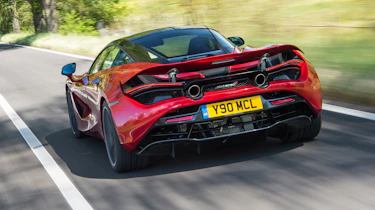
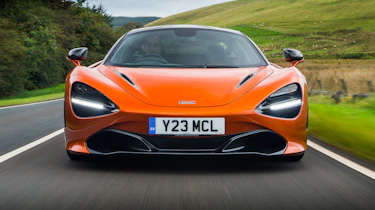
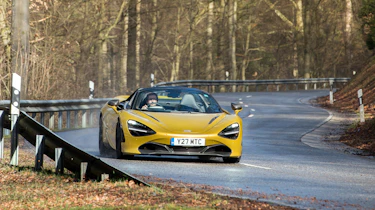
Time lessened the shock value of the 720S, and what remains is, to our eyes at least, one of the best-looking supercars on the roads. Distinctive, original and perfectly proportioned, it serves perfectly as both a unique design in its own right, and a centrepoint for the McLaren range as a whole, with varying degrees of extremity either side of it.
Engine, gearbox and technical highlights
- Mid-mounted 4-litre twin-turbocharged M840T V8
- Output of 710bhp and 568lb ft of torque
- Monocage II carbon tub contributes to low 1283kg weight figure
It’s fair to say that with a mid-mounted 4-litre twin-turbocharged V8 the 720S’s beating heart isn’t a huge mechanical departure from other McLarens, but it’s nothing if not startlingly powerful. McLaren quotes a peak power output of 710bhp at 7500rpm from the dry-sumped M840T unit, together with 568lb ft of torque at 5500rpm.
It’s attached to a seven-speed dual-clutch transmission, and as is customary with McLarens, an open rear differential, albeit one equipped with McLaren’s ‘Brake Steer’ system which replicates the limited-slip effect to a degree. Suspension is by double wishbones at both ends, with adaptive dampers and Proactive Chassis Control II – hydraulic cross-linking of the damping designed to balance the occasionally conflicting requirements of ride quality and body control. Unlike many competitors, McLaren still uses hydraulic assistance for its steering – and, not without coincidence, the 720S has fantastic steering, as we’ll discover later.
All these components are attached, via subframes, to the second generation of McLaren’s carbon Super Series structure, dubbed Monocage II. The structure itself contributes only 102kg of the 1283kg dry weight (1419kg at the kerb) and forms both the basis of the chassis, and acts as the passenger safety cell – as well as something from which to hinge McLaren’s customary butterfly doors.
It’s probably fair to say that fuel consumption isn’t a major factor in the purchase of many McLarens, but for those who wish to know, McLaren quotes a combined WLTP figure of 23.2mpg, with a low of 12.1mpg and a high of a remarkable 30.7mpg – not bad at all from a 200mph-plus supercar.
Performance, ride and handling
- Astounding straight-line performance
- Sophisticated cross-linked suspension straddles comfort and poise
- Extreme levels of performance hold up almost a decade on
The road test figures for McLaren’s legendary F1 have been seared into every petrolhead’s brain for the last few decades, but in recent years we’ve seen its remarkable acceleration numbers fall to dozens of new models – even if precious few have ever beaten its top speed.
Predictably, the 720S is one of several cars that will get from a standstill to 62mph in less time, somehow finding enough traction off the line for a 2.8sec run. Zero to 62mph takes another tenth, with 124mph done in 7.8sec, and the quarter-mile would please Dominic Toretto, over in just 10.3sec. Top speed is 212mph.
We can provide a few more figures, having independently tested the 720S to 60mph in 2.9sec, and clocked 0-100mph in 5.6sec. We’ve also run the 720S at Anglesey’s coastal circuit, which provides a great basis for comparison with other supercars. At 1:11.5, it’s actually 1.1sec quicker than the P1 hypercar on its standard road rubber and only three-tenths off a P1 on sticky Trofeo R tyres.
The 720S is very much one of those cars that feels good for its numbers, too. In fact, you’d swear it was making more than its 710-horse output, given the way it’ll get from one measure to another on an autobahn or circuit. You’d not know it at idle, when the engine sounds harsh and faintly gravely. Get up to speed though and it feels faintly unhinged, particularly on dry roads where it’s easier to find traction. The rush is accentuated by a real build-up of boost through the mid-range and you feel like Slim Pickens hanging on at the top end. While McLaren’s yet to build a V8 that has true aural appeal, the angry blare as the revs rise and rushing whoosh of the turbochargers is fully appropriate for the way the 720S absolutely lunges up each straight.
Despite the huge potential, though, the engine also has a milder, useable side, quiet and smooth at lower speeds, and the dual-clutch ’box is as happy to trundle around as it is swapping cogs at the red line. The build-up in power delivery does give the V8 some character too – adding an element of excitement to every journey knowing huge potency is just a throttle-squeeze away.
A wise person once said ‘what is good for ride is good for handling’, and it’s a saying McLaren has taken to heart, the 720S dealing with iffy surfaces better than some hot hatchbacks. The result isn’t just a car that’s surprisingly comfortable, but also one that makes light work of roads that would feel a lot busier, and require a lot more driver input, in some of its rivals.
It’s a factor of that hydraulically interlinked suspension set-up, which takes the place of conventional mechanical anti-roll bars. While anti-roll bars do what they say on the tin, controlling roll around a car’s axis, linking each side of the car can be detrimental to ride comfort, with bumps at one wheel having an effect at the other. Like an old Citroën – albeit a lot more sophisticated and controlled by some mind-bending algorithms – McLaren’s set-up allows for both compliancy and control.
It has limits, even given the stiff carbon structure – it’s not immune from potholes, and really sudden intrusions can still thump through the chassis. But for the most part, the 720S rides with an impressive fluency.
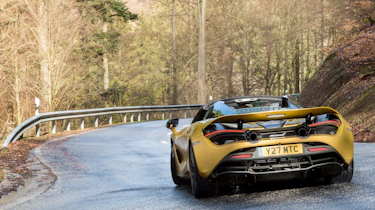
As you’d expect, it’s also a capable handler. Key to its appeal is the steering, which is about as good as it gets short of McLaren’s own hardcore, slack-free ‘Longtail’ models. The wheel feels quite light at first, but perhaps a better way of putting this is that it isn’t artificially heavy – there’s simply not much weight sitting over the front axle, and on the move there’s a constant stream of feedback tugging lightly through the rack. Precision and response are both perfectly judged too.
Few supercars inspire so much confidence over the first few miles, at least in the chassis department – with the full performance of that engine never far away, you’ll tread more carefully on the right-hand pedal than you’ll lean on the front end.
The 720S will carry huge speed along a road, and feels spectacular when you’re in the groove. It’s also got a more intimidating side though, harder to read when the chassis starts moving around – something you’re admittedly more likely to discover on a track than on the road.
evo Car of the Year 2017 verdict – Stuart Gallagher
‘Throughout the year the 720S has proved its credentials at every opportunity. From our first drive back in May (evo 236), contributing editor John Barker concluded: ‘The new generation Super Series McLaren is astonishingly, effortlessly fast, and remarkably efficient. You can cover ground at an unbelievable pace in complete control, and yet feel oddly unexcited.’ Damning with faint praise? Slightly. But with more exposure, more time behind the wheel and more superunleaded fed into its 4-litre V8, the 720S came to us more, got under our skin and proved to us why it’s worthy of the 2017 crown.
‘A 2000-mile road-trip (evo 242) had Adam Towler convinced: ‘Precision is, for me, the 720’s defining characteristic, but by no means its only one. Completely absorbing, frighteningly intense, life-affirming, but not inherently scary – everything the car does is defined by absolute precision.’
‘Steve Sutcliffe described the 720S as an intense experience when it came to extracting a lap time from it (also issue 242): ‘Insane. Absolutely, brilliantly insane.’ James Disdale found it equally enthralling: ‘It’ll cause no more sweat on the commute than an executive saloon, but find the right road to fully explore its potential and you’ll experience the biggest hit of undiluted adrenaline this side of a base jumper.’
‘For me the 720S is all of the above, but it’s also what it says about the company, how far it has come and, perhaps crucially, what is yet to follow. The 720S is the product of a manufacturer that hasn’t changed its focus on wanting to build the most exciting, thrilling and best performance cars it can despite any obstacles it has faced along the way. McLaren Automotive has defined itself as one of the greats, and in the 720S it has created the best of the best: evo’s Car of the Year.’
Interior and tech
- Comfortable cabin offers unsurpassed panoramic views
- Excellent driving position and neat layout
- Flawed infotainment and confusing controls
It’s a tale of two parts inside the 720S. On the one hand, this is a clean, modern and comfortable cabin with some fabulous details and a view of the road almost unsurpassed among supercars. On the other, McLaren’s vision of in-car entertainment still lags sorely behind that of rivals.
Good stuff first. Enter through the dramatic butterfly doors (you’ll find the microswitch behind the upper edge of the sinuous air intake) and you’re presented first with a reasonably chunky carbon sill to step over, and then an artfully designed and well-trimmed cabin. With a huge range of personalisation available there’s little point in commenting on individual material or colour choices, suffice to say the cars we’ve driven so far have all felt absolutely appropriate for the class.
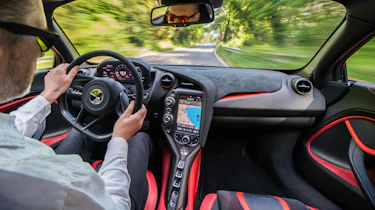
Several elements are as close to perfect as you’re likely to find. The driving position is generally excellent, with a slim-rimmed wheel ahead of you, shapely seats, and a panoramic view thanks to the glassy cockpit. The view forward isn’t unlike that of a Lotus (or an old Honda NSX), with a low scuttle and, thanks to the stiff carbon structure, fairly slim forward pillars.
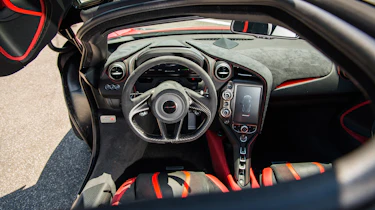
The two pedals are arranged in such a way that left-foot braking is encouraged, which may take a little getting used to for some drivers, though right-foot braking certainly isn’t out of the question even if there’s been some compromise made on the brake’s location. The two seats are positioned either side of a fairly slim centre tunnel, but it’s not so tight you’ll rub shoulders with your passenger – and the vertically stacked controls on the narrow centre console look neat.
Directly in front is a digital screen for all the vital functions, while Track mode rotates this unit to a slim bar-graph with only the essentials. There’s another screen though on the dashboard, and it’s this that may cause some issues. There’s little wrong with it aesthetically, but McLaren’s ‘Iris’ infotainment set-up is just a little tricky to navigate, slow to respond and occasionally unreliable, and while you do get physical hot keys to swap menus, it’s still a nuisance controlling minor functions through the screen.
There are a few other ergonomic issues too. The spoon-like controls behind the wheel for functions such as cruise control and the car’s nose lift never seem to operate the same way twice, while McLaren’s driving mode arrangements – two, four-position rotary dials, which operate differently depending on whether the Active button between them is pressed – are borderline unfathomable.
Price, rivals and buying guide
Since the rise of McLaren Automotive in 2010, it’s been aimed squarely at one marque: Ferrari. The 12C fought the 458, the 650S fought the 488, the 720S went toe-to-toe with the Ferrari F8 Tributo, while its successor the 750S is Woking’s riposte to the Ferrari 296 GTB.
What makes the 720S especially interesting however, is that it’s a serial depreciator. None is a more prominent poster car for depreciation in the premium and performance car space, except perhaps for the Porsche Taycan. Not great for McLaren’s image, excellent for those who want an eCoty-winning supercar for BMW M5 money. Early examples have already dropped as low as £100,000 – a fall of £100k from the basic, non-optioned figure they were worth originally. In terms of bang for your buck, they’re a bargain that should be too good to ignore, though there are caveats.
Those caveats are around reliability. A wise buyer of an early 720S will secure a warranty to cover off the issues they can suffer. The engines can be susceptible to failures due to relatively weak pistons and cylinder liners. They can also suffer with electrical issues and the infotainment system was somewhat on the back foot from launch.
New buyers received a three-year unlimited mileage warranty, but it’s well worth plumping for the extended 12-year warranty if you’re intending to keep the car for longer, covering the majority of mechanical and electrical components, with a few exceptions. It’s also available on used cars, which will be good news to anyone eyeing up examples dipping down to the £150,000 mark.
Otherwise, specialists are there to take care of any issues you might have. Thorney Motorsport have risen to the fore in recent years as the preeminent McLaren experts that in a worst case scenario, can fully rebuild a McLaren V8 with a 12-month warranty for £25k.
McLaren 720S specs
| Engine | 4-litre twin-turbocharged V8 |
| Power | 710bhp |
| Torque | 568lb ft |
| Weight | 1283kg |
| Power-to-weight | 553bhp/ton |
| 0-62mph | 2.8sec |
| Top speed | 212mph |