Bentley Blower review – we drive the world’s oldest supercar
It featured a supercharger that Bentley founder WO considered a 'perversion'. It ended up as one of the company's most iconic models
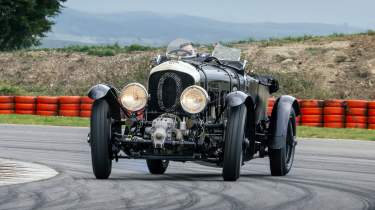
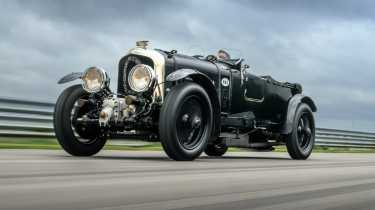
Formally known as the Bentley 4½ Litre Supercharged, the ‘Blower’ nickname was coined thanks to the huge Amherst Villiers Roots-type supercharger protruding from beneath its radiator. Much like Porsche’s later 930 Turbo, the novelty and impact of the Blower’s performance-boosting forced-induction system bestowed a kind of mononymous notoriety akin to today’s music industry celebrities.
The Blower was commissioned and initially self-funded by Bentley Boy ‘Tim’ Birkin before being bankrolled by the inordinately wealthy oil, banking and tobacco heiress Dorothy Paget. WO Bentley himself had no hand in its conception, and nor was it endorsed by him – by all accounts he hated it, stating that ‘to supercharge a Bentley engine [his engine] was to pervert its design’. Despite his engineering objections, the factory – by now under the financial control of diamond-mine heir Woolf Barnato – agreed to fund building the 50 road cars required to homologate it for racing.
Hugely potent and wildly expensive (roughly the price of two large luxury homes in 1929) and with cutting-edge competition pedigree, it was unquestionably the supercar of its day. It certainly has a rock-star aura when disgorged from its transporter. The Lotus test track at Hethel has surely never seen the like. If ‘Light is Right’, what’s this near 2-ton behemoth? We’re about to find out.
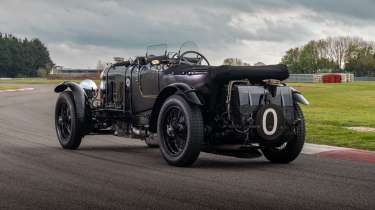
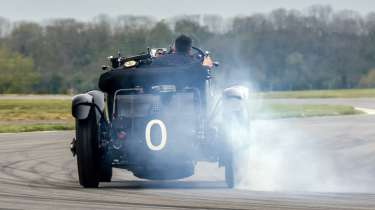
As denoted by the large ‘0’ painted onto the mesh of its huge radiator grille, this isn’t one of the original 1929 machines, but ‘Car Zero’, the now famous in its own right prototype for Bentley Mulliner’s extraordinary Blower Continuation Series.
Built in 2020, this wonderful car is the forerunner of the project that saw the most famous of all Bentleys – the factory’s original team car, UU 5782 – laser-scanned before every single component was remade from scratch using authentic materials and processes as in period to build a very limited run of perfect toolroom copies.
> Bentley Continental GT review – not Ferrari sharp, but still the ultimate grand tourer
Car Zero was the first car built from these parts, whereupon it completed more than 6000 miles of gruelling test and development mileage to prove the durability of the individual components and the ‘new’ car as a whole. Only then did the build of 12 £1.5m customer cars begin, a process that was completed in 2023.
With development duties done, Car Zero signed off with a six-hour endurance test at Goodwood, followed by competing at the Le Mans Classic to celebrate the 20th anniversary of Bentley’s 2003 Le Mans 24 Hours victory with the Speed 8. Evidence of Car Zero’s gallant duties is everywhere, the rash of stone chips, streaks of oil, smudges of soot and heat-scorched paint lending it the patina of its illustrious 1929 forebear. It’s a truly awe-inspiring creation and one I can’t wait to drive.
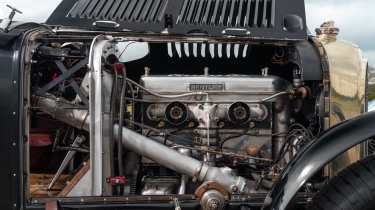
The technical specification is largely alien, at least if you were raised on reading about wishbone suspension, rack-and-pinion steering and sonorous multi-cylinder engines. Instead, what underpins the Blower reads – and looks – like a mash-up of automotive and locomotive.
The chassis was unchanged from the regular 4½ Litre, but the huge, pressed-steel ladder frame, complete with bracing bars and struts along its rails, looks like it possesses industrial strength. With Bentley’s drivers hammering it around Brooklands or La Sarthe, it would have needed it. Suspension is hefty and odd-looking to contemporary eyes, with half-elliptic leaf springs controlled by Bentley & Draper friction dampers – one per corner on the front and two per corner at the rear.

Steering is by worm-and-sector: a screw-shaped gear on the end of the steering column meshes directly with a partial gear (imagine a slice of cake with teeth around the outer edge), which in turn rotates a sector shaft. This is connected to Pitman arms that push or pull the steering linkages via hefty drag-links to turn the wheels left or right. Steer-by-wire it ain’t. The wheels are 21-inch steel-spoked rims shod with 6-inch-wide crossplys, and the brakes are large, mechanically operated (that means by rods, not hydraulics) cast-iron drums.
The 4398cc four-cylinder engine was advanced for the ’20s and features a cast-iron block and head, cast-iron cylinders and a crankcase made from a mix of aluminium and Elektron, an early magnesium-based alloy. A hollow, single overhead cam acts on four valves per cylinder, with twin-spark ignition supplied by a pair of magnetos. Two SU carburettors sit out in the breeze on the left-hand flank of the distinctive, ribbed, crank-driven supercharger.

Developing 240bhp at 4200rpm, the Blower had 50 per cent more power than the regular 4½ Litre Bentley upon which it was based. Contemporary figures state a top speed of 125mph with a 0-60mph time of 12sec, the former relying upon a determined lack of imagination and the latter heavily dependent upon the ability to cleanly navigate the non-synchromesh four-speed gearbox. As we’re about to discover, this is not without its challenges.
Everything about the Blower seems oversized. Unsurprising given that the wood-framed aluminium-skinned body stands tall atop the ladder chassis, itself riding high on those huge 21-inch wheels. To get in, you climb up on a step mounted on the passenger side, opening the small door and working your way across to the driver’s seat. Why no driver’s door? Because they had a nasty habit of bursting open, apparently. Quite what the riding mechanic thought of this is anyone’s guess, though they had enough on their plate without worrying about falling out.
> Bentley Bentayga review – Range Rover rival is a school-run bus fit for a king
The plump squab cushion positions you rather high. Better to remove it and sit on the floor, though it’s then hard to see forwards because of the high scuttle and large dashboard. Festooned with all kinds of weird and wonderful gauges, knobs, switches and mysterious glass bowls that are part of the supercharger’s manually adjustable drip-feed oil system, it’s distinctly steampunk.
The steering wheel is huuuge, so wide that holding it at quarter-to-three feels like you’re reading a broadsheet newspaper. It’s also sprung; that’s to say the hollow rolled steel rim is connected to the cast centre boss by spring steel spokes, which serve as a primitive form of shock absorber to isolate the driver’s hands from kickback and vibrations. Aston Martin F1 team please take note…
The wheel has a disconcerting amount of flex, which combined with the convoluted steering hardware means it’s both heavy and strangely disconnected. It takes a lot of getting used to. As do the pedals, which site the clutch on the left, as normal, but the throttle in the centre and brake on the right. Combined with a tall gearlever that rises vertically from the wooden boarded floor under the dashboard just ahead of your right shin, operating the Blower is like learning to drive all over again.
The engine is a real thumper, with the chuff-chuff-chuff of a vintage car spliced with a proper fwarrp from the fantail exhaust during wide throttle openings. There’s so much torque you don’t need any throttle to pull away, but it quickly gets a bit busy working up and down the ’box, as you always need to double declutch. Tricky when you find your brain sending instructions that your feet seem to disobey.
Timing is everything, the clutch pump and throttle-blip upshift needing to be just-so if you’re to avoid an ugly gnashing of teeth and a frustrating loss of momentum. Downshifts require even more thought, as in addition to the clutch pump, instead of instinctively placing the ball of your right foot on the brake pedal and rolling your ankle to the right to blip the throttle, you instead adopt a duck-like splay.
Pushing into the soft and largely unresponsive brake pedal with your toes pointing at two o’clock and then pushing your heel down to execute the all-important blip-assisted downshift is challenge enough. But when you’re fumbling under the scuttle to move the gearlever through the unbiased gate and are then caught out by brakes that are barely better than a strong headwind, attempting to hustle this immense machine is sobering to say the least.
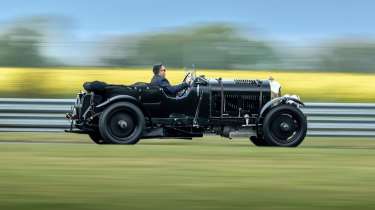
And yet, give yourself a chance, be more methodical in your approach and try not to overlap too many of those critical inputs and things start to gel. Accepting that for the most part you don’t need to downshift below third unless it’s a tight corner helps greatly, for it allows you to focus on how the Blower handles.
> New Bentley Continental GT S review – the sweetest Continental aimed at Aston Martin's DB12
Despite the unnerving combination of flexy sprung wheel and that worm-and-sector steering, the Blower is surprisingly accurate. It doesn’t like initial direction changes – something the weight of that chunky supercharger poking way out front exacerbates – but so long as your initial steering input is a commanding shove, and you help it along with a brief lift of the throttle, it’ll slice through faster curves with surprisingly little lock and genuine poise.
Tighter corners need more planning, as excess speed will see you quickly overwhelm the skinny front tyres, but judge your braking, nail your downshift, give it an encouraging lift as you turn in and, while it won’t exactly rotate into the corner, it finds enough purchase to allow you to pick up the throttle and steer it from the rear.
Sliding a Blower Bentley should be on everyone’s bucket list. It’s hard to see where you’re aiming, and such is the diameter of the steering wheel you’re unlikely to use more than a quarter of a turn of lock, but the sensation of powering it through a corner is utterly gleeful. There’s no limited-slip diff, so the inside wheel spins up if you’re greedy before corner exit (something you hear before you feel), but the fact this near-hundred-year-old design responds to the same basic high-performance driving techniques of using weight transfer to work different ends of the car makes it unexpectedly relatable.
The Blower’s great rival – and another bona fide supercar of the era – was the Mercedes SSK. With a 7.1-litre straight-six engine designed by Ferdinand Porsche and featuring an on-demand supercharger that only engaged when the driver pushed the throttle beyond a certain point, it was even faster than the Blower. While both cars fought a race-defining battle in the 1930 Le Mans 24 Hours, neither would win the iconic endurance race.
That honour went to WO Bentley’s preferred Speed Six racers, which famously benefited from the Blower and Benz’s self-destructive pace to take 1st and 2nd places in that 1930 race: the last of Bentley’s five pre-war victories. Ironically all were achieved with non-supercharged models, yet it’s the Blower that has always been the star. WO must be fuming.
Get a copy of evo 346 here for the full supercar origins feature, plus much more
Specs
| Engine | In-line 4-cyl, 4398cc |
|---|---|
| Power | 240bhp @ 4200rpm |
| Torque | n/a |
| Weight | c/1720kg (c/142bhp/ton) |
| 0-60mph | c/12sec |
| Top speed | c/125mph |
| Price new (today's money) | £1720 (£100,000) |
| Value now | £500,000-plus depending on history for original non-team cars, £2million-plus for Continuation series |