Alfa Romeo Giulia Quadrifoglio Luna Rossa review – a yacht-inspired saloon for Ferrari-inspired money
Many of the styling touches are in dubious taste, and the estimated £250k asking price for this special edition is faintly absurd, but any chance to reacquaint ourselves with Alfa’s beguiling Quadrifoglio supersaloon is still to be grabbed with both hands

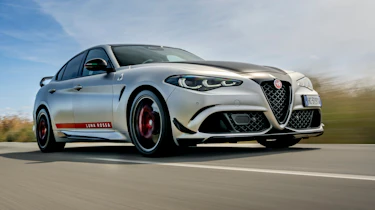
The Alfa Romeo Giulia Quadrifoglio is destined to become one of those cars, a little like the Elise was, or the Nissan GT‑R, that is more or less immortal, and one we never tire of finding excuses to drive. The original was launched back in summer 2015, making it 11 years old, so it’s not yet as era-spanning as an Elise or GT‑R, but with no obvious successor in sight, there are a good few years in it yet.
We are, however, approaching the Austin Mini playbook of stringing the Giulia out with a special model every year or two. Alfa has so far resisted the urge for a Flame, Sidewalk or Italian Job, but we do get one called the Luna Rossa. Now, you don’t need an A-level in Italian to figure out what the name translates to in English, but you might need an insight into product planning to figure out why this model exists. On one hand, it celebrates the Italian sailing team of the same name, and one of the car’s distinguishing features is a section of the sail from the 2024 America’s Cup entry used as a dashboard inlay. I assume the team has since acquired a new sail and didn’t one day wake up to find a load of triangles cut out of its existing canvas.
More reviews
> Alfa Romeo Giulia Quadrifoglio 2026 review – Italy’s BMW M3 isn’t dead yet
The other purpose of the Luna Rossa is as a bit of a shop window for Alfa Romeo and Maserati’s ‘Bottegafuoriserie’ department. It’s best-known for the Maserati-based Alfa 33 Stradale that evo drove last year (issue 334), and when you clock the Luna Rossa’s cosmetic additions, there’s an argument to be made that they should probably continue to promote the 33 as the best example of what the department can do…
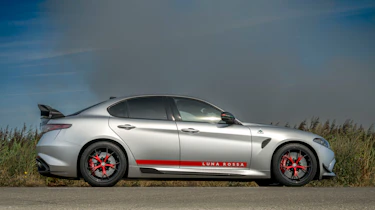
At first glance, and then for several more glances after that, it’s whatever the romantic Italian term for a dog’s dinner is. In ascending order, from least appealing to the elements that would be welcome on the options list for the regular Giulia, we start with the red side-stripe with the sailing team’s name emblazoned on it, closely followed by a set of all-red and all-naff Alfa badges. Next up is the matt-black treatment on the bonnet and bootlid, and a curious red-to-black fade on the otherwise attractive slim-spoked 19-inch wheels.
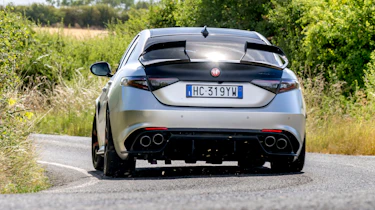
Better is the carbonfibre roof panel and matching door mirror caps, and then the Luna Rossa’s unique carbonfibre aero package: dive planes at the front, side blades along the skirts, and a striking rear wing – or rather, two rear wings – inspired by the foils on the Luna Rossa AC75 yacht. Together they contribute 140kg of downforce at 186mph, five times more than a standard Quadrifoglio, and sit upon an iridescent, steel-effect silver finish. Along with the slice of sail on the dash, there’s another of those red badges on the steering wheel, while the Quad’s excellent Sparco seats are trimmed in a neoprene-style material, another nod to the Luna Rossa crew’s equipment.
Engine, gearbox and technical highlights
Bottegafuoriserie hasn’t touched the mechanicals, so there’s the same 513bhp, 2.9-litre twin-turbo V6, eight-speed automatic, and mechanical locking diff of the regular car. Likewise, the chassis tuning is unchanged, which means electronically adjustable dampers, sizeable carbon-ceramic discs with brake-by-wire, and a ‘DNA’ switch that can tweak the behaviour of the suspension, steering, throttle, gearshift and exhaust.
Coincidentally, this is all stuff that didn’t need any fiddling with. Settle behind the wheel, try to ignore the red badge, and the Giulia still feels just right. The tape measure doesn’t suggest a huge difference between a Quadrifoglio and an M3 (other than in length: the Alfa’s 17cm shorter) and they’re of similar weight, but the Giulia still feels light and nimble in a way we’ve loved now for over a decade. The quick steering is initially a little disconcerting, but you key into it within a few corners, and while it’s overly light in Normal mode, it’s spot-on in Dynamic.
Performance, ride and handling
The fluidity is still there too. Shortly after collecting the car, I wonder if Alfa’s surreptitiously firmed it up over the years, but I think it’s probably just that the roads have got worse; in Normal it’s very pliant indeed at higher speeds (to the point where there’s some float over undulations), and in Dynamic it’s much better tied-down without losing its ability to deal with poor surfaces.
Engines with 500+bhp have never been friendlier either. The V6 is a little tuneless these days (some Ferrari 296-style musicality would be welcome) but few high-performance engines make it so easy, or predictable, to meter out their power. Under hard acceleration there’s the sensation of the rubber smearing along the road surface proportional to the pressure of your right foot, and this sense of connection means the engine further contributes to the absolute joy of cornering in these Alfas.
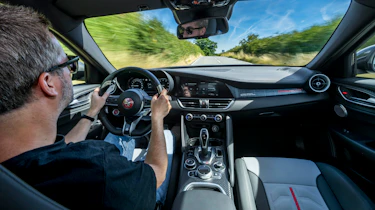
Brake hard (with way better feel and progression than in the early days), click down a few ratios using the fabulous metal shift-paddles, and put the nose exactly where you want it with one flick of the steering. If there’s another corner immediately after, it’ll follow that line too, since rapid direction changes don’t seem to faze it, and then you can blend into the power just enough to feel the rear tyres subtly arc around, letting you straighten the steering before corner exit.
In other ways the Giulia is feeling its age. The infotainment system is geriatric, the A-pillar trim on both sides buzzed in our test car, the right rear door appeared to be a different shade of silver to the rest of the car, and I ran out of fingers to count how many times the driver-side door didn’t shut properly on the first pull. Maybe the ten Luna Rossa buyers each paying an estimated £250k won’t notice, as it’ll get stashed deep in a collection somewhere. It’s a little more irritating on an £87,155 standard Quadrifoglio, but on the plus side you’re getting a much better deal, and a more tasteful car to show for it.
Alfa Romeo Giulia Quadrifoglio Luna Rossa specs
| Engine | V6, 2891cc, twin-turbo |
| Power | 513bhp @ 6500rpm |
| Torque | 442lb ft @ 2500-5000rpm |
| Weight | 1660kg (314bhp/ton) |
| Tyres | Pirelli P Zero Corsa |
| 0-62mph | 3.9sec |
| Top speed | 191mph |
| Basic price | £250,000 (estimated) |