Alpine A110 R (2023 - 2026) review – the flawed but fantastic Porsche Cayman GT4 alternative
Designed for the track but brilliant on the road, the R takes the Alpine A110 in a different direction. It’s a uniquely thrilling car
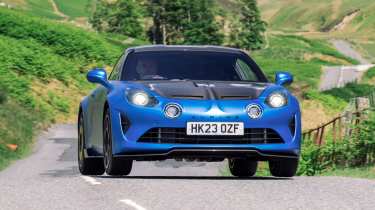
Now out of production as of July 2026, the Alpine A110 R has become a modern classic in its own lifetime. Launched in 2023, it was an even lighter, more focused and thrilling version of the A110 – albeit also a version which was also far more expensive, and came with its own unique set of compromises.
‘Less is more’ is the gospel so often preached when it comes to sports cars and there are few better examples of this minimalist mantra than the Alpine A110. The regular model weighed an already barely believable 1102kg and Alpine pushed things even further with the track-focused A110 R, trimming that figure down to 1082kg in the pursuit of performance. That such weight savings were made on an already featherweight car was testament to the French marque’s fastidious approach. Indeed, the only heavyweight part of the A110 R was its £89,990 price tag at launch (£28,000 more than the A110 S), which grew to £106,490 for 2026’s final R 70 run-out model. Even this, however, was an indication of the fervent following within Alpine’s global fanbase.
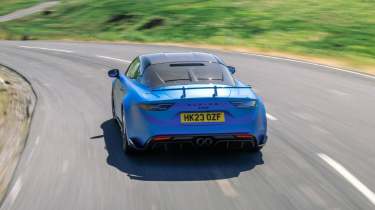
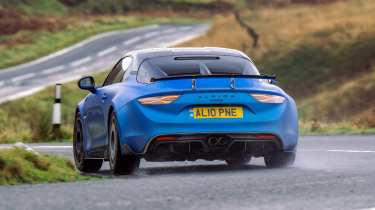
The formula for the A110 R’s impressively shredded physique is a high-fibre diet. Carbonfibre to be precise, the expensive and exotic material being employed extensively across new and highly effective aero parts, plus the bonnet, roof, engine cover (meaning there’s no rear window), seats and even the wheels. The resulting look is reminiscent of the Weissach Pack offered on Porsche’s RS models, with large areas of unpainted bodywork giving the normally chic-looking A110 a suitably skunkworks vibe.
More reviews
Unashamedly aimed at circuit use, Alpine describes the R as an A110 that’s ‘dedicated for the track and useable on the road’. For context, it describes the A110 S as ‘sporty on the road and credible on track’. It’s an important distinction, because it frames the R as a car that promises to be scintillating around a racetrack but possibly compromised on the street. Our experiences with the R have proved, in fact, that it’s actually just as rewarding on the road – arguably even more so – as it is on the track.
Engine, gearbox and performance
- Same 1.8-litre in-line four as A110 GTS
- With 296bhp output unchanged
- Seven-speed dual-clutch transmission
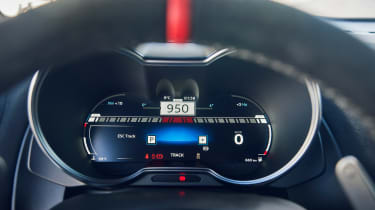
Top speed is 177mph, up 6mph over the A110 S, with 0-62mph arriving in 3.9sec, 0.3sec sooner. Transmission is the same seven-speed, dual-clutch paddleshift with auto, manual and Sport modes as the regular A110.
Perhaps the biggest area of contention is the 1.8-litre 296bhp turbocharged four-cylinder engine, as it’s the same unit used by the A110 S and GT (later amalgamated into the single GTS model for 2025) and one of the few areas of the R to remain unchanged. Alpine rightly contends that efficient performance through lightweight construction and slippery aerodynamics is integral to the brand’s DNA, but reading between the lines if it weren’t for the punitive CO2-related tax applied to high-performance cars in France, you sense the R would have had its wick turned up to further boost its performance and sweeten the substantial price hike.
With a little over a ton to propel, 296bhp and 251lb ft equate to healthy power- and torque-to-weight ratios. The engine has a carefully optimised – but not synthesised – soundtrack that has a pleasingly gutsy growl under load and exhales through a new 3D-printed twin-wall tailpipe.
Having said that, there’s a fruity paradiddle of pops and bangs on the overrun – the same three pops, every single time – which can get tiresome if you’re on a road that has you repeatedly on and off the throttle. As turbocharged four-cylinder engines go it’s characterful enough. Just don’t spend too long considering the kind of engines £90k can buy you access to on the used market.
Pace wise you never feel truly pinned into the seat when accelerating through the gears, but the A110 R is a deceptively quick car in a straight line as well as corners. It romps along very nicely indeed, the firm brake pedal encouraging you to brake late and deep and the snappy DCT gearshifts punching up and down the ratios with crisp urgency. It’s in these moments that the R driving experience really crystallises.
Clever tweaks to the exhaust and induction system have brought more breadth and volume to what you hear – especially under load – but there’s no ignoring the powertrain lacks aural sparkle. The chassis and aero improvements are meaningful but leaves an imbalance in that they are lacking the engine performance to stretch them.
On the positive side, being so light the A110 absolutely makes the most of what power and torque it has got. Aftermarket tuners such as UK-based Life110 offer a 280lb ft remap (an increase of 29lb ft) while Litchfield goes further with 306lb ft and an accompanying 10bhp lift. Each makes a meaningful difference, largely because you can take most corners a gear higher, but there’s still much to enjoy with the standard power output.
Ride and handling
- Adjustable dampers and ride height
- Stiffer springs and special bump-stops
- Full carbonfibre wheels by Duqueine
The chassis upgrades speak of a car targeting outright pace, with coilover suspension that uses ZF dampers, Eibach springs (10 per cent stiffer and now employing main and helper springs for the first time in order to save some weight) and new bump stops made by BASF.
With 20 clicks of combined bump/rebound damper adjustment and ride height settings that drop the R by 10mm for road use and 20mm for track, there’s plenty of scope for set-up tweaks. Completing the hardware changes are stiffer anti-roll bars front and rear (by 10 and 25 per cent respectively), plus a set of sticky semi-slick Michelin Pilot Sport Cup 2 tyres wrapping those carbon rims, which themselves save 12.5kg in total. The standard damper set-up in Europe is on 9 clicks, which leaves 11 more to play with before the R is in full soft.
Given its track bias there’s a similarly extensive aero upgrade, with a new front splitter, side skirts, rear wing and diffuser upping the downforce levels and altering the aero balance. This balance has been shifted rearwards to aid high-speed stability, while drag has been reduced by the integration of air intakes in the carbon bonnet amongst other wind-cheating mods.
The 320mm Brembo brakes are the same as those fitted to the A110 S and GT, but cooling has been improved by 20 per cent thanks to some neat (and patented) airflow management that reduces peak disc temperatures by up to 90deg C.
The ESP system has been tuned to suit the R’s increased grip levels and altered balance, while the carbonfibre wheels – made with a more repeatable, less laborious industrialised manufacturing process than that used for many such items and handled by aerospace supplier Duqueine – feature bonded structural facings (don’t call them wheel trims!) that differ from front to rear axle, each design optimised for cooling and reduced drag.
Alpine’s initial presentation of the A110 R suggested it prioritised lap times over on-road prowess yet despite the obvious increase in spring rates, damping control and resistance to roll, there’s an underlying pliancy that helps it shine on decent roads.
Whatever the road on which you’re driving, be it motorway or mountain switchbacks, the R feels more of an event; special in unexceptional circumstances and more charismatic when experienced away from the singular challenge of a racetrack. It feels keener and more energised than any A110 before it. Unlike a circuit, where you can rapidly find and ultimately breach the limit of grip and have the space and freedom to accelerate through the gears with everything the R can muster, the public road presents more fleeting opportunities to uncork its performance and feel it come alive.
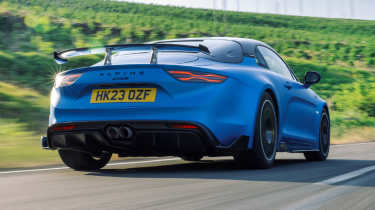
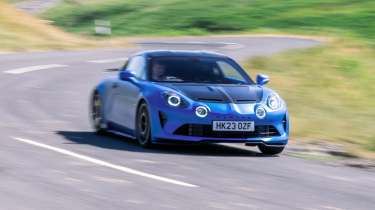
With greater body control and grip the R revels in direction changes, its appetite for apices matched only by the enthusiasm with which it surges between corners and the self-assured way in which it dives into braking areas. There’s a confidence about the R that gives you tremendous encouragement, and a deftness of touch that provides sensory confirmation that this is indeed a lightweight sports car that’s far from light on feel. Few if any new cars on sale today feel quite like this.
Our first drive was on smooth Spanish tarmac on the R’s international launch, however, the pliancy of its damping (and light body for which the suspension to carry) makes it genuinely supple on broken British roads too.
In fact, in its baseline set-up we’d say the R shines more brightly on the road than the track, where the tighter body control and increased sharpness make it a dazzling partner, whether the road is fast and flowing or tight and technical. It’s a more cerebral sports car, one that excels under braking and loves stringing sequences of turns together as only a car liberated from the limitations of inertia can.
In cold, slimy weather conditions the Michelin Cup 2 tyres take longer to get heat into than when fitted to other cars, perhaps because the Alpine is so light. It remains a little squirmy around roundabouts for quite a few miles into a journey but it telegraphs its limits so clearly and gives such a well-matched response to every input that it never feels like a fish out of water, even in stormy weather.
Track testing
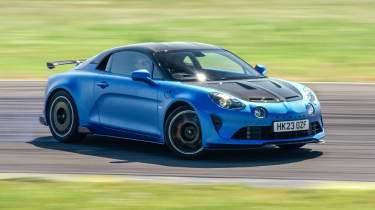
Launch venue for the A110 R was Jarama, near Madrid. Its compact layout lends itself to street cars thanks to a sinuous mix of corners, sizeable gradient changes, a long, swooping main straight and plenty of big braking areas. The Alpine doesn’t feel lost here, but it does feel a little lacking between the corners.
Balance-wise the A110 R is resolutely stable. If anything it’s too keen to run its nose wide in slow- and medium-speed corners. Fast corners are its forte, but it seems that in controlling the A110’s tendency to roll into oversteer, and trimming out the front-end downforce so it’s not too pointy in high-speed corners, the R has sacrificed the playfulness of its siblings without gaining the kind of aggressively grippy front end that would feel like a fair trade.
It’s taken rather a lot of effort to persuade it to slide for our photos, and while that’s overly reductive in terms of measuring the R’s capabilities, it does point to a car that’s prescriptive in the way it wants to be driven. Given its commitment to delivering a definitive trackday experience, not to mention the abundant character of the base car, the R felt – initially – a bit one-dimensional. That first impression has softened in our subsequent experiences with the car, however, which have revealed greater depths.
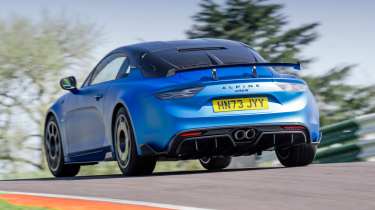
We’ve tested the R on track subsequently in evo’s 2024 Track Car of the Year contest at Lincolnshire’s Cadwell Park, where it came very close to finishing on the podium. For that test, the set-up was tweaked with a lower ride height and some rake plus more aggressive camber and toe, all changes which would be achievable by an owner (though it’s more easily done in a workshop than trackside). The set-up tweaks made it more engaging and incisive than on the original launch at Jarama.
‘Once you have heat into the tyres it feels quite close to the Porsche 911 GT3 RS in some respects, in that you’re aware of extraordinary grip and corner speeds, but the driving experience is very true to the regular Alpine,’ Richard Meaden said during TCOTY, adding: ‘It’s found its happy place at Cadwell.’
We’ve also driven evo’s long-term A110 R 70, in its standard suspension set-up, on evo’s track evenings where its handling has been more in line with the launch – relatively safe, nose-led and stable, and a little more one-dimensional than some cars. Nonetheless, it’s fantastic fun to drive on track and with such light weight, it doesn’t wear out its tyres and brakes as heavier road cars do. It’s very much fit for purpose and fantastically rewarding to lap in.
Interior and tech
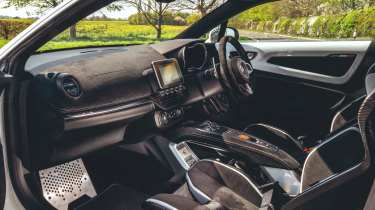
- No interior mirrors but parking camera included
- Single-skin carbon bucket seats by Sabelt
- Six-point harnesses with no traditional seatbelt
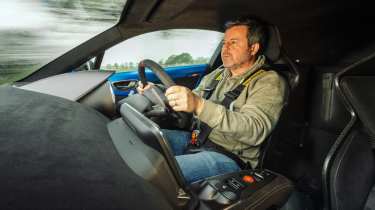
Inside it’s a blend of familiar A110 design and dedicated R items. Foremost amongst the latter are the Sabelt single-skin carbon seats. Featuring strategically positioned pads attached with Velcro, they are very supportive and – perhaps surprisingly – extremely comfortable.
Six-point harnesses are also standard. Few things are more frustrating than race belts in road cars, especially when there’s no inertia reel fitted as an alternative, but they’re a statement of intent and bring added safety for track use.
Grappling with the harnesses for every journey does make using the R as a daily-driver a more frustrating experience, especially for the passenger, whose seat is bolted in place. That also makes ingress and egress a bit trickier in parking spaces, and an occasionally bruising experience on the unforgiving carbon of the seat’s side supports.
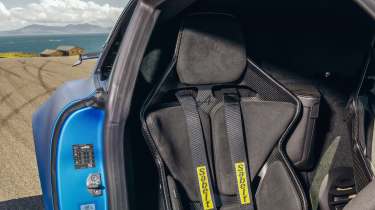
Having no main interior mirror isn’t as much of an issue as it may seem, though you do need to watch the door mirrors closely and develop a sixth sense for scooters and motorcycles. Checking your blind spot is trickier than in the regular A110 due to being harnessed firmly into the seat, and so you need to ensure you line up as squarely as possible at junctions to avoid needing to slacken the harnesses to lean forward and get a better view.
Were there more budget for Alpine to spend on the car, a permanent camera display in place of the rear mirror would have been a handy addition.
Like the regular A110, there are physical air-con controls (and the A/C works brilliantly in hot weather). The touchscreen is rather clunky to use but does include Apple CarPlay and Android Auto. Like other A110 models, there is no dedicated volume control for passengers. This is very much a driver-focused car.
MPG and running costs
In its time on long-term test with evo, the A110 R has been averaging mpg in the 30s bracket but higher figures are possible driven gently on long runs. The light weight and slippery shape help it greatly in that regard.
Standard Michelin Pilot Sport Cup 2 tyres are more costly to replace than regular rubber and need to be factored in, plus it pays to be mindful of kerbs – the carbonfibre wheels certainly won’t be cheap to repair or replace. The A110 R sits in insurance group 50.
evo Car of the Year 2023 result
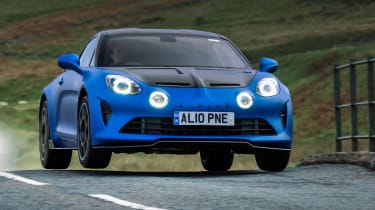
The Alpine A110 R finished second at evo Car of the Year 2023 in issue 317, just 0.6 points off the winning 992-generation Porsche 911 GT3 RS. Here's our summary of its performance, by editor-in-chief Stuart Gallagher:
'So close. So very close. But when all the votes were finally cast, the A110 R’s blistering eCoty journey came to an end on the second step of the podium.
'On eCoty the stripped-back, superlight A110 was a revelation. It required so few miles to understand it and discover just how special it is that each judge in turn would actively push their colleagues towards it. ‘Go on, have a go in it on this road. It’s sensational,’ was the only encouragement I needed from Peter Tomalin one particular afternoon.
'Adam was first with the superlatives when the votes were being cast: ‘I love this car. I wanted to put it top but my adoration of the GT3 RS was just too strong. Nevertheless, as an A110 fan I was pre-sold on the way this car drives, and the R spec only adds to the experience.’ Henry was equally enthused. ‘As rare and refreshing as having a sorbet halfway through a hefty meal,’ he purred. ‘Every time I got behind the wheel of the Alpine it felt at least half a ton lighter than whatever else I’d been driving.’
'Its 1082kg kerb weight was a welcome reminder that less is so much more where mass is involved. ‘Why can’t more cars be like this?’ pondered Peter. ‘You can sense literally from the instant the wheels start turning just how light it is. Brush the throttle and there’s real urgency, a sense of almost zero inertia.’
'The lightweight approach also benefits damping. ‘Even on really dilapidated roads that pretty much anything else would struggle with, the R doesn’t flinch,’ said James, while Dickie added: ‘I just like the way it goes down the road. It’s a horrible motoring journalist cliché but as soon as you drive it out of the car park and onto the road it just feels so good.’
'Then there’s its size, perfectly suited not only to tight UK roads but any road. And the fact that it’s such a simple, straightforward car to operate. There’s no agonising over which mode to select; it’s a simple driver’s car that simply does so much brilliantly. What counted against it? The engine and transmission still didn’t find favour with a handful of judges. Some also felt it required a specific type of road to perform at its best where others thought it great everywhere. But in this company, over this week, in all weathers, the small, blue sports car delivered a performance beyond expectation and was beaten to the top spot by a measly 0.6 of a point.'
Price, specs and rivals
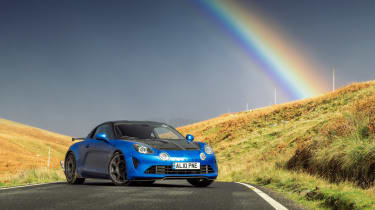
At the end of the Alpine A110’s production run, the R was superseded by the £106,490 R 70 edition, which celebrated 70 years of the Alpine marque. It was limited to 770 units worldwide. Within that number were three further Tricolor-themed special tribute editions, in Glacier White, Caddy Blue and Seismic Red, limited to 70 cars respectively. There’s no getting away from the fact that the last A110 Rs cost very roughly double the price of the original base-model A110. It was expensive on its arrival, costing from £89,990 at launch in 2023.
Whether it is worth it or not depends on your point of view. There’s no doubting the quality of componentry fitted as part of the uplift in price, and dynamically, the R absolutely can do things that the base car cannot. In becoming stiffer, more focused and less usable it also travels further away from the soft, classic-car-like character of the base car. That said, it still handles bumpy roads remarkably well and it’s a car in which you can get into a magical flow on UK B-roads and Continental mountain passes alike.
Given the £-per-bhp maths, you can buy more bang for your buck new or used, but if you love purity and obsessively detailed engineering then there is much to celebrate in this car. Rare and exotic with admirable authenticity and an unmatched kerb weight, it’s got true star quality. Does it deliver on its promises? If you approach it with your eyes open then yes, but also no. This is a very particular take on the track-focused sports car, one that majors on the cumulative effect of marginal gains and demands you look beyond raw performance and dry-mouthed thrills.
Direct rivals are few. Porsche’s aforementioned Cayman GT4 is a more rounded car overall though also a more predictable choice. The new Lotus Emira 420 Sport is plusher but less nimble. It too features aluminium construction – and in fact, there’s no small amount of Lotus know-how in the A110, given many ex-Lotus personnel were involved in its initial creation. One could argue the closest cars in ethos to the A110 R are some of the harder-core models in the Elise range, though the Alpine is a more usable car day-to-day.
Specs
| Engine | In-line 4-cyl, 1798cc, turbocharged |
|---|---|
| Power | 296bhp @ 6300rpm |
| Torque | 251lb ft @ 2400-6000rpm |
| Weight | 1082kg (278bhp/ton) |
| 0-62mph | 3.9sec |
| Top speed | 177mph |
| Basic price | £89,990 at launch in 2023, £106,490 for R 70 edition in 2026 |