The subtle trick that makes Audi’s old interior better than a touch screen
Its tech is no longer state of the art, but it’s got ease of use nailed

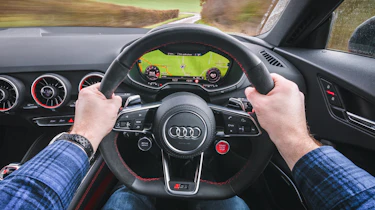
Instruments with hundreds of possible display combinations. A touchscreen that’s infuriating to operate because the natural movements of a car mean you’re forever accidentally brushing the wrong option. A touch-sensitive button on the end of a steering-wheel spoke that your palm sometimes catches when you make a turn, activating something you didn’t want activated. The Audi TT has none of these things, and is very much all the better for it.
Instead there are real buttons that go ‘click’ when you press them and rotary controls that go ‘tick-tick-tick’ when you turn them. As for screens, there is just the one: the so-called Virtual Cockpit. When it debuted all the way back in 2014 – on the TT, no less – it initially seemed like Audi swerving the expense of fitting two screens to some of its models, but in fact it proves you don’t really need a faux iPad glued to the middle of your dashboard.
> Audi RS5 Review - the fast estate that takes the fight to BMW’s M3
It’s funny how something that was cutting edge a decade ago now seems almost old-fashioned. So simple, too. Unlike more recent offerings, there are essentially just two ‘looks’ to flick between: either large speed and revs dials with a small info panel in the middle, or small dials out to the sides to maximise the space for whatever’s in between – perfect for the nav map or Apple CarPlay/Android Auto. But the overall style and layout stay broadly the same regardless, which keeps it at-a-glance understandable all the time. The graphics may lack the whoosh and sparkle we’re used to seeing these days, but instead they’re just really bloody legible, which is actually just really bloody nice.
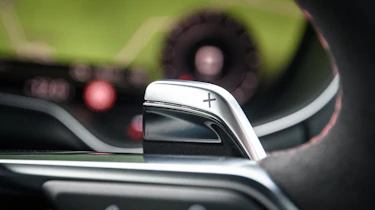
Less nice are the shift paddles attached to the back of the steering wheel. They’re bigger than some Volkswagen Group items, extended by an additional section of silvery plastic, but I’d swear this makes them sound even worse when you operate them. Genuinely, on occasions I have avoided using them when I’ve had a passenger on board, lest their embarrassingly plasticky ‘clack’ be heard. It’s simply not a sound that belongs in what was £70,000 car and once again has me wondering why a manufacturer hasn’t included a set of premium metal paddles on the options list for £400. You’d tick that box without hesitation.
Thankfully, when you’re driving alone they’re but a small blot on an otherwise neat and driver-focused interior that’s ageing remarkably well.
| Mileage this month | 1185 |
|---|---|
| Total mileage | 4997 |
| mpg this month | 27.8 |
| Costs | £0 |
| Price when new | £71,495 |
This story was first featured in evo issue 306.