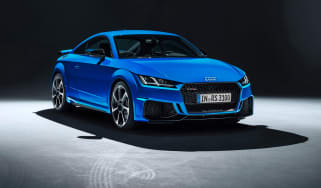
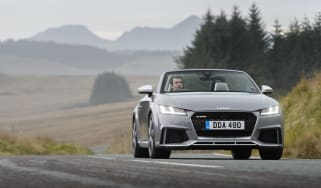
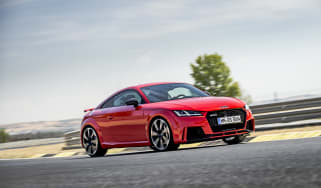
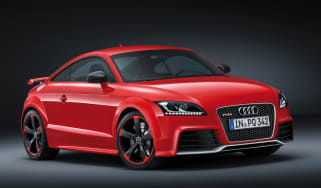
Audi TT RS (2016- 2023) review – Ingolstadt’s Porsche Cayman rival went out on a high
In its final outing, the TT RS just about broke free of the typical numb understeering Audi stereotypes. It’s genuinely thrilling, with a wonderful engine
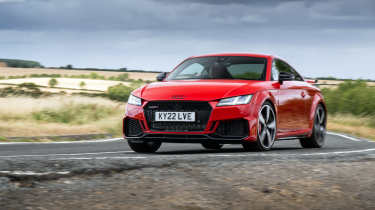
When Audi first squeezed a turbocharged five-cylinder engine under the bonnet of a TT back in 2009, two flashpoints in the firm's history combined to create what should have been an instant icon: the TT RS. Except things didn't quite turn out that way, and the competent but numb TT RS never delivered on the promises of that glorious engine.
Fast forward to the Mk3 TT and here was a car that proved to be a more appropriate home for it. With the TT RS (and the TT model line as a whole) having now been put out to pasture, in its final outing, the primal thrill of the five-pot motor was finally backed up by a higher level of focus from the rest of the car. With that, the TT RS went out on its best form.
A mid-life revision in 2019 brought updates to the powertrain to comply with emissions regulations, but by-and-large, the TT RS recipe remained unchanged from its launch in 2016. It might not be as natural, flexible or rewarding a sports car as the recently departed Porsche Cayman. Nor is it anywhere near as light, delicate or tactile as the Alpine A110. But it’s stylish, beautifully put together, fast, capable and features one of the most distinctive combustion engines you’ll find this side of the supercar class.
Engine, gearbox and technical highlights
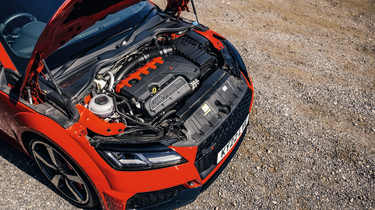
- Aluminium engine reduces weight over the front axle
- Haldex AWD
- Seven-speed dual-clutch only
More reviews
The fitting of a 2.5-litre five-cylinder engine into the TT was not a new thing, as the second-generation TT lineup also featured an RS variant powered by Audi’s five-cylinder engine. The old car used an iron-block US market-based unit, that was better for tuning but heavier than the newer engine, which had a lighter block with an alloy crank case designed specifically for Audi RS models. It reduced weight over the nose by 26kg.
Alongside impressive figures, principally almost 400bhp, the real talent of this engine is its spread of torque, imbuing the small coupe with a broad and muscular feel throughout the rev range.
In order to keep this engine in check with emissions regulations, Audi had its work cut out, installing particulate filters into the exhaust system, subsequently muffling the engine’s addictive thrum. Not only did that reduce the volume (even with the sports exhaust system fitted), it meant less urgency to the drivetrain, even in Dynamic mode. More of a voice and better responses are one good reason to go for pre-facelift car. Audi exclusively paired the engine to a seven-speed S-tronic gearbox, a fine partner in crime.
The TT RS, like other all-wheel-drive cars on VW’s MQB platform, employs a Haldex system that uses a clutch pack to engage the rear axle whenever the car decides it needs torque delivered to both pairs of wheels, but never sending more than 50 per cent to the rear.
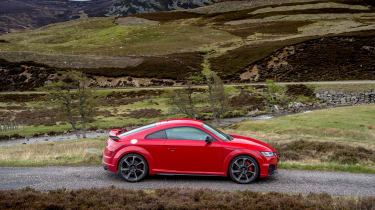
The eight-piston front calipers clamp 370mm steel discs as standard, but carbon-ceramics are an option. Likewise Magnetic Ride adaptive dampers were available at extra cost.
Audi’s Drive Select system controls the car’s personality, with Dynamic being the sportiest mode, alongside Comfort, Auto and Individual. In Individual, you can mix and match parameters across the engine and transmission, steering, suspension (with the Magnetic Ride option) and exhaust.
Power, torque and 0-62mph time
This 2.5-litre turbocharged unit produces 396bhp from 5850 to 7000rpm. Maximum torque is 354lb ft, spread thick and even from 1950rpm right through to 5850rpm. The claimed time for the sprint to 62mph is 3.7sec, with the pre-facelift cars claimed to be good for it in 3.5sec. We however, recorded a 0-60mph time of 3.4sec.
That’s quicker than the 3.5sec evo recorded in a Ferrari Enzo, and as near as dammit McLaren F1 quick. Madness. Once up and running, the TT RS does still suffer some turbo lag, but commit and it is every bit as fast as the figures suggest, ripping through the seven short ratios with an urgency that’s unmatched this side of a Porsche 911 Turbo.
Performance, ride and handling
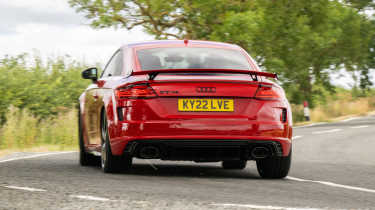
- Blisteringly fast to 62mph in well under 4sec
- More tail-happy than you’d expect…
- … but still lacking a bit of adjustability
The first time that you floor the accelerator with the sports exhaust cracked wide open it’s hard not to fall for the TT RS. A loud, complex soundtrack fills the cabin, the note changing from deep warble to something harder-edged but still slightly askew as the revs home in on 7000rpm. The five-cylinder produces as distinctive a war cry as any engine and Audi plays it to perfection.
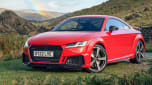
That first surge of acceleration will also leave you in no doubt as to how stunningly fast the little coupe is. The power feels totally contained, however, with the quattro system deploying every ounce of the 394bhp in manageable fashion.
Traction off the line is deeply impressive. To activate the launch control you need to be in Dynamic mode, with the transmission and ESC both in Sport. Then it’s simply a case of holding the RS on the brakes with your left foot and pushing the throttle all the way through the kickdown to the end of its travel. Then, with the revs steady at about 3500rpm, you just release the brakes.
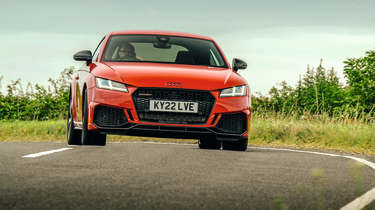
As dual-clutch gearboxes go, the TT RS’s high torque rating makes it slur more than you might expect, while the transmission’s tardy response and turbo lag combine to create a sort of lethargy that can be quite difficult to drive around. Lamborghini Aventador's drivers suffer the same issue.
It’s bursting with energy but, in the dry at least, it is all put to good use, with no sense of slip between rubber and road. Yes, you can feel the TT driving more from the rear with the Haldex system set to its Dynamic mode, but the rear simply hunkers down and drives you forward rather than allowing you to really adjust the arc of the back of the car on the throttle. You also need to keep on top of the gears going into corners, because if you are below about 4000rpm there is a little bit of hesitancy when you get back on the throttle.
Turn-in is very encouraging, with the front end feeling more responsive than on any TT we can remember – something that is helped by the RS’s brake-based torque vectoring and lighter alloy engine.
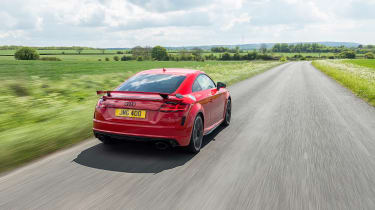
Don’t for a minute write it off as a boring, understeering Audi, because it is far, far from it, but at the end of the day we can’t shake the nagging feeling that with a more malleable, rear-biased four-wheel-drive system, the TT would become the star performer it threatens to be.
Point the TT RS down a worse road surface and the cracks in its capability begin to widen, as the underlying physics of lumping a heavy engine over the front 20-inch wheels with barely an inch of tyre sidewall become clear. The ride never quite settles, and the secondary bump absorption quickly deteriorates as the wheels crash into variances in the road surface.
> Audi R8 V8 (2007 - 2015) review – the Porsche 911’s equal is a bargain super sports car
Push hard over undulating tarmac and the suspension runs out of travel, often struggling to keep the wheels in contact with the ground. On roads that a 718 Cayman would hoover up, the TT RS bucks and fights, hitting compressions with an uncomfortable harshness that leaves you unsure of the state of the 20-inch wheels at the end of a brisk drive.
Interior and tech
- One of the best interiors of the last 20 years
- Not even the digital driver’s display ages it
- Rear seats more useful for luggage than passengers
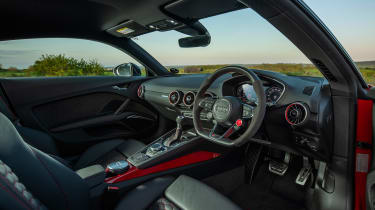
If there were to be a template for how sports car interiors should all look in the future, this TT’s cabin at the time of launch would have probably been it. It’s a very rare thing to be able to say of a design that features any kind of digitisation but even with first-generation 12.3-inch Virtual Cockpit driver’s display, there’s a timelessness to the Mk3 TT’s interior. The RS builds on that with performance detailing: RS badges, the R8 steering wheel, the diamond stitching in the leather and the Alcantara trim.
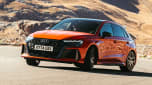
The TT’s interior is chock-full of brilliant detailing and little features that make you realise that Audi really thought about the cabin in a different way to most other manufacturers. The three propeller-inspired air vents are outstanding, featuring controllers for the entire HVAC system, with twist knobs that also (optionally) function as temperature and fan displays.
The quality feel - the way buttons and rotary controls click - is just utterly alien to more recent VW Group cabins. The shrunken steering wheel boss and red starter button of the R8 wheel mean it looks like it could have come straight off a concept car. The basics are just so right.
Despite the car having what Audi calls back seats, in usual TT fashion they are only suitable for very small children or extra luggage. Boot space is generous for the class, and if you fold the second seat row you're left with an oddly shaped, but still usable cargo area.
MPG, running costs and checkpoints
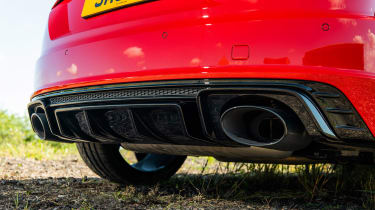
Taken at face value, the Audi TT RS is surprisingly efficient for a car that can hit 62mph in under four seconds. Claimed economy figures were 31.7mpg and 201g/km – not brilliant for an engine of this size, but impressive considering the performance on offer.
There’s one big drawback with the TT RS’s economy, however. In reality you do not drive the TT RS in a way that manifests those impressive figures. With the noise the engine makes, and with such easily accessible rapid acceleration, you can’t help but prod that throttle pedal to enjoy both attributes. On anything other than a long motorway run, if you can achieve an mpg figure north of 20 you have better self-restraint than we do.
By comparison, the Porsche 718 Cayman S will officially hit a less impressive 29.4mpg on the combined cycle, which is a surprise given the Porsche's weight advantage and smaller, less powerful four-cylinder engine. The bigger, heavier BMW M2 manages 29.1mpg.
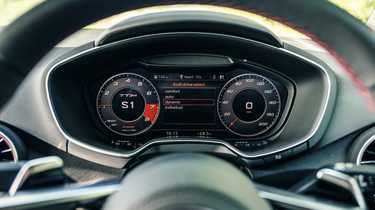
Being an Audi and not something with a more exotic badge, servicing and other running costs should be reasonable compared to those of the Porsche 718, but the highly tuned and bespoke nature of the power plant will make it a more expensive proposition against more humble TT variants.
Look for good service and MOT history on your chosen example and try to avoid tuned or extensively modified cars. Though lighter, these alloy block engines aren’t as stout as the iron blocks in older TT RS and RS3 models. Such modifications are also indicative of a car that’s had a harder than average life.
Make sure the tyres are a matching quality brand and are all in good condition. The differentials are known to be sensitive and quick-wearing when the tyres do not match whether due to differing brands or states of wear. Likewise the brakes, the ceramics are known to be expensive but even the steels are a decent size and pricy to replace.
Note too, a TT RS registered after April 2017 (17 plate) will be on the cheaper £195 per annum standard tax rate. Earlier cars are £395 a year.
Living with one – Ian Eveleigh, evo managing editor
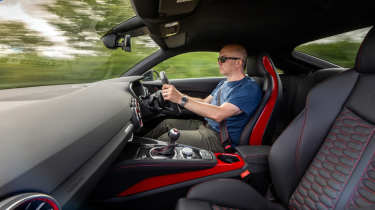
‘It’s the seriousness of it that’s taken me by surprise. It’s been about a decade since I last drove a TT RS and in my head I had it filed as ‘a posh TT’ – the one people choose if their pockets are deep enough and they want Audi’s smallest coupe with all the bells and whistles and an engine that sounds expensive.
‘So I hadn’t expected to drop down into seats that favour high, snug bolsters over squidgy padding. Or to grasp the steering wheel and find not plush leather but instead that curious, beyond-dry feeling of Alcantara. Or to look in the side mirrors and see the ends of the fixed rear wing clearly in view. Or, most significantly, to drive away and discover a firm ride – actually, make that a very firm ride – that has the car, and therefore its occupants, jiggling up and down in tune with every little imperfection of the road.
‘They’re the kind of cues that almost make you want to check over your shoulder to see if there’s a half cage and a helmet net in the rear. (There isn’t: just two tiny rear seats is all you’ll find. Perhaps this one’s in ‘Touring’ spec.) They’re also cues that make me think I may have misjudged the TT RS.
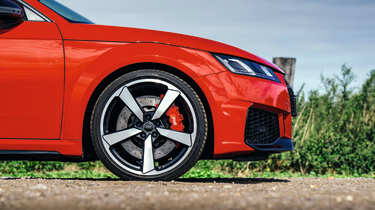
Might Audi have been targeting a different audience to the one I thought? Is this thing actually a pukka driver’s car? I reckon it’s time for me to cast aside my preconceptions and start gathering opinions about this car afresh.
‘Naturally, our TT has a few extras. It’s in top-level Vorsprung spec, which added £10,000 exactly when it was new and brings 20-inch wheels (up from the standard 19s), Magnetic Ride, an RS Sports Exhaust system, Matrix LED headlights and a black styling pack. Also options are the Tango Red Metallic paint (£575), red brake calipers (£345) and an extended RS styling pack (£1125), which brings red outer side panels on the seats, red trim on the transmission tunnel, red rings in the air vents and red stripes on the seat belts. The grand total? £71,495.
‘It’s already clear that this will be one properly rapid car when it can be fully unleashed. I’m hoping the rest of the package can keep up and deliver on the promise of those early signs. The chance to find out can’t come soon enough.’
Prices, buying options and rivals
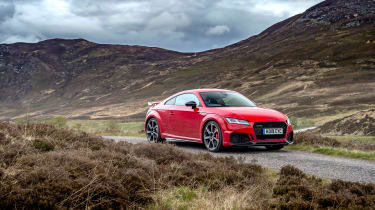
The Audi TT RS list price was £62,165 at the end of its life, exclusively available in high-spec Sport Edition guise.
This came equipped with 20-inch alloys, an RS Sports Exhaust system and carbon fibre inlays inside, along with a full MMI navigation system embedded within the virtual cockpit dial pack. Diamond-stitched leather seats also come as standard, with the most significant interior upgrade coming as part of Audi's £1195 Comfort and Sound pack (this bundles a rear-view camera and a 680w Bang & Olufsen sound system).
Now, Mk3 TT RSs can be had for as little as £25,000, though these will have higher miles and fewer desirable options. Nicer examples are priced north of £30,000 at the time of writing (February 2026).
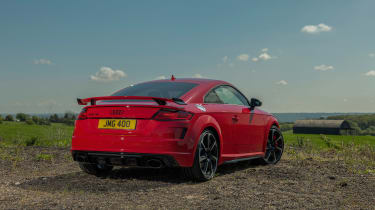
The Porsche Cayman S offers a very different experience. The finely tuned chassis makes for a sublime steer which the Audi can’t quite match. The Porsche’s supremacy isn’t all-conquering though, as the turbo-four isn’t a patch on the Audi’s five-cylinder. The Porsche’s motor sounds dull in comparison and feels like a backward step from the 981-generation flat-six engines.
The BMW M2 offers a more usable four-seat cabin, even more power and an entertaining rear-drive balance. Its muscular turbocharged straight-six engine doesn't sound nearly as good as the Audi's though, and the M2 is a few tenths slower in the sprint to 62mph, but it's still a deeply satisfying performance coupe.
Then there's the Alpine A110, which has an attitude and character all of its own. The French coupe trades big power for low weight; it’s delicate and malleable, where the TT leans towards brute force for a more intense driving experience. It might be far slower than the TT on paper, but the Alpine is truly captivating to drive and costs about the same in more powerful S form.