Caterham Project V is delayed, but a running prototype is finally here
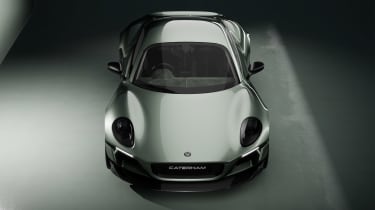
Caterham’s new age electric coupe is now officially behind schedule, but the first running prototype has now been unveiled at the Tokyo Auto Salon
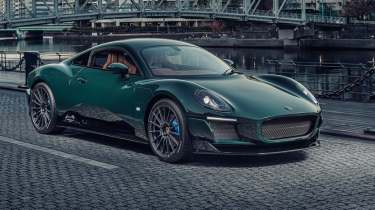
At the beginning of last year Caterham gave us our last update on its all-electric Project V sports car, announcing that development would be complete towards the end of 2025. Clearly, it hasn’t quite met this goal, but what we have instead is our very first look at a running prototype, shown at the Tokyo Auto Salon.
Under the ownership of Japanese car retail giant VT Holdings, the model is being conceived as a battery-powered coupe to rival Porsche’s forthcoming electric 718 Cayman, and will pack Yamaha powertrain technology to deliver the kind of performance and ability expected of a Caterham.
> Panic over. The Porsche Cayman and Boxster aren’t going electric-only after all
This first running prototype has been assembled at the firm’s research and development facility in Tokyo, and is designed to evaluate the Yamaha drive assembly, chassis durability and new battery system. Caterham now says its testing programme will continue throughout 2026, and exactly when we’ll see the car in its final form isn’t yet known.
Kazuho Takahashi, CEO of Caterham Cars, said: 'This is a significant milestone in the development of Project V, with our prototype making its public debut at the Tokyo Auto Salon. This next step enables us to begin a comprehensive vehicle testing program in collaboration with our technical partners. Our objective remains unchanged: to realise our vision of a pure electric sports car that embodies the unmistakable DNA of a Caterham.'
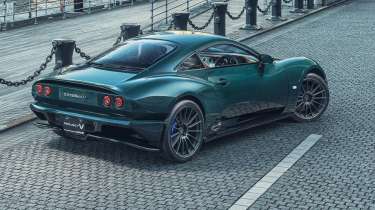
The Project V shares nothing with the Seven, which has sustained the iconic British sports car maker for 50 years, save for a few subtle styling hints and, crucially, the company’s philosophy: lightweight, simple, fun to drive. It’s been designed by Anthony Jannarelly and the show car has been engineered and manufactured by ItalDesign.
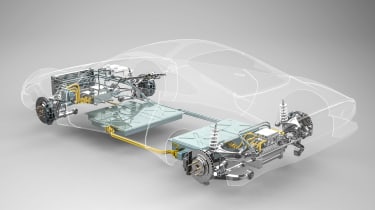
The new model will be rear-wheel drive and powered by two battery packs: one in front of the rear axle and another under the floor in the front footwells, supplied by Taiwan-based Xing Mobility – these packs make use of the firm’s immersion liquid cooling technology for optimum heat management and power density.
Having initially favoured an extruded and bonded aluminium structure, Caterham is now looking at a blend of aluminium, carbonfibre and glassfibre due to the significant weight saving it offers. The quoted weight is 1190kg (with fluids), and the rear-mounted Yamaha e-axle will generate 268bhp; good for a 0-62mph time ‘in the low 4s’ and a maximum of ‘above 230kph’ (143mph).
Consideration was given to re-engineering one or two existing sports cars with an EV powertrain before the decision was made to start with a clean sheet. Six design houses and individuals were invited to submit proposals for what a new Caterham should be, guided by a three-page brief that said it was an EV, mentioned performance targets and named a few iconic cars to inspire it. These included the original Lotus Elan, a favourite of Takahashi. The brief didn’t ask for a finished design but to describe the journey from the Seven to a new Caterham, and the winning submission was from Anthony Jannarelly, co-founder of Jannarelly Automotive.
Behind the development of Caterham Project V
John Barker goes behind the scenes at Caterham
On a large screen in a darkened auditorium, a cursor picks a file and a moment later the new Caterham is on the screen, finished in light green and digitally rendered in a street setting. The viewpoint shifts from front three-quarters, moving around to show the profile and now the rear. Wow! My initial reaction is that I love the curves, the almost individual pontoon look for each wheel. And it looks so low and muscular. It’s quite a retro, almost ’60s look for a 2020s car, but I think it will stand out in the EV marketplace, like a tantalising dessert in a market full of stodgy main courses.
Jannarelly explains that some of the elements are inspired by the Seven: the mouth is the shape of the Seven grille, the swage lines converging on the door are to evoke the Seven’s door aperture, and the flat rear panel references the simple rear of the Seven too. It doesn’t need these visual clues but it’s not an issue because they don’t compromise the look. The front end reminds me of another car and it only dawns on me hours later that it’s the Jaguar C‑X75.
We get the chance to experience it in 3D with the help of a virtual reality headset, which allows you to lean in through the roof and see the simple, neat interior. I’m not convinced by the two-plus-one interior concept which sits a (small) rear passenger centrally, although, as in a 911, the rear seat space will probably get used for luggage (a 2+2 will also be an option). One great idea is the use of reskinned doors from the Audi TT rather than engineering new ones from scratch.
On May 25 2023, we headed back to ItalDesign to see the final show car that would be revealed to the public. We made our way to a different part of the ItalDesign factory this time, to a design studio to see the full-size model of Project V. It was the first time it'd been on its wheels, so this was quite a moment. We saw it head-on as we enter and the smoothness of the nose and the rounded, tumblehome of the roof suggests the early ’70s Opel GT coupe to me.
Sitting there, it’s hard to get the scale. I ask Jannarelly how it compares with a Cayman. It’s not far off, he says, ‘A little lower, a little wider, about the same length.’ A Cayman that’s been under a rolling pin, then. I wasn’t convinced by the ‘Seven’ mouth last time. Here, standing in front of it, I have no issue. ‘Photographers will kneel and get a more dynamic angle but this is how people will really see it,’ says a thoughtful Jannarelly. I’m still more of a fan of the rear, particularly the rear screen and bootlid area, where the rear haunches and the vestigial buttresses come together beautifully.
The front wheels need a bit of camber and are sitting 5mm too low in the arches, says Twohig, but he’s impressed. ‘What ItalDesign has done in the time, with the budget, is incredible,’ he says.
There’s a seat inside, and a dashboard and wheel. An ItalDesign staffer tries to get Jannarelly over to be the first person outside of ItalDesign to sit in it, but he’s deep in conversation at the back of the car. I step forward for a closer look and get invited to sit inside. I don’t need asking twice.
The seat is from a Maserati MC20 and has no cover over the foam cushion yet, but it is powered. Where the front battery sits, below the footwell, you can see the floor rise gradually against the sill. This is to get the H-point (driver’s hip point) as low as possible.
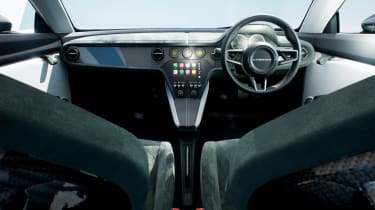
There are two pedals, floor-hinged Tiltons that look offset to the right. But, having whirred the seat into place, I find the driving position perfectly aligned and the wheel perfectly placed. It’s narrower in here than I expected, the window line quite high, but not cramped. The facia looks great: simple, and somehow ’60s American. The steering wheel is as small as you’d want it diameter-wise, and in production will offer height and reach adjustment. Set to its mid-point, it’s spot on for me. The three dials in the centre will include a clock and a drive mode indicator. Normal, Sport and Sprint will be offered, the latter sacrificing range for maximum performance. There will be a screen in the centre but no software – your phone will provide satnav, and music via Bluetooth speakers in the doors.
There’s undoubtedly space in the market for a car like Project V. We’ve seen announcements of many £1m, 2000bhp EV supercars but arguably no genuine sports cars since the Tesla Roadster. The market is hotting up, though, with electric sports cars from Alpine and Lotus and Porsche’s 718 EV on the horizon. We suspect these will be a little more mainstream than the Project V: perhaps a bit heavier, a bit more everyday-biased. So it rests with Caterham to hit its bold weight targets and deliver a unique EV: one that is ‘lightweight, simple and fun to drive’. If they manage that, we reckon it will be a winner.