He won the world title, then Porsche showed him the door: the life of André Lotterer
Three-time Le Mans winner and self-confessed Porsche addict André Lotterer talks about the special cars in his life – and why he’ll continue racing for some time yet
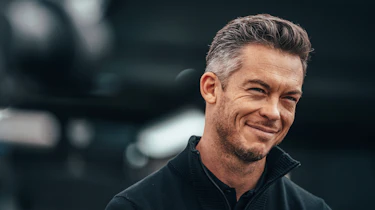
The last thing you expect when you’ve just sealed a world title is to be looking for work. But that’s the position André Lotterer found himself in as the 2024 World Endurance Championship drew to a close in Bahrain, the German sealing the drivers’ trophy alongside Kévin Estre and Laurens Vanthoor.
‘It’s the dream of a lot of drivers to race a Porsche,’ says Lotterer today, ‘but you want to be successful too. When that finally happened, the team changed their approach. They told me in the middle of the year that they weren’t sure if we would continue, that it was the end of my contract and they wanted to reduce the driver pool. They offered for me to stay in GT and do ambassador stuff, but that didn’t really stimulate me. I want to decide when I stop racing at the highest level.’
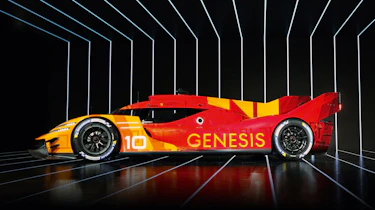
> The Genesis GMR-001 brings V8 power to tackle Ferrari at Le Mans
Plenty of drivers might let fate guide their hand and take the GT seat, but 43-year-old Lotterer isn’t prepared to turn the dimmer switch on his racing when WEC is enjoying its truly golden Hypercar era. From 2026 he’ll target Le Mans and endurance glory once again, this time in the freshly unveiled, bright orange Genesis GMR‑001. The Korean luxe brand may not immediately stand out as a favourite against the might of Porsche, Ferrari, et al, but the wider Hyundai Motorsport effort is already a major force thanks to its World Rally exploits – the new LMDh car’s twin-turbo V8 is effectively two i20 N Rally1 four-cylinder motors, further galvanising the link.
‘It was very clear for me early on that this is the way to go,’ says Lotterer. ‘It’s the chance to be part of a new team and to channel my experience into more of a captain’s role. It feels meaningful to be there from the beginning, and Genesis has intentions beyond just participating. Racing is my priority; I know it can’t be forever, but at the moment I’m there mentally and physically and with a lot of motivation.’
He’s possessed that from a very early age. Lotterer was born in Germany but his family soon moved to Belgium, where his dad played a key role in the Ras Sport rally team: ‘I was always playing around in the workshop. I wanted to be a racing driver from the moment I saw theirs.
‘We went karting when I was seven and Dad saw that I had good lines, that I was hungry for more. When we purchased a go-kart he looked at me and said, “If you really want to do this, you commit, you don’t change your mind. Commit here and we’ll get you to Formula 1.”’
Success in karting ensured his family worked hard to secure the finances needed for the leap into single-seaters, and esteemed management helped catalyse the move. ‘I got a famous manager called Werner Heinz. He’d worked with Nick Heidfeld, Frank Biela, Tom Kristensen and Bernd Schneider. He had good connections and got me into the Formula BMW scholarship.’ There André succeeded against more powerful competition and sealed back-to-back Formula BMW championships. A step forward into German Formula 3 followed, and race wins there quickened his journey to the holy grail his father had promised.
Lotterer was on Red Bull and BMW’s radar, but it was under the short-lived Jaguar Racing banner that he became an F1 reserve driver in the early noughties, enjoying plentiful test opportunities. ‘I learned a lot there,’ he smiles. ‘But then the management changed and the people we were aligned with on our goals – and who had a plan to get us there – moved on. Different management came in with other drivers’ interests in mind.
‘I’d become friends with Eddie Irvine, and his management had contacts in Japan. I went over for a test against Romain Dumas and Sébastien Philippe for the Nakajima Racing team. I got the seat and went on to spend 15 years racing Super GT and Super Formula.’ More often than not, both in the same season.
‘I was living at the core of my passion in Japan. The tyre development in the Super GT cars was fun – their name is misleading, they’re essentially prototypes faster than today’s WEC Hypercars. And all on amazing tracks. There was nothing in Europe that felt worth going back to.’
The romance with his new homeland formed quickly. ‘I moved to Tokyo. It was Disneyland for adults. All the foreign drivers were friends and we made local friends too. A city like Tokyo never sleeps, so any time we wanted to do something fun, we had the opportunity. It was a work hard, play hard environment and you were only really judged by your on-track performance.’ There Lotterer proved himself ably, winning the Super GT Championship in 2006 and 2009 as well as the Formula Nippon (now Super Formula) title in 2011.
‘The only thing I was manifesting was racing for Audi at Le Mans. It was a brand I’d always liked, and from afar their programme looked proper. That was a bit of a dream.’ A dream that André poured thousands of his own euros into when the opportunity materialised to race the privateer Kolles Audi R10 TDI at the 2009 Le Mans 24 Hours.
The pace in Japan had helped prepare him for the vast performance of a diesel LMP1 car. ‘I just had to learn the track and luckily there were a lot of Audi engineers in the team to keep us going. On race day, one of my teammates went for a last-minute pee and tried to jump over the pit wall to start the race, dislocating his shoulder. We were forced to compete with only two drivers, Charles Zwolsman Jr and I.’
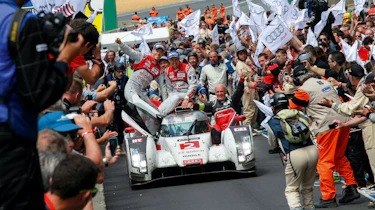
A man down and in a customer car, the pair finished seventh, garnering plenty of attention and alerting the Audi factory team. Six months later, Lotterer was on their books and in June 2010 he finished second at Le Mans in a works R15 TDI. A year later he claimed an epic victory just 13 seconds ahead of the second-placed Peugeot 908. Another brace of Le Mans victories followed in 2012 and ’14, while the inaugural WEC season was sealed by Lotterer, Marcel Fässler and Benoît Tréluyer in 2012. Audi permitted André to combine World Endurance and Japanese racing calendars, the only proviso being the odd skipped race in the Far East when there was a clash. Which did mean missing out on another pair of Super Formula title wins.
‘Audi gave me confidence to reach new levels within myself. The LMP1 cars were so advanced, so fast, so fun to drive. We had a great time and it was fascinating to see the rise of the technology. I joined when it was diesels, then the hybrids came and the team got much bigger, hiring lots of electrical engineers to pour all this new tech into the cars. It was really cool to develop. One of my biggest regrets is selling the 2011 and 2012 R18 race cars Audi allowed us to buy. It was strictly forbidden to run them, but I should have kept at least one of them. They’re way too expensive to get back now.’
In 2014, another glimpse of F1 emerged. A guest spot in Kamui Kobayashi’s Caterham at Spa came Lotterer’s way via Colin Kolles, familiar from that plucky Le Mans privateer entry five years earlier. ‘I felt a lot of responsibility because I was at the top of my game in WEC and Super Formula. I was representing the other drivers in those series, so I felt a bit of pressure to deliver. F1 is always on a pedestal and the big picture is it’s the top 22 drivers in the world. But it is also the ones that also have the opportunity, right? I thought it would be a sidenote that I joined the race, but when I entered the paddock it was a huge thing. The Caterham motorhome was full.’
He qualified 21st, in front of teammate Marcus Ericsson. ‘That was job done for me in terms of reputation,’ he adds. Sadly his car didn’t make it to the end of lap two in the race, but while its reliability couldn’t live up to his dreams – and Lotterer declined a follow-up appearance in Monza – his dad’s early prophecy had come true. ‘It was fun to be an F1 driver for one weekend,’ he affirms, ‘especially in Belgium where I grew up.’
Two years later, Dieselgate led Audi to pull the plug on its WEC programme, presenting André the option of racing its cars in DTM or sticking around in the endurance paddock with Porsche or Toyota. ‘I went for Porsche, but I underestimated the diesel scandal and its effect across the whole Volkswagen group. I signed a multi-year deal but Porsche pulled out in 2017. That was a big blow, as I could have gone to Toyota and potentially won Le Mans a few more times to equal some legends. Sometimes you must choose left or right and they both look good at that time. But digesting it wasn’t easy.’
He stuck around in WEC thanks to Rebellion, racing as Toyota’s sole LMP1 competitor in 2018 alongside Neel Jani and Bruno Senna. ‘Of course there was no chance against Toyota,’ he admits, ‘though I was grateful to the team and I had fun. Then the momentum moved to Formula E and I followed everyone there. It was cool to have a new challenge. I knew Porsche would also join, so I wanted to be ready.
‘They had kept me under contract on a reduced programme. I did the Nürburgring 24 Hours for them. Whenever I race there my eyes are wide open and obviously there are a lot of variables, different category cars and blind spots, but it’s the mecca of driving. The wall is not far, but it feels the same at Le Mans and when you’re averaging 250kph per lap.’
Formula E race wins evaded Lotterer, and Porsche’s return to the top tier of endurance racing in 2023 prompted an easy switch back to hybrid power. Having raced both 919 and 963 prototypes, how do the two compare? ‘The new Hypercars can be up to 10 seconds slower a lap in some places. They are a bit more unstable, more pitch-sensitive, so you’re always on a knife-edge. You’re at the wheel doing a lot of work. But a lot of brands are on board, which is very positive. The championship is in a very strong position with more cars coming because it’s more affordable. The LMP1 times were glorious but very expensive. It was amazing for us drivers, but it wasn’t sustainable.’
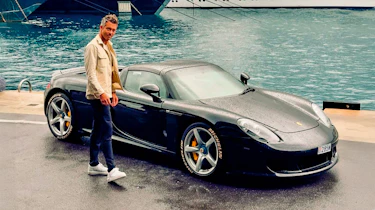
After a handful of podiums in the first season, he and his teammates sealed 2024 WEC honours before his move to Genesis Magma Racing. ‘In a winning season you don’t think that they will change a winning team,’ he laments. But while contracts inevitably come to an end, a peek inside Lotterer’s garage proves that a love of Porsches can be unbreakable.
‘My first car was my mum’s Ford Sierra estate, which we’d put the go-kart in. Then I leased a Ford Focus from my management in German F3. When I was in British F3 I got a Jaguar X-type; for fun I bought a Subaru Impreza STI, which I put a bigger turbo in to play Fast & Furious.’
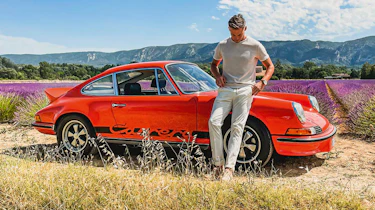
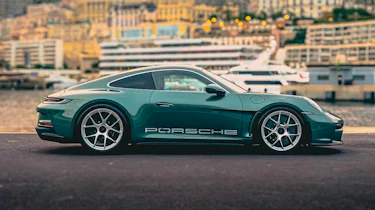
A run of company cars in Japan leads us to André turning 30 and his awakening as a classic car collector in 2011. ‘My first was a 1973 2.7 RS that I restored back to original. Then I got my dream car, a Porsche Carrera GT. I now have a black and a silver one. I have a 964 Turbo Look in a beautiful green and tan combination, and a 356 Speedster. I also have an Audi Sport Quattro, ’67 Mustang and Land Rover Series II. My latest purchase is a new 911 S/T.
‘They’re here with me in Monaco but I have a holiday home in Provence with a bit more space. The roads are amazing there. You have some of the most beautiful villages in France and there’s not much traffic. It’s a nice playground and the weather’s always good.’ When you can resist slipping from the limelight and into a life like that, your desire to keep racing really hasn’t dimmed…
This story was first featured in evo issue 334.