Honda NSX-R review – Japan’s Porsche 911 GT3 RS is one of the most exciting supercars ever
The NSX-R is a product of Honda’s fanatical attention to detail and engineering focus. It’s a triumph – one of the very best supercars of all time
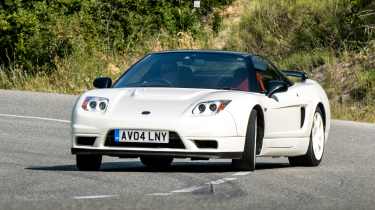
Sharpened, lightened, track-focused supercars are hardly uncommon these days, but the concept was still relatively new when the Honda NSX-R launched back in 1992. Preceding the likes of the Ferrari 360 Challenge Stradale, Porsche 911 GT3 RS and the Lamborghini Gallardo Superleggera was this hardcore take on the famously user-friendly NSX, which blew us away from the moment we first drove it. A comprehensive makeover including a blueprinted V6 VTEC engine, lightweight components and a chassis reworked in virtually its entirety turned one of the most iconic '90s Japanese performance cars into a vivid, all-consuming supercar that still stands among the greatest we’ve ever driven.
We’ve mainly driven the facelifted (NA2) NSX-R over the years, and we’ve consistently been blown away by its singularity of focus, and how plain exciting it is to drive. It speaks to enthusiasts on so many levels. It’s rare groove and obsessively stripped-back, it uses lightweight materials in all the areas that count and it’s intensely focused on pure driving enjoyment. Not performance numbers or lateral Gs, but purity of response, feedback and providing the driver with all the tools to exploit everything it has to give.
The combination of this strict brief, brilliant engineering and a fundamentally superb platform on which to build creates a unique and unforgettable driving experience. There’s no slack at all in the blueprinted engine and gearbox. Imagine the freakish speed and connection of a GT3 flat-six and PDK ‘box, but you’re actually hitting those perfect shifts… that’s the NSX R. The more effort you put in, the better it gets. It’s the very definition of a driver’s car – read on to find out why.
Engine, gearbox and technical highlights
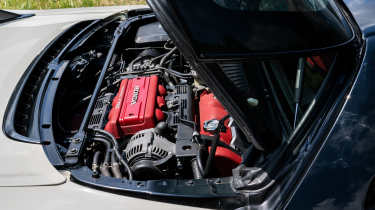
- Blue-printed V6 with a quoted 276bhp – but closer to 300bhp in reality
- Extensive lightweighting program results in a 1270kg kerb weight
- No power steering and extensively modified suspension
More reviews
Back in 2002 the NSX-R lapped the Nürburgring in 7:56.73. Pretty incredible for a car with a 3.2-litre V6 producing a quoted 276bhp at 7300rpm and just 224lb ft at 5300rpm. Yet when you delve into the obsessive work put into creating the R, it’s little wonder that Honda’s mid-engined sports car performs at such a high level.
The NSX’s transformation into the R was remarkably detailed and laser-focused. Each piston and connecting rod is balanced to a tolerance of half that of a standard NSX engine. The crank assembly features carefully matched components to reduce friction; the clutch/flywheel/pulley assembly is hand-machined and rotating weight tolerance is reduced to below 1/10th of that of a regular NSX. Honda claimed no more power for the R engines but much greater and more accurate response. However, cars have been known to produce close to 300bhp in reality.
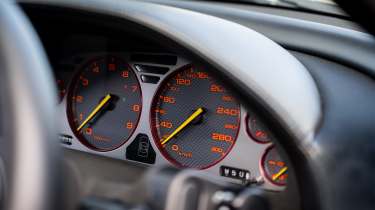
Similar rigour was employed on the aero, chassis and the mission to reduce mass. There’s a carbonfibre bonnet, saving 2.2kg. The hollow carbonfibre wing saves 1.3kg. Thinner rear glass shaves 200g, the instrument panel is 620g lighter and even the mesh material used for the shift gaiter saves a whole 10g. And there’s so much more. A smaller battery, the removal of central locking and powered side mirrors, lightweight carpet, carbon seats, forged aluminium wheels, a titanium gearknob, no undercoating for the chassis. Honda also ditched the power steering. Imagine doing something as radical as that for a new Porsche RS product! It’s a breathtaking programme and results in a kerb weight of 1270kg. A 4.1 per cent shorter final drive also helps with acceleration.
Honda didn’t provide numbers for the NSX‑R’s aero performance but talked at length about ‘negative lift’ and ‘aerodynamically induced stability’ matched to a stiffer bodyshell, new springs and Showa dampers, revised hollow anti-roll bars and stiffer bushings. It is a car born of obsession. Shigeru Uehara, executive chief engineer, perhaps summed this up best. ‘We spent many hours and much energy to arrive at the purest, most balanced definition of a sports car,’ he said upon the model’s launch. ‘To the point that even the slightest change in spoiler angle, stabiliser bar diameter or suspension bushing rigidity would distance the car from what a true Type R is all about.’
Driver’s note
‘The NSX‑R’s carbon-Kevlar seats are almost sumptuous. So supportive but with a soft touch. Why can’t all fixed-back seats feel this good? You sit in a reclined position, perhaps because the seat is mounted a shade too high. Then again, maybe that’s an illusion created by the plunging windscreen that seems to end almost at road height and the frankly wonderful view it affords.’ – Jethro Bovingdon, former evo contributor
Performance, ride and handling
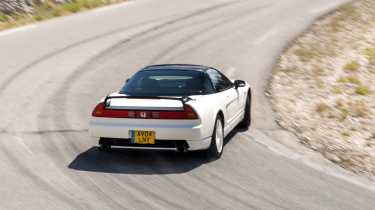
- Stunning blend of balance, feedback and interaction
- Heavier, slower steering than modern supercars – but perfectly intuitive
- Engine comes alive at the VTEC switchover
It takes some time to warm up to the NSX-R. Sure, it has superb, carbonfibre-shelled Recaros and a classic three-spoke Momo but the first couple of miles are challenging. There’s no power steering so it’s very heavy at low speed, and initially the ride is so stiff you’re relying on the padding of the Recaros. Also, with most of the sound-deadening gone that V6 is (brilliantly) noisy, and in the rain it’s a worry that it’s on what look like hand-cut slicks.
What you come to realise is that Honda has sacrificed the low speed steering and ride so that they are perfect when you’re on it, and they are: the weight of the steering and its feel are utterly sublime and the chassis is exquisitely balanced and finely adjustable on road and track.
Even once up to speed the steering is heavy and more deliberate than the super-pointy feel of modern supercars, but it matches a chassis of such calm. The NSX R is highly responsive but has deep-seated poise and because you’re so connected to the car, any shift in balance is easy to read or even provoke. It’s an odd juxtaposition. The noise is fantastically urgent, you can slice through changes literally as fast as you can coordinate your inputs and everything is happening at an elevated pace, but the car is unflustered, eager for ever more commitment. Throw more energy at the car and it just gets better and better.
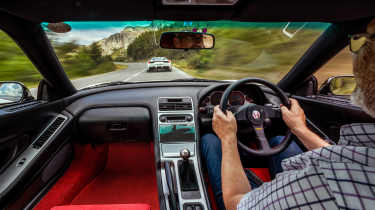
Add in that 8000rpm, inertia-free engine, a brilliant gearshift and sensationally feelsome brakes and you’ve got a deeply engrossing driving experience. The V6 isn’t particularly engaging on a light throttle, its note a tappety zizz, but when you get the opportunity to wring it out, it changes from Clark Kent to Superman. The mid-range is healthy but it’s when the VTEC kit kicks in that the fun really starts, the note taking on a pure, hard-edged bellow that has the same effect as a cold finger down the spine. At 7000rpm there’s a little green light in the rev counter to suggest an upshift but it’s almost impossible to resist letting the engine howl on until the red light just before the limiter.
All in, the NSX-R car that makes most lightweight specials seem a bit half-hearted, a bit lacking in commitment. It’s one of the best mid-engined cars of all time.
Driver’s note
‘The detailed steering, the stripped-back feel of the entire car and how that brings such a sense of purpose, plus the remarkable precision of the engine and gearbox, combine to stunning effect. The NSX-R remains one of the most engaging, immersive and exciting cars I’ve ever driven.’ – Jethro Bovingdon, former evo contributor
Price and rivals
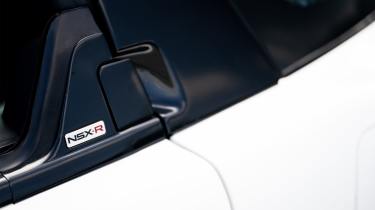
It seems the market has caught on to the NSX-R’s brilliance. In 2025’s Broad Arrow Villa d’Este auction, a 2003 example sold for just shy of €1m. That puts it in the realm of hypercars.
But though the NSX-R is a wonderful, uniquely thrilling driver’s car, you don’t need to spend six figures to get your hands on a stripped-back track focused supercar. Close in philosophy is Porsche’s 996-generation 911 GT3 RS, low mileage examples of which can be bought for around £110,000 at the time of writing. From Italy, there’s the Ferrari 360 Challenge Stradale, which cost in excess of £300,000, or Lamborghini’s first-gen Gallardo Superleggera for over £100,000.