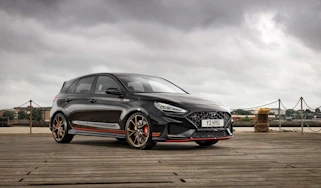
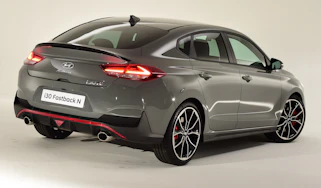
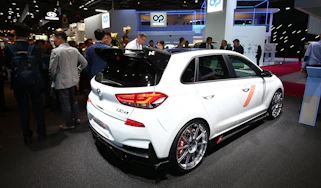
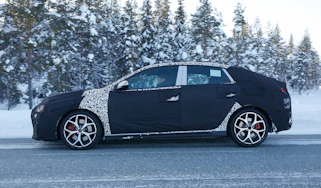
Hyundai i30 N (2017 - 2024) review – the bargain Civic Type R rival
Hyundai knocked it out of the park at the first time of asking with the i30 N. It’s not perfect, it’s one of the most rounded and rewarding hot hatches of the last decade
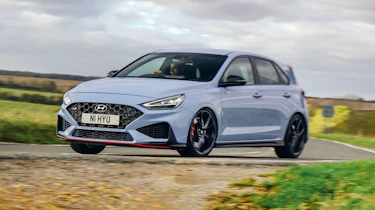
There’s nothing old-school about Hyundai’s i30 N but its sense of fun is certainly from an earlier, less complicated era. Hailing from a time when Honda pursued cornering perfection and the Germans championed all-wheel drive with big speed, the Hyundai feels much less po-faced.
It’s still rapid, and certainly capable, but the enthusiastic sound of the engine (with some of the rowdiest overrun crackles this side of a dodgy aftermarket remap), the meaty control weights, and an appetite for lift-off oversteer egg you on like few rivals do. Over its six years, the i30 N was available in normal and N Performance forms, with the Fastback body style and DCT transmission option added latterly with the 2021 facelift. Here’s everything you need to know about Hyundai’s sublime Honda Civic Type R fighter.
Engine, gearbox and performance
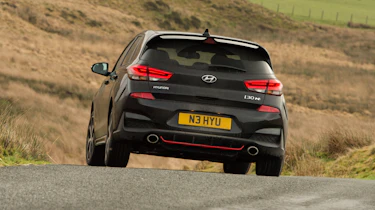
- The Theta engine is powerful enough but feels a little flat
- Manual lacks the tactility of a Civic Type R’s shift
- Dual-clutch is less interactive but 0.5sec quicker to 62mph
The i30 N’s power comes from a 1998cc turbocharged four-cylinder ‘Theta’ engine borrowed from the wider Hyundai/Kia conglomerate. It’s a simple enough unit, with one big turbocharger and a pretty standard electronically controlled direct injection system. The pre-facelift came in two states of tune, either 247bhp and 260lb ft or the Performance model with 271bhp and 260lb ft of torque. Power saw a marginal increase with the i30 N’s 2021 update, reaching 276bhp between 5500 and 6000rpm, while there’s 289lb ft of torque available between 2100 and 4700rpm – 29bhp and 10lb ft rises respectively over the original.
Along with the six-speed manual is an eight-speed dual-clutch transmission option, designed specifically for the i30 N and the closely related Kona N, as well as the Veloster N sold in overseas markets. It’s a wet-clutch unit that isn’t just designed for fast shifts – it also facilitates various software-based modes that have questionable names, giving you direct access to full-bore upshifts without any torque dip (and therefore no corresponding snap) and a clever adaptive set-up tuned specifically for track driving. Drive is then sent to the front wheels via an electronically controlled limited-slip diff.
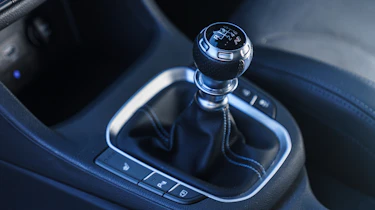
Performance on paper is strong enough, breaking the 155mph mark having passed 62mph in 5.9sec. This is not class-leading but on the money compared to its rivals. In our own performance testing we recorded a pre-facelift i30 N Performance at 60mph in 6.6sec, and 100mph in 14.9sec. DCT models take a huge 0.5sec off the 0-62mph time, down to 5.4sec, the difference on account of not just the faster shift times, but also shorter gearing.

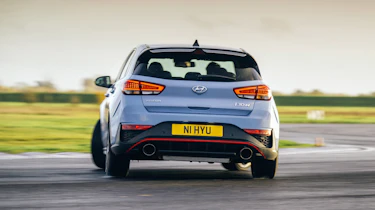
All Ns feature a variable exhaust system. It’s loud, raucous and perfectly judged for the car’s character, with pops and crackles thrown in for good measure (a pleasing, authentic sound far from the synthesised ones in several other cars).
Engine and exhaust noise can be tailored via the Custom mode in the driving mode menu so you can switch it off when you want to fly under the radar. A firm, short-throw gearshift and good traction also both contribute to the entertainment of extending the N’s engine, while a reassuringly firm brake pedal pays dividends when it comes to shedding speed.
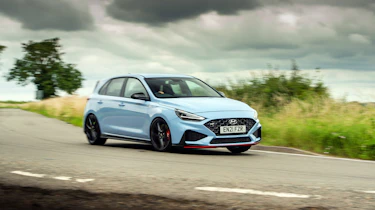
If there is a weak point within the i30 N’s dynamic package, though, it’s this Theta turbocharged engine. Compared to the units found in rivals, the 2-litre four-cylinder can be a little flat. While it revs cleanly to its red line, it doesn’t have the top-end enthusiasm of units found in the last Mégane RS and Honda Civic Type R, and it also lacks the huge mid-range punch of the Focus ST. All are of course, now discontinued.
The engine’s relative lack of sophistication is partly due to its fairly humble beginnings in American-market midsize saloons and SUVs. It feels like a potent engine put into a small car, rather than one designed specifically for the job.
‘We’ve rated the i30 N highly from the start, and the mid-life refresh in 2020 helped maintain its appeal. If you analysed its key attributes – handling, steering, refinement, performance, etc – and plotted them on a spider chart, the resulting web would stretch evenly in all directions; the i30N is the perfectly centred, archetypal hot hatch.’ – John Barker, evo editor-at-large.
Ride and handling
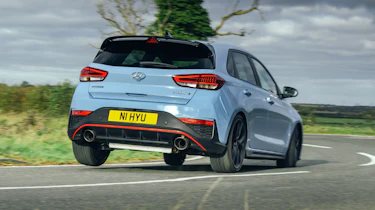
- Earlier cars have a punchy ride. Later cars were more compliant but no less competent
- Steering is tactile but some consider it overly heavy
- All i30 Ns are balanced, fun hot hatch packages
Structurally, the i30 N is much like any other car in this class, with a steel, five-door monocoque shell and steel panels. In terms of hot hatchbacks its suspension set-up is also common, with MacPherson struts at the front and a multi-link axle at the rear. As part of the N’s upgrades over a regular i30 the chassis receives a strut brace between the rear suspension towers, as well as additional welding in the shell. Fastback models carry a little more of their weight towards the back of the car, which actually improves the front-to-rear weight balance; its shape improves aerodynamic efficiency, too.
Electronically controlled and adjustable dampers were standard on both the hatch and the Fastback. Initially the Fastback’s chassis differed to that of the hatch, including longer bump-stops (from 55mm to 62mm), spring rates reduced by five per cent and a one millimetre-thinner front anti-roll bar, but from 2020 these chassis changes, along with reduced camber on the rear axle and stronger gearbox and differential mounts, were made to the i30 N hatch, too. Brake discs measuring 360/314mm front and rear respectively were standard on both body styles.
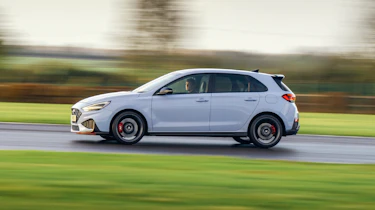
Both hatch and Fastback facelifts were fitted with a set of forged 8x19-inch wheels and 235/35 R19 Pirelli P Zero tyres, with electrically assisted power steering and 2.14 turns lock-to-lock.
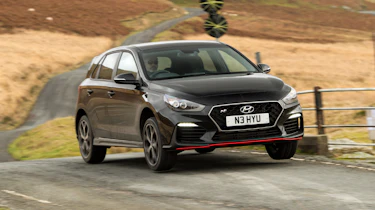
Officially the i30 N manual weighs in at 1499kg, a subtle 10kg drop compared to before the facelift on account of the later model’s forged wheels and optional lightweight bucket seats. The dual-clutch transmission only adds a relatively subtle 36kg to the total.
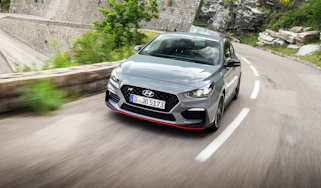
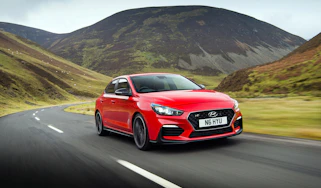
There are hot hatchbacks with more grip, some with more adjustability, and others that will outsprint the i30 N point-to-point, but none will do everything the Hyundai does with so much breadth of talent or engagement. It’s a near compromise-free driving experience that is engrossing in a way that none of its direct rivals could manage.
The i30 N’s steering is the first statement of intent. It’s weighty even in its lightest setting, not unlike that of a BMW Motorsport product. Delve into the menus and it’s possible to adjust the weighting, and Sport mode feels about right on the road; whichever setting you choose, it’s always responsive, with the slightest movement off the straight-ahead resulting in a positive and proportional reaction at the front axle.
There’s grip to back it up, too, and feedback that feels natural rather than artificial, which allows you to push deeper into the N’s talents. It’s not a chassis likely to catch you out, either, unless you take liberties, while the rear end will rotate with a sharp lift of the throttle and grip is matched with poise and a sense of fun that’s missing from some rivals. There’s a hint of old-school Renault Sport in there.

Three stages of stability control (Off, Sport and Normal) give you options depending on how much you appreciate electronic intervention, but the electronically controlled limited-slip diff is so well managed that it’s best to switch it all off and have some fun. For an electronic system it feels nicely mechanical and you can lean on it to get the best from it and ask more of the front two Pirellis regardless of the angle of the curve. It finds strong traction on the exit of lower-gear corners and manages torque and understeer through the quicker stuff with an unexpected level of sophistication.
Our biggest criticism of the i30 N hatch when it first arrived was how ride quality had been sacrificed, or perhaps optimised for racetracks and ultra-smooth tarmac roads, therefore pegging back its performance. It was an issue rectified with the introduction of the i30 N Fastback, which received softer chassis settings, and before long Hyundai’s N Performance division equipped the hatch with that same chassis set-up.
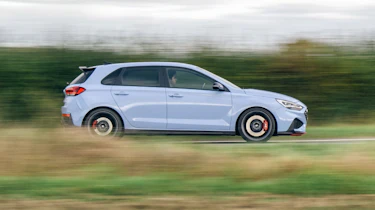
A reduction of the front wishbone angle and a drop in spring rate of five per cent were at the core of the changes, so too seven millimetre-longer bump-stops and a thinner anti-roll bar. At the rear the camber angle was also reduced.
The result of these chassis changes to the 2021 model-year i30 N were a hot hatch that you no longer need to fight with if the surface deteriorates or you find yourself on a typical UK road. Its softer edge rounds off the original version’s harder focus, allowing the car to breathe with the road in a more consistent manner than before - allowing you to exploit and enjoy more of its performance more of the time.
There’s a further fine layer of polish to its steering, too, with a little more accuracy to work with, allowing you to lean on the diff that bit harder. They are incremental improvements, but then there wasn’t a huge amount to rectify in the first place. So while there are hot hatches that have more power and torque to get you down the straights a little quicker, few will allow you to carry as much speed through the corners as the Hyundai.
Track Car of the Year 2018 test – Adam Towler
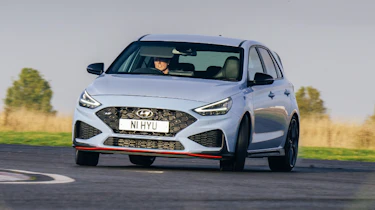
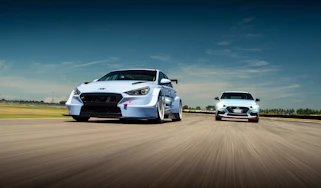
‘Rockingham allows use of the Hyundai’s far-too-stiff-for-the-road N suspension mode, and lunging towards the first corner the 271bhp i30 feels plenty fast enough, the gearshift confidence-inspiring, too. But already I’m thinking of the same few seconds in the Civic Type R earlier, and how it sprang from the pit exit with frenzied alacrity, the next gear slotting home in a blur of mechanical precision.
‘The i30 is fast, but it’s not that fast, it’s gearshift good, but not that great. And so the laps pile on, and the limited-slip diff works tirelessly, shifting the torque across the axle, the front-end grip good as long as the tyres aren’t overworked for too long, the brakes hanging on in there under sustained punishment. The onset of rain makes the stiffest suspension setting a hindrance again, but there’s adjustability here, and entertainment, too.’
Interior and tech
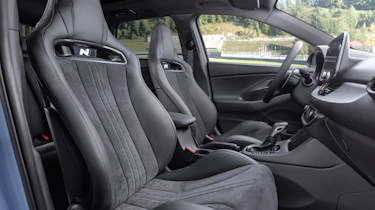
- Welcome updates to infotainment and a lightweight seat option came late…
- … but mercifully analogue dials were retained
- Scratchy plastics but quality is better than you’d expect
Save for lots of hard and slightly scratchy textured plastics here and there, there’s not a lot to complain about in the i30 N’s cabin. As with the standard i30, it’s logically laid out, feels well built and offers good levels of comfort and refinement.
The big changes that came with the 2021 update included a new infotainment screen that’s wider with a higher resolution. The actual interface was more complicated than it used to be, but the core functionality remains, with even more N-mode toys to play with.
There was also the added lightweight sports seat option, which replaced the fundamentally good standard seats with a thinner and more aggressive-looking design. As well as having better lateral support and a more direct connection to the chassis. They also look the part, and don’t lose out on their built-in heaters.
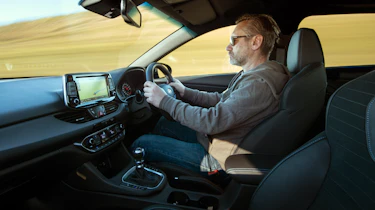
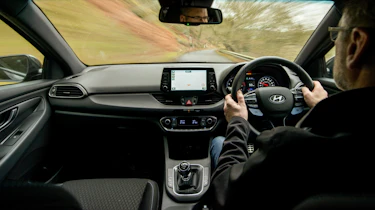
The steering wheel is good to hold – a chunky (but not too chunky) three-spoke affair whose buttons for stereo controls, cruise control and information display functions are logically arranged. Here you’ll also find two larger, Performance Blue buttons used to select drive modes. On the left spoke is the button to switch between Eco, Comfort and Sport modes, while the right, denoted with a small chequered flag, switches between ‘N’ mode and a custom setting.
Those custom settings are adjusted through the central touchscreen, and are one of the i30 N’s highlights, allowing you to tailor the drive to your own preferences, forever just a couple of quick presses on the N button away, and only ever a press on the left-hand button away from switching back to the car’s more relaxed modes. For us, it’s driving modes done just right.
A final mention deservedly goes to the dial pack which was retained from the old car, mercifully lacking the overwrought graphics of the i20 and Kona N. Instead, clear and crisp analogue dials with an active red line (à la BMW M) and a well-sized display between that shows only useful information. Post-facelift standard i30s replaced this with a completely digital instrument cluster, so the active decision to keep on with this older dial pack was welcome.
MPG and running costs
We’ve become familiar with modern cars failing to match their official combined fuel consumption figures in normal driving, and while performance cars often get closer than many – usually because they aren’t designed to be economical in a very specific set of conditions from the outset – the i30 N’s real-world fuel economy was still slightly disappointing for us.
Officially, it’ll do 35.3mpg combined on the WLTP cycle, a figure matched by the Fastback N Performance. That's fairly close to reality, where you’ll be looking at mid-30s on a gentle motorway run and possibly just scratching the surface of 30mpg in everyday driving, with numbers plummeting the more performance you use. Oddly, despite the extra gears, the DCT’s mpg rating is lower than the manual’s at 33.6mpg – blame the transmission’s habit of throwing fuel into anywhere it’ll burn for the sake of those jolty upshifts.
On its own, this car’s mpg wouldn’t be such a problem – plenty of other cars in this class will do similar, albeit slightly better – but the 50-litre tank can often seem a little on the small side for a car consuming at that rate. In theory around 300 miles should be possible, but a realistic fill-up interval of around 250 miles can wear a little thin on longer trips.
Aside from a few satnav stutters and a pessimistic tyre pressure sensor, our Fast Fleet i30 N Performance proved trouble-free over seven months of use.
Values and buying guide
The i30 N is relatively reliable as well as fun. There are plenty of reports from owners who’ve taken their cars well over 100,000 miles with no significant issues, and while the early cars will now be a few years out of warranty, the fact that Hyundai was confident enough to offer five years suggests it foresaw no major costs in that time.
Engine-wise, turbo wastegate actuators on early models and high-pressure fuel pumps across the range are faults that are more than one-offs according to the owner base. The cars can also suffer with carbon buildup on the intake valves, common on direct injection engines.
Beyond some bolster wear and a slightly shiny leather steering wheel, cabins are also holding up. Almost all cars will be in Performance trim; there was a stock 247bhp version of the N, but most buyers spent the extra and Hyundai dropped the regular car after a couple of years. Likewise, most will be manual, though a DCT was available for the last few years of production.
When Hyundai condensed the range by dropping the standard 247bhp model, the i30 N’s head-turning £25,995 starting price no longer applied, but even comparing like for like in terms of spec, the i30 N’s new £34,595 base price was a substantial £4000-plus jump. The DCT added a further £1975 to the price, making the five-door hatch £36,570, but given the effort and expense involved in its development, it felt like a good deal.
Used prices for early cars (from 2018) now start at around £15,000 for an N Performance-spec car. Prices extend up to £34,000 for sub-3000-mile 2023+ cars.
Specs
| 2017 Hyundai i30 N | 2017 Hyundai i30 N Performance | 2021+ Hyundai i30 N | |
|---|---|---|---|
| Engine | In-line 4-cyl, 1998cc, turbocharged | In-line 4-cyl, 1998cc, turbocharged | In-line 4-cyl, 1998cc, turbocharged |
| Power | 247bhp | 271bhp | 276bhp @ 6000rpm |
| Torque | 260lb ft | 260lb ft | 289lb ft @ 2100-5500rpm |
| Weight | 1400kg | 1429kg | 1419kg (198bhp/ton), 1455kg (DCT) |
| 0-62mph | 6.4sec | 6.1sec | 5.9sec (manual), 5.4sec (DCT) |
| Top speed | 155mph | 155mph | 155mph |