The Land Rover Defender's toughest test: how the D7X-R triumphed at the Dakar Rally
The Defender D7X-R is tackling the world’s most gruelling off-road race, and unlike many competition cars, this one has strong ties to a car we know well
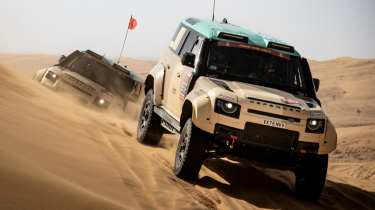
Bundled into the back of a Defender support vehicle, we’re making our way from AlUla’s remote airport to the paddock – or bivouac in Dakar terms. It’s not long before it comes into sight. Amidst Saudi Arabia’s vast, barren desert sits the automotive equivalent of Nevada’s ‘Burning Man’ festival, a vast collection of tents and structures, and a hive of activity. But unlike Burning Man there are no out-of-body spiritual journeys to be had here; this experience is very real, and the most demanding in modern motorsport by some margin.
> Land Rover Defender Octa review – the super SUV that’s more fun than sports cars
For a total Dakar novice like me, it’s an eye-widening encounter. I’ve always had immense admiration for the people and the machinery of the Dakar, but witnessing it first-hand is something else. And the sheer scale of the operation is mind-blowing. To help put things into perspective, this year’s rally is host to over 800 competitors, 197 teams and a total of 433 vehicles – the Le Mans 24 Hours, the world’s most renowned endurance race, featured ‘just’ 62 cars last year.
Not only is the bivouac impressive in its own right, it’s also very temporary. The gargantuan set-up exists for only a few days before everything’s dismantled and each and every component departs for the next stop along the 5000-mile route. The logistical magic required to make this race possible is almost as fascinating as the engineering behind the cars themselves, and the challenges start long before the teams reach the desert. The race itself might be two weeks in length, but the journey to Saudi Arabia is a mission in itself, often beginning in November for the British support crews, two whole months before the flag drops.
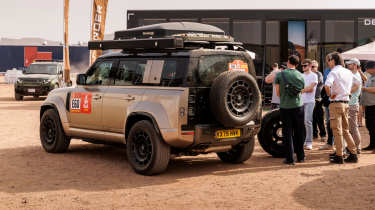
Breaking away from the crowds to walk the full length of the bivouac is no gentle stroll in the desert heat, so it’s hard to fathom the fitness required for those actually competing. Or those trying to change a gearbox. There’s very little in the way of restricted areas, so at one point I come across the KTM riders (including eventual bike class winner Luciano Benavides) rolling in from a full day in the desert. To compete on four wheels for hundreds of miles on end is one of the biggest challenges any driver could face; to cover the same terrain while standing on a motorbike almost defies understanding.
The scale of the Dakar is one thing I’ve always struggled to grasp, but the number of classes is also daunting for a newcomer. And as incredible as the top-class Ultimates are to watch, these highly bespoke, ultra-advanced prototypes have become so far removed from the early road-based Dakar contenders that they’re almost impossible to relate to for those not in the know. Which is where a change to the rules for 2026 came in.
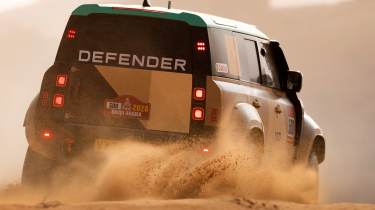
While the regs for the top classes remain as they were, the Land Rover Defender D7X-R is the first car built to Dakar’s fresh ‘Stock’ class regulations, devised to make the category more relevant. In recent years, Stock cars had fallen so far off the pace that they would finish days behind the rest of the pack, making interest in the class minimal at best. Given this is the class that has the closest ties to the cars we see out on the road, it has incredible potential for drawing new eyes to the spectacle and adding some motorsport credibility to performance SUVs. Which is why we’re here to follow the new Defender as it makes its race debut.
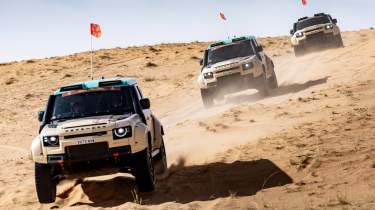
The basic concept of these new regulations is that any manufacturer with a modern SUV should be able to build a competitive car. Previously the rules were highly restrictive and had failed to keep up with advances in road car construction, making it near-impossible to convert a new road car to fit – the aluminium structure of the Defender, for example, made it unfeasible to modify for the old regulations. But that’s all changed now.

Sell 1000 examples or more per year, retain the basic structure, engine, driveline layout and chassis mounting points, and you more or less have yourself a car fit for the Stock class. That is precisely what the D7X-R is, being based on the Defender Octa with its D7X architecture (hence the name) and with a production-spec 110 bodyshell lifted straight from the production line. It’s built and developed in Banbury by Prodrive, who know a thing or two about rally raids (they also build the Dacia Sandrider, featured in issue and this year’s overall Dakar winner).
The Octa’s BMW-derived 4.4-litre twin-turbocharged S68 V8 and eight-speed ZF automatic transmission are carried across wholesale. Peer into the Dakar Defender’s engine bay and you won’t see exotic motorsport componentry but the exact same hardware you’ll find in the standard road car, right down to the airbox and paper filter within it. The only change is the use of restrictor plates on each bank of the V8, limiting peak power to 390bhp in order to comply with the regulations.
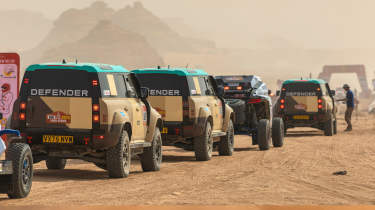
That’s well down on the road car’s 626bhp, but because the limit only really takes effect above 4000rpm, low-rpm performance is almost identical. Besides, brake horsepower isn’t the most important metric on the Dakar, it’s torque, and that remains untouched at 553lb ft. While the transmission is basically the same as the Octa’s, the final drive is shortened to 4.6 in line with the Dakar’s 106mph speed cap.
The secret to longevity with these production-based components is the use of new control units, allowing for finer management of parameters for the engine and transmission. This enables unique features, including a proper hydraulic handbrake and what’s dubbed ‘Flight mode’, deliberately slipping the transfer-case clutch while the car is airborne to reduce any potential shock to the powertrain on landing.
The D7X-R also features a side-exit exhaust system free of catalytic converters, which, as we experience for ourselves on the start line, makes for quite the sound. That’s not its raison d’être, though – it also helps minimise the risk of damage to a standard rear-exit exhaust that might result in an increase in back pressure and a subsequent reduction in engine output.
There are a number of factors that make for success on the Dakar, but reliability is paramount. For that reason, the Defender does ditch a handful of road-spec components for more rugged items, with the Octa’s electronic differentials swapped for fully mechanical items, and its electric steering ditched for a bespoke hydraulic rack.
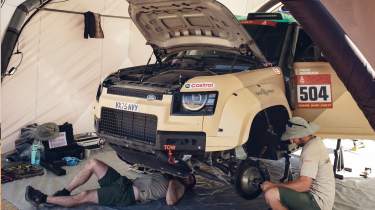
The simplicity of these components helps them last in such an extreme environment, but it also makes them considerably easier to repair if they don’t – on the first race day the hydraulic steering system on one of the cars springs a leak, but it’s fixed in a matter of minutes by the co-driver during a wheel change. Try doing the same with a faulty EPAS…

A few changes have been made to the Defender’s bodywork to improve approach and departure angles, increase the ride height and accommodate the weight of its huge 550-litre fuel tank. Track has increased by 60mm, which is covered by wider arches, and the sills have been modified to match the extended underbody protection. The rally car runs smaller, 17-inch wheels than the road car, with huge 35-inch tyres; the smaller wheels mean the brake discs are also smaller, but the extra energy absorption provided by those huge sidewalls is ample compensation.
That extra fuel in the rear adds in the region of 400kg to the 2485kg starting weight, and when you consider that Dakar machines experience impacts of up to 10 g, it’s easy to see why the suspension has also seen some attention. Out goes the complex 6D Dynamic tech of the road car and in comes a bespoke outboard twin-damper system based on the Bilstein Blackhawk at the rear, ensuring it has the strength to endure such extreme conditions.
Despite Prodrive’s meticulous development work, the Defenders aren’t immune to failures. As Jack Lambert, head of technical integration for Defender Rally explains, during the prologue a lower rear suspension arm was kiboshed by an impact with a rock. In the spirit of Dakar, the support crew fashioned a clever new solution in the mobile workshop to prevent it happening again, applying it to the rest of the fleet thereafter.
Preparing for the worst is as critical to the final result as sheer pace, so where you’d usually find rear seats there are three spare wheels, tool kit, compressed air pump and essential spares. There are even integrated hydraulic jacks to make wheel changes less time-consuming (the current Defender wheel change record, from stopping the car to proceeding, is 1min 10sec).
When repairs can’t be done on-the-fly, the support crew has enough spare components at hand to completely rebuild a car from top to bottom – they even carry new, factory-sealed engines, though strictly as a last resort, as fitting one incurs a steep 20-hour penalty.
As it transpires, the Defenders perform brilliantly, with Rokas Baciuška and Oriol Vidal winning the Stock class and teammates Sara Price and Sean Berriman finishing second, albeit while competing against a sole rival in the form of long-standing Stock class competitor Toyota. In 10 of the 13 stages, the three Defender crews manage a 1-2-3 result.
The Defender road car is now into its sixth year and still selling in record volumes; the hope is that prolonged exposure in the World Rally Raid Championship will help maintain that success for some time yet. A win on the Dakar Rally is certainly a good way to start.