New Volkswagen T-Roc R is a 329bhp rival to Cupra’s Formentor
Second-generation T-Roc R slots Golf R mechanicals and tech into a taller package

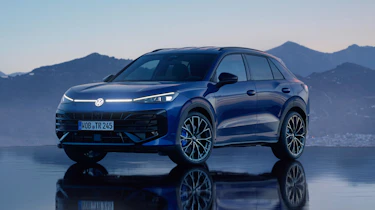
Never one to shy away from a niche, Volkswagen has announced the new T-Roc R, a high-performance variant of its popular Golf-based family crossover with a mechanical specification that closely mirrors the lower-slung Golf R.
We’ve been here before of course. Back in 2019, Volkswagen launched the first T-Roc R, based on the previous-gen T-Roc and again related to the contemporary Golf. It was quick, with 0-62mph coming up in 4.9 seconds, and capable too with all-wheel drive and adaptive dampers, but lacked the more energetic feel of a lighter hot hatch.
Unless Volkswagen’s pulled off a blinder with the latest model we’re expecting more of the same, but the brand does claim the new T-Roc R was ‘born on the racetrack’, and true to form one of the stand-out features from the spec list is a Nürburgring mode, which adjusts the various aspects of the Dynamic Chassis Control (DCC) system to their optimum settings for a lap around the Nordschleife.
To justify such a feature the underpinnings have to be pretty good to start with, and with the T-Roc R you’re looking at the same MQB Evo architecture as the Golf R, along with the familiar 1984cc EA888 turbocharged inline four-cylinder engine. While the number’s the same, this evo5 generation of the EA888 is more advanced than ever before, with Miller cycle combustion (incorporating a 48V driven electric supercharger, working in parallel with the turbo), energy recuperation under deceleration, and a belt-driven starter/alternator.
The important bits for us are the 329bhp output (from 5750 to 6500rpm) and 310lb ft of torque, aided by that electric supercharger at low revs, for a spread of 1900-5250rpm. Power is sent through a seven-speed DSG (no manual is available) and 4Motion all-wheel drive. A torque splitter can divert power both between the axles and across the rear axle, sending 100 per cent of the power to the outside rear wheel in certain scenarios. Keep everything in a straight line, and the claims are 0-62mph in five seconds flat, and a limited 155mph.
The chassis has seen similar attention, from stiffer subframe mountings to a thicker rear anti-roll bar, stiffer suspension mountings, and firmer springs to go with the retuned DCC. Playing with the settings can alter the behaviour of the engine, steering, gearshift, ESC, differentials, suspension and more. Most changes are clustered within dedicated driving profiles, from the expected (Comfort, Snow, Offroad) to the more specialised – Race, activated by the blue R button on the wheel, Special, the Nurburgring mode, and Drift, which VW says is for non-highway use only…
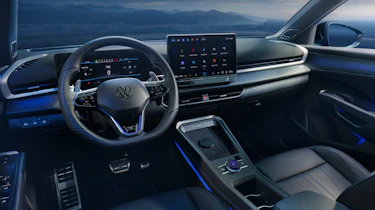
Other features include the option to start the engine with a ‘motorsport sound’ (hold the button for a couple of seconds before pressing the brake pedal, for a flare of revs, and a couple of Sport views for the digital gauge cluster, the second using a now in-vogue horizontal rev counter. The Sport display also incorporates lap and acceleration timers.
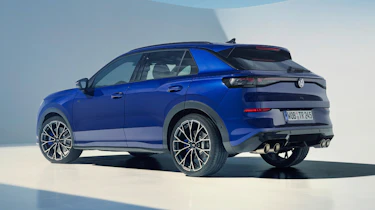
The T-Roc isn’t the ideal starting point for a sports car, but taking a leaf from the Golf’s book, all the typical R trimmings are out in force: new bumpers with larger air intakes, blue painted brake calipers for the R performance brakes, new alloy wheels (a 19-inch design dubbed Zandvoort, a 20-inch forged design will be optional), a quartet of tail pipes rounding out the Akrapovic system, R logos as far as the eye can see, and naturally, the ability to paint the whole thing Lapiz Blue.
Inside, there’s a set of sports seats, an R performance steering wheel in either velour or leather, blue contrast stitching, and R logos on the sill plates, for the very real risk of the letter R losing all meaning. Pricing and full UK specification details are yet to be confirmed, but with T-Roc models coming in at up to £5000 more than a Golf of equivalent specification, expect a healthy bump over the £47,300 that VW asks for a bare-bones Golf R.