Porsche 911 Flachbau RS revealed: the Flatnose returns on a one-off GT2 RS
One-off Sonderwunsch project turns 991 GT2 RS into a modern-day ‘slantnose’ 911
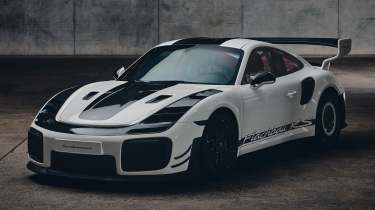
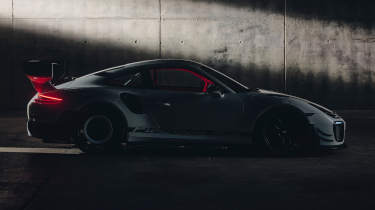
Ever wondered what a modern version of an ’80s Flatnose Porsche 911 might look like? Wonder no more, as Porsche has created just such a car – albeit as a one-off special for a private customer. The Flachbau RS has been created as a ‘factory one-off’ project by Porsche’s Sonderwunsch (‘special wish’) department, in further collaboration with Porsche’s design studio, motorsport departments and Manthey Racing.
Rather than taking a brand-new 911 as its source material, the donor car was the customer’s 2018 991.2-generation Porsche 911 GT2 RS.The Flachbau or ‘slantnose’ 911 body style was introduced on the 930-generation Porsche 911 Turbo in the 1980s, with flatter front wings and pop-up headlights, inspired by the Porsche 935 racing car. They are rare cars, with 948 examples sold between 1982 and 1989, though some further 911s have been converted to slantnose-spec since.

> Manthey Racing Porsche 911 GT3 RS review – the ultimate Nürburgring toy
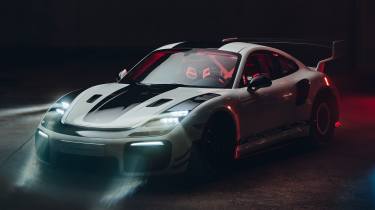
The one-off project echoes the original with a totally restyled front end, with flatter wheel arches sporting slatted air outlets and a completely new lighting system, with a staggered headlight arrangement in narrow LED units. The high- and low-beam and daytime running lights are arranged in individual tiers, and have the side benefit of saving weight versus the original 911 light system.
Manthey Racing’s Kit for the 991.2 GT2 RS, which features numerous aerodynamic and chassis upgrades, has been adapted to the car. Front splitter, underfloor surfaces, rear diffuser and carbon aerodiscs on the rear wheels work together to increase downforce yet reduce drag, while the aforementioned arch slats reduce pressure in the front wheel wells.
There are changes at the rear too, with a new wing on S-shaped mounts for increased downforce. According to the customer’s request, its design is based on that of Porsche’s 911 GT3 R Rennsport limited-edition track car made in 2024. It has three, manually adjustable, positions. Porsche says that at top speed of 211mph in the highest-downforce setting, there is 554kg acting upon the rear axle.

A cryptic ‘033SV’ label is displayed on the rear wing, the number being an internal Porsche code and the SV lettering being a request from the customer. All of the aerodynamic changes have been ratified by physical and windtunnel testing. Long-standing Porsche designer Grant Larson (who also designed the modern version of the 935 in 2018) was responsible for the car’s design while serving as Director of Special Projects, shortly before his retirement at the end of 2025.

The Grand Prix White paintwork (colour-matched to a 1974 911) and U-shaped contrast graphic on the bonnet have been chosen to echo the historic Porsche 935/78 ‘Moby Dick’ Le Mans car, part of the customer’s inspiration for the project. Some sections have been painted matte black and others are in exposed carbonfibre for contrast.
Inside, the area behind the seats is stripped out and the infotainment and audio systems have been deleted to save weight. Most of the sound-deadening and floor covering materials in the cabin and boot have likewise been removed. Even the wiring harness has been reduced in size, and left uncovered, other than by protective sheathing.
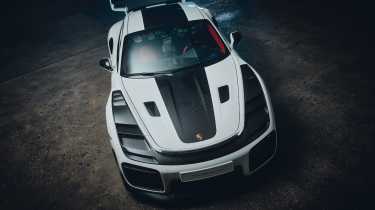
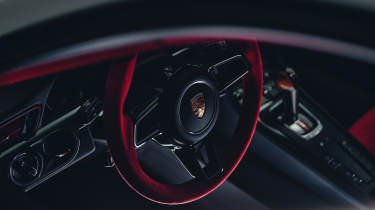
The donor car already had the Weissach Package fitted, which includes numerous carbon and titanium body and suspension components, and the further weight-saving work has made it 31.6kg lighter than it was before. Many parts in the cabin are now in exposed body-coloured metal, with other parts of the front cabin finished in Alcantara and carbonfibre with a rather bold black/white/red colour theme, including rollcage in white and rooflining in red.
The outline of the Nürburgring Nordschleife has been embroidered on the carbon bucket seats’ headrests, since the owner has commissioned the car with plans for use on the circuit. An official lap time recording was discussed, to discover the Flachbau RS’s true potential, but it was decided that all the lapping and testing a serious attempt requires would take too much toll on the car for it to be used for years to come as intended.
Although it has been commissioned with track capability in mind, the car remains fully road-legal. It sits on Michelin Cup 2 R tyres, configured for Nordschleife purposes, on magnesium rims taken from the GT2 RS. They are unchanged apart from high-gloss black paint.
The GT2 RS powertrain is also unchanged, so this is a Flatnose 911 Turbo of sorts, with a twin-turbo 3.8-litre flat-six developing around 690bhp, and PDK transmission. The brief from the customer was to increase performance without increasing horsepower. There’s new carbonfibre trim beneath the engine cover, with cooling fans picked out in white to match the body.
The price? That hasn’t been disclosed, and could be anywhere between the €2m and €15m fee Porsche charges for a Sonderwunsch factory one-off project such as this. Customers get their own Porsche staff ID card and become ‘a part of Porsche,’ accessing the factory as project leader during the concept phase.
This process – itself priced at €150,000 – takes up to a year and a half, and assesses requirements, feasibility, cost-effectiveness and so on. Customers have a chance at this stage to decide whether to go ahead with the project or not; Porsche says, so far, no one has taken the decision to pull out of a commission. The next operational execution through to final completion takes up to two and half years. Porsche says the Flachbau project has taken almost three years.
‘Converting the car to a slantnose model proved to be very challenging, even though we left the drive unchanged, in agreement with the customer,’ says Porsche’s vice president for product offering and individualisation, Alexander Fabig.
‘Our aim was to reinterpret the look of the 935 without compromising on safety, technology or road-legality. Thanks to thorough lightweight measures, this one-off car now weighs 31.6 kg less than before. That may sound unspectacular at first, but the 911 GT2 RS with Weissach Package is already uncompromisingly optimised in terms of weight reduction.’
The development included digital crash simulations and structural analysis, production of new tooling, evaluation of the new components on test rigs, plus creation of three test vehicles for real-world testing to validate the new body on the road, at Weissach and at the Nürburgring. The new front wings have also meant the fuel filler system has needed to be modified.
Porsche is publicising the car partly to promote its Sonderwunsch department, which is connected to its Exclusive Manufaktur operation but offers more bespoke projects, from tailored options on new cars to ‘factory recommission’ restorations of older models up to ‘factory one-off’ cars such as this. The Flachbau follows the first factory one-off machine, a yellow 993 Speedster LT built for collector Luca Trazzi in 2024.
Does this mean Porsche is expanding Sonderwunsch to do more one- and few-offs as per Aston Martin and Ferrari? Potentially, though not necessarily: it emphasises projects such as this will always be restricted by staff and resource availability. We can expect there to be around two years between projects like the Flachbau RS, and they will be driven by customers’ requests rather than Porsche product planning, though the factory retains the right to veto any requests which are ‘completely contrary to Porsche history.’
Will any further Flatnose cars follow? Porsche registered the model designations ‘Flachbau’ and ‘Flachbau RS’ with the European Patent Office in May 2025 (triggering interest and conjecture from industry observers as a result). This one-off car was the trigger but it’s possible further similar projects will follow.
Sonderwunsch representatives say that there will never be another car exactly configured and produced like this one but add that the Flachbau shape is not saved for this car exclusively.