Porsche 911 R (2016) review - was this the perfect 911 of its generation?
It nearly scored a perfect win at evo Car of the Year 2016, so what makes the 911 R so special?

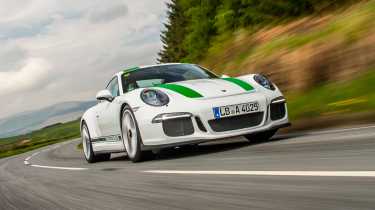
I understand and cherish that the 991 Porsche 911 R had a brand new manual gearbox, the most sublime normally aspirated engine, and that it was honed to deliver its best on the road rather than on track. I love that it doesn’t carry ridiculous downforce figures around its neck or deal in lap-time boasts. But what if all this stuff – this amazing stuff that we hold dear – doesn’t quite add up to create the car we all think that the 911 R should be?
I sense some guffaws at this point. ‘Of course it will,’ you’re thinking, right? But hear me out. The 997-generation GT3 RS, GT2 RS and, perhaps the finest of them all, the 997 RS 4.0, were all ‘ultimates’. They were the very best that Porsche knew how to build from the raw ingredients. Every gram was shaved, every ounce of grip extracted from the tyres, every micron of slack chased out. The feedback, the balance and the way they moved with the surface was natural, authentic and inherent – a by-product of making the 911 better and faster. Just as Porsche has always sought to do.
Now things aren’t so simple. The 991 GT3 RS was the best they knew how to build at the time. The R was something else. A deliberate step away from chasing minute gains and instead an exercise to imbue some of the classic 911 traits into the 991 platform. Porsche called it a car for the purist, but I wonder if by dipping this 911 in the goodies that used to define the breed, it might have created something a little less palatable. Could the car descend into some sort of pastiche?
Engine, gearbox and technical highlights
The 911 R is some 50kg lighter than a GT3 RS, at 1370kg, and the four-wheel-steering system has been recalibrated to deliver even greater response. The detail work here is typically comprehensive: the PASM dampers are retuned, there are new carbon front wings, the magnesium roof from the RS, plastic rear and side screens, carbon-ceramic brakes as standard and a new titanium exhaust system. Some 4.5kg of sound deadening has been removed and there's a single-mass flywheel to liven the engine's responses.
More reviews
In-depth reviews
- Porsche 911 Targa review – the opposite of a purists 911, but still superb
- Porsche 911 Cabriolet review – going top-down is no longer a compromise
- Porsche 911 Carrera S review – the daily 911 that’s quicker than a GT3
- Porsche 911 review – more complex than ever, but still the best sports car
Reviews
> The Porsche 911 GT3 S/C convertible is here, and it's required by law to be lightweight
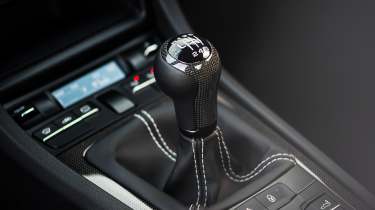
The gearbox uses the same casing as the PDK unit and the seven-speed manual found in the Carrera and Carrera S, but it has six ratios… It was no surprise to see it appear in the following generation of GT3. But what was really important about the R was the philosophy it adopted rather than the components used to realise the final vision.
According to Porsche Motorsport, it was all about feedback, purity and driver involvement. That it has an engine that produces 493bhp at 8250rpm and 339lb ft at 6250rpm, does 0-62mph in 3.8sec and can hit 200mph is, presumably, just a bonus…
Driving the Porsche 911 R
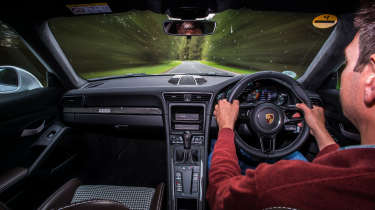
There’s a Porsche 911 R with my name on it and, one way or another, I’m driving over 500 miles in it in the next 18 hours or so. That feels pretty momentous. When I finally lower myself into its carbonfibre driver’s seat, trimmed in brown leather with houndstooth cushion sections, I’m determined to enjoy every second. With involuntarily held breath, I twist the key.
I’m excited. Of course I am. But even as I’m waiting for the 4-litre flat-six to catch, I do have worries of my own. I mean… what if I don’t like it? What if the car that was billed at its launch in 2016 as the saviour of all things good and holy in 911s doesn’t do it for me? I know it should be brilliant.
The engine chunters three or four times and then ignites. The noise is deep and dirty and the single-mass flywheel rattles like the chest of a 60-a-day smoker. To the untrained ear it might sound like something’s about to go horribly wrong, but to me it’s a sign that things might be perfectly right. My brow begins to unfurrow.
It takes less than 100 yards to know this car is not simply a 911 GT3 or GT3 RS fitted with a manual gearbox. The steering is so light and the ride a little smoother, but somehow the whole car feels busier and less locked-down. Compared to the 991 GT3 RS in particular – which felt ten-feet wide in terms of its stability, or like the wings and splitter are working from 1mph – the R has a narrower, almost flighty feel. There’s no question it feels the lightest and shortest of all the 991s I’ve driven, which should be useful when the opportunity arises to uncork the 4-litre engine.
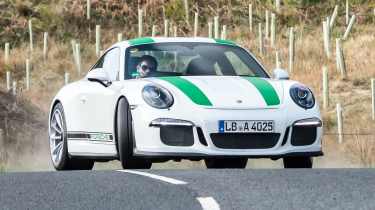
Knockhill is surrounded by some pretty mighty roads. This had passed me by on the taxi ride earlier, transfixed as I was by the driver’s complete inability to master the manual gearbox on a car I assume he drives all day, every day. The irony. Anyway, I get to pin the R’s throttle to the stop pretty much immediately (don’t worry, the car’s fresh from the track and nicely warmed through).
The engine sounds different to the RS’s, strangely. It’s a deeper, snarlier noise at low revs and you feel its rhythm through your back. It’s not a sensation you can savour for long, though.
Whether in second, third or fourth gear, the R responds to a wide throttle opening with astounding ferocity from low speeds, the bassy purr stretching and growing into an intense metallic rush that tears up the air into fragments as sharp as splintered carbonfibre. Wow. The R is angry.
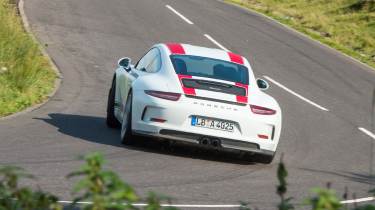
Maybe it’s the relatively subtle looks that makes the R’s performance feel shocking. The RS has the ability to leave you awestruck, too, but in that car you tend to just enjoy the rabid final 1500rpm or so, click-clicking away on the paddles for an instant upshift.
The R can provide that rush, too, but the manual ’box changes the way you operate the engine. I find myself leaving the manic top end for special moments and instead enjoy the vast breadth of performance. That means sticking in a single gear, usually third, and letting the revs rise and fall with the topography, the drama of the engine scaling its power curve washing over every nerve ending.
The gearbox itself? Sweet. Not too short in throw but economical, a nice meatiness to its weighting and a really satisfying precision. It’s not quite as good as a 981 Cayman GT4’s ’box, but it’s close, and miles better than the seven-speeder found in other 911s. More importantly, it does exactly what I’d hoped it might: it draws you deeper and deeper into the process of making the R unpick what’s ahead and rapidly being sucked towards the windscreen.
We’re soon spearing down the busy but well sighted A68 towards Jedburgh, picking off lorries and daydreamers happy to sit in their sooty wake. If I bother with a downshift before overtakes, the upshift requires care to smooth out and isn’t even half as quick as the PDK. But that’s okay – I’m in control and happy to accept the odd clunker if there’s a peachy shift to cancel it out. I could select Sport to activate a downshift throttle blip, but it doesn’t feel right. This is very much a do-it-yourself car. So I do.
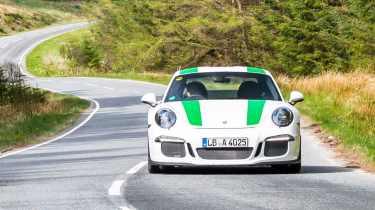
It’s nearly 3pm when we arrive in Jedburgh and brim the pared-back R with the inelegantly named V-Power Nitro+. I’m even more excited about how the R will perform on the tumultuous roads beyond, but – and I hesitate to say this – I’m still wearing a slightly furrowed brow. Such is the weight of expectation on the R that I keep waiting for it to do something amazing.
I’m not sure quite what that is but so far it hasn’t happened. The engine and gearbox combine to spectacular effect, the steering’s lightness takes some getting used to but then feels really natural and certainly has an ebb and flow not found in the RS’s super-precise (but still slightly lifeless) setup, and the damping feels subtle but imperiously controlled. Yet I’m not getting that eureka moment that arrives within minutes of driving an RS 4.0, for example.
That nagging ‘when’s it going to happen?’ feeling doesn’t go away as we head to roads only ever used by logging trucks, the odd tractor and maybe a heroically shabby Defender from time to time. So much so that I find myself going faster and faster in search of the magic.
I’m only mildly offended when photographer Barry Hayden suggests he’d like to get out while I scour every scrap of tarmac and every last rev in my increasingly frantic quest. ‘Perfect. Even less weight to worry about,’ I mutter with a forced smile, before heading off again, hitting the limiter clumsily in first and second.
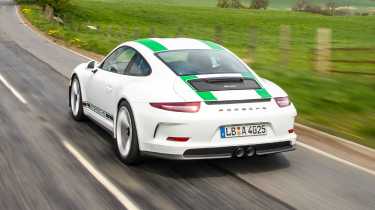
The next 30 minutes reveal the depths of the 911 R’s ability – the magnificent control it exhibits in every situation despite that hyper-alert, almost wayward feel that initially separated it so clearly from the GT3 line, and also the majesty of that engine and gearbox. Porsche may have stripped back some of the grip and downforce, but the R remains a car of staggering potential.
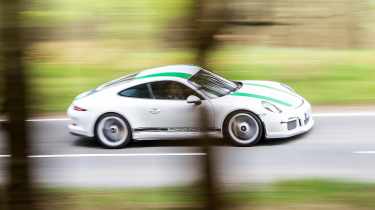
Steer assertively into the lightness and the front Michelin Pilot Sport Cup 2s bite and push back at you, the car pivots, and then you can pick up the throttle really aggressively with no fear of a spike of oversteer. As each corner unwinds and entry speeds spiral upwards, the R continues to grip and dart with absolute accuracy. Only when you push way beyond what’s comfortable on the road does the front finally start to slip away by a matter of a few degrees.
A good lift stabilises the grip and brings the rear into play – just as it always has – but to my surprise the R is perhaps not as easily provoked as the GT3 RS, which uses its wider front track and bigger contact patches to almost kill understeer entirely and encourage a tail-led stance. Instead the R just howls along this fantastic road, utterly composed, hooked-up and the very vision of composure.
I’ve got a death grip on the wheel, though. Still waiting for that moment. Still can’t define what I’m dying to experience. My mind wanders back to the RS 4.0, which seems the perfect benchmark as a modern, hugely capable 911 that’s still alive with feedback and seems to thrive on a driver working it hard. The R matches its speed and adds plenty more on top.
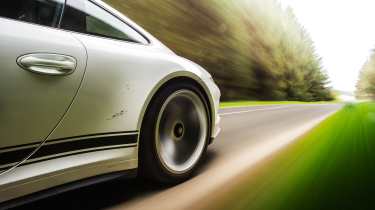
Where the old RS would skip and leap along this road with wheels occasionally contacting the inner arches, with the cooling ducts and various other bits of protruding plastic being shaved by the raggedy surface, and the car generally more susceptible to being bumped off line or pushing into understeer and then oversteer, the R remains true, accurate and unfazed by even the most ferociously pock-marked sections.
It’s not even close to inert – there’s real flow here – but it isn’t as physical, demanding and enthralling as the 4.0. And the steering feel – wonderful as it is for an EPAS system – isn’t even close. It’s right when I’m thinking these slightly depressing thoughts, when I slow down just a bit and relax at the wheel, that the R suddenly clicks.
The steering does jiggle and wiggle with the surface and the front end feels light and the rear more pendulous; the whole 911 experience suddenly seems to intensify. I’ve been waiting for a dramatic ‘ta-dah!’ moment through gritted teeth and instead the R has ever so slowly crept up on me. The death grip and crazy eyes have gone and the R is dancing the old 911 dance right underneath my seat.
Suddenly every corner is an opportunity to let the car’s balance subtly shift. Turn in and feel the front respond quickly and then start to lighten into understeer, back off to pull it back towards you and then squeeze on the power and get that sense that the throttle is steering the car as effectively as that lovely little hollow-spoked steering wheel. The R is good. The R is great. The R delivers.
The sunset doesn’t. And as grey cloud becomes black sky without much of anything in between, we realise just how tired we are after a horribly early start at Luton airport. But I get another run along the same stretch of road and even Hayden seems more at peace as the 911 R pours towards Newcastleton, a lamb shank and a cold beer.
‘It’s just so sorted,’ he says, feeling the car’s absolute security and infallible damping. At the same time, I’m being drawn in with subtle signs that grip might soon fall away, trying to master perfect downshifts and being reminded that 911s have always been about the detail, not big, obvious gestures. In that respect the R really does recapture some of the magic that’s been swallowed up by raw grip and downforce in the 991 GT3 and GT3 RS.
The next morning it’s cold, bright and the road is sodden from a big dump of rain overnight. Once again, the 911 R impresses. It feels so agile and has phenomenal levels of grip, but also communicates clearly enough that you feel submersed in the experience even at half speed.
The engine and ’box are nothing short of magnificent, the brakes astonishingly communicative and the car has an intense energy that means you just want to keep driving it, to keep learning more about its character, its capabilities and because it’s pretty cool just to spend time in the company of that engine. Even on the M6 it feels special. ‘Raw’ is the wrong word, because the car rides beautifully at speed, and although the flat-six growl is ever-present, it’s never tiresome. It just feels honest.
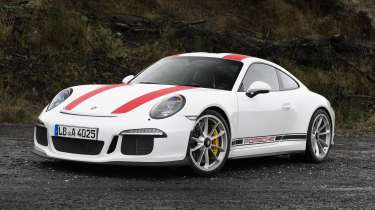
For me that’s the most exciting thing about the R. It isn’t a 991 with a dash of 997 added here, a splash of 993 there and the essence of ’73 RS used to tie it all together. It’s distinct, its own car. A sort of factory hot-rod that feels crazily potent but with a real sense of humour.
It respects all the great 911s that have gone before it but doesn’t try to blindly copy anything. The result is as fast as you could wish, as useable as a Carrera S and has that edge that makes the new GT3 RS so incredibly thrilling when you push it right to its limits. It’s a beguiling car in every sense. The 911 R swims around my head for the next few days and all the natural questions bubble up. Is it more fun than the 991 GT3 RS? Has it become revered as the moment Porsche rediscovered what made 911s so special in the first place? Can it match the involvement – the specialness – of the old RS 4.0?
The answers aren’t simple. Yes, the manual gearbox creates interactivity that the RS it shares much with does miss, but that car’s ruthlessly focused character is arguably ample recompense. Had Porsche ever really forgotten what makes the 911 unique? Of course not, it’s just the parameters have shifted ever further upwards and so those qualities have become less accessible. The 911 R does, however, prove beyond doubt that it’s possible to skilfully balance supreme capability and lucid feedback.
Now, the big one. The RS 4.0. Is the R the car to eclipse it? For me, the answer is ‘no’. Nothing will dim the brilliance of the previous greats. But after a few days to ruminate, I realise the really important issue is whether the 911 R is a great 911 in its own right. The answer to that, I’m pleased to report, is a resounding ‘yes’.
The 911 R debuted in 2016 and was priced from £136,901, with just 991 set to be made. There were many more people who wanted a 911 R than there were cars being made – at the time it the idea this might be the last manual Porsche Motorsport car was a real consideration. This supercharged a crazy used market at the time. Today used values start from £350,000, which is a serious cooling by comparison to what it was. It transpired that the 991 R was not the last manual hardcore 911, with subsequent GT3s (if not GT3 RSs) offered with the R's six-speed, if not its single-mass flywheel.
Specs
| Engine | Flat-six, 3996cc |
|---|---|
| Power | 493bhp @ 8250rpm |
| Torque | 339lb ft @ 6250rpm |
| Weight | 1370kg (366bhp/ton) |
| 0-62mph | 3.8sec (claimed |
| Top speed | 200mph |
| Price new | £136,901 |
| Value now | From £350,000 |