Renault 5 GT Turbo (1985-1991) review – the ultimate foil for Peugeot's 205 GTI
They don’t make them like the Renault 5 GT Turbo anymore. Reacquaintance with the 850kg hot hatch is a pallet cleanser
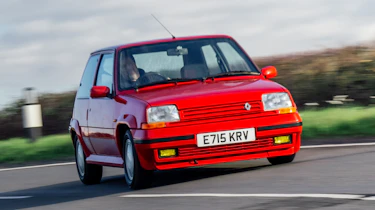
The Renault 5 GT Turbo was the progenitor for the Renault Clio Williams and, indeed, a years-long run of outstanding, class-leading Renault Sport hot hatches, from the first Clio 172 to the Renault Mégane RS. The original rally-derived, mid-engined Renault 5 Turbo will forever be an icon, but the GT Turbo brought forced induction – a novelty at the time – to those with more modest budgets.
In its standard form the rapid Renault was a pretty good steer, with strong straight-line go and, thanks to extensive chassis modifications over the standard 5, was a deft handler, too. Its tunability, however, quickly made it a darling of the modified scene – extracting more power from its turbocharged 1.4 was far easier than getting more go from a Golf GTI or a Peugeot 205 GTI. Finding a standard car nowadays is difficult and thus prices are steep
We’ve crossed paths with the Renault 5 GT Turbo a few times over the years, each reacquaintance a trip of nostalgia and a pallet cleanser after frequent exposure to more modern hot hatches. The throughlines between Richard Porter’s 2008 encounter and Richard Meaden’s 2026 drive are clear: the Renault 5 GT Turbo was something special and an icon of an unrepeatable era.
Renault 5 GT Turbo in detail
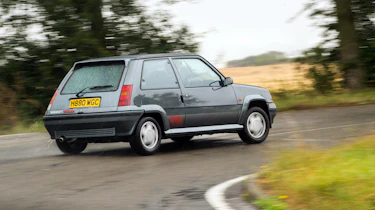
- 1.4-litre four-cylinder, Garrett turbocharged and intercooled
- 115bhp upgraded to 118bhp in 1987
- But there’s under 900kg of mass to shift
More reviews
The 5 GT Turbo was launched in 1985, bringing some excitement to the otherwise functional and workmanlike second-generation Renault 5 range. The brand new 5 might have been little more than an ’80s remix of the 1970s original, but its Marcello Gandini lines looked good, even when adorned with the Turbo’s wide-grilled bumpers, thick arch extensions and ever-so-French yellow front fog lights.
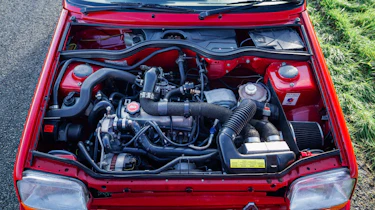
Contemporary road tests largely agreed these add-ons were a bit tacky, but they’re very much of its time and hinted at the GT Turbo’s potency. Under the bonnet was the engine from the bigger Renault 11, a pushrod 1.4-litre carburettor-fed engine fitted with a Garrett T2 turbo and an air-to-air intercooler. The net result was 115bhp and 121lb ft. In a modern context this might sound dismal, but in 1985, in a car weighing just 853kg, it was genuinely impressive.

It was still impressive almost a year later when the 5 GT Turbo finally made it to Britain and marched straight into the heart of a classic hot hatchback war, advancing boldly towards the Fiat Uno Turbo i.e. and the mighty Peugeot 205 GTI (1.6), both of which turned out just 105bhp. The R5 GT Turbo could hit 60mph from rest in 7.5sec and topped out at 125mph – both a significant improvement over its Italian and Gallic competitors as well as eclipsing many of the cars from the class above. And at £7360 it was competitively priced, too.
In mid ’87 the GT Turbo enjoyed a light facelift, with engine revisions including new ignition mapping, better knock detection, tighter build tolerances and a water-cooled turbocharger, these changes ostensibly bringing better drivability and durability to a car that had earned a bad rep for hesitant hot starting and traffic-jam tetchiness. However, it can’t have been an accident that, less than a year after a revised 205 GTI had been massaged up to a matching 115bhp, the changes allowed the little Renault to now make 118bhp.
The GT Turbo wasn’t just a fierce engine inside a roly-poly shopping car chassis, as Renault really went to town on the suspension too. The front springs, dampers and anti-roll bar were all new, resulting in a 38mm drop in ride height, whilst the changes at the back were even more fundamental, comprising a brand new V-section beam at the forward end of the trailing arms, plus an additional transverse torsion rod and a new anti-roll bar, both split in the middle and attached to a floating lengthways link that anchored to the main beam.
Renault claimed the net result was greater roll stiffness, reduced understeer and less risk of lift-off oversteer. It must have got it right too, because contemporary road tests found much to like about the GT Turbo’s performance and handling.
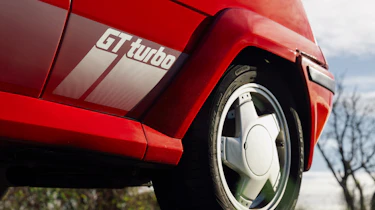
The 1987 facelift gave it a body-coloured body kit, new stickers on the sides and seats trimmed in a fabric so 1980s that the design might as well have featured a picture of Limahl. And whilst the ooh-la-la yellow fog lamps remained, the never-popular fake ducts on the rear arches disappeared. The ride height was dropped by another 5mm all round and the front geometry tweaked.
The interior’s a bit of a novelty too, though mostly because of how amusingly retro it is with that uniquely old-school French feeling of thin and shoddy plastic trimmings casually working their way loose from what’s actually a fundamentally tough hull underneath.
Driving the Renault 5 GT Turbo: Richard Porter, 2008 – evo issue 123
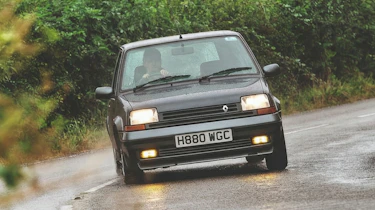
‘Turbocharged cars these days have engine management systems that can massage and manipulate to mask the lost moments whilst the impellers spin up. The turbo lag in a Renault 5 GT Turbo is a sort of exhilarating build-up to the main event that makes it all the more exciting when it arrives. And when it does, the GT Turbo doesn’t hang around, because 120bhp is more than enough to make this little featherweight fly.
‘The really interesting thing about the 5, however, is the way it handles, in particular the way the front end just dives into corners and then feels quite unnaturally nailed to the road. Sometimes it’s almost as if it grips too much, and at the point where you’re expecting to turn the wheel more to get around a bend the car is actually digging in harder, forcing you to wind off lock. Anyone who’s ever driven a Clio 172 or its descendants would recognise the way the GT Turbo behaves, although if anything the older car’s rear end feels more benign and less edgy than that of its kid brothers.

‘Add in the kind of weight change and gentle jittering through the steering that you don’t get in most modern cars plus a sweet, slick gearchange and the GT Turbo is a mighty slice of old-fashioned fun. More than that, it’s one of those cars that’s incredibly easy and fun to drive hard on a good road. Even the ride, reportedly more composed and gentle on these “phase 2” cars, is pretty acceptable and contributes to the easy fluency with which the R5 will flow along at a remarkable clip.
‘The GT Turbo has the qualities we want in all great hot hatches. It’s exciting, it’s addictive, it goads you into driving it harder, and when you do it’s on your side rather than trying to bite your arm off. In so many ways, most notably its uncanny front-end grip, firm but acceptable ride and fluid, easy gearshift, it feels recognisably like a Renault hot hatch. It feels like the place where it all began.'
Driving the Renault 5 GT Turbo: Richard Meaden, 2026 – evo issue 343
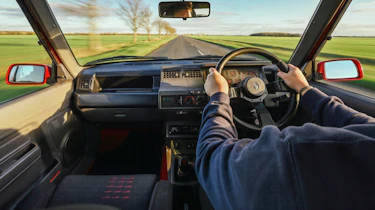
‘It’s not often you’ll hear an ’80s Renault being described as feeling substantial, but that’s what the control weights are, even if the brittle-looking plastic dash and instrument binnacle look like they might shatter on a cold winter’s morning.
‘The clutch pedal requires a proper push, and the heavily sprung, short-travel pedal needs just as much effort to control it on the way up. Stop-start traffic will have your calf muscle quivering, but it’s all part of the GT Turbo experience. The gearshift is also brawny, the short lever and strangely chamfered knob requiring some sinew to slot through the tight and strongly spring-biased gate.
‘The steering (unassisted as in all GTTs) is terrific. Admittedly this is largely due to the steering wheel, which is right up there on my list of all-time great wheels, but the weight is matched by connection, so although the rack isn’t quick (at 3.85 turns it’s similar to the 205’s) you never feel like you’re applying excessive lock to get through twistier sections of road.
'The seats are fantastic: grippy cloth, pronounced squab and side bolsters locating you like Velcro, with an underlying level of squidge in the cushioning material that defines sporty Renaults of the period. It doesn’t suffer quite as much flex or wobble as its period rivals either.
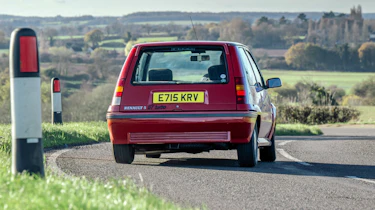
‘The strapping control weights and excellent driving position set the tone for the R5 GTT’s gutsy performance. Displacing just 1397cc and tracing its origins back to the early 1960s, the pushrod OHV carb-fed engine was long in the tooth when Renault decided to strap a Garrett T2 to it, but it proved highly effective.
‘Phase 1 cars suffered with hot-start issues, but these were addressed in the later Phase 2 models like this one, gaining 5bhp in the process to hit a peak of 118bhp at 5750rpm along with an impressive 122lb ft of torque at 3750rpm. Though 118bhp at 5750rpm along with an impressive 122lb ft of torque at 3750rpm might seem laughably low by today’s bloated standards, these were strong figures for the time, especially in such a light car. It’s what gave the Super Cinq its merited reputation for punching well above its weight.
‘Progress is spikey in the crudely turbocharged Renault, acceleration charted in a series of hearty lunges. But what it lacks in keenness while boost is building, it more than makes up for plentiful mid-range muscle. It’s this torque-to-weight ratio that you feel every time you squeeze into the throttle, and what even in bone- stock spec made the Renault feel like a more serious performer. Compare the GTT with a Renault Sport Clio 197 or 200 Cup and you’ll see why, the old stager summoning 149lb ft per ton while the late-noughties Clio (a light car for its day at 1204kg) only flexes 134lb ft per ton and needs 1650rpm more to do it.
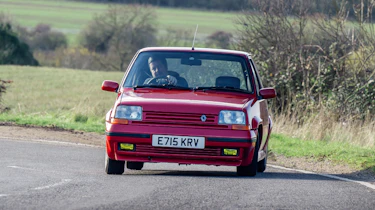
‘It grips well and turns in keenly, with a determined feel and down-to-business style that makes you roll up your sleeves and commit it to corners. Despite the grip and grunty engine it’s a nuanced machine. One which possesses plenty of fine adjustability on corner entry and usefully exploitable lift-off oversteer. The steering really gives you something to lean on, and the weighty pedals mean you can make firm, positive inputs. The GTT responds to a firmer hand and requires greater provocation to wag its tail.
‘With building boost and more torque to contend with, it needs you to be mindful with your throttle inputs. There’s no limited- slip differential so it doesn’t snake and tug at the wheel, but get greedy with your throttle inputs, or go a bit too soon in an effort to pre-empt the turbo lag, and the rising swell of torque will have the inside wheel momentarily scrabbling for traction. It’s all part and parcel of the GTT’s full-bodied character and reflective of Renault’s distinct dynamic style.'
You can purchase a copy of evo issue 343 from the evo Shop here
Renault 5 GT Turbo values and buying guide
The Renault 5 GT Turbo is at once a modern-ish hot hatch, but also a classic car. For one it’s carbureted, which for those who are used to switching on their cars rather than starting them up, will come as a sharp surprise. Rough running can be remedied with a twist of the idle screw – there’s no OBD port to be found here.
Renault 5 GT Turbos were darlings of the tuning scene, so unmolested, clean examples are rare. Many featured modified bodywork and more power due to their easily tuned turbocharged engines, so knowing the history of a car, or at least knowing it’s enjoyed the attention of a specialist, is preferable.
Be eagle-eyed for obvious crash repairs and rust (particularly at the edges of panels, whether against glass or the atmosphere), and look for undue puffs of blue smoke on start-up, while head gaskets are a known failure point too.
What will you pay? Well, as aforementioned, nice R5 GTTs are rare, given the fast lives they lived in the years after they went off-sale, in the ownership of the Ali G generation. Projects are upwards of £5000, while you’ll pay £12,000 for a nicely presented car with higher miles. Low-mile minters exist, albeit for upwards of £20,000.
Specs
| Renault 5 GT Turbo | Renault 5 GT Turbo (1987+) | |
|---|---|---|
| Engine | In-line 4-cyl, turbocharged | In-line 4-cyl, turbocharged |
| Capacity | 1397cc | 1397cc |
| Max power | 115bhp @ 5750rpm | 118bhp @ 5750rpm |
| Max torque | 121lb ft @ 3000rpm | 122lb ft @ 3750rpm |
| Weight | 853kg (137bhp/ton) | 830kg (144bhp/ton) |
| 0-62mph | 8.0sec (claimed) | 8.0sec (claimed) |
| Top speed | 125mph (claimed) | 128mph (claimed) |
| Value now (fair condition) | £10,000+ | £12,000+ |