Porsche Cayenne Coupe Electric review – Ferrari Luce too pricey? Porsche has a solution
Coupe SUVs make no sense, not that this has stopped Porsche from launching its Cayenne Coupe with an electric powertrain

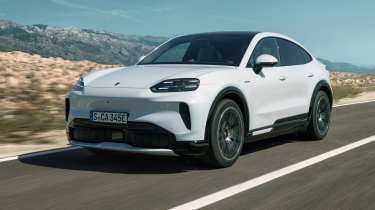
Porsche’s not been in the SUV coupe game for that long, launching its Cayenne Coupe back in 2019 as a combustion engined powered sibling to its uber-successful and, at the time, near twenty year old Cayenne SUV. It’s been a commercial winner, with one third of all Cayennes sold in the last six years a Coupe of one flavour or another. Justification enough for a Cayenne Coupe Electric, then. We’ve been driving it, in max-attack Turbo form as well as the base model and middling S trim, which we suspect will be the sales success Porsche is counting on.
The Cayenne Coupe Electric follows the usual approach of transforming from SUV to coupe with a 24mm lower roof with its ‘911 flyline’ (yes, they really said that) resulting in a slipperier design that, at 0.23cd, is 0.02 more efficient through the air than its SUV brother. It means it yields an appreciable 11-mile increase in range for the longest-legged Cayenne S variant. Better than that though, is that life isn’t totally ruined by the lower roof for rear seat passengers.
> Ferrari Luce unveiled as bold 1035bhp four-door with the world’s most unusual wipers
Motors and performance
- Coupe, S and Turbo versions available
- Formula E tech for the S and Turbo rear motor delivery 600kW of regen
- Turbo’s 1156bhp maximum is incredible, but the S is enough
The Cayenne Coupe shares its powertrain options with the SUV. That means there’s a base car - simply called Cayenne Coupe - with 402bhp, the Cayenne S with 536bhp and the Turbo with 845bhp. Each can jump to 436bhp, 657bhp and 1140bhp respectively with the boost function and all use a 113kW battery with modular pouch cells and double-sided cooling. The rear motor on the S and the Turbo uses direct oil cooling and can deliver Formula E levels of recuperation, up to 600kW.
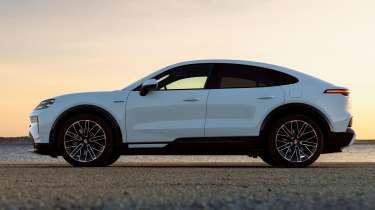
As in the Cayenne SUV, the performance of the Coupe Turbo remains utterly dumbfounding and is borderline unusable in its entirety when it’s wet. Plant the throttle in Sport + with boost engaged and the fake V8 sounds and vibrations through the pedal are almost too much. You immediately feel the vast amounts of potency being passed between the rear wheels, as each scrabbles at the surface to put it down. The P Zero R performance summer tyre (yes, that’s serious 911 rubber) and rain-soaked surface doesn’t help and indeed, we know from experience in the SUV, it hooks up nicely, if nauseatingly so in the dry. 2.5-seconds to 62mph using launch control does that to you.
That figure makes the Coupe S look almost tardy with its launch control assisted 3.8-second 0-62mph, but that’s Carrera GT levels of acceleration. But whilst the Turbo always feels like it’s on a mission to turn the planet on its axis, the S is more measured. You can make progress without forcing your stomach through your spine every time you think of using the throttle. And like all electric cars the rate of acceleration tails off almost as quickly as it arrives. Even the sub-five second 62mph sprinting time (once again using launch control) of the Cayenne feels plenty enough in a car of this size and weight. All will reach an autobahn approved maximum of 143, 155 and 162mph maximum speed and deplete their batteries quicker still.
Ride and handling
- S and Turbo can be had with Active Ride and rear-wheel steering. It’s worth it
- Turbo gets the upgraded LSD as standard but it’s an option on S
- New Lightweight Sport pack shaves 17.6kg… off a 2.6-ton SUV
As with the SUV, the Cayenne Coupe S and Turbo can be specified with Porsche’s excellent hydraulically cross-linked Active Ride suspension system, with the standard air springs and PASM dampers the only option on the Cayenne Coupe. The Turbo also received the Porsche Torque Vectoring Plus rear differential as standard but it’s an option on the S. Rear-wheel steering is an option on all Cayenne Electric variants.
New for the Cayenne Coupe is, and know I’m typing this with a smirk on my face, the Lightweight Sport pack, shaving a mighty 17.6kg off the top of your 2.6-ton Cayenne Coupe. Almost literally, as this includes a carbonfibre roof in place of the panoramic glass item, plus lighter 22-inch wheels and Race Tex interior trim. You’d need a race track to be generating forces and be travelling at pace, and a car without it with which to compare, to really feel the difference.
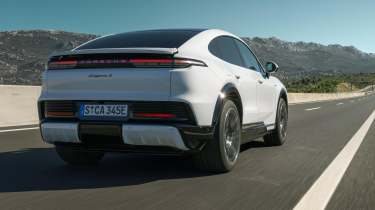
You do feel the difference when Active Ride, the PTV+ rear axle and rear steering are fitted, though. A Cayenne so equipped with the drive mode set to Sport+ is much more agile and controls its mass under hard cornering more like a fast estate than an SUV. I’ll stop short saying it’s either thrilling or engaging. At a fast cruise both active ride and the standard air suspension set-up result in a comfortable ride, with the hydraulic system feeling like you’re floating across clouds. It stops short, however, of ironing out all high-frequency chatter at town speeds.
All the extra chassis technology is worthwhile to get the best out of the Cayenne in terms of capability, performance and response and if you don’t need the performance of the Turbo (who does, really?), the S with all the boxes ticked doesn’t surpass the price of a basic Turbo. This would be our pick.
Interior and tech
- Head and legroom still good – an achievement in a coupe SUV
- High-quality cabin fit and finish
- More luxurious-feeling than any Cayenne before it
Our drive from Munich was a top-spec Cayenne Turbo Coupe Electric (now there’s a mouthful), which was equipped with fully powered doors. Pull the handle and the door opens for you. Climb in, press a button and it then closes for you. That takes a moment to get used to and the action has resistance in manual operation, like manually shutting a powered boot lid.
Inside it’s as per the Cayenne SUV. The big news is the flow display, which on reacquaintance, I’m growing to like more and more. It’s well-positioned, with a leather pillow to rest your wrist on, for ease of use. Air direction controls still hidden within the screen remain a blunder, though there are physical toggles for fan speed and air temperature.
The biggest difference between the Coupe and SUV, you’d expect, would be in the back. Namely, in terms of space for rear passengers. Happily, whether you have the panoramic roof or the carbon roof, headroom remains good. Boot space is still decent too, only moderately chopped by around 250 litres thanks to the sloping rear end.
Range and efficiency
- Coupe range is up 11 miles compared to the equivalent Cayenne S SUV
- Maximum of 414 miles of range (Cayenne S Coupe)
- 113kWh (gross) battery, 400kW charging capability, 600kW regeneration
My curiosity that a hair over 400 miles of range in a car with a battery that’s the same size as that in BMW’s iX3, which manages 500 miles of WLTP-certified range, remains. The Coupe’s slipperier body (0.23cd down from 0.25) aids an 11-mile improvement in range in the Cayenne S, at least, bumping it to 414 miles as measured on the WLTP cycle.
Our test took place around Munich in Germany, which included everything from mountain roads, to derestricted Autobahns. So it’s not exactly helpful consumer information that the Cayenne Coupe Turbo feels rocksteady at 163mph, where it’s consuming electricity at a rate to empty the battery in under 100 miles.
Over the course of a day of driving, we saw efficiency of between 25kWh/100km and 35kWh/100km, or between 1.7m/kwh and 2.5m/kWh (claimed is over 3m/kWh for all Cayenne Electric variants) which means range of around 170-250 miles in the real world. I expect in more realistic driving, between 250 and 300 miles on a charge is perfectly possible. Not great, not terrible, similar distances to a twin-turbo V8 in fact.
Ease of filling up in an EV can be more variable than for a V8 of course. Porsche’s innovative 11kW wireless charging system helps in that regard, allowing owners to simply park their car in their garage and it will start charging automatically. And yes, it’s pet safe. We tested it and found the car easy to position over the induction pad, the car guiding you via its cameras and graphics on the screen. You control it with the My Porsche app, including during what hours the car takes charge. Between the pad in the car and the pad on your floor (sold separately), it’s expected to be a c£6500 option when available later this year.
Price and rivals
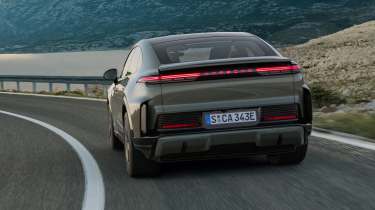
The Cayenne Coupe Electric starts from £86,200 for the base car, £103,100 for the Cayenne S and £133,300 for the Turbo, which equates to around £3000 more than the equivalent Cayenne SUV models.
Rear-axle steering adds £1389, PTV Plus adds £1215 and Active Ride adds £6,799. Carbon Ceramic Brakes add a further £7592 while electric sport sound adds £408. The real kicker is the Lightweight Sport Package at £13,676, though this does include 22-inch wheels with P-Zero R tyres, the GT Sports steering wheel and roof lining in Race Tex, open-pore carbon interior trim and Pepita fabric seat centres. Add that all to a Cayenne S and yes, you do get to just over the starting price for a Turbo, but it’ll be the better car.
In the world of the all-electric super SUV, only the Lotus Eletre gets close, starting from £84,990 for the base model. Its interior looks and feels a bit more special and it offers more performance for the money, but its powertrain leaves plenty to be desired where efficiency is concerned.