Tesla Roadster delayed (again), but a new patent suggests it could have British inspiration
In true Tesla Roadster fashion, it’s been delayed yet again. This time though, we have a new patent filing to analyse in the meantime
To say the second-generation Tesla Roadster has had a tumultuous launch would be an understatement, as almost a decade since its initial announcement, it’s still not here. Tesla CEO Elon Musk claimed it would enter production six years ago before pushing it back again to 2025, then to October 1 2026 and now, October 15 with weather cited as the cause. Whenever it arrives, this new patent suggests it could come with some very familiar technology for Brits.
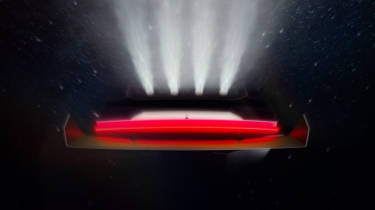
Details on precisely what we’ll see in October are limited to an abstract teaser image, a countdown timer ending on October 15, and a short statement from Musk confirming that Tesla will ‘unveil’ the car on this date. The teaser image itself reveals little more than the fact that the Roadster’s design appears to have changed drastically since the 2017 preview, with what appears to be an extreme diffuser section and a full-width lightbar now part of the design.
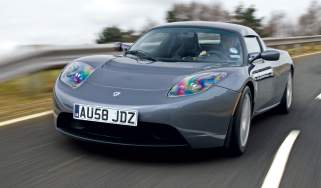
> Tesla Roadster (Mk1, 2008 - 2012) review – the original electric sports car
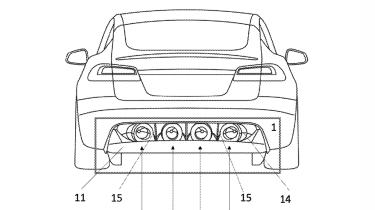
On 29 September 2026 the US Patent and Trademark Office granted a new patent for Tesla (US 12,746,987 B1), which could go some way to explaining that new diffuser design. It outlines the technology required to create an ‘electric fan car’ in order to ‘improve grip around corners and stability under braking,’ taking air from beneath the car and feeding it through ducted axial fans integrated into an active, extendable diffuser – this allows for a considerable improvement in grip not only at high speeds, but low speeds too. A moveable diffuser wouldn’t be a first for a production car, having been seen on the new Mercedes-AMG GT 63 saloon, used primarily for improved efficiency. If you’ve kept a close eye on Britain’s latest performance cars, you’ll know that fan technology isn’t entirely new either.
All credited inventors on this patent are based in the US, but this is technology similar to the kind seen on Britain’s record-breaking McMurtry Spéirling and the GMA T.50 hypercar. Unlike McMurtry, this patent specifies that fans won't be used in conjunction with a skirt beneath the car, but a separate patent filed last year did include a skirt. Filing a patent or having one granted is no indication as to whether or not a feature will make it to production, but it certainly proves how seriously Tesla is taking performance.
In the last update given on the car in 2024, Elon Musk revealed that the company had ‘radically increased the design goals,’ adding that ‘...there will never be another car like this, if you could even call it a car’. Continuing an X thread from 2018 in which he spoke about the use of gas thrusters, Musk said that the model would be a collaboration between Tesla and the spacecraft manufacturer SpaceX, revealing that it would achieve a record-breaking sub-1sec 0-60mph time.
Tesla Roadster with SpaceX thrusters?
This latest teaser image suggests the firm has indeed stuck to this, with it previewing what appears to be a set of four cold gas thrusters at the rear of the car. Given it came with a ‘go for launch’ caption, it seems a SpaceX collaboration is still on the cards after all.
In 2024, Bugatti-Rimac CEO Mate Rimac responded to the suggestion that Tesla would employ this rocket-derived tech for its incoming flagship: ‘...it is possible with thrusters. We did the simulation. Problem is, you release the air in 2-3 seconds and then you have a lot of dead weight that you are carrying around (tanks, compressor, valves, nozzles etc.).’ He went on to say that such an acceleration figure could also be achieved through the use of fans as we’ve seen in the McMurtry Spéirling, but added that ‘the tyres would be overloaded very fast with any kind of car with “normal supercar” weight’. Rimac concluded that ‘thrusters are really the only way to go. But bring a lot of downsides as well.’
As is common with all Tesla product launches, the ambitious new Roadster has seen a number of setbacks since its 2017 reveal, with Musk blaming both the pandemic and parts supply issues for the over four-year delay to its initially proposed launch. In 2019, Tesla confirmed that we’d only see the all-electric supercar hit the road once the firm had achieved a number of milestones, most notably the construction of its Berlin ‘Gigafactory’, establishing Model Y production and launching the Cybertruck, all of which have now been achieved.
Powertrain, performance and 0-62mph
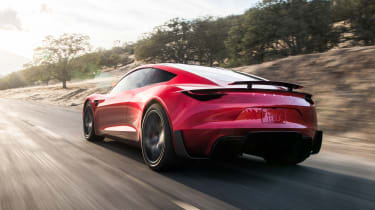
The original Roadster was Tesla’s first production model, based on a heavily modified Lotus Elise platform. This new model looks rather more ambitious – as we've come to expect from Tesla – and is promising some pretty ambitious on-paper performance figures. No power figure is yet quoted, and you can ignore Tesla's torque figure of over 7300lb ft, as it's a ‘wheel torque’, multiplied by gearing and therefore not directly comparable to the crank torque (or motor torque) quoted by other manufacturers.
This time around, the Roadster delivers its power and torque figures through all four wheels, and will do so effectively from rest. Tesla hasn't specified a weight figure, but it's safe to assume the Roadster will be lighter than models S, X and 3, given its claimed sub-1sec 0-60mph time. The quarter-mile time previously quoted was just 8.8sec thanks to its ‘Plaid’ powertrain, consisting of three motors as opposed to the usual two, and a new uprated battery pack.
Unlike many electric cars, acceleration doesn't come at the expense of a range-limiting top speed either, with Tesla suggesting 'over 250mph' at the top end. It's fair to assume that top speed would somewhat limit range, though driven at a more sedate pace, Tesla also claims a 620-mile range from its 200kWh battery pack.
Design and interior
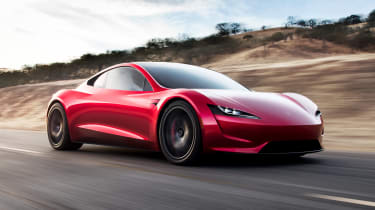
Its styling is still a representation of what the new Roadster could look like, rather than a direct correlation to what will be available to buyers when (if) it does eventually arrive. If the coupe styling is confusing given Tesla's choice of the Roadster moniker, things become a little clearer when the central targa-style panel is removed.
The interior is said to seat four, and is typically Tesla-minimalist. Though the dashboard layout is more conventional than that of other Teslas, it does feature an aircraft-style yoke steering wheel that’s already caused so much controversy in the latest Model S Plaid.
Tesla began taking deposits of $50,000 on the $200,000 Roadster from the moment it was unveiled – or full-price deposits of $250,000 on what it's calling a Founder Series model.