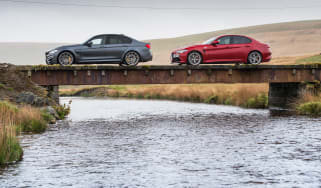
Alfa Romeo Giulia Quadrifoglio 2026 review – Italy’s BMW M3 isn’t dead yet
Alfa has announced that the Giulia Quadrifoglio will live on through 2027, which is very good news indeed – it’s one of the best supersaloons on sale
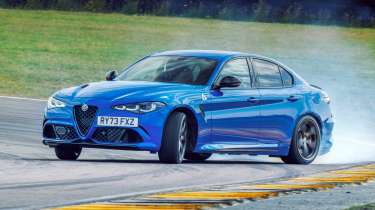
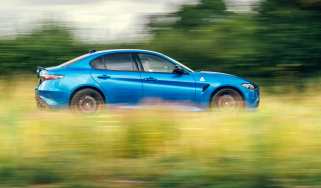
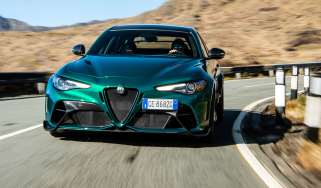
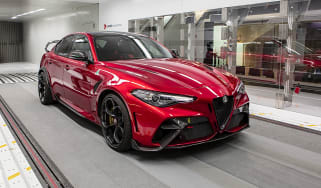
The Alfa Romeo Giulia Quadrifoglio has been with us now for over a decade. We’ve loved it since its introduction but Alfa Romeo has diligently and carefully nipped and tucked its performance saloon. Revealed in 2015 and launched in 2016, the Alfa Romeo Giulia Quadrifoglio is a car that has become something of an instant classic. From the very first drive, it was clear this was a spectacular supersaloon.
All of this excellence seemingly came from nowhere too, with Alfa Romeo enlisting a crack skunkworks-like team of designers and engineers to design almost every part of the Giulia from scratch, as the first rear-wheel-drive Alfa Romeo sports saloon since the 75 ended production in 1992. At the head of the project, Philippe Krief, former Ferrari technical director and the man behind the chassis of the 458 Speciale. The excellent ‘Giorgio’ platform on which the Giulia was based also underpinned the Stelvio SUV, as well as models from Maserati.

It went through a (very) light update in 2020, the only notable updates being an improved digital interface (up to 8.8-inch with Apple CarPlay and Android Auto), an optional Akrapovic exhaust and properly-finished gear selector. They also added port injection as part of a WLTP-related emissions cleanup. Not only is the Quadrifoglio a great execution of a supersaloon, it leaves plenty of the German establishment with bloody noses.
More reviews
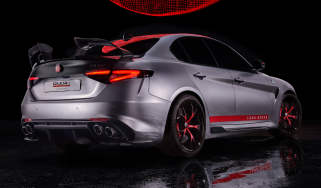
The latest update that came a couple of years ago added some welcome mechanical and visual refinements, without stifling the essence of a sports saloon that feels like it hails from a different time, in the best way – a time before cars of its like got so large, heavy and complex. And thankfully the Quadrifoglio will be around for a little while yet – Alfa has confirmed production will continue through 2027, at which point it’ll be over a decade old but surely still one of the most desirable supersaloons on sale.
Engine, gearbox and technical highlights
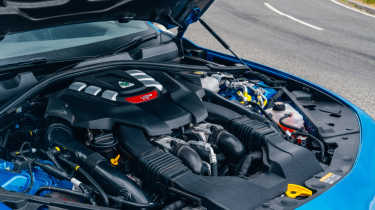
- Turbocharged 2.9-litre V6 with over 500bhp
- Auto-only in the UK – manual available oversees
- Carbonfibre bonnet, roof and propshaft
Like many great Alfas of old the Giulia Quadrifoglio is powered by a V6. Its 2.9-litre twin-turbocharged motor might not have the reputation (or emit the same acoustics) as Alfa’s legendary Busso engine but it shares plenty of DNA with the V8 first found in the front of Ferrari’s California T.
Peak power of 513bhp (previously 503bhp before 2024) is achieved at 6500rpm. It revs to 7000rpm and produces 442lb ft of torque between 1800 and 5500rpm (or at 2500rpm in post-2024 cars). It isn’t the revviest engine, but it delivers its performance in such a linear and manageable manner that you don’t lament the opportunity to stretch the motor beyond the limiter. Performance figures are a supercar-worthy 0-62mph time of 3.9sec and 191mph flat-out.
In the UK there is no choice of transmission: an eight-speed automatic gearbox is all you get. Yes, it’s that same ZF unit that BMW, Aston Martin, Audi, Land Rover and Maserati use. Left-hand-drive cars can be ordered with a six-speed manual gearbox.
Drive is sent to the rear wheels via a carbonfibre propshaft. Pre-2024 cars had an electronically controlled limited-slip differential that could vary the amount of lock across the rear axle, and actively send torque to a specific wheel to create torque vectoring, too. This has been replaced with a mechanical limited-slip diff for the 2024 update, for more consistent handling at the limit and also to avoid overheating issues when driven hard on track.
Some of the suspension changes from the special-edition Giulia GTA and GTAm of 2021 have since been mapped over to the standard car, specifically the tuning for the standard-fit electronically controlled dampers and a thicker and stiffer rear anti-roll bar, which work with a double-wishbone front, multi-link rear suspension layout.
To keep weight down the Quadrifoglio uses a carbonfibre propshaft, bonnet, roof and front splitter. The subframes are made from aluminum, as is much of the engine. Alfa Romeo quotes a kerb weight of 1660kg, which though not featherweight is significantly lighter than its key rival, the near-1800kg BMW M3 Competition.
Driver's note
‘The combination of ultra-direct, quick steering and relaxed body movements characterises the way the Giulia drives. It’s a lovely combination on bumpy roads, and you always have the option of dialling up a much fiercer character by switching to Race mode.’ – Yousuf Ashraf, evo Senior Staff Writer
Performance, ride and handling
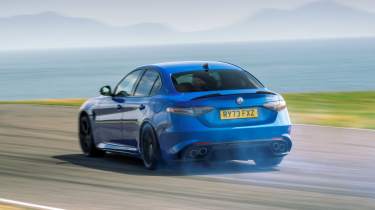
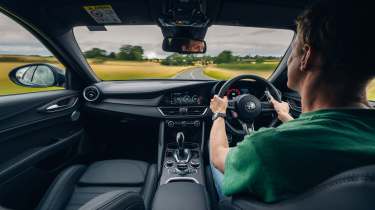
Before you even start the Giulia Quadrifoglio you get the feeling that the team behind this car really cares about driving. You sit low, with your entire body hugged by the optional carbonfibre-backed Sparco seats. The generous range of adjustment on the steering column means you can pull the steering wheel into the exact position you want, too.
The starter button is positioned on the steering wheel while two long aluminium paddles, that follow the curve of the rim, are mounted on the column. Both feel very Ferrari-esque. But that’s no surprise, because Alfa poached engineers from Ferrari to help develop the Giulia.
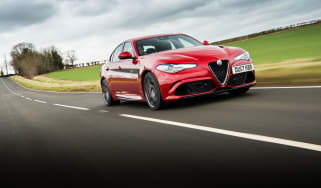
Another aspect of the Alfa that feels oh-so Ferrari is the steering. Just metres down a road you become aware that the Giulia has a very fast steering rack, more than a little reminiscent of that found in the Ferrari 458. But the Quadrifoglio isn’t a rabid, spiky animal. The delivery from its 2.9-litre V6 is progressive and linear.
There’s a suppleness to the chassis which feels odd for a car with such a sporting bent. The ride is rounded and plush, unlike the firm ride some of the Alfa’s rivals exhibit. It’s only as you begin to really push the Giulia that the softer chassis feels slightly lacking in body control, and a touch too much roll is apparent. The stiffer anti-roll bar in the updated 2024 and altered damper software help in this regard.
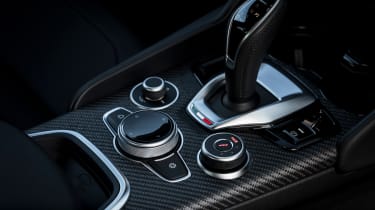
The Giulia's DNA drive settings allow you to stiffen up the dampers as well as sharpening the throttle, adding weight to the steering and making the exhaust a bit louder. There are four DNA driving modes selected by a small rotary knob on the transmission tunnel. Advanced Efficiency (A) is the most fuel efficient and allows one bank of the V6’s cylinders to shut down.
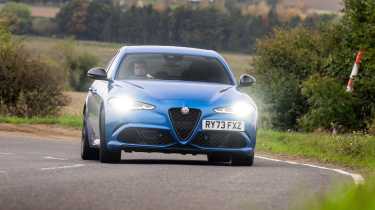
Next up is Natural (N), but Dynamic (D) and Race (R) are where it gets interesting as the throttle, exhaust, gearshift, suspension and steering all ramp up the involvement. The exhaust sounds bassier too, and you get either a satisfying crack or a slightly mediocre burp at every upshift.
Dynamic firms up the dampers, but the car still feels compliant. Should you wish to have the noise, steering and throttle of Dynamic with the softest suspension, a button in the middle of the DNA dial allows you to relax the dampers.
Race mode is firmer still, but just as in Dynamic you can back the dampers off to a softer setting; not fully soft, but the same setting as the default in Dynamic. No matter which mode you’re in though, the suspension never feels unbearably stiff. Only the very bumpiest of roads makes Race feel less than ideal, but the tighter body control is still preferred by some of the evo team. Others prefer the more compliant modes, as it never really feels wayward or unrestrained. Either way, there’s a setting to suit everyone.
Race mode also disables the ESP and traction control – it’s the only way to deactivate the safety systems. Away from open B-roads and in town the pre-2024 Giulia revealed some slight quirks. It shakes and rocks at idle and the diff is reluctant to lock up; the inside rear wheel often spins as you leave junctions. The carbon ceramic brakes are very hard to modulate at low speeds, and you find yourself fighting the car as it wants to creep forward until you add more and more pressure to the middle pedal to stop it.

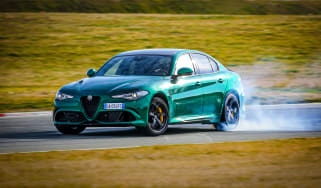
These low speed peculiarities are easy to overlook, though, because the Alfa is such an accomplished car when driven enthusiastically. On track the Giulia’s soft, compliant suspension is still more than capable, although it is at its best in Race mode. The engine and drivetrain work together to allow a fantastic degree of adjustability, and you can control and balance the car from apex to exit.
Up until 2024, the Quadrifoglio didn’t always want to play the hooligan like its rivals. Provoked into a slide, the electronic diff could contradict your actions and push you straight. After one or two corners of tomfoolery the diff could call time, flashing a ‘Service ATV System’ message on the dash. It would then fail to lock up, acting instead like an open differential. Giving some time to allow the diff to cool, it would be possible to continue.
The mechanical locking diff in post-2024 cars has solved this problem. You can get on the power remarkably early without wheelspin or the rear becoming unstable. And when you do deliberately want to slide the car, it’s very progressive and intuitive. In cold, damp or greasy conditions it broadens the spectrum in which to control the car beyond the limit, with a clearer dialogue between car and driver. In short, the Giulia is now an easier car to control when traction is at a premium.
Driver’s note
‘It doesn’t have the resolute precision and control of an M3, but there’s so much to love about the Giulia and its distinctive character. The engine is full of life and the car feels pointy, alive and expressive. Its ride quality is better than the BMW’s, too.’ – Yousuf Ashraf, evo Senior Staff Writer
MPG and running costs
Naturally, a 500bhp+ supersaloon is rarely cheap to run, and it would be unrealistic to expect huge mpg figures and minimal fuel bills. Alfa claims the Quadrifoglio will achieve 28mpg on the combined cycle, but we’ve seen more like low-20s in mixed use. In Advanced Efficiency mode, the engine does have a cylinder deactivation function to save fuel, and the transmission a ‘sailing’ function, which are bound to help somewhat.
Another expenditure to take into account is tyres. Replacing the rears with new Michelin Pilot Sport 4 Ss will cost you around £700, with a set of fronts coming in at £500, including fitting.
Ordinarily with a powerful rear-drive saloon, you’d expect the back tyres to wear faster than the fronts. That can be true of the Giulia too, but the front tyres fitted to test cars that we’ve had access to had a wear rating of 60 (a more conventional performance tyre would have a rating of 300, and an ’eco’ tyre of about 400). Consequently, driving on track can rapidly wear down the fronts.
Interior and tech
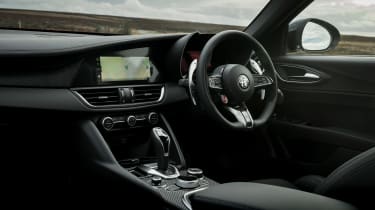
Historically, this has been the Giulia’s weakest area. Although the seats and driving position are faultless, and the design of the interior is neat if a little plain, the materials let it down, with lots of tough and scratchy plastics and flimsy switchgear. This has been gradually improved with various updates since the 2017 launch. The 2024 car features open-weave ‘3D’ carbonfibre, which is something of an acquired taste, but is distinctive.
A 12.3-inch TFT digital instrument panel sits inside the traditional tunnelled cowlings ahead of the steering wheel. It has multiple configurable displays, including a ‘Race’ layout, which introduces shift-up lights for manual gear control.
The latest Giulia's infotainment system is serviceable. The only real issue we have found is when trying to listen to audio via a Bluetooth device, the system takes a long time to reconnect and allow the phone to play. And, sometimes it refuses to play anything at all. Something that makes the Alfa system easier to decipher than others is that it doesn’t try to be too complicated; it does everything you need but nothing more, although its graphics do look dated.
The liberal use of carbonfibre and Alcantara, both of which can be found on the rim of the steering wheel, do help give the inside a sporty feel. But there’s no denying it, it’s some way off the solid, supremely well appointed and well put together interiors of its main rivals from BMW and Mercedes.
Living with a Giulia Quadrifoglio
It’s no secret that I’m an Alfa fan, so it was with great delight that I nabbed the key to RY73 FXZ from regular custodian James Taylor. I spent plenty of miles in our previous Alfa – the four-cylinder Giulia Veloce – and enjoyed its deftness and impressive turn of speed. It looked great, too. Less muscular than the Quadrifoglio, but beautifully svelte and super-stylish.
Trouble is, despite its abundant appeal, the Veloce suffers from not being the Quadrifoglio. That might sound disappointing, as people like us aren’t supposed to be so easily swayed, but hopefully it’s forgivable given the seductive qualities of a 513bhp twin-turbocharged V6 and that jacked four-door physique.
Life feels good when you’ve got a Quadrifoglio to walk up to and take for a drive. It’s got such presence that every journey becomes an event. The lusty V6 is a real force of nature, firing with a baritone blare before settling into a deep, pulsing idle. The eight-speed automatic transmission is smooth and responsive when left to its own devices, which emphasises the effortless flex from the generous 442lb ft of torque.
Despite this abundant performance and obvious charm, once beyond the initial flush of enjoyment, further exposure has led me to the reluctant conclusion that the Giulia is beginning to feel its age. Not so far as performance is concerned – the biturbo V6 is as epic as ever – but the chassis doesn’t have the poise, control and mass-defying agility of its rivals.
Part of this is due to limited scope when it comes to what you can dial-up or wind back, at least compared to the endlessly configurable G8x-series BMW M3/M4, but my main issue is that what choice you do have with the suspension either feels under-damped or over-sprung, with nothing in between.
In the softer setting you can settle into things well enough, thanks to a pliant low-speed ride, but once you build speed it doesn’t have sufficient body control to cope with crests and compressions. It’s not forever falling into its bump-stops, but you do sense the car is using more of its wheel travel than it should for the speed you’re carrying. Up your pace and those same compressions regularly have the Giulia running out of ideas. It creates a sense of weight, which is the opposite to the physics-defying dynamics of M division’s heavyweight mid-sized supersaloon.
Switching to the firmer damping mode tightens the vertical movement for better control in those critical moments, but it feels like it’s constantly tensing its core muscles. The resulting brittleness becomes wearing after a while, so you knock the dampers back into their softer mode, only to feel frustrated by the soggy body control. It’s a frustrating cycle, and something which began to taint my overall enjoyment of the car.
During my spell with the Alfa I took it to Goodwood for an evo trackday. Not with the expectation of pounding around all day – it’s not that kind of car – but to see how the Giulia felt with its new mechanical limited-slip differential.
Goodwood’s long, fast curves were less of a test for the diff, which hooked-up nicely out of the looping horseshoe-shaped Lavant corner, but rather more of a challenge for the left-front Pirelli P Zero. These flagship Giulias have always been nose-heavy on track, but it never ceases to amaze me how quickly they will ruin the hardest-worked front tyre. Three laps was enough to make a chewed-up mess of the shoulder, which was very disappointing. Especially as the heavier BMW M4 Competition we ran a year or so ago shrugged off many more laps at the same circuit.
It’s indicative of life as a vicarious Alfisti that now that Taylor has finally reclaimed the Giulia I find myself missing it despite the flaws. But that’s the Alfa Paradox: can’t live with them, can’t live without them. – evo issue 327, Richard Meaden
Prices, specs and rivals
The Giulia’s asking price has increased markedly since launch, to the point where it’s now a £90k car – matching much more modern and sophisticated rivals like the latest M3. In fairness, the Alfa is still at the cutting edge in some ways – including in its array of exotic carbonfibre body parts and components and 500bhp+ engine.
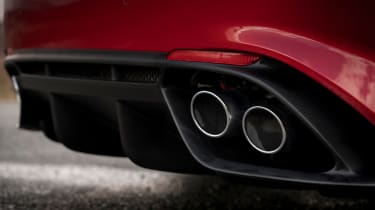
There aren’t many options, but the ones you might want to choose are expensive. Carbon ceramic brakes are recommended for track use, although the strange pedal feel and odd low speed behaviour that comes with them could put you off. What you may well wish to fork out for are the carbon fibre-backed Sparco bucket seats; not only do they look great, but they're some of the most comfortable and supportive seats in any performance car currently on sale. The optional Akrapovic exhaust system is in titanium, with carbon fibre exhaust tips. In the cabin, black perforated leather is standard, and a mix of leather and Alcantara, still black, is an option.
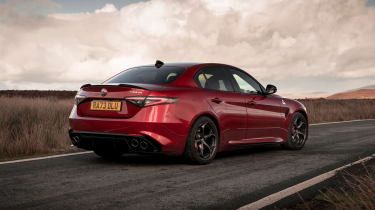
Generally speaking, a fully loaded Giulia is less expensive than a similarly specced BMW M3. Indeed, the latest updated M3 is priced from £91,315, with a lot more scope for price creep in the options list, than the slightly cheaper (at base) Alfa Romeo. The BMW has long been at the top of the tree in this sector and the current, four-wheel drive G80 Competition is no exception. Truthfully, it’s a credit to the Alfa that it still warrants objective comparison with the M3, given it was introduced as a rival to the previous F80 generation a decade ago.
Audi is set to join the party with its new £90,220 RS5, but being a 630bhp plug-in hybrid it’s a very different (and at 2355kg, substantially heavier) proposition to the Alfa. Mercedes-AMG doesn’t currently have a direct rival, with the four-cylinder C63 S E Performance having been axed. Its current closest competitor is the £76k CLE 53 – a 465bhp straight-six-powered coupe that’s more GT than sports car.
Used Alfa Romeo Giulia Quadrifoglio – prices and checkpoints
As a car that first landed in showrooms almost a decade ago, the used market for the Alfa Romeo Giulia Quadrifoglio is a rich one. Prices range enormously from the oldest high-mile cars at under £28k, to over £60k for cars as young as 2023 and obviously, over £80k for a facelift car that’s essentially nearly new.
For the budget-conscious buyer looking to get into the best Quadrifoglio possible, as new as possible with an immaculate service history is what you want. These cars had teething problems from new with a few documented engine failures. Those issues, among others, have since been ironed out. For ultimate peace of mind we’d go for a 2020 facelift at minimum, with the Akrapovic exhaust, improved 8.8-inch infotainment with smartphone mirroring and the added port injection system. The latter especially, can ease any fears of carbon buildup some DFI cars can be prone to. These are available for around £40k.
One of the advantages of an earlier car is they come without gas particulate filters and have a richer, louder, raspier sound. But be warned, earlier cars are more prone to electrical gremlins. On a test drive of any Giulia, be sure to pay attention to the rear end, particularly listening out for a whining differential. Look for an immaculate history record, including evidence of remediation of common issues, including faulty sensors, coolant leaks, faulty fuel pumps and turbochargers. The transmission, being the eight-speed ZF unit used across a wide range of manufacturers, is considered dependable.