Mazda’s museum proves it’s one of the most innovative car companies in the world
In the global automotive ocean, Mazda is a pretty small fish. It's also one of the bravest, as its spectacular history shows

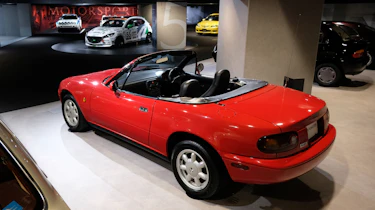
Mazda has always been a bit of an automotive nonconformist. Throughout its history it has pursued design and engineering solutions that other automakers have neither the will nor ability to execute – or are perhaps too risk-averse to investigate further.
The prime example is the rotary engine, a technology Mazda began improving in the early 1960s and continues to work on to this day, but there are others too: installing V6 engines in virtually every model in its range in the 1990s; the recent revival of in-line sixes just as the rest of the industry is electrifying; and of course being the sole manufacturer worldwide still to offer an affordable roadster in the MX-5.
Mazda is even out on a limb geographically; while most of Japan’s automakers are clustered between Tokyo and Nagoya, Mazda sits more than 250 miles further west in its original home of Hiroshima. In a way, it’s a kind of Far Eastern Citroën or Lancia; it can’t have been purely coincidence that sub-brands Eunos and Autozam were concessionaires for the French and Italian marques in the Japanese market in the ’90s.
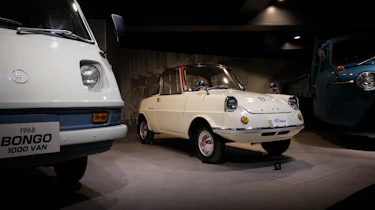
There are no Citroëns or Lancias on display at the Mazda Museum in the heart of the brand’s enormous factory complex, but you do get a sense of how Mazda has played things a little differently over the years. It’s a small museum, befitting Mazda’s independence, but a recent refit has given it a sophisticated feel that also feels appropriate, and regular rotation of the vehicles on display means there’s something new to see if you’re making a return visit.
Mazda RX-7 FD (1992 - 2002): a '90s Japanese icon
Some exhibits persist though, such as the trio of Mazda’s earliest models that greet you as you walk through a long, spotlit tunnel between the foyer and the museum. Mazda was incorporated as Toyo Cork Kogyo Co in 1920 and began producing its first vehicle, the Mazda‑Go autorickshaw, in 1931.
The company’s factory was miraculously unscathed when the atomic bomb was dropped over Hiroshima in August 1945 (founder Jujiro Matsuda, celebrating his 70th birthday, also narrowly avoided being killed in the blast) so it restarted production in December that year as the city began rebuilding.
It would be more than a decade until Mazda built its first passenger car, the tiny, almost Jetsons-like twin-cylinder R360 of 1960, built to the kei-jidōsha (‘light vehicle’) regulations that Japan had implemented in 1949 to stimulate demand for automobiles post-war. The R360 proved hugely popular, accounting for two-thirds of the entire kei-car market in its first year.
Spin around, though, and you’ll see another of Mazda’s 1960s stars: the Cosmo. Development was led by Kenichi Yamamoto, who had been at Mazda since 1946 and began working with rotary engines in 1961. The Cosmo launched in 1967 as Mazda’s first sports car, with a 982cc twin-rotor engine good for 110bhp at a time when a 1.8-litre MGB wheezed its way to 95bhp.
> Mazda 787B: the anatomy of a rotary Le Mans icon
The rotary really did feel like the future at the time, spinning more smoothly than sixes and eights yet weighing less than the average iron-block four. Mazda proved it could be durable too, entering a pair of Cosmos in the 84-hour, 6000-mile Marathon de la Route at the Nürburgring in 1968, with one car finishing fourth behind a pair of Porsches and a Lancia, and the other only retiring near the end from tyre failure.
Mazda went on to install rotaries in everything from the compact R100 to a large Holden-based saloon called the Roadpacer, and even a 26-seat coach. But its best-known installation is in the RX‑7, which went on sale in Japan in March 1978. By the time production ended in 1985, the first-gen model had sold more than 471,000, making it not just the most successful rotary-engined car of all time but outselling its closest rival, the Porsche 924, by nearly three to one.
Mazda launched two further generations of RX‑7, in 1985 and 1991, and while neither was the whirlwind success of the original, each brought something new to the table and kept the rest of the sports car industry on its toes (the third-generation especially, giving Porsche’s 968 a hard time) until production ended in 2002.
Mazda has examples of each in the museum: an early first-gen ‘SA22C’ wearing its Japanese-market Savanna RX‑7 badging and fender mirrors, a second-generation turbocharged GT‑X, and a late third-gen Spirit‑R, sporting BBS wheels, Recaro seats and an engine that probably makes a little more than the claimed 276bhp.
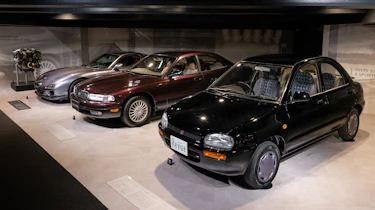
Nestled in between are lesser-known Mazdas such as the bubble-shaped Autozam Revue – briefly sold in the UK as the Mazda 121 – as well as a late-1980s Luce (929) wearing stickers to celebrate Mazda’s 20 millionth car, and a Mazda Sentia, a large, V6-powered, rear-wheel-drive luxury saloon with four-wheel steering and solar-powered cabin ventilation.
More interesting yet is the engine perched on a stand nearby. This 4-litre V12 was designed for a saloon even grander and more luxurious than the Sentia, under the standalone Amati brand. This engine predated Toyota’s V12-powered Century and was the first of its type Mazda had attempted, effectively built from two of the company’s small-capacity V6s.
> Mazda MX-5 review – the last surviving affordable sports car
The intention was to offer greater performance than any rival at the time – no mean feat, considering BMW’s 750i and Mercedes-Benz’s S600 had recently hit the market – but development was brought to a screeching halt when Japan’s economic bubble burst in 1991. Tantalisingly, the engine here is attached to a manual gearbox…
Alongside are a pristine – and extremely rare – Mazda 6 Sport and Demio, cars you’re more likely to spot in Gran Turismo than on the road. Likewise the early rotary-powered RX‑8 in distinctive Velocity Red Mica, many road cars having long ago fallen victim to their engines.
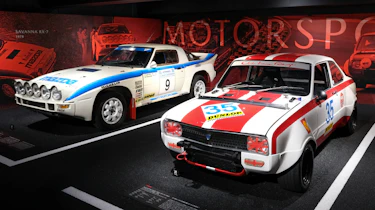
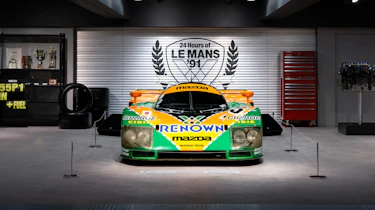
Car number 55, the green and orange 787B Group C machine that won the 1991 24 Heures du Mans, had no such issues. It is probably Mazda’s and undoubtedly the rotary engine’s greatest achievement, the culmination of more than a decade of Le Mans entries, first with RX‑7-based machines like the 254i, then Junior Group C from 1983. Car 55 is presented in its own garage-like space, a 700bhp, four-rotor reminder of Mazda’s history of innovation and persistence.
Until Toyota’s first victory in 2018, Mazda was still the only Japanese brand to have triumphed at Le Mans, but near the 787B are examples of some of its other motorsport ventures, from a Group B RX‑7 to a rotary-powered Familia Presto (aka R100) that raced at the Spa 24 Hours in 1969, finishing fifth behind a quartet of 911s. Also nearby is a Mazda 2 Super Taikyu endurance machine from 2022 that raced in the experimental ST‑Q class, running on algae-based biodiesel.
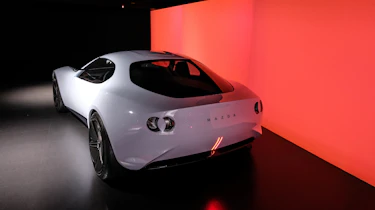
A display of concepts in an adjacent room is led by the pretty Iconic SP, our best hint yet at Mazda’s future styling direction, while another area is dedicated to the current Kodo design language, showcasing not just the four-door Shinari concept and stunning RX‑Vision, but a clay buck for the Kai concept (which previewed today’s Mazda 3).
Perhaps the highlight of the museum, though, is a chance to watch the production line in action; at the end of the tour you step onto a deck overlooking the point at which MX‑5s, CX‑5s and others receive their engines, while the next room overlooks the docks from which cars built at Hiroshima are shipped all around the world.
In the global automotive ocean, Mazda is a pretty small fish, selling fewer cars each year than Tesla and roughly a ninth as many as Toyota. That it has cultivated a reputation among car enthusiasts out of proportion to its sales figures is a testament to the company’s habit of doing things just a little differently, and if you’re yet to be convinced by Mazda’s methods, the museum in Hiroshima is a pretty good place to start.