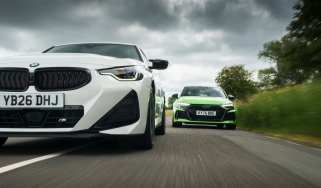
BMW M3 v Mercedes C63 v Lexus IS F v Audi RS4: 2010s V8 executives go head-to-head
400bhp-plus, naturally aspirated V8s in humble saloons and estate cars were once almost common. Twenty years on is Audi's RS4, BMW's M3, Mercedes-AMG's C63 and the Lexus IS F as good as we remember?

Back in the 2000s, the motoring landscape was a wondrous place, full of interest and appeal right across the spectrum, from city cars to supercars. We rediscovered this last year in our ‘Eras’ series when we attempted to represent the post-millennium decade with just six cars, an almost impossible task. Even if we’d allowed ourselves eight or even ten cars there would still have been trends and sub-genres that didn’t get the exposure they deserved, and here’s where we get to right one of those wrongs, celebrating one of the most unexpected but exciting phenomena of that time: the V8‑powered compact saloon.
It’s a genre that looks even wilder in these days of downsizing, although, of course, that hasn’t gone so well for some, including Porsche – 718 Cayman, anyone? Anyone? And it’s gone even worse for AMG, which has finally conceded that you can’t replace generations of beloved, woofling V8s with a hybridised, turbocharged in-line four. In short, that you can’t deliver performance by numbers alone.
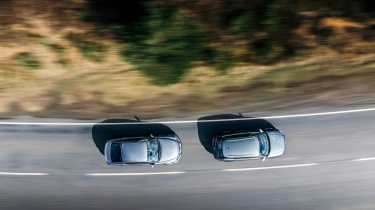
> Mercedes C63 AMG (W204, 2008 - 2014): absurd in the best possible way
That’s not an issue here. All of the upsized, naturally aspirated V8s of our quartet deliver over 400bhp with full-fat V8 character and flavour, yet each has its own distinct aural and motive signature. First to market in 2006 was Audi, slotting its new 4.2-litre V8 into the RS4 – this the engine that would also power the upcoming R8 supercar. Audi was followed in quick succession by BMW with the first V8-engined M3 road car and Mercedes, which shoehorned the AMG 6.2-litre V8 into the C‑class and gave us the AMG C63. The fever wasn’t confined to Germany though; Lexus joined the fray in 2008 with its first high-performance model, dropping a tweaked 5-litre V8 into the IS to create the IS F.
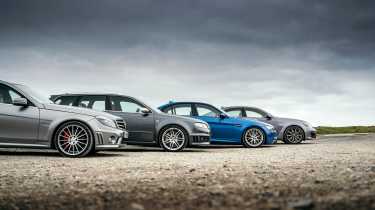
We did plenty of group tests back in the day but not one with these four together, partly because here in Europe the RS4 was quite short-lived as a saloon. As a consequence, the most relevant group test included – oddly, it seems now – the RS5 coupe, which had an even feistier, 444bhp version of the 4.2-litre V8. Despite this, the RS5 proved as short of talent as it was of doors, finishing well off the pace with just three evo stars. Meanwhile, the scrap for the podium places saw the Lexus finish third (4.5 stars) and a very tight contest for the top spot between the five-star M3 and C63 that went the BMW’s way, just. We rated the RS4 as a five-star car too, so this retrospective gathering promises to be a tight affair.
You’ll no doubt have noticed that two of our four aren’t saloons. Personally, I’d go for an RS4 Avant or C63 estate over the saloon versions any day because they’re so much more useful and, happily, they have the same dynamic fidelity. I think they look cooler, too, particularly the Audi, whose bulbous arches match the rounded edges of the tailgate. And, of course, the RS4 references that earlier icon, the RS2, which was sold only as an Avant.
Other preferences/vested interests that need to be declared before we get into the test proper? Well, the Merc is here with its owner, evo senior staff writer Sam Jenkins, so he’s already been through the process of deciding which of these four best suits his needs and taste. And so has his younger brother, Matt, who has brought along his E90 M3 saloon.
For my part, back 2006-7 I ran a long-term RS4 saloon, which I adored, then a few years later I ran an M3 coupe (E92), which I didn’t warm to as quickly as I expected. I preferred the four-door E90, which young Jethro Bovingdon ran, for its slightly more supple and easy-going dynamics. All that said, at its heart this is a celebration of that slightly crazy period from 2006 to 2014 when we had the pick of a bunch of muscle cars in compact saloon-car suits.
Lexus IS F
So let’s start on relatively neutral ground with the Lexus. It’s a pretty rare sight, unless you work at evo, because web editor Ethan Jupp smokes around in one. This one is from the Toyota GB heritage fleet and, with fewer than 15,000 miles under its wheels, it’s barely run in. While the BMW and Audi look taut, the Lexus looks slightly weighed down by the body kit intended to make it look more sporty. Like all the cars here, it’s on 19s but looks a bit under-wheeled, the overall impression being the car equivalent of David Byrne in his big suit. And if your most memorable feature is double-stacked tailpipes, you’re not really hitting the bullseye.
The interior doesn’t contradict those first impressions, being rather plain and more luxo than sportive, with gently supportive seats trimmed in perforated, light cream leather. There’s a sort of metallised, carbon weave for the centre console trim and, this being a later version, the instruments feature a large tacho with a glowing blue needle centre-stage, but other than that it’s all a bit vanilla. Evidence that the Lexus brand was inspired by Mercedes is there in the pedal-operated ‘handbrake’ and the stepped-gate auto selector, both now extinct, thankfully; it’s too easy to drive off with the handbrake on, while the gearlever moves up and down the gate as awkwardly as the cut-height adjuster on a lawnmower. At least there are wheel-mounted paddles.
Press the start button and the V8 stirs into life with a rich, mellow rumble. Like all the others here, it’s a 32-valve V8, but while the Audi and BMW get 414bhp from high-revving V8s of 4.2 and 4 litres respectively, the Lexus makes its numbers in the traditional way, extracting 417bhp from 5 litres. Consequently, it has a useful torque advantage, boasting 370lb ft, giving it a useful 77lb ft more than the especially torque-light BMW. Of course, the Mercedes is a different proposition entirely, its 6.2-litre V8 delivering far and away the biggest power and torque numbers.
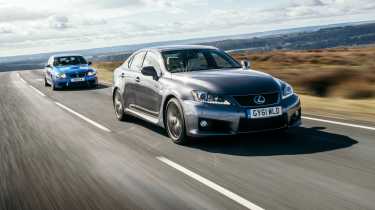
The IS F did deliver some innovation, though, boasting the first deployment of an eight-speed auto ’box and also being an early adopter of EPAS. Rolling away, the steering is surprisingly heavy, betraying a lack of speed-variable assistance, and the ride is firm too, but with some speed both feel right, and at a cruise refinement of road and wind noise is to a luxury car standard. Unfortunately, to a degree, so are the dynamics. On an enticing bit of road the calm of the smooth ride is occasionally interrupted by single-wheel bumps thumping through, while tacking into turns the car feels willing enough but there’s not much steering feel adding detail to the picture.
Foot down, there’s a step change in the V8’s vocals at about 3500rpm as the engine switches to a snortier, sportier intake mode, though the red line seems to come quite soon after, with an annoying warning beep too. However, as with the other three here, there’s a happy reminder of times past. With almost every new car being turbocharged, it’s easy to forget how useful the engine braking of a big-capacity, naturally aspirated engine can be. Even with a torque converter auto, you can simply roll off the throttle to trim your speed where in a turbo car more often you’d be on the brakes, which finesses the ebb and flow of your drive. Also, at the limit that throttle control becomes a real asset, as we’ll find later on.
Audi RS4 (B7)
You need just couple of minutes in the RS4 – certainly less than a mile of this North York Moors road – to realise what’s missing from the IS F. Almost immediately you appreciate the composure, the confident heft of the RS4, and while there’s more detail to the ride, the control and poise are really impressive… and will remain so for the duration of the test, no matter what the roads throw at our foursome. Diagonally cross-linked dampers are the RS4’s secret weapon.
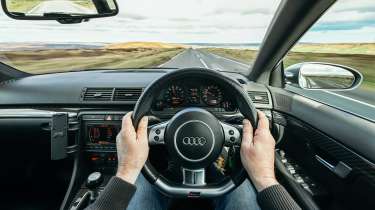
Mind, even before you fire up the RS4 you can’t help but be impressed. All these cars are based on humble base models – that’s part of their appeal – but 20 years ago, Audi interior quality was at its peak, besting Lexus, showing that Mercedes had rowed back, and making BMW look a touch budget. So the cockpit of the RS4 starts as the highest quality here and then builds on that with (optional) near-bucket seats with seriously deep leather bolsters and inserts in a sort of carbon cloth with a hint of yellow that matches the weave of the deeply glossy carbonfibre trim. Then there’s a small steering wheel with the perfect rim diameter, quality switchgear and stylish red displays and needles. It all adds up to a feel-good ambience and, as you’d hope, even over punishing surfaces, this 20k-miles example feels utterly solid, box-fresh.
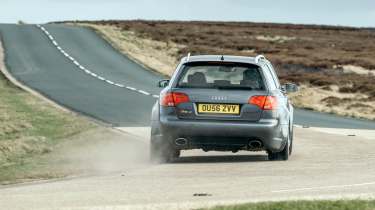
The Audi also has the only manual gearbox here, a six-speeder. It’s great to use, the shift short and pleasingly snappy with a well-defined H-pattern, though what makes it a joy is a really forgiving, easy clutch action. There’s no sharp bite point and the damped take-up covers any clutch-pedal clumsiness, so you can relax and enjoy the shift and the performance of the high-revving, 4.2-litre V8, which is brilliant in the R8 and just as impressive and engaging here, even without a Ferrari-style open shifter.
A flat-plane-crank V8 might be inherently better suited to delivering high-rpm performance but I’ve never forgotten the first time I drove this traditional, cross-plane V8. I was used to traditional V8s fading at 6000rpm but this one just revved harder, all the way to 8000rpm with a howl to die for. Who’d want the plain, in-line four-like thrum of a flat-plane V8 when you could have this? On paper, it’s similar to the M3 V8, but it gets going sooner and delivers strongly and enthusiastically all the way through, in a very linear fashion, so it doesn’t seem to matter where the rev-counter needle is when you floor it.
No question, the RS4’s steering isn’t the most lucid or connected-feeling here, but when you have a chassis that grips so hard and responds so keenly yet so calmly, it’s not something you ever miss. You turn, the car takes the exact line you’ve chosen, the damping soaks up and neutralises any potential deflection, and the V8 powers you through with guts and character. It’s all very contained, very satisfying.
When I ran my RS4 long-termer, the only weak spot was its cast-iron brakes, which were apt to rumble with heavy use, but this later Avant has that covered, being fitted with optional carbon-ceramic discs. They work fine from cold and come with good pedal feel, but the RS4 isn’t a car you itch to take on a circuit – except maybe the Nürburgring – because although it’s very capable, it feels like it has been honed and polished to excel on the road, not the track.
Is the Audi too polished? It’s not a complaint that’s ever been levelled at the Mercedes C63 AMG, a car whose very existence seems ever more implausible as time goes on. Did AMG design the 6.2-litre M156 engine knowing it had to fit in the C-class shell, or did the Mercedes engineering team design the W204 C-class so that the M156 V8 would fit? Either way, fitting your smallest saloon (which could be ordered with a 1.6-litre in-line four) with the biggest engine you’ve built since the 1970s is a ballsy move.
Yet it’s great to drive, which is some feat given that, as well as making 451bhp, it delivers 442lb ft of torque to a pair of rear tyres that aren’t the widest here, or assisted by a limited-slip differential. Remarkably, the locking diff was still optional even if you paid for the Performance Package Plus, which bumped power up to 480bhp and raised the speed limiter from 155 to 174mph. Happily, Sam’s estate has both the Pack and an aftermarket Quaife diff.
Mercedes C63 AMG (S204)
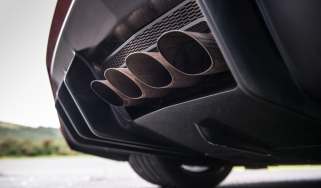
The cabin is a snapshot of Mercedes interiors of the 2000s, all black with lots of silver detailing, and aged by a Blackberry-like numeric keyboard next to the CD slot. Stick the fob in the dash, give it a twist and the outsize V8 fires with an appropriately heavyweight beat, the needle steadying at just 600rpm, but it’s no lazy lump; the tacho is redlined at 7200rpm. Jiggle the lever down the stepped gate to D, squeeze the throttle and the Merc moves off gently enough, but as soon as you get the chance to give the throttle a decent prod, it’s off like a Santa Pod hot rod with a hearty V8 roar to match. Should you be following the Merc when it’s floored, the thunderous blare from the quad tailpipes drowns out the engine of whatever you’re driving.
The engine might not put you at ease, but the rest of the car quickly does. You sit nice and low and the seat itself offers terrific support, so you feel well placed to deal with whatever comes at you. The chassis quickly inspires confidence, having a willingness to turn, coupled with a reassuring poise even at speed over tricky surfaces. It’s not as impervious to distractions as the Audi or as crisp and focused as the BMW, but it’s way ahead of the Lexus while having a gait that’s just as easy-going.
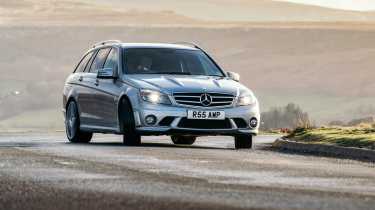
This is a later car with the improved, seven-speed ‘MCT’ auto but, although it’s a bit sharper, compared with the RS4’s manual and the M3’s DCT, throttle response is rather cushioned. Not that this gets in the way of oversteering the C63. In fact, it might be part of what makes it so easy to coax onto opposite lock and hold there, the buffer that takes the edge off your throttle inputs. Other factors are the abundant torque, (relatively) modest grip, the limited-slip diff ensuring smooth breakaway, and multi-link rear suspension that responds in a linear fashion to help collection and recovery. The upshot is a near-500bhp estate that’s as easy to slide as an MX‑5, and as much fun, too. I mentioned this to Sam later and he agreed before revealing that the car he owned before the Merc was an MX-5…
There’s no greater contrast with the C63 than the M3, the car which, back in the day, prevailed in every group test it was a part of, though never by a huge margin. Gleaming in the sunshine, Matt Jenkins’ Monte Carlo Blue example looks tight, sharp and smaller than the others, as if the underpinnings have been skinned with shrink-wrap bodywork so that the handsome, dished alloys fill out the arches and the bonnet bulge describes the shape of the engine. Speaking of bonnets, the Merc has twin, slim humps, echoing the hood of the ’50s SL; the bonnet of the Lexus is one big bulge, like a bluff headland in profile, while, remarkably, despite having the whole of its V8 ahead of its front axle, the Audi has the standard A4 bonnet with no bulge at all.
BMW M3 (E90)
Hop into the driver’s seat of the M3 and it feels like a smaller car than the others, taller and narrower too. Much of the cabin is leather-trimmed, but it betrays its repmobile origins more than its rivals, notably in the single-piece facia with its twin, moulded brows, one for the centre screen and one for the instruments. The latter comprises just a pair of dials that look inexpensive, even with an 8200rpm red line. As ever, the press/turn iDrive controller works brilliantly and the odd-looking DCT shifter works much better than its appearance suggests, though I keep hunting in vain for Park.
From the moment the M3’s V8 fires up, it sounds different, not just to the bigger-capacity motors of the C63 and IS F but different from the RS4 too, despite the closeness in capacity and their shared high red lines. The BMW’s S65 V8 has a distinct and appealing motorsport edge, like a hi‑po American V8, and it’s sportier in its delivery too, being lighter on torque and feeling truly in its element from 5000rpm to the red line, delivering its peak power at 8300rpm, 500rpm higher than the Audi.
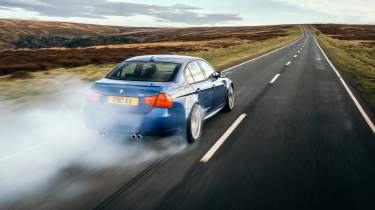
A six-speed manual came first, and it was good to use, but you lose none of the connection and gain another gear with the seven-speed DCT, BMW’s first. It has a crisp directness that the IS F’s eight-speed auto can only dream of, and you can adjust the shift speed until red-line upshifts thump home brutally.
The car itself has a directness that’s missing from all of the others. The steering is very connected, very direct and very tactile, and there’s a tautness to the handling that matches the drivetrain. More than matches with this example, because owner Matt has upgraded the suspension with Ohlins dampers, so the chassis responds with an utter lack of slack, snapping to the steered line like a race car and riding with just enough suppleness to deal with the challenges of these roads.
If it’s race car sensations you want, that’s what this M3 delivers. You want playfulness, indulgent oversteer? Not so much. Chucking this one into a second-gear corner was a reminder of the long-termer I ran; there’s so much rear grip that you need to be well up the rev range to have enough torque to unstick the rear tyres, and when you succeed in that, you then have only a couple of thousand revs left to keep it there, so it’s gone in a click of your fingers, snapping back into line. It’s almost as big a challenge in the wet, too.
The M3 is very effective, though. When we tested it against the standard, 451bhp AMG C63 (evo 123), despite the E90’s shortfall in power and torque it was only two tenths slower to 60mph, four tenths slower at 100, and around the West Circuit at Bedford Autodrome it was over 2.5sec a lap faster. It is an incisive car. The author of that test, David Vivian, concluded ‘…the M3 saloon is sharper, cuts deeper and will keep you hooked for longer’. I recall being in agreement at the time but, 20 years down the line, does that conclusion still hold true?
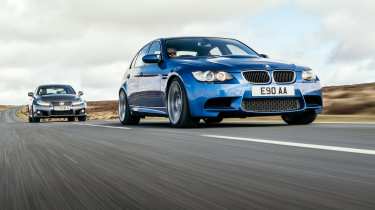
Which is best?
The first thing to say is that this quartet of V8s is so refreshing in a world that seems ever more restrictive and prescriptive; no nannying systems, no endless modes to navigate, just straightforward, big-hearted fun.
The Lexus doesn’t put up much of a fight. As the test went on and we swapped cars and swapped again, its shortfalls became easier to spot. The seats have decent support but in corners you slide on the slippery leather; the ride is unexpectedly robust at low speed, but at speed the damping is occasionally thuddingly wrong-footed, and when downshifting and braking hard, the gearbox occasionally finds neutral between gears, so the car runs away from you momentarily.
It’s got the power, it’s got a limited-slip diff, so it will be coaxed into easily controlled oversteer (partly, we discovered, because it’s on ten-year-old Bridgestones!), so it can entertain richly, if not with the feel of the Merc, the car it’s most like.
‘It feels like a luxury car with added carbonfibre,’ says Sam. ‘Immediate throttle response is good, the two-stage intake sound is a neat party trick, but the fun is soon brought to a halt when you hear the upshift beep and hit the low red line.’
In the end, there’s nothing the IS F excels at that makes it compelling. It is a rarity, though; quite a few are coming in as Japanese imports, showing that there is interest, but in terms of capability the three German cars leave the Lexus trailing in their wake.

On paper, the AMG C63 is an absurd car. In reality it’s an absurd car too, because it’s barely believable that a rear-drive car with 480bhp is so approachable, capable and exploitable. And fun; you can rumble around short-shifting or confidently pick up the pace on a demanding road, enjoying the feedback and poise of the chassis, or you can turn off stability control and balance it on opposite lock with the ease of an MX-5.
Sam is a big fan, of course, recognising its strengths – that monster motor and well-matched auto ’box, seats as supportive as the RS4’s without the awkward bolsters, and the steering which, as he says, is ‘really responsive and communicates front-end grip well, which is nice in a car that’s so happy to oversteer. It inspires great confidence despite being the most powerful car in the test.’ He’s not blind to its faults, principally brakes that don’t offer top-of-the-pedal bite, but he’s clearly very happy with his choice. Quite right, too.
Unsurprisingly, his brother Matt thinks the Merc is a lazy old barge, and compared with his M3 it is, but then so are most other cars, no matter what their ilk. Like the C63, the M3 is consistent to its core: the delivery of its engine matches the character of its transmission, matches the character of its ride and handling… For me, the last thing the M3 needed was even firmer suspension, but that’s what the Ohlins seem to have done for Matt’s car. Along a testing road, the M3 feels like a touring car, but I reckon the Merc would be as quick over the same stretch, just in a diametrically opposed fashion, the M3 wielding a scalpel, the AMG C63 swinging a sledgehammer.
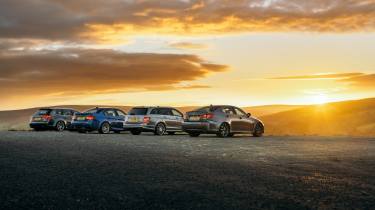
I get the M3’s appeal; it’s almost a size smaller than the others here and its demeanour and V8 are more racer-raw, slack-free. Sam gets it too. ‘The BMW engine has a proper, exotic, motorsport edge and the DCT leans into that with its sharp shifts… but there’s very little torque down low, so short-shifting for easy progress doesn’t do much for you in this car. The hydraulic steering is direct and responsive off-centre but lacks some of the feel of the Mercedes’ and the chassis never quite settles on these roads, taking the edge off initial confidence.’
So is it BMW or Mercedes? Actually it’s neither, because objectively (that is, according to me) the Audi is the best car here. Why? Well, for starters because there’s magic in the way it covers the ground – an unmatched, extraordinary composure. There are bits of road up here that unsettle the others but not the RS4, which glides over them like a WRC car. The Audi might feel too calm for those who like the snap, the directness and urgency of the M3 or the playful oversteer of the Merc, but with a manual ’box and an ever-ready, rev-hungry V8, you don’t find you miss that chance to kick the back end out. And it’s not like the M3 offers that up very often, anyhow.
To his credit, C63 owner Sam acknowledges the RS4’s greatness. ‘Looks great, feels really sturdy and well put together – the best of any in this test,’ he reckons. ‘The engine doesn’t have the motorsport edge of the M3’s or the high-displacement torque of the Mercedes, but it revs so cleanly right to the red line that you don’t need any of that. Combine that with all-wheel drive and a surprisingly sophisticated, well-damped chassis, and it instantly inspires huge confidence to push. It feels like an R8 V8 estate, just without a gated manual gearbox.’
So, the RS4 it is then? Yes. Probably. Then again, as a lover of thunderous, big-capacity V8s and oversteer, I should want the Merc more. Maybe I do. So is that the winner? Heck, I don’t know. Fact is, 20 years ago when this unlikely genre of cars came along, we were all winners. We just didn’t know it.
Specs
| Lexus IS F | Mercedes C63 AMG (W204) | BMW M3 (E90) | Audi RS4 (B7) | |
| Engine | V8, 4969cc | V8, 6208cc | V8, 3999cc | V8, 4163cc |
| Power | 417bhp @ 6600rpm | 451bhp @ 6800rpm (480bhp with PPP) | 414bhp @ 8300rpm | 414bhp @ 7800rpm |
| Torque | 372lb ft @ 5200rpm | 442lb ft @ 5000rpm | 295lb ft @ 3900rpm | 317lb ft @ 5500rpm |
| Weight | 1714kg | 1655kg (saloon) | 1605kg | 1650kg (saloon) |
| Power-to-weight | 247bhp/ton | 277bhp/ton | 262bhp/ton | 255bhp/ton |
| Tyres as tested | Bridgestone Potenza RE050A | Michelin Pilot Sport 4 S | Michelin Pilot Super Sport | Pirelli P Zero |
| 0-62mph | 5.2sec | 4.5sec | 4.9sec | 4.7sec |
| Top speed | 173mph | 155mph (174mph with Performance Pack) | 165mph | 155mph |
| Value today | £20,000-25,000 | £25,000-35,000 (saloon and estate) | £28,000-35,000 (saloon) | £20,000-25,000 (saloon), £25,000-30,000 (Avant) |
This story was first featured in evo issue 346. With special thanks to Matt Jenkins.