Ferrari F355 by Evoluto review – can you improve on sports car perfection?
The Ferrari F355 is beloved by almost all even after three decades. A brave choice for a restomod then... We drive it

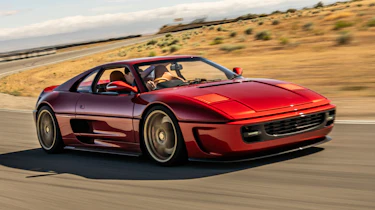
The Ferrari F355 by Evoluto is the latest restomod on the market and the second offering to emerge from under the DRVN Automotive umbrella. I’d been in it for the best part of two days before it dawned on me just how beguiling a driving experience it was offering. It sneaks up on you.
Like age, or love, or an appreciation of gardening. Suddenly it dawns on you just how many miles have passed without your mind wandering from the tasks at hand. You’ve been so engrossed with trying to snick every shift seamlessly. So wrapped up in a conversation with the steering. Looking so intently for every opportunity to extend the engine through its crescendo and hear that remarkable 8500rpm refrain. So you don’t notice. By its very nature, when a car is really involving, it often sneaks up on you.
As with any car, you take note of all the individual elements in the first few miles; you appreciate highlights and ponder the negatives, but it’s only as time goes on that you find out whether you’re driving a car that makes you tune out or tune in. Only as the miles stack up do you discover whether all the different facets are of fleeting interest or combine to create something that holds your attention for hour after hour, no matter the speed.
More reviews
Neither is it a car whose charms you could divine from the numbers on its spec sheet. They are not large or small enough figures, certainly in the current landscape, to suggest something exceptional. And anyway, regardless of their size, a 0-60, a bhp or even a kg is in isolation simply sterile, incapable of painting a picture of tactility or feelings of joy or involvement.
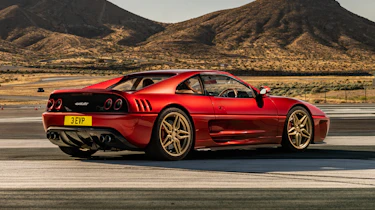
All that being said, this restomod’s core numbers do offer clues and hint at interest if you read between the lines. For example, with 414bhp and 295lb ft of torque, you know straight away that Evoluto hasn’t thrown the baby out with the bathwater.
Both outputs are only around a 10 per cent increase over the stock factory figures, so it suggests the essential character of the original 90-degree, 3.5-litre, naturally aspirated, F129 V8 is likely to have remained intact (there is a more powerful 3.7-litre engine on the way, but that’s for another day). It also signals that the reason for the significant £714,000 – plus donor car – price tag is possibly rooted more firmly in the handling than the straight-line performance.
The key number with the chassis is 23. That’s the percentage by which Evoluto says it has increased the torsional stiffness, also allowing it to extend the track widths by 77mm at the front and 66mm at the rear. The improvements have come by way of spot-welding the chassis and then, after extensive computational analysis of load paths and weak points, fusing carbonfibre into key places such as the rear bulkhead, sills and suspension pick-up points.
The double wishbones, uprights, anti-roll-bar drop links and numerous other parts have all been re-engineered. The ride height has been dropped by 25mm and the three-way adjustable dampers are from British company R53, which kitted out the GMA T.50. There’s a new hydraulically power-assisted steering system and the rack has been reduced to just 2 turns lock to lock, down from 3.25 in a standard F355 or 2.75 in one with a Fiorano Handling Pack.
There is an entirely new tubular rear subframe to cradle the V8 and a whole new wiring loom that comes with just the one big connector to unclip when the engine needs to come out, which should make servicing a little easier. MoTec supplies the dedicated new engine management system and there is a redesigned quill shaft between the engine and gearbox as this was a known weak point on the F355. I could go on; driveshafts, wheel bearing units, HVAC system, camshafts… suffice to say, nothing has gone unexamined.
Overall, Evoluto claims the dry weight has been brought down to just 1250kg, which is a significant 100kg less than it rolled out of the Ferrari factory with. Much of that diet has come through the use of carbonfibre bodywork, with Callum Designs responsible for the changes to the pretty Pininfarina-penned panels. I imagine the redesign was an incredibly tricky line to tread, because you want to show that this is different but, as with the driving experience, you don’t want to completely ignore what made the original such an icon.
> Best Italian cars – the ultimate machines from the home of the supercar
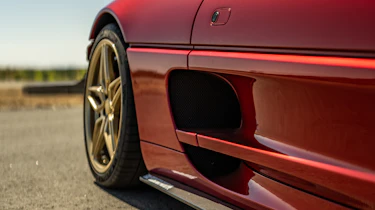
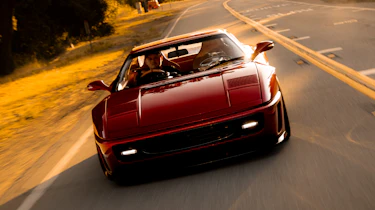
I like the incorporation of some little 288 GTO details such as the slats above the pop-up headlights (now LED), the three gills on the rear arches and the extra up-flick of the tail. The lowered stance is great and I think it would pair perfectly with some simple Speedline five-spoke wheels, like those you see on the F355 Challenge race cars. The one other thing I would definitely spec differently is the bare carbon surround for the front grille; paint it body colour (perhaps along with the splitter and sills) and I think it would make a world of difference, with a more cohesive vibe that could speak of an F355 Speciale or Scuderia that never was.
Talking of the front grille, you might have noticed that it has one of very few Ferrari badges on it and that’s because it’s an original part. The bonnet, for example, can’t keep its prancer because it’s new and if you applied an old badge the Ferrari legal department would fire up the fax machine faster than you can say ‘cessare e desistere’.
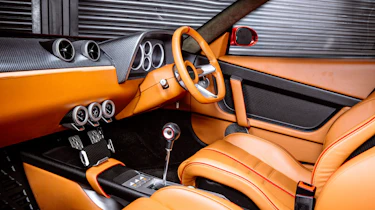
Inside this final prototype it’s much the same story as outside, with trim that has been designed to show off what has changed. So you’ve got biscuit-coloured leather contrasting with naked carbonfibre, and bare aluminium adorned with fluoro orange icons. All the materials are excellent in their own right, but I think a more subtle spec would do wonders for the overall aesthetic.
Slipping behind the wheel, you have a typical Ferrari driving position of the period, one that feels as though it was designed with a bias towards people with short legs. If my knees had fingers then they would be both disturbing and also perfectly placed to work the indicators and windscreen wipers. However, there is no arguing with the steering wheel itself, which has a beautifully thin rim and plenty of dish to the aluminium centre. It’s the perfect companion to the steering system it controls, which is beautifully judged in terms of feel and rate of response.
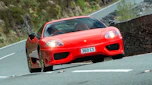
There is a definite directness to it and it’s well weighted around the straight-ahead so that you always feel connected and informed, but there is also none of the lighter flightiness of more modern Ferrari models. It is definitely the most noticeable and biggest improvement over a standard F355, the steering of which always felt a little slow, and light (especially compared with its predecessor, the 348).
On paper you might view the suspension as a backward step because the ability to choose your ride quality has gone, replaced instead with a passive set-up. However, you don’t need to drive very far to realise that the R53 dampers are striking a fabulous balance of comfort and support. There is certainly a sense of the car riding low and flat to the ground, but it also has the almost spooky ability to soak up bumps with what feels like very little wheel travel.
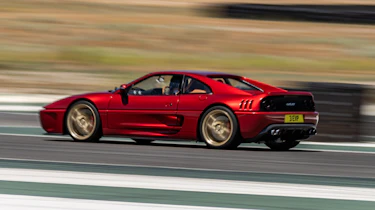
Michelin Pilot Sport 4 S rubber is fitted to the magnesium wheels, and I’m rather glad that Evoluto didn’t go down a more aggressive Cup 2 route, as it means there’s a softer edge to the contact patch. That’s important, because there isn’t a whole lot of low-down torque to easily overwork the 295-section rears. This is a car that you flow with and adjust on a more nuanced level. You can still work with the weight and play with the balance, but it’s on a more contained, detailed level. It feels Lotus-like to me.
The gearshift is one of the other obvious highlights of the car and also one of the elements that immediately tells you this is still a Ferrari driving experience at its core – and not just because the original open gate, complete with Prancing Horse, remains in place. The feel is so distinctly that of a Maranello manual. Gone is the cool sphere of metal and in its stead is a warmer-feeling carbon and aluminium confection that looks a little like a stylised rose joint, but a waggle and then a slide over and up for first gear instantly tells the palm of your hand that the unseen mechanicals below are fundamentally familiar.
That almost delicate feel of a tall lever that is light in its action between the prongs but then requires quite a bit of pressure at the very end of each shift in order to engage the gear. It’s not as slick and sure as an Audi open gate, there is a little less clack clack than you might imagine, and it’s not a shift you rush, but it is very Ferrari. And very rewarding.
Of course, what happens with the lever is only half of the story, but the pedals live up to it and have a real sense of resistance beneath the balls of your feet. All three feel nicely matched in terms of response as well, so that when you’re working brake, throttle and clutch for a downchange, aiming for just the right blip at just the right moment, you can do so with an instinctive confidence. It’s worth doing, too. A sequence of heel-and-toe shifts from fourth to third and then again from third to second in quick succession with the accompanying yelps of revs is supremely satisfying.
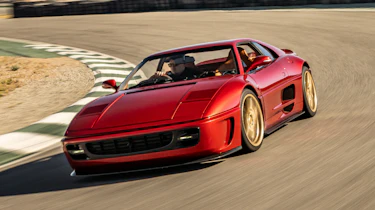
The sound is angry and loud, and because it’s a naturally aspirated engine with peak power right at the fizzing scream of a top end, there is real purpose to seeking it out. Yes, a modern turbocharged engine may sound most pleasing up high on the rev-counter, but odds-on its best work is done lower down, so there is a disconnect.
With the 355 the power and sound both crescendo together and there is an unwavering logic to wringing the final decibels from the exhaust and ensuring that your spine is at maximum vibrato, because only then will you have made the most of the available performance. This is not a rocketship by modern standards but it is genuinely satisfying in its swiftness.
After many miles over a couple of days, it’s clear that the F355 by Evoluto was born first and foremost from a desire for dynamic improvement rather than any wish to wholesale reimagine or reinvent the original. You can picture driving along in an original F355 and loving it but just wishing for tweaks here and there, and this is the dynamic answer to those wishes.
I don’t think anyone would get behind the wheel and declare that it wasn’t tangibly better to drive than a stock F355. In fact I think Evoluto has done a fabulous job of being restrained with the updates to the driving experience, enhancing what makes a F355 great rather than vaingloriously seeking to stamp their own dynamic identity all over it.
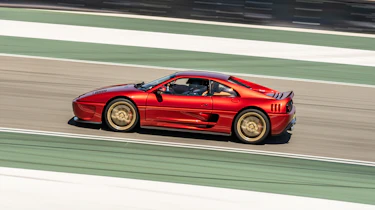
The trickier part is with the design, because while I think Evoluto has also been pretty restrained in that department (spec of this car aside), it seems that as soon as you alter even an inch of a Ferrari you strip away an entire identity. While 911s from Singer or Workshop 5001 or even Gunther Werks all seem to remain Porsches, this somehow isn’t a Ferrari anymore. It’s instantly been cast out from the family, like a princess who snuck off to get a tattoo and an unusual piercing.
Whether that matters or not is largely academic, really, because if you can afford one of the 55 cars from Evoluto then you can probably stump up to have an unmolested original sitting alongside it in the garage to negate any feelings that you don’t own the real thing. And if you’re behind the wheel of Evoluto’s F355, then you’ll be so involved in the driving experience that you won’t worry about it anyway.
Price and rivals
The Ferrari F355 by Evoluto costs £714,000 plus the price of a donor car. After customisation, most will be £1million cars. As for rivals? The restomod space is growing at such a pace it's tough to keep up. Obvious other options include Porsche 911s reimagined by Singer, though the high-revving exotic that is the DLS was around twice this 355's price from 'new', more still on the used market.
The outlandish TWR XJS is on the way, as is HWA's wild reinterpretation of the 190E, the HWA Evo. For the 1990s connection, it's Gunther Werks and their wild 993-based 911s that match the 355 closest for era. Encore's Lotus Esprit is on the way too. Other restomods of which development is complete (they're the rarest) include E-Types from Eagle and 911s from the likes of Theon Design.
Specs
| Engine | V8, 3496cc |
|---|---|
| Power | 414bhp @ 8000rpm |
| Torque | 295lb ft |
| Weight | 1250kg (dry) (337bhp/ton) |
| 0-62mph | 4.5sec (est) |
| Top speed | 185mpg (est) |
| Basic price | £714,000 plus donor car |