Ford Puma ST review – the last gasp for fun fast Fords as we know them?
The Puma ST is the last vestige of the combustion-powered Ford ST era, and a far cry from the glorious warbling five-pots of old
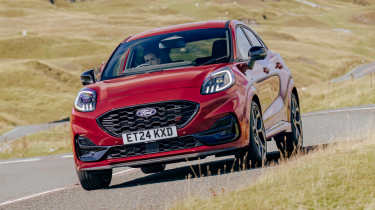
With the Ford Fiesta ST and now the Focus ST put out to pasture, Ford’s reign as a champion proprietor of superb hot hatches is over. The last remaining combustion-powered ST-badged performance car left in its lineup is the Puma ST. What was the Powershift is now the only ST, with the lineup shorn of the zinging 1.5-litre turbocharged three-cylinder as formerly used in the Fiesta ST. Is the Puma ST and the ST brand as a whole a shadow of its former self?
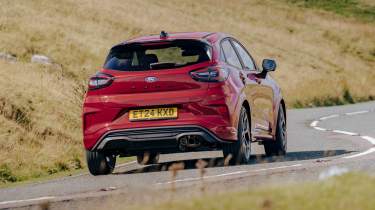
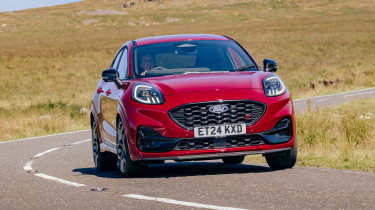
It does at least feature the same charming design as its departed pure-combustion cousin, with the ST-specific wheels, grille inserts, roof spoiler, diffuser and splitter setting it apart from lesser Pumas – that splitter said to increase front-end downforce by almost 80 per cent over the non-ST for high-speed stability. There’s an updated interior with refreshed tech to consider too.
Engine, gearbox and performance
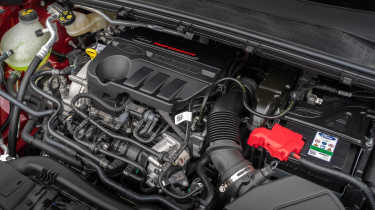
- Mild-hybrid 1-litre ecoboost augmented by 48-volt mild hybrid system
- Power and performance are reduced, while weight is (slightly) up
- Seven-speed DCT now the only transmission option
Swapping the torque-rich 1.5-litre turbocharged three-cylinder for a smaller 1-litre version, the six-speed manual for a seven-speed DCT, and adding 48V mild-hybrid assist, the Powershift takes a different approach to the original Puma ST, increasing kerb weight by 36kg to 1394kg as a result.

Outputs stand at 168bhp and 183lb ft of torque, 29bhp and 53lb ft behind the pure-combustion ST. That allows the Puma ST a 0-62mph time that’s seven-tenths slower and a top speed 7mph slower. While a 36kg weight increase seems insignificant, the combination of this and the reduced power output make for a significant drop in power-to-weight. The Powershift has 121bhp/ton to the discontinued 1.5-litre car's 145, with torque-to-weight down 42lb ft/ton.
More reviews
The Powershift’s 1-litre is immediately more gruff than you might expect – three-cylinder units are inherently unrefined, but this one feels particularly uneven, sending unwanted vibrations through the cabin. Engage drive via the somewhat cheap-feeling, generic gear selector and things improve, with seamless shifts and eager low-speed torque making it a pleasant drive around town. Its low-end mild-hybrid pull does a very good job of imitating the feel of the full-fat 1.5-litre at low speeds, but this doesn’t last.
Out of town, the Powershift’s relative lack of torque and top-end zing are very apparent. Such is the drop in performance when the revs and speed rise out of the Powershift’s low-end, around town, switchback comfort zone, that it feels like a hard limiter’s kicked in.
The first time you wade into an overtake on a country road, just as you pull alongside, your rate of acceleration drops, like limp mode’s kicked in. It’s a bizarre sensation and one you don’t expect, given the rough’n’tumble soundtrack of the engine, however augmented it may be. It might be a mistake you make only once but this is a powertrain attribute that almost haunts the Puma ST as it remains, in this final combustion form.
The dual-clutch transmission is reasonably responsive most of the time, if occasionally reluctant, when you access its services through wheel-mounted shift paddles. It at least handles town dawdling well. It just isn’t as involving as a nice manual. Redundant perhaps but then, one wonders whether a manual had to be omitted from what is a sub-170bhp jacked-up hot hatch, or if it was simply a cost or emissions-saving measure. Ho hum. It is at least relatively efficient – we saw between 35mpg and 42mpg during our test.
Ride and handling
- Chassis of normal ST remained and it’s still a hoot
- Bespoke rear twist beam, springs, anti-roll bars and sharper steering ratio
- Ride is busy on occasion
What isn’t any less engaging is its chassis, thanks to the same bespoke rear twist beam, force vectoring springs and anti-roll bars as fitted to the regular ST. The ride is undoubtedly firm, occasionally crashy, and can be a tad unsettled on trickier roads.
There’s potential to add even more focus to the ST’s dynamics, with the ST Handling Pack. Not fitted to the car we tested, it features KW coilover suspension and bespoke 19-inch alloy wheels, as well as a round steering wheel in place of the weird-shaped wheel the standard car now has. No limited-slip diff as before, though.
The 11.4:1 steering ratio is also unchanged, remaining 25 per cent faster than the standard Puma’s to make the ST feel darty and on its toes. Steering feel is also strong, with a surprising level of feedback and off-centre heft inspiring confidence. What does feel slightly odd is the rate and strength of self-centring when in the Sport drive mode that contributes to that feel, almost akin to a sim racing rig with a little too much force feedback.
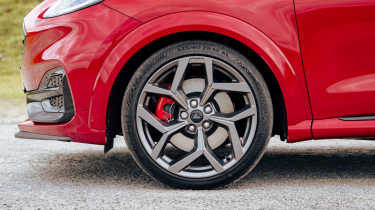
As with the 1.5-litre ST, the brakes are over-servoed and grabby on initial application, but offer a satisfying, tight pedal and plenty of stopping power in most on-road scenarios. Like the Fiesta, though, fade is easily reached should you push on, with the Powershift’s extra weight likely to bring that limit forward. One unexpected benefit of the mild-hybrid system, though, is a (slight) increase in perceived engine braking via energy recuperation, taking some load away from those discs.
Dial into the steering and the brakes, learn your way around that peculiar, eventually breathless powerband and you can start to appreciate the ST’s talents. Within is a car with handling qualities that are worthy of the ST badge. It’s responsive, lively and engaging. It doesn’t just dig in and go with the kind of sanitised feel of say, a Polo GTI.
Rather, it moves around on its Continental Sport Contact 7 tyres, dancing in response to your steering and braking inputs, taking set on its stumpy four-square stance. You feel the weight and that it’s higher up, and yes the set-up feels clumsier than the best conventional hatches as a result but the spirit of the Fiesta ST does live on here, even if its presence is more distant than you’d like because of the powertrain.
Interior and tech
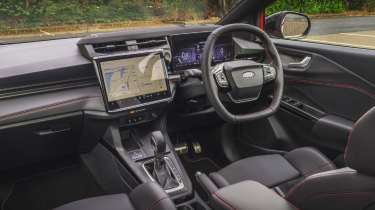
- Refreshed interior features a weird new steering wheel
- Bigger 12-inch infotainment screen and 12.3-inch driver’s display
- Excellent ST seats remain
Inside, the familiar Ford Performance bucket seats offer great support, long-distance comfort and the ability to sit nice and low in the cabin. Everything else is different, with a comprehensive cabin overhaul that distances the Puma from its departed Fiesta cousin. Dominant features are the strange squirkle-shaped wheel and the 12-inch touch screen with Ford’s SYNC tech. It’s responsive enough but it’s a shame a lot of what were once physical controls have been absorbed by the screen. The addition of Apple CarPlay and Android Auto is welcome, though.
Below it a wireless phone charger and the automatic gear selector, a part with no trace of ST branding, and something that looks and feels like a Tonka Toy if you’re being uncharitable, or as if it’s come from a model of a class below if you are. It lacks tactility and precision in the shift which makes it easy to engage the wrong mode while manoeuvring.
Look through the weird new wheel and a 12.3-inch digital driver’s display dominates, with less emotive graphics than were previously used. Sport mode does add flares of orange and red to the rev counter, and even GT-aping shift light indicators, but the graphics are largely devoid of personality otherwise, if clear and easily navigable.
Apart from the toy gear selector, overall interior quality is solid, but persistent road noise and the occasional rattle let it down. In other respects, the Puma ST is as the Puma ever was – relatively spacious and practical, with a good view out, as you’d hope for what is effectively a taller, fatter Fiesta.
Price and rivals
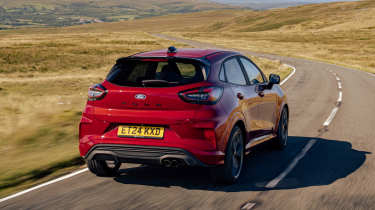
When the Puma ST Powershift first launched in 2023 it was priced from £31,060 but the updated car is now a £34,000 proposition. Our test car bumped up to £36,450 thanks to the £1100 panoramic roof, £800 aqua blue paint and £550 for a tow bar. It is generously equipped without options though, with even the 10-speaker Bang & Olufsen sound system coming as standard.
The Puma’s rivals are few – Hyundai is still out of the combustion-powered N game for now, with the Kona N a distant memory. The new Volkswagen T-Roc is set to get the R treatment but even if it comes to the UK – and it’s not confirmed yet – it’ll be a more expensive, c300bhp proposition. So too is BMW’s £53,995 X2 M35i xDrive, with almost 300bhp.
Specs
| Engine | Three-cylinder, 1-litre & hybrid assist |
|---|---|
| Power | 168bhp @ 5750rpm |
| Torque | 183lb ft @ 3000rpm |
| Weight | 1394kg |
| Power-to-weight | 121bhp/ton |
| 0-62mph | 7.4sec |
| Top speed | 130mph |
| Price | £34,000 |