Honda NSX (1990-2006) – the modest supercar that humbled Ferrari
Almost four decades ago, the sports and supercar world was turned on its head by the launch of Honda’s sublime NSX. We retrace its origins and rediscover its enduring magic
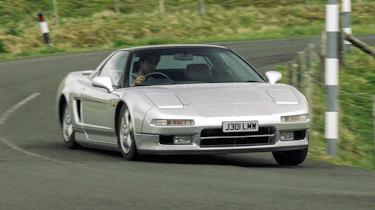
The Honda NSX arrived like a bolt from the blue, unveiled to the world at the Chicago Auto Show in 1989, with sales beginning in 1990. Like any overnight success, design and development had been quietly bubbling away for many years prior, however. And ‘success’ is a complicated word when it comes to the NSX. It was the most accomplished car of its generation, immediately setting new standards for mid-engined cars and sports cars, but not that nor even celebrity endorsement seemed to shift the dial of its commercial performance. Gordon Murray famously used one for benchmarking the McLaren F1 and Ayrton Senna owned three, apparently. You can still see the much-viewed YouTube video of him wringing out an NSX‑R around Suzuka in loafers and white socks.
> Used Honda Accord Type R (1998 – 2002) – review, history and specs of the forgotten Japanese icon
The NSX also won many accolades. In its impressive lifespan, it was Performance Car’s Car of the Year twice, winning in ’91 at a canter (defeating, among others, the 964 RS!), and again in 1995 (993 Carrera), while the sublime NSX‑R won eCoty in 2002 (996.2 Carrera 4S). And yet here in the UK it sold in tens while the 911 sold in the hundreds.
More reviews
Ability is all very good but there’s reputation to consider, and heritage, plus nebulous concepts like image. Sports car choice is not some sort of meritocracy, so even if you have the most able, most technically advanced and highest quality product, you can’t expect customers to beat a path to your showrooms.
Honda probably knew that you can’t take on European sports car royalty head-on: only Porsche can build a car with the engine in the wrong place, only Ferrari can get away with selling a car that won’t go into gear properly until it’s warm. So Honda looked forward and made the car that Porsche or Ferrari might have made if they’d started from scratch. In 16 years, fewer than 20,000 NSXs were delivered worldwide. Kudos to all those who bought one. Everyone else, you need to put aside your prejudices and preconceptions and get behind the wheel.
Honda NSX: the backstory
The progenitor of the NSX is often cited as the HP‑X, the Honda Pininfarina eXperimental concept, revealed at the Turin Auto Show in 1984. It had a mid-mounted, 2-litre V6, as found in Honda’s then-current Formula 2 race car, and featured ground-effect aerodynamics and carbonfibre and Kevlar construction, though its most striking feature was a one-piece Perspex canopy in lieu of doors. Recently, the concept was restored and went on display at the 2024 Pebble Beach Concours d’Elegance.
However, the NSX arguably owes more to the Austin Rover Group. Honda was collaborating with ARG in the ’80s and at Frankfurt in 1985 the Brits revealed the striking MG EX‑E concept to widespread acclaim. It boasted a Cd of just 0.24, had an advanced, bonded aluminium spaceframe chassis and was powered by a mid-mounted 250bhp V6. Sounds like the NSX, doesn’t it? Now google it and take a look at its styling. The stark reality for ARG was that it was far too exotic for them to put into production, but the management wouldn’t let it go. Four years later, Honda revealed the NSX.
In summer 1990, the crucial US market got its first taste of the NSX, branded Acura there, and we at Performance Car took a story from our US correspondent that prompted the cover line ‘Drives like a Ford, goes like a Ferrari’. A more accurate and flattering description would have been ‘Drives like a Honda…’ but, you know, sub-editors love alliteration.
Engine, gearbox and performance
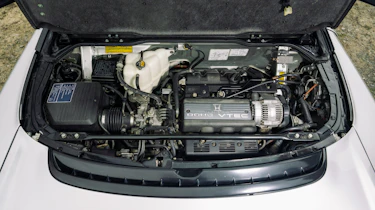
- 3-litre V6 develops less than 276bhp, per JDM standards
- Aluminium construction with titanium con-rods
- Variable valve timing and variable-length intake tracts
Turn the key – a machined sliver of nickel-copper alloy – and the V6 behind rouses with a light, slightly tappety drawl. As a general rule, naturally aspirated V6s feel a bit gruff and rev reluctantly, but as soon as you step on the throttle this one feels super-eager, like it has no internal inertia. Titanium con-rods (another production car first) help foster that feeling and there are other trick parts including torque-enhancing variable-length intake tracts. The sensation of easy-spinning eagerness is further magnified by perfectly spaced gearing and, of course, it was a pretty lightweight car.
> Honda NSX-R review – Japan’s Porsche 911 GT3 RS is one of the most exciting supercars ever
Much of the NSX’s structure is made from aluminium – the semi-monocoque chassis, bodywork and double-wishbone suspension – and so is much of the engine. It’s no lighter than the 964 Carrera, despite all the aluminium, but the NSX casts a much bigger shadow and these days 1370kg feels featherweight.
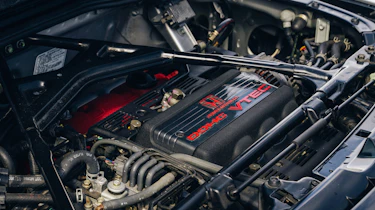
Initially, the 3-litre V6 wasn’t going to have Honda’s VTEC system, which seems absurd now, but at the time Honda was benchmarking Ferrari’s 328, which had just 266bhp. Thankfully, VTEC was fitted late on, even though it compromised the engine installation. It almost instantly proved its worth, because as the 270bhp NSX was launched, the 328’s successor arrived: the 296bhp 348.
That the NSX develops less than 276bhp is largely down to the gentlemen’s agreement between Japanese manufacturers of the time to avoid a horsepower war. When you get into the VTEC zone, however, there’s an addictive sense of urgency: it is a truly quick car.
The V6 is keen from low revs, gets stronger in the mid-range and then smoothly but thrillingly ramps up the urgency at 6000rpm as VTEC switches to the higher-lift cams. The redline is at 8000rpm and the limiter at 8300, by which time the howl from behind is utterly glorious. The gearshift is slick, accurate and wrist-flick light, and the next ratio drops the revs to 6000rpm, right back to the start of the VTEC zone. You get the impression that if there were no speed limits you’d be well on the way to the 168mph top speed before the acceleration started to tail off.
Ride and handling
- Supple ride, grippy and benign handling
- Original wheels 15/16in; later cars have larger rims
- Early manual cars went without power steering
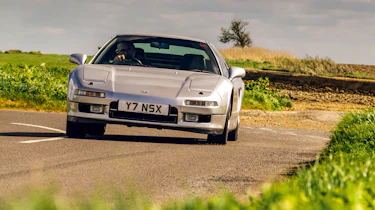
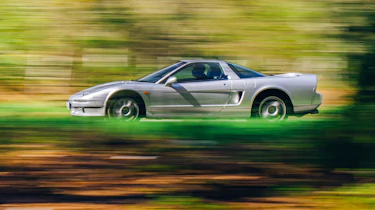
The NSX’s party trick is not straight-line speed but beautifully balanced ride and handling. There’s something magical about the poised, precise momentum you can carry, the steering calm if a little low-geared, and the gearshift a snickety, mechanical delight. You can get into a zen-like flow with it.
Famously, this isn’t a car that’s tied down by stiff suspension. It breathes with the road and there’s a deftness to the ride that makes light of patches of turbulent asphalt, allowing you to carry speed. The steering is quite light when you make small inputs on a meandering road, while the underlying feeling is one of calm composure, the zingy V6 crooning away behind you, compressing the straights.
On its original pastry-cutter five-spoke wheels, diameters just 15 inches front and 16 rear, it looks positively dainty compared to modern performance cars, and that no doubt contributes to the supple ride quality. Later cars’ handsome seven-spokers are an inch up in diameter.
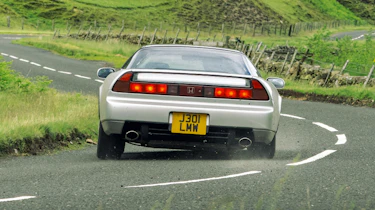
Unusually for a car of this era, there is traction control and you can switch it off, but I’m not minded to do that, discouraged by the thought of winding on opposite lock when the steering efforts are quite high, in both power-assisted and unassisted versions. Of course, it’s never been that sort of car. The NSX is at its very best effortlessly devouring a flowing road, perfect gearing and easy heel-and-toe shifts keeping the V6 singing, all the mass feeling low-slung, the responses precise, assured. There was nothing quite like it back in the day and there still isn’t.
‘The performance always felt a little bit modest,’ says evo editor-at-large Richard Meaden, who tested the Honda for Carweek magazine in period. ‘I love that now, however. It feels well judged within the package. The engine is smooth and linear and the ride and body control are immaculate: consistent and precise, and it never seems to run out of ideas. I think the most revolutionary thing about it was how usable it is. Honda proved you could build a reliable, comfortable, refined mid-engined supercar. I absolutely love it.’
Senior staff writer Yousuf Ashraf is similarly enamoured after his first NSX drive: ‘I didn’t know what to expect, because it has the reputation of being “the usable supercar”, so I thought it might feel competent but dull,’ he says. ‘But it has such amazing bandwidth: easy-going and subdued when you’re not pushing, but when you start using the revs and leaning on it, it becomes a proper sports car.’
Driver’s note
‘There isn’t anything you have to make allowances for because it’s 30 years old; it feels very modern: the structure stiff, the gearchange slick, the damping composed. It’s often described as “Japan’s Ferrari”, but to me it feels like “Japan’s 911”. It’s not obstructive to drive in any way, yet it’s got that extra bit to give you when you dig deeper.’ – Yousuf Ashraf, senior staff writer
Interior and tech
- Superb driving position and visibility
- Interior is durable and has aged well
- ABS and traction control standard fit
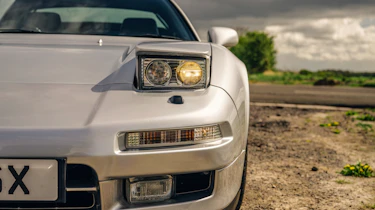
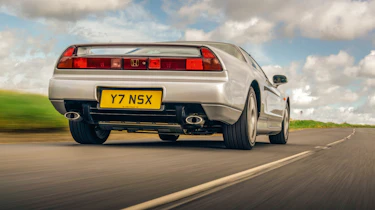
Although low and sleek, the styling was tidy rather than thrilling, the front end a little bland despite the pop-up headlights, the rear overhang, shading a pair of weedy tailpipes, rather bulky because the boot was big enough for a set of golf clubs (gotta love the US market). My colleague, Brian Laban, nailed it when he described the Honda as ‘crypto-Ferrari’. But beneath the skin the NSX was fantastically exotic; it was the world’s first series-production car with an aluminium monocoque, a decade ahead of Ferrari. There were forged aluminium control arms for the double-wishbone suspension found at each corner, too.
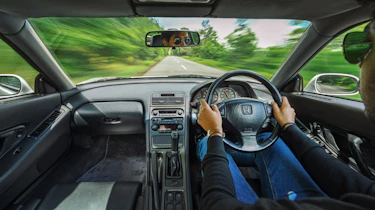
I was dispatched to Germany for the European launch. The pre-drive press conference was fascinating because it focused on how the NSX had been developed to be as easy to handle as any other Honda. This extended not only to ease of use of the controls – steering, gearshift and pedals – but also to the excellent driving position and outstanding visibility.
The interior was considered to be a little on the modest, sensible side for a supercar in period, but it’s aged well, physically and visually. You sit slightly reclined, on squidgy leather amid hard-wearing plastics and family-car-style switchgear, all the controls angled towards the driver at easy reach.
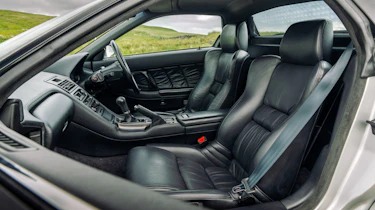
It looks neat and stylish, while the driving position is instantly excellent, with seat, wheel and pedals perfectly aligned. The all-round view is outstanding for a mid-engine car; the Pininfarina one-piece canopy of the HP‑X concept might have been a fantasy, but Honda was inspired by the F-16 fighter and its bubble canopy. The scuttle is low and gives a great forward view, yet while the cockpit looks airy, it feels a little tight. In profile, the NSX is a wedge and it’s getting thin where you sit, so although you are slung low, the facia and instruments are low, too, so you do feel a little like you’re sitting on the car.
Beyond the small-ish steering wheel is a set of brilliantly clear instruments with red needles in the Porsche style. A little closer, a collection of lumpy-looking stalks sprout from the column, placing vital switchgear within sight and touch, which is neat, though at first you may find yourself indicating with the wipers because the NSX was from a time when Japanese cars hadn’t adopted the European stalk conventions.
Driver’s note
‘The NSX was the first supercar I ever drove and my recollections of that car are so true to how a good example drives today. For the memories to stay that fresh shows it was quite unlike anything that had come before. Getting back into it after all those years, all the things that were great are still intact. It feels so clean and polished and honed. In every way it feels solidly built and brilliantly engineered’ – Richard Meaden, editor-at-large
Values, rivals and buying guide
In period, and today, while the junior Ferrari supercar was the inspiration, the Porsche 911 was the NSX’s closest rival. The 964-gen Carrera 2 was priced at a little under £50k when new, the NSX a little above it, while the Ferrari 348 was a few hundred quid shy of £70k. The 911 and NSX (and Nissan 300ZX) met in the April ’91 issue of Performance Car, on road, on track (Thruxton) and at Millbrook, where performance figures were extracted. In many ways it was a close contest. The 911, already 30 years old by this stage, won for the usual reasons: character, tactility, compactness, challenging but rewarding handling, and then carried on for the next 30 years largely as if the NSX had never happened.
It was the car that wasn’t on that test, the 348, that was most impacted by the Honda’s arrival. I can’t recall, but I suspect our request for a 348 was denied. Not having it there was no great loss, though. It felt like a model born of a complacency that was mercilessly exposed by the NSX, which didn’t so much move the goalposts as pack them up and ship them to another county. Still, the shockwaves that ran through Maranello resulted in the F355, which was so much better than the 348, setting new standards of approachability and driveability in a Ferrari, so we should be grateful to Honda for that.
As it turns out, the European establishment didn’t need to worry all that much, because Honda sold fewer than 20,000 NSXs globally in 15 years (Porsche sold nearly 70,000 993-generation 911s in around a third of the time). Badge snobbery was perhaps to blame. But its influence is greater than the sum of its sales.

NSXs are rare so you may have to wait a while to find the right one for you. At the time of writing in 2025, there are in the region of 250 cars in the UK, of which over 150 are SORN. Given their rarity, even early cars will now set you back from £60,000, with the very best, low c10,000-mile later cars currently on the market for in the region of £150,000.
Most NSXs will have been well looked after, but expert knowledge is vital to their wellbeing. The NSX might be as dependable as a Civic, but its running costs are more like a Ferrari’s thanks to parts prices. Graham Horgan of NSX specialist Plans Motorsport says that while the basic servicing is not dear, there’s usually something else to be done, and owners should expect to spend £1000 a year on maintenance. The US is a source of cheaper parts, though: ‘Typically they’ll cost the same in dollars as pounds,’ he says.
Hondas are well known for oil-tight engines, so view leaks with suspicion. There should be a hardening of engine note and a surge of power as the revs rise; if not, then something is amiss with either the VTEC variable valve-timing and lift system or the VVIS variable-geometry intake plumbing. It is highly recommended that the camshaft pulley is replaced when the cambelt is changed (every five years or 60,000 miles). Failures of the camshaft pulley can cause either poor running if the belt just slips a notch or two, or, far worse, valve damage if it breaks or fails completely.
Nothing much to worry about gearbox-wise apart from listening for untoward whines from bearings, including the input shaft bearing which might grumble in neutral with the clutch engaged. The gear change should be light and positive. Early five-speed gearboxes numbered between J4A4-1003542 to J4A4-1005978 might have a faulty countershaft bearing snap ring which could cause major gearbox failure. If possible, check it has been replaced. That said, if the car has now covered a big mileage the chances are it’s okay.
Suspension balljoints, bushes and bearings do wear, especially if the NSX has been driven hard on track. This hurts if it’s a front lower balljoint, because you have to buy the whole upright. The other parts are pricey, too. Plans Motorsport can convert an NSX’s suspension to NSX‑R specification, involving springs (stiffer front, softer rear), dampers, anti-roll bars and rear lower wishbones. One effect is to reduce the pendulous oversteer to which a standard NSX ultimately succumbs. Check the tyres for wear – the rears don’t last long.
The body is aluminium, and any repairs must have been done by someone familiar with working the metal and making sure the paint bonds to it properly. Check inside the nose and tail for repairs, overspray, non-original seam sealer and other evidence of impact. Corrosion is not a problem, but panel gaps should be perfect. Make sure all the locks, catches and the pop-up headlights (if applicable) work, remembering that the cost of replacing even insignificant items can be very high if they are NSX-unique. The cabin’s furnishings are very durable but check everything works and be worried if any warning lights don’t extinguish when they should. The Bose stereo is unique to the NSX, so if you’re looking at a car with aftermarket sounds and you want to reinstate its originality, be prepared to spend.
Honda NSX (NA1) specs
| Engine | V6, 2977cc |
|---|---|
| Power | 270bhp @ 7300rpm |
| Torque | 210lb ft @ 5400rpm |
| Weight | 1370kg (1415kg Targa) |
| Power to weight | 200bhp/ton (194bhp/ton Targa) |
| 0-62mph | 5.9sec |
| Top speed | 168mph |
| Basic price new | £55,000 |
| Value today | £70,000-80,000 |
With thanks to owner Ravi Bansal, whose car featured in evo issue 334, and Paul Brace, whose car featured in evo issue 349