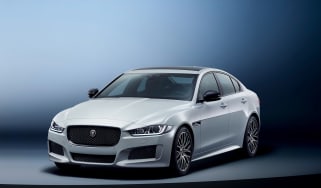
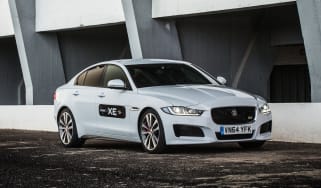
Jaguar XE (2015-2024) review – a BMW 3-series rival from the era Jaguar abandoned
Jaguar’s new era may be a completely fresh start, but that shouldn’t make you think any less of the excellent small saloon it orphaned
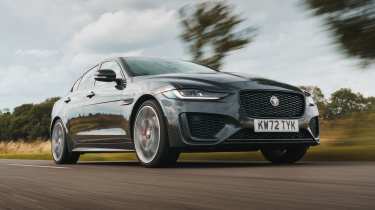
It doesn’t feel like so long ago that the Jaguar XE was the face of one of the company’s previous new eras. But the car which Coventry had best intentions of cracking the German-dominated small executive saloon market with now seems alien to a Jaguar that’s reinventing itself as a lower-volume proprietor of imperious luxury EVs costing over £100,000. But does Jaguar’s Ian Callum-penned one-and-done BMW 3-series rival bow out with grace? Given that, for a moment, it had probably the best chassis in the class, we’d urge keen drivers not to overlook the orphaned small saloon.
The XE entered a fiercely contested segment of the market with a point to prove when it went on sale in 2015. The previous ‘small’ Jag to be sold, the X-type, didn’t exactly set the world on fire, and since then the Germans had moved the compact executive game on and tempted a number of outsiders in to come play. Jaguar for one, of course, but also Lexus and then Alfa Romeo. The Jag and the Alfa had the 3-series as their benchmarks, their aim to be as satisfying to drive as they were handsome to look at.
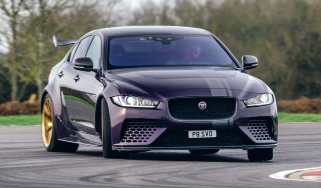
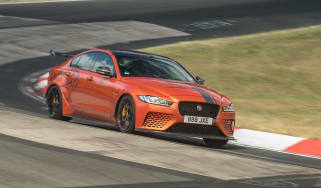
Production of the XE began in April 2015, with an update to the interior and engine lineup coming in 2017 and a facelift and range reshuffle in 2019, with mild hybridisation added in 2020. The flagship was of course the wild, widened, near-600bhp XE SV Project 8. The XE remained on sale until 2024.
Jaguar XE in detail
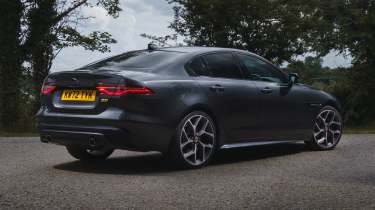
- Aluminium architecture
- Ford EcoBoost up to 2017, JLR Ingenium after 2017
- Also available with Jaguar’s own supercharged V6 and Ingenium diesels
More reviews
The Jaguar XE (and its F-Pace sibling) was born out of the ashes of the stillborn C-X75, the savings from the hypercar’s cancellation funnelled into the development of the D7 variant of Jaguar’s aluminium Premium Lightweight Architecture and Ingenium family of engines. The platform is the heart of the XE and a huge part of what makes it such a compelling drive, even compared to BMW’s 3-series. The use of aluminium didn't have a great effect on reducing weight – at its lightest, the 1450kg diesel XE was still 20kg more than a steel-bodied Audi A4 TDI – but the structure felt admirably solid.
Front suspension was a theoretically ideal double-wishbone setup based on that of the F-type, and the rear was what Jaguar described as an ‘integral link’ arrangement. This variation of a multi-link suspension separates lateral and longitudinal forces, theoretically allowing the directional stiffness required for a precise chassis with compliance in the other plane for a smooth ride. Steering was electrically assisted.
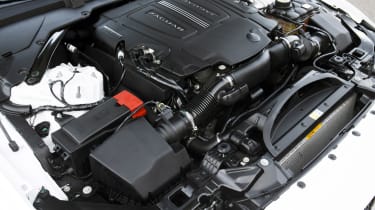
A range of engines powered the XE across its nine years on sale. In terms of petrol engines, it entered the market with Ford’s EcoBoost four-cylinder petrol in 197bhp and 237bhp forms, before JLR’s own range of Ingenium 2-litre petrols came on stream in 2017, with 197bhp (running until 2019), 247bhp and 296bhp respectively. The Ingenium engines used Fiat’s MultiAir electrohydraulic variable valve lift technology under licence, to improve efficiency, emissions and performance. The Ingenium four-cylinder engines also received 48-volt mild-hybrid tech in 2020.
There was also Jaguar’s own AJ126 supercharged V6, which spanned 2015 to 2017 in 335bhp form and 2017 to 2019 with 375bhp, before being discontinued upon the introduction of WLTP regulations.
Naming conventions weren’t Jaguar’s strong suit, though power figures are easier to decipher on petrol cars – 20t, 25t and 30t badges broadly speak to power levels available (just add a zero). Jaguar later introduced slightly more sensible P200, P250 and P300 badging. The V6s died as this convention was introduced, so look out for S badges if you want the 335bhp and 375bhp supercharged models. The flagship was, of course, the XE SV Project 8, which got a 592bhp 5-litre supercharged V8.
> Jaguar GT prototype review – driving 2026’s most controversial car
The basic petrol model developed its 197bhp at 5500rpm and 236lb ft of torque from just 1200rpm, putting its power down through the rear wheels alone. The 247bhp (at 5500rpm) model was also rear-wheel-drive only, and made 269lb ft at 1200rpm. Move up to the 296bhp Ingenium unit (the same output as that of the four-cylinder F-type) and the XE became four-wheel drive, sharing 295lb ft from 1200rpm among its four wheels.
The only diesel offered in the XE was an Ingenium unit, initially in 161bhp and 178bhp 20d forms and a 237bhp 25d with all-wheel drive. The 20d latterly became the D180, while 48-volt mild hybridisation came to the Ingenium in 2020 to create the 200bhp D200 MHEV. The 161bhp diesel developed its peak output at 4000rpm, and put 280lb ft to the rear wheels from 1750rpm. The 178bhp diesel also had its peak at 4000rpm, with a greater 317lb ft at 1750rpm. The 237bhp option, meanwhile, produced 369lb ft at just 1500rpm. The last of those was available only with all-wheel drive, while the 178bhp model had a choice of rear- and four-wheel drive.
Two transmissions were offered. The six-speed manual was largely the preserve of earlier XEs and, eventually, only the diesels, and was a rare choice. The much more popular and prolific eight-speed ZF automatic was the other option. All-wheel drive was available on earlier diesels and the petrol V6, and later on the higher-powered Ingenium petrols.
Performance and 0-62mph
- Diesels were clattery in spite of Jaguar’s claims
- Four-cylinder petrols had punch but lacked character
- The V6 bowed out at its best in 375bhp form
The XE is sporty by nature and, in 178bhp trim at least, the 2-litre diesel doesn’t let the side down, good for 0-62mph in 7.4sec in both manual and auto forms.
Once spinning and on the move, the diesel is capable of a refined push – plenty to enjoy the well-balanced chassis and enough to make overtaking relatively effortless. Jaguar had boasted that instead of the normal diesel clatter, the Ingenium diesel sounds more typical of the Coventry brand, with a ‘mellow growl’ at low revs, changing to an ‘edgy growl’ when you put your foot down. Sadly, that is far from the reality, and the engines, no matter what the power output, are coarse and make a typical diesel rattle throughout the rev range.

Obviously swifter is the 237bhp four-cylinder petrol. However, when you start to push on and extend the 2-litre’s performance, the drivetrain begins to unravel. The engine note takes on a coarseness that’s totally unexpected after what has been experienced at lower speeds and is not what you expect of a Jaguar. As the revs increase there’s very little in the way of turbocharged surge, the power delivery very linear but not especially memorable. The claimed 0-60mph time of 6.0sec is certainly plausible, though.
The 296bhp petrol was the best of the four-cylinders. Further fettling smoothed out the Ingenium engine and more insulation quietened its harsher tones, and there's even a cultured background warble under acceleration. It's still not an engine that revels in high revs, but it's no longer unpleasant, and at 5.7sec to 62mph it's quick too.
What it isn't is a particularly compelling alternative to the supercharged V6. While that engine wasn't perfect, it at least had some character, and the growling exhaust note added an extra dimension that none of the four-cylinders can hope to match.
The V6 in its lower-powered 335bhp forms lacked a bit of enthusiasm in the higher revs. The updated XE S 380 of 2017 remedied that, with those extra horses arriving precisely where the original engine started to die away. With a 0-62mph time of five seconds dead, the XE trailed, slightly, its all-wheel-driven competition of the time, but you never feel short changed from behind the wheel.
The manual transmission, where offered, isn’t particularly pleasant; the action is clunky and rubbery while the gate is obtrusive. So, uncharacteristically for evo, we’d choose the auto option. However, there is one benefit of the manual transmission: it does offer a greater sense of connection to the drivetrain that the auto simply can’t. The auto's mapping improved over time though, hunting less and offering crisp changes and fairly consistent responses to flicks of the gearchange paddles. Left to its own devices it's also smooth and seems to work well with the petrol engines in particular.
Driver’s note
‘There’s something charmingly old-fashioned about the XE S, and that’s largely a good thing. While utilising forced induction, the Jag’s supercharger not only permits a more natural, vocal induction note than the modern breed of oh-so-competent turbo engines, but its delivery has a vivacity that the highly competent but studiously linear turbo engines can’t match. It also deploys all of its 375bhp through the rear wheels only.’ – Adam Towler, evo 237, August 2017.
Ride and handling
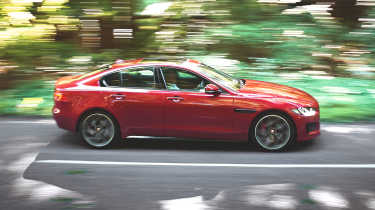
- XE loved for its front-end response and supple damping
- A saloon car that’s rewarding to drive
- Passive sport, passive comfort and adaptive damper options
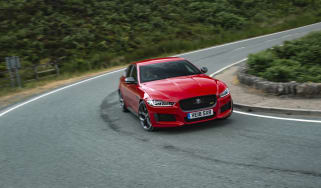
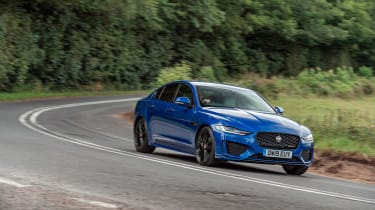
With double wishbone front suspension and an ‘integral link’ rear axle that helps separate longitudinal and latitudinal cornering forces, the XE remains a true sports saloon. It’s a car that gets better the harder you drive it and has a wonderful sense of balance.
The three different damper options – the passive suspension in Sport or Comfort specs and the adaptive setup – all offer a similarly imperious ‘bring it on’ resolve. They manage to balance grip with grace and a fluid economy of motion whatever the road surface or ambition of the driver. In the XE, you can get as down and dirty as you like at the wheel, yet the end result will always be poised and pretty, which, of course, is very flattering and something few of the German opposition do quite as well.
The XE also manages to serve up a ride quality not dissimilar to the Mercedes C-class of the day: there’s a controlled suppleness to the way it deals with a road and excellent suppression of tyre noise. In other words, it’s very comfortable and refined.
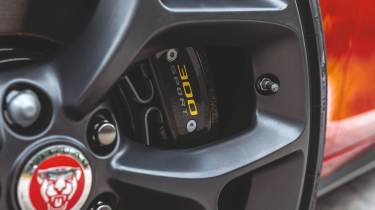
Where it differs immediately from the Merc is in the acuity of its responses. Darty is the first word that springs to mind, though you quickly relax and adjust and begin to marvel at how little effort is required to get the nose arcing towards the apex.
The steering progressively weights up as you attack a corner, encouraging you to really dig into the chassis’ ample but beautifully balanced reserves of grip. Not bad at all for an electronically assisted power steering system. No, there isn’t much genuine feel and the strong self-centring action feels a bit artificial but, like the F-type, the XE has turn-in chops the BMW F8X BMW 3-series would kill for and a bias towards mid-corner neutrality that’s hugely gratifying. The XE demonstrates the kind of capability and ability to engage that we really hope Jaguar has not forgotten in the development of its new EV.
Driver’s note
‘The XE S chassis has an inviting, playful nature that puts the driver in the right mood from the first 100 yards. It’s an expressive sort of car, which has an inherent rightness about its approach to performance rather than endless modes in search of “sportiness”. The steering is quick, needing only small inputs for the majority of the time, but this agility, combined with ample power to the rear wheels, means the XE S often feels neutral at the very least. There’s never any doubt this is a powerful rear-wheel-drive car. Neither is its poise at the expense of ride, because with Jaguar’s Adaptive Dynamics variable damping it always retains its composure.’ – Adam Towler, evo 237, August 2017.
Interior and tech
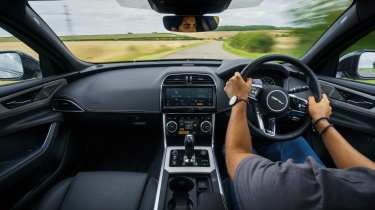
- Slightly bland design
- Good driving position and front-seat comfort
- Facelift features twin-screen ‘Touch Pro Duo’ HMI set-up
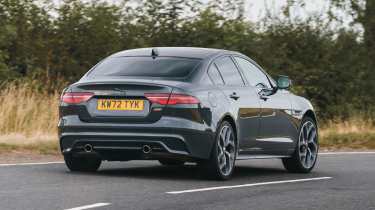
Although Jaguar would have you believe its coming era is a total transformation compared to its slightly staid past, the company abandoned the wood 'n' leather gentlemen's club vibe long ago. The XE feels so far away from that ambience that it could have been created by a different manufacturer altogether. While there's nothing particularly wrong with the cabin, there's nothing that really marks it out as a Jaguar either. It’s far from bold.
Earlier cars featured a smaller infotainment screen with four physical buttons at each flank, while the larger 10.2-inch option incorporated all controls on the screen. The biggest change to the system came in 2019 with the major facelift, which introduced InControl Touch Pro Duo, JLR’s twin-screen solution, with integrated rotary dials for climate controls in the lower screen. The facelift also saw Jaguar dispense with the rotary drive controller that first debuted on the XK and XF in the 2000s, in favour of a more conventional selector.
Look closely and you'll spot the ‘Riva Hoop’ across the top of the dash. This first saw service in the XJ, but in an otherwise conventional environment it doesn't particularly stand out like it does in the flagship saloon. What you do get is widespread piano black plastic and plenty of leather. Build quality and how the switches and controls operate is all fine, but the basic design is fairly uninspiring.
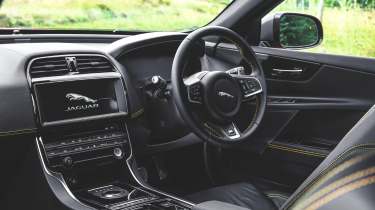
The leather gear gaiter on the manual models looks a little cheap, and there are some ill-thought-out ergonomics (for example, the light on the centre console that shows which driving mode you’re in is invisible in bright sunshine). The rear-seat packaging makes it 'cosy' in the back for six-footers, too.
It's more comfortable in the front though, with a good driving position and plenty of adjustment in both the seats and steering wheel. Jaguar's rotary gear selector felt old when new, so a facelift car with the Sport Shift Selector is preferable in this sense, but the steering wheel feels good in the hands.
Driver’s note
‘Ergonomically, the XE feels designed for the driver – pedals, steering wheel and seat all adjust to where you want them. The layout ahead is clean and logical to use and read, the material fit and finish tight as a drum-skin.’ – Stuart Gallagher, evo editor-in-chief, evo 313 (2023).
MPG, running costs and reliability
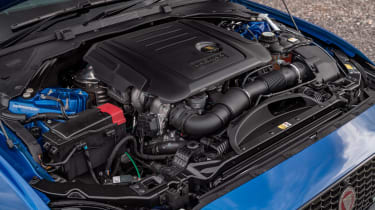
- Ingenium diesel engines notorious for issues…
- … even if their efficiency makes them tempting
- Petrols are sturdier, the V6s the sturdiest
A combined figure of 57.6mpg is still commendable for a small executive saloon. The corresponding 126g/km CO2 figure should keep tax bills relatively low, too. The 178bhp diesel manual is slightly behind at 55.4mpg and 133g/km, which drops to 53.3mpg and 141g/km when the automatic transmission is equipped and 51.4mpg/145g/km with all-wheel drive. The most potent diesel, also with automatic and all-wheel drive, returns 48.7mpg and 153g/km.
Petrols have respectable economy too, with up to 38.7mpg possible in the entry-level automatic, rear-drive 197bhp car. Curiously the 247bhp model is actually slightly less thirsty, with a 39.2mpg average and 164g/km of CO2, but with all-wheel drive the 296bhp car drops back down to 36.2mpg and CO2 climbs to 177g/km.
Worth keeping in mind are the issues that are well-known around the Ingenium diesel engines. They have a reputation for timing chain failure, issues with the turbochargers, oil dilution, and problems with the diesel particulate filter and fuel injection system. If you’re in the market for a diesel, it’s vital the history of the car is known and that remedial work is accounted for, either in the car’s recent past or in terms of the purchase price.
The petrol engines are much more well-behaved. Perhaps unexpectedly, even if it’s the thirstiest and worst for emissions, the AJ126 supercharged V6 appears to be the most dependable of the XE engine lineup.
Jaguar XE used prices
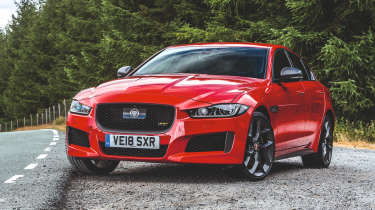
The Jaguar XE was sold between 2015 and 2024, so the variety of cars on the used market is enormous. Consider that ‘spare or repair’ XEs are under £3000, while at the same time XE Project 8s are topping £150,000.
That’s a remarkable price spectrum, but a number of factors do keep the prices of many XEs deflated. First, there’s that the XE feels like it’s the product of a now-defunct manufacturer, so comprehensive does Jaguar’s break with its past seem. As well as being the most common variants, there are also well-known reliability issues that keep the values of XE diesels depressed – early cars with as little as 60,000 miles can be had for well under £7000. Needless to say, if you’re in the market for a diesel, caution is advised. Speak to specialists and demand a detailed history.
The XEs you actually want are petrols, for reliability reasons, but also because they’re just nicer. Especially as they’re not much more expensive. Early Ford EcoBoost cars are still cheap, in the region of £6000 to £10,000 with perfectly acceptable miles. Later Ingenium petrols are priced from around £8000. For a petrol XE with over 230bhp, you’re looking at £13,000+, likewise for a V6. The latter really is a bit of a bargain and rare too.
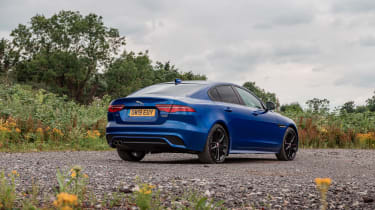
The compact executive car market was a rather competitive place to be in the mid-2010s, with Germany bringing the BMW 3-series, Mercedes-Benz C-class, and Audi A4 to the table. As has been the case for perhaps the entire history of the segment to date, the 3-series was the best choice for those who enjoy getting behind the wheel. The G20-generation arrived in the XE’s lifetime, the improvements to interior tech and refinement edging it ahead of the XE.
The C-class fights back with a fantastic cabin, one that takes more than a few cues from Merc’s flagship saloon, the S-class. Audi's A4 is a model of competence; incredibly quiet and refined, and capable (if not that involving) on a twisty road.
Elsewhere the choices are more diverse, but each has its own appeal. The Lexus IS is worth a look, with sharp styling, a sense of build quality to rival Audi, and the option of hybrid powertrains. Alfa’s Giulia is the compact saloon that really appeals to drivers. Whether it’s the Quadrifoglio version or 2-litre four-cylinder, the Giulia is the most focused small saloon of its era. All models come with super-sharp steering, a carbonfibre propshaft and 50:50 weight distribution.