How this Range Rover's clever hidden tech has saved me serious money
Why four-wheel steering is a vital part of the Sport’s tech armoury

Once a quarter, the late LJK Setright would use his column in Car to discuss the subject of four-wheel steering. Specifically the four-wheel steering Honda had developed for the Prelude. Like many, I enjoyed reading Setright’s views on the technology finding its way into new cars during the ’80s and ’90s gold rush of car development. And, like many, I rarely had the intellect to fully comprehend his work. Reading his copy then, and now, is the literary equivalent of trying to keep up with Dickie Meaden when he decides to make some progress behind the wheel.
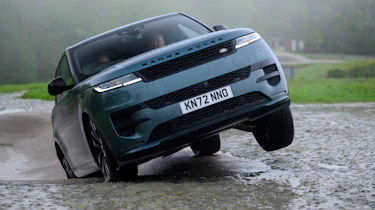
What does any of this have to do with our Range Rover Sport? It too has four-wheel steering, and it’s one of the best systems I’ve experienced. Art director Rich Browne’s Audi S8 has it too, but in the limo, while effective at providing it with impressive low-speed mobility, it’s not as impressive as it is in the Sport.
> Range Rover Electric review – why we’d have the EV550 over a V8
The S8 has 3.1 metres of real estate between its two driven axles, the Sport 2.9 metres, and while the Audi’s system works its miracles at low speed, at medium to higher speeds, when the rear wheels turn in the same direction as the fronts, it feels less effective despite the built-in stability its overall length naturally provides.
More reviews
Reviews
- Range Rover Sport Electric review – a Porsche Cayenne’s worst nightmare
- Range Rover Sport SV review – A Defender OCTA in a suit
- Range Rover Sport Overfinch Supersport review - for when a Range Rover Sport SVR just is too subtle
- Range Rover Sport SVR (2014-2022) review – Land Rover's big bold hot rod SUV
- New 2018 Range Rover Sport revealed with plug-in hybrid and 567bhp SVR
The Sport would be a kerb-battering, wheel-destroying disaster without its rear wheels being able to turn up to 7.3 degrees in the opposite direction to the fronts. Approaching car park kerbing that has taken chunks out of previous evo Fast Fleet residents (Heathrow T2, level 4, lane 6, I’m looking at you) feels like threading a needle through the open door of St Paul’s Cathedral when navigated in NNO.
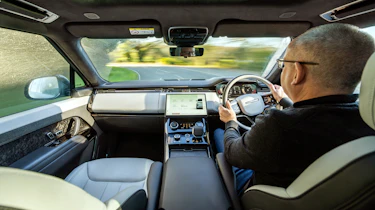
Its wheel-saving properties in our pothole-ridden urban environments are most welcome, but it’s also essential if you do take your £120,000+ Sport into the woods and find yourself hemmed in by trees on a rutted path millimetres wider than the car. Which, let’s not forget, is what Land Rover products are created to do, even those with white leather interiors and 23-inch wheels. More of that in the next report.
At higher speeds on more interesting roads, the Sport’s rear can become unexpectedly mobile if you’re too enthusiastic on turn-in, the rear snapping round sharply and pushing wide before jumping back into line as the rear steer rolls up its sleeves. The tech and mechanical loads to manage such mass becoming mobile doesn’t bear thinking about. Although I suspect LJKS would be able to explain it in his uniquely erudite manner. Whether I’d understand is another matter.
| Total mileage | 19,041 |
| Mileage this month | 1212 |
| Costs this month | £0 |
| mpg this month | 20.1 |
This story was first featured in evo issue 323.