Lexus RC F (2014-2025) review – a characterful coupe with one of the world’s great engines
The Lexus RC F is neither the fastest or most dynamic sports coupe out there, but it still holds lots of appeal – chiefly because of its fabulous V8 engine
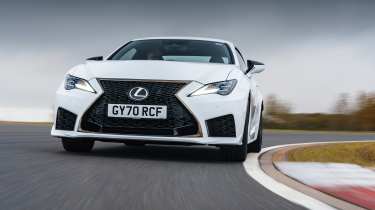
In objective terms, the Lexus RC F was never a class-leading sports coupe. It’s not as crisp as a BMW M car, as rounded as an Audi RS model nor as brutally fast as a V8-engined Mercedes-AMG. Its price-point wasn’t far from its more capable rivals either, so it didn’t serve as a serious value proposition either.
And yet the Lexus RC F occupied a high place in our affections up until it went off sale last year, because the thrill of driving is not always about outright ability or figures on a spec sheet. The RC F is about more than that. Its desirability is derived from an increasingly rare combination of elements that really do make it a unique entity alongside its more obvious rivals. With used examples now costing from as little as £30k, it’s also something of a bargain today.

The wild styling also helps the RC F’s appeal, so too its rarity, but its biggest asset is the jewel under its bonnet: the 5-litre, naturally aspirated V8 that defines the RC F, and enriches the driving experience in a way that raw numbers can’t describe. The RC F isn't perfect, but it’s a sports coupe that pulls on the heartstrings like few others.
Engine, gearbox and technical highlights
- Naturally-aspirated 5-litre V8 tuned by Yamaha
- Rear-wheel drive with an optional torque vectoring differential
- Eight-speed automatic gearbox
More reviews
As stated, the engine is an enormous part of what makes the RC F special. At 4969cc, by modern standards it’s a big-capacity unit, and unusual in being naturally aspirated. It’s built by Toyota and used in a variety of different models across mostly American markets, but in Lexus-specific ‘2UR-GSE’ form this V8 has a substantial amount of bespoke engineering applied to it. The main differentiator from lesser Toyota V8s is the Yamaha-designed head, titanium valves, high-lift cams and a dual-length intake.
Peak outputs are 470bhp at 6400rpm, and 391lb ft of torque between 4800 and 5600rpm. The latter sounds like a healthy number until you consider that a contemporary M4 develops 25lb ft more from less than 2000rpm. And that the RC F isn’t exactly a flyweight at just under 1800kg.
Although the engine lacks a screaming red line (7100rpm is all it has to give) it’s the lightweight internals and induction system that make the 2UR feel like more than just a luxury-car engine. It feels honed and crafted, and is clearly from a company that knows a thing or two about acoustics – Yamaha. It’s mated to an eight-speed automatic gearbox, rather than a DCT – or the ten-speed auto fitted to the LC500, which uses the same engine. A Torsen limited-slip differential came as standard, with a torque vectoring unit offered as an option.
Keep the throttle pinned and the RC F will top out at a limited 168mph. The claimed 0-62mph acceleration time is 4.3sec, an impressive number in isolation, and on par with the F82 BMW M4 (4.3sec). Modern hot hatches like the Audi RS3 and Mercedes-AMG A45 S would give the Lexus a hard time, however.
Performance, ride and handling
- Engine lacks the flexibility of turbo units, but makes up for it with exciting soundtrack and sharp response
- Intuitive, adjustable handling – providing you’re in the right mode
- Feels more leaden and less dynamic than an M4
Slide into the cabin and the driving position takes a little getting used to. It’s not particularly low, but the view out feels slightly obstructed, as if the scuttle is too high. It’s somewhat reminiscent of being in a TVR or Aston Martin, and exaggerated by the strip of bonnet visible from the front seats. Drive away and the stiff accelerator pedal motion, relatively heavy steering and lumpen low-speed ride only add to the cumbersome feeling.
However, as speed rises, over 40-50mph, the suspension seems to find its range and begins to flow in a more dignified manner than your first impressions suggest it might. The new adaptive dampers have usefully increased the amount of body support over larger undulations: where before the body would have begun to lose some of its composure, it now hunkers down and better utilises the suspension travel. The lowered unsprung weight afforded by the Track Pack’s forged wheels and carbon-ceramic brakes helps here too, giving you extra confidence that the car will not be knocked off-line when things get rough.
That same fluidity is maintained through longer, wider corners, and regardless of damper mode the RC F settles onto a well-supported outer-rear corner, the throttle allowing just a slight influence over the car’s attitude. If this all sounds a little flat, there is a remedy: drive through the heavy control weights, become more liberal with your inputs, and the RC F responds accordingly, switching from chunky GT to something more sports car-like.
Put your foot down with Sport S, or even better Sport S+ mode activated, and the engine’s background burble is replaced with a fantastic bark – one unique to the 2UR and which seems to amalgamate the bassy, off-beat thrum of a traditional V8 with a polished yet still motorsport-like howl.
Little of the volume actually emanates from the exhausts – the supposedly more cultured LC500 that features the same unit is more muscle car-like in its voice – but it’s still a highly satisfying noise that can’t help but elicit a smile. It doesn't rev to the heights of a BMW S65 V8 perhaps, nor does it have quite the tingly response of a Lamborghini V10, but it’s still a more exciting and satisfying powertrain than the turbocharged motors you’ll find in most rival coupes.
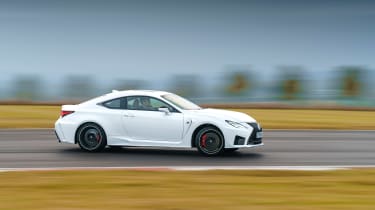
The eight-speed automatic transmission is less of a highlight, and although it doesn’t subtract from the powertrain’s brilliance, neither does it accentuate it like a good dual-clutch unit might. While mooching about, the auto slips in and out of ratios with noticeably less decisiveness than you get from the best modern torque converters. Increase the pace and it does sharpen up, and with a sportier mode selected it’ll feel more alert still, with sharp, blipping downshifts, although it still lacks the final layer of crispness found in rival transmissions.
Have you driven a brisk hot hatch recently? Something like a Golf R or a Mercedes-AMG A45? Because if you have, the RC F will probably feel like the slower car, especially in day-to-day driving. That's because instant gratification is not the game here, as when mooching around at low revs that naturally aspirated V8 doesn’t really have much in the way of low-down grunt. It’s not unresponsive – actual throttle response is very crisp – it just doesn’t pack much instant punch.
If you want more freedom to exploit the engine’s top-end power and the super-accurate control it grants you in slower corners, you can switch the stability control (or VDIM – Vehicle Dynamics Integrated Management – in Lexus-speak) fully off, or there’s also an ‘Expert’ mode in which the electronics take a back seat and only intervene to prevent a spin.
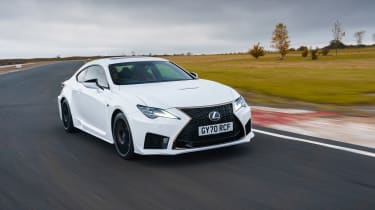
We’ve only driven RC Fs with the optional TVD differential. In its Standard and Slalom modes it can be frustrating at higher speeds, taking its time to engage and allowing the inside rear wheel to spin, sapping your momentum. On the occasions it does lock, it then tries to quell any slide before you’ve had a chance to enjoy or react to it. It’s the final, most focused Track setting that provides the most natural responses, the diff engaging as soon as you touch the throttle and staying locked as you dictate your angle of slide with the throttle. It can easily be kept small and tidy or pushed large and boisterous depending on how much throttle you choose to use.
The RC F is not as talented dynamically as an F82 M4, as capable as an RS5 or as boisterous and lairy as a V8-engined Mercedes-AMG C63, but it is certainly gratifying, and because you’re never quite carrying the sheer speed of those German rivals, it feels more exploitable on the road.
MPG and running costs
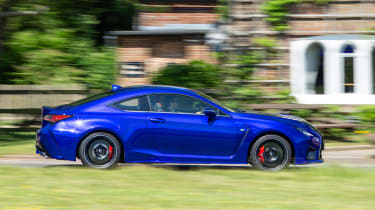
When we ran a Lexus RC F on our long-term test fleet, matching Lexus’s official combined mpg figure of 26.2 proved tricky; we averaged around 22mpg. For comparison, our long-term Audi RS5 averaged 25.9mpg against an official claim of 32.5mpg.
With the RC F being so comfortable going sideways, you might want to budget for the tyres to be replaced frequently. Replacing both 275/35 R19 rears will cost you nearly £600, if you go for Michelin Pilot Sport 5s.
In contrast to high fuel bills and expensive consumables, the RC F is a Lexus, and one of a bygone era, which means build quality and reliability are second-to-none. The relative rarity of these RC Fs also mean they hold onto their value well, and being so specialised with their naturally-aspirated engines, we wouldn't count against values remaining steady since they’re no longer available new.
Interior and tech
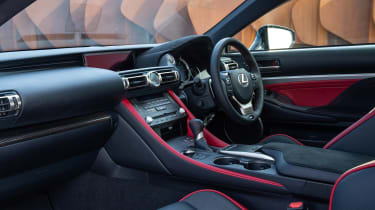
Whatever else is said about the RC F’s interior functionality, you cannot fault how it’s built. It’s constructed to such fine tolerances and with excellent materials, so wobbles and rattles simply don’t exist.
How it all looks and works, however, isn’t as universally loved. The seats, with their many sinewy patches that look like exposed muscles, are set too high for some taller drivers, leading to restricted headroom. Meanwhile the grey centre console and hi-fi is so sparsely populated with buttons that the evo team has described it as both ‘boring’ and also the perfect example of Dieter Rams’ ‘as little design as possible’ philosophy. You’ll have to make your own mind up about it.
Programming the satnav, connecting your phone via Bluetooth or changing radio stations can be vexing even for the tech savvy among us. As much as we may applaud Lexus for being different in certain areas, we’d rather have a more conventional and intuitive entertainment system in the RC F.
Prices, specs and rivals
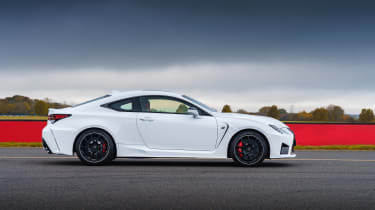
Today, an early RC F from 2015 with less than 50k miles on the clock will cost you just under £30k. Though buying a decade-old V8 coupe might sound like a recipe for big bills, Lexus’s fantastic track record for reliability – and the standards of its dealer network – mean a used RC F is far from the sketchiest used purchase you can make.
For later models like the RC F Carbon – equipped with an exposed carbonfibre bonnet, roof and spoiler – expect to pay in the region of £35,000. Facelifted models from 2019 onwards tend to command much higher price tags, with low mileage examples fetching around £50k.
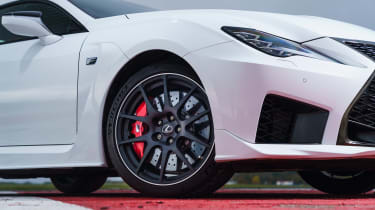
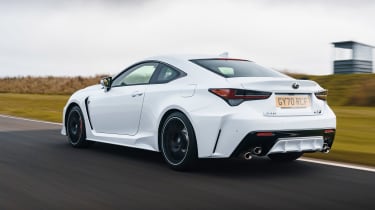
Also introduced in 2019 was the Track Edition, adding an aggressive fixed rear wing, more boisterous interior trim, forged BBS alloy wheels, a torque-vectoring rear differential and carbon-ceramic brakes. Lexus only brought a limited number to the UK, however, so they rarely come up for sale.
Most of the Lexus’s main rivals came from Germany, and are now available for similar money on the used market. The F82 BMW M4 is a sharper and more athletic car to drive, with a healthy torque advantage making it noticeably quicker in the real world. They’re vastly more plentiful on the used market and thus generally more affordable than the Lexus, starting from around £25,000.
Audi’s previous-gen RS5 is more of a rounded sporting GT than an out-and-out sports coupe, with four-wheel-drive traction and a powerful, smooth and torquey twin-turbo V6 engine with 444bhp. You can pick up a good example for just under £30k.
If muscle and brawn are more your style then the previous Mercedes-AMG C63 Coupe could be right up your street. Like the Lexus, the AMG has a V8, but adds two turbochargers nestled between the banks of cylinders, adding both power and torque. In ‘S’ form, the AMG peaks at 503bhp, with 516lb ft of torque. Yours from £30k.