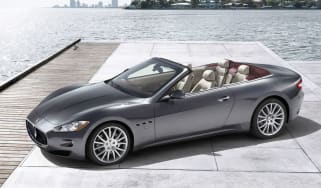
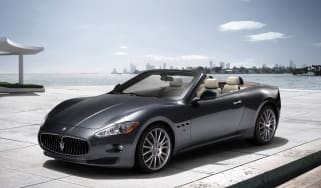
Maserati GranCabrio Trofeo review – can it possibly be £67k less car than Ferrari's Amalfi Spider?
Far cheaper than Aston’s DB12 Volante and Bentley’s Continental GTC, but the Maserati GranCabrio does fall short in some areas
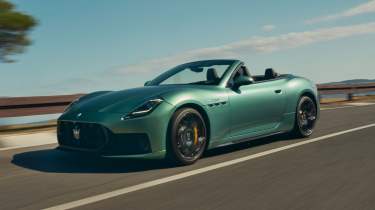
We’ve been fans of the Maserati GranTurismo since we first drove it, so much so, it received an invite to eCoty 2023. Despite finishing in the final spot, it still impressed us with its rather unique blend of pace, grace and practicality.
It’s since been developed into the GranCabrio convertible version and had a tri-motor powertrain crowbarred in to create the electric Folgore. Now the whole range has been facelifted, with the aim of upping the intensity, both visually and in terms of the driving experience. The lineup’s halo, the GranCabrio Trofeo, is now more powerful and channels more MCPura supercar personality than ever before.
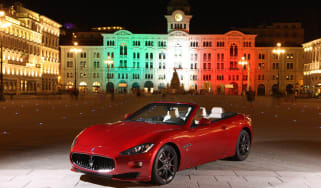
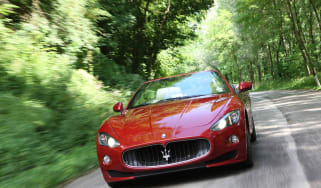
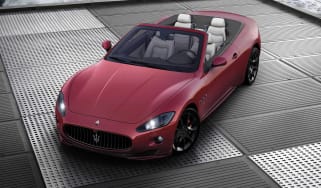
Before the update the GranCabrio was simple, elegant, if vast. Now, we’ve got an angrier, more angular, GT2 Stradale-inspired schnoz. At the rear, there’s now the option of clear lights. Still beautiful and not exactly ambitious? Yes, but there’s surely more anger here. And the same goes under the bonnet.
Engine, gearbox and performance
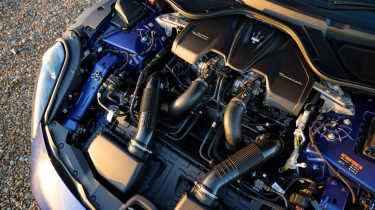
- The MCPura-based V6 has more supercar character than before
- While it’s not quicker by the numbers, there’s more intensity up in the revs
- Eight-speed ZF ‘box quick enough on the upshifts, a bit slurred on the way down
Pop the bonnet – or the ‘cofango’ as Maserati refer to it, a sprawling panel that combines the bonnet with the front wings – and it’s immediately apparent that the long nose is by no means necessary to contain the engine. The Nettuno twin-turbocharged V6 is entirely behind the front axle line, contributing to a 51:49 weight distribution (50:50 in the Folgore). The 3-litre motor features Maserati’s twin combustion tech (MTC) as seen first in the MC20, but unlike the supercar is in wet sump-form here. It produces 583bhp and 479lb ft of torque.
More reviews
> Aston Martin DB12 Volante v Maserati GranCabrio Trofeo – open-top GTs go head-to-head
Down by 70bhp the Trofeo may be on the Aston Martin DB12 Volante’s twin-turbocharged V8, no one seems to have explained that to the little V6. It’s an effervescent, eager mill, ripping eagerly through the revs – even more so now with this update – to deliver a whip-crack in the exhaust with every gear shift in Sport or Corsa mode. With the eight-speed ZF ‘box sending power to all four wheels, the GranCabrio Trofeo launches to 62mph from rest in just 3.6 seconds.
The exhaust is another point of evolution for the GranTurismo during this update, with a completely removed central silencer and a change of design for the resonators at the rear. The result is an increase in timbre for what was already a resonant, rippling V6 sound. It still sounds like an old diesel at startup and idle sadly, but it’s a cooler-sounding thing as you run up and down the revs.
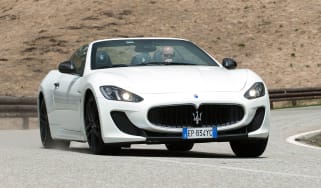
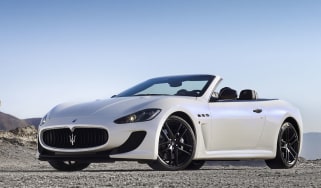
Far from revolutionary compared to its predecessor it may be, but you can’t deny it has quite some presence, particularly with the roof stowed. It is extravagantly proportioned, but pleasingly free from visual clutter, and as you walk up to it, the sheer impressive scale of the car becomes readily apparent. That roof takes just 14 seconds to lower should conditions allow, and 16 to raise it, with both possible at up to 31mph. Once you calm the crackling V6 down, the GranCabrio is particularly adept at relaxing progress, and wind buffeting with the roof lowered is especially well contained.

What of the electric Folgore? Well, as someone who’s always seen a charismatic Italian internal combustion engine as a key part of the Maserati recipe, particularly when the cars of the past have often been a bit flaky in other areas, I have to say the idea didn’t exactly thrill me. But in all honesty, it does work well, as long as you’re buying this car principally as comfortable, stylish transport. It’s searingly fast in a straight line, too, and there’s a real novelty factor in being able to hear nature as you pass through it.
Range has always been an issue and the fact the Folgore can now decouple its front axle when cruising should aid this, bumping stated range to 335 miles. But it’s still no marathon machine in. Whether the pre- or post-facelift, without that sense of mechanical interaction the experience left me cold, there’s no hiding the weight when you want to push on a bit, and I’d never take one over the Trofeo.
Ride and handling
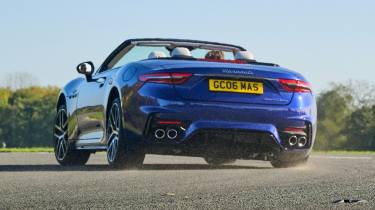
- GranCabrio remains the consummate cruiser, with a bit of supercar theatre
- Between the ride and steering, everything’s well-resolved…
- … but this is no ten-tenths sports car
The GranCabrio was developed alongside the coupe from the beginning, the platform designed to offer the flexibility to support all variants while sharing as much in common as possible, including passing down the same production line.
The chassis is of a hybrid construction that consists of 65 per cent aluminium, but with additional bracing underneath to claw back rigidity lost with the application of the tin opener on the roof. Maserati’s engineers describe the cabrio as having comparable rigidity to the structure of the coupe, although there is a 100kg weight penalty once bracing and roof mechanisms have been taken into consideration.
Incidentally, that difference narrows to 80kg on the all-electric version as the battery pack mounted underneath the car has a bracing effect all of its own. Then again, the weight penalty overall to go electric is considerable, the Folgore version tipping the scales at a hefty 2340kg.
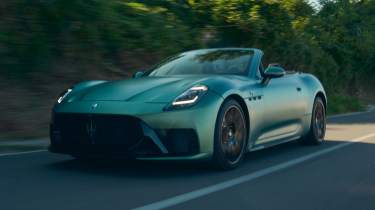
Like the GranTurismo, it uses air suspension and is genuinely pliant in GT mode, which has been tautened slightly for this update. In fact, the logic of all the drive modes has been revised, so that GT is the more intuitive ‘standard’ mode, in terms of the ride, steering and transmission. Corsa is still the best mode for fast road driving.

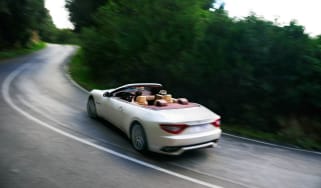
The steering is quick but not nervously so, and has an oily accuracy that suits the soft-edged ride; it really does make very few demands on the driver. Like all air-suspended cars, it can feel a little flat-footed on certain smaller, awkward surfaces at speed, that occasionally catch it out with a wobble, but you’d think nothing of doing many hundreds of miles a day in this car.
Up the ante to Sport and the suspension firms up, as the engine develops a bit more growl. Even if it feels like it’s bracing itself for a brawl, it’s still a pleasingly fluid car to drive quickly, with loads of traction but one that never feels obviously four-wheel drive. It’s capable, secure, and rather satisfying, but this is the GranCabrio at its best.
Corsa drops the ride height as well as stiffening the suspension further, and this is a little less successful. Ultimately the GranCabrio is a big, heavy car and compared to the coupe, it doesn’t inspire the same confidence in its capabilities when you really up the pace. You’re less inclined to lean on the car, to try to dance it. The GranCabrio definitely loses some tautness and rigidity.
Interior and tech
- Touch screens already feel dated and lack tactility
- New toggles for gears aren’t very nice, nor the new digital clock
- More interior spec options should increase its appeal
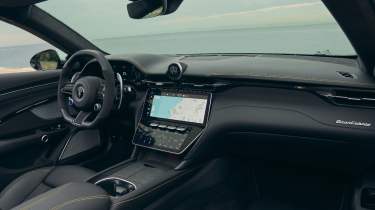
Dropping the roof still requires a root around in the touch screen. It’s a modish but slightly overwrought exercise in place of a normal button that would do perfectly well, but then the Maser’s interior is very touchscreen heavy, which brings the usual frustrations. Nevertheless, responses and reactions of the system improve as the model years march on and it’s surprisingly intuitive and easy to get along with. Over just a couple of days with the GranCabrio, the day-to-day controls and processes quickly became second nature.
The interior generally is much like the coupe’s. The driving position is decent and it’s nice and spacious for front occupants. A neck warmer (hot air blown out through the top of the seat) does away with any nasty drafts in cooler climes. There’s no doubt it’s a comfortable place to be and reasonably practical. There’s a genuine pair of human-sized seats in the back that can be used for more than just extra storage, though it’s far less comfortable to go four-up in than say, the more spacious coupe.
It’s just a shame it slightly lacks the wow factor of its (more expensive) rivals, with none being clawed back for this update. Gone the gear selector buttons may be but the ‘toggles’ that take their place are no more tactile, as you soon find they’re actually just protrusions from a shared panel that flexes when you use them. The signature central Maserati clock has evolved too, with a Patek-esque bezel now surrounding the multi-function digital (but not touch-sensitive) display. More useful? Yes. A nicer object? Not really.
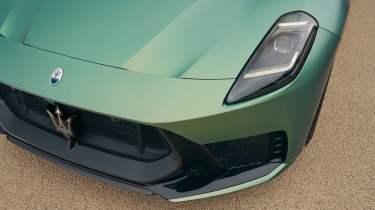
The cabin can at least be specced a bit more adventurously now GT production has returned to Modena and the full suite of Bottega Fuoriserie options are available. Even as standard, the yellow stitch option is a bit more ‘out there’ in that Instagram-friendly way, which will appeal more to buyers of these sorts of cars. The exterior green colour, in case you're wondering: Fuoriserie Green Jupiter, a £16,900 option...
Price and rivals
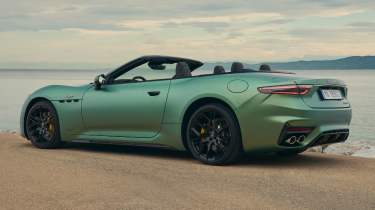
Overall, the GranCabrio’s biggest strength is its unique blend of characteristics. In spite of having the heart of a supercar – that engine is a joy to wind up – it’s more GT than a DB12 but more sports car than a Bentley Continental GTC. It’s considerably cheaper than both on price, too. Maserati like to point out they’ve been making cars like this for decades, and it has to be said that with the new GranCabrio, that experience seems to count for plenty.
The GranCabrio Trofeo will set you back from £160,680 in the UK, a £9000 premium over its GranTurismo Trofeo sibling. Modena and Folgore variants are also available, at £136,920 and £138,605 respectively. All told, the GranCabrio range, like the GranTurismo, is very competitively priced.
The Mercedes-AMG SL55 starts from £154,400 – £6000 cheaper than the GC Trofeo but also, down on power by over 100bhp. Jump to the SL63 and the price jumps to £178,650 – almost £20k more than the Maserati for near-identical power and 3.6-sec 0-62mph performance.
The new Bentley Continental GTC is another potential rival, but with a much higher 671bhp output from its hybrid V8 and a lofty £200,000-plus price tag, it’s not a perfect match. The same can be said for the similarly priced and powerful Aston Martin DB12 Volante and Ferrari’s 631bhp Amalfi Spider which starts at £227,200. The Amalfi’s an excellent car and a better car than the Maserati, but £67,000 better? Tough call.