Porsche 959 (1987-1988) review – the Ferrari F40’s high-tech nemesis
Before it was the monster it is today, Porsche created a giant-killing technical tour de force of a supercar. There’s nothing quite like the 959
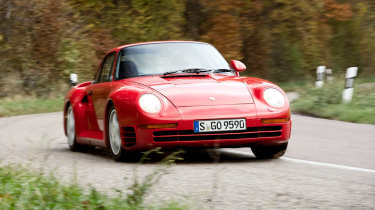
Designed to take advantage of the pretty relaxed and laissez-faire Group B rules, the Porsche 959 was built to compete on track against the likes of Ferrari’s 288 GTO. But after a lack of interest from other manufacturers the anticipated track side of the Group B era never materialised, and as Porsche didn’t want to enter he World Rally Championship the 959 was all dressed up with nowhere to go. Never mind the fact that by the time development and production delays had taken their toll, the Group B era was all but wrapped up.
It did have a brief competition history with a prototype winning the 1984 Paris-Dakar, while it also won the Rallye of the Pharaohs in 1985 before completing a one-two in the 1986 Paris-Dakar. Impressive feats, but what the 959 will be remembered for is providing one of the most impressive of all the 1980s driving experiences.
The continual refinement and honing of the 911 theme was, in part, thanks to the technological advances Porsche made with the 959. From its turbocharging to its adjustable suspension and all-wheel drive, the 959 was a pioneer and a technical tour de force. That informed its monstrous £145,000 price in 1987, which translates to just shy of £450,000 today.
Porsche 959 performance and tech
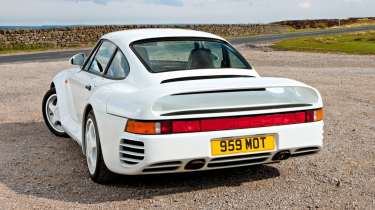
Development of the 959 started as early as 1981, partially to see just how far the evergreen 911 could be developed. Porsche’s chief engineer at the time was Helmuth Bott. He managed to convince managing director Peter Schutz that all-wheel drive could be one way of extending the 911’s bloodline into the future and so set to designing an ultimate 911 that would also adhere to Group B rules.
> Ferrari F40 – review, history, prices and specs
A prototype, simply known as the Gruppe B, was shown at the 1983 Frankfurt motor show, and while there were glimpses of the contemporary 911 in the Gruppe B – the wheelbase, the roofline, the windows and doors, much of the interior – in truth the new model had little else in common with Porsche’s perennial sports car.
The Gruppe B’s bodywork went through further developments – air vents in both the front and rear wheel housings as well as the air intakes in front of the rear wheels were added – and it was in this form that it made its debut as a production car at the 1985 Frankfurt show. Much of the hardware was as per the prototype.
The engine is a 2.85-litre twin-turbo flat six, based on the unit used in Porsche’s 935/78 Le Mans racer, aka Moby Dick. It featured water-cooled cylinder heads and an air-cooled block. To ensure a smooth, lag-free power delivery, a pair of sequential turbos, with the smaller turbo acting at low revs and both blowing higher up the rev range.
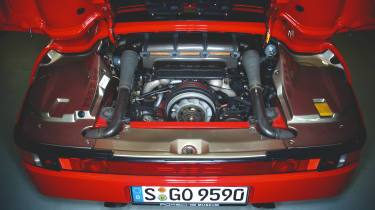
The engine featured an impressive array of motorsport-inspired hardware such as titanium con rods, forged alloy pistons and Nikasil-lined cylinders. These helped the unit produce its claimed 444bhp at 6500rpm and 369lb ft at 5000rpm. The rare 959 S – S standing for Sport – upped power to 508bhp and was claimed to weigh 100kg less, with manual window winders, no air con, just one door mirror, manually adjusted cloth seats and no rear seats. Production of the 959 S was thought to be under 40.
To help make the most of that performance, the 959 featured Porsche’s computer-controlled Porsche-Steuer Kupplung (PSK) four-wheel-drive system. Based on data received from sensors in each wheel, it could split torque 50:50 front/rear in slippery conditions, or at the other extreme send up to 80 per cent to the rear wheels under hard acceleration.
All-wheel-drive traction helped it get off the line pretty sharpish – 0-62mph was a claimed 3.7sec and its top speed of 197mph made it the world’s fastest production car.
The 959’s suspension was completely different to the 911 with which it shared a passing resemblance. Gone were the MacPherson struts of the 911’s front end and the semi-trailing-arm of the rear end. In their place, double wishbones at all four corners. Even today’s 992 retains MacPherson struts at the front, with the GT3 only going to a double-wishbone nose for the first time for this generation.
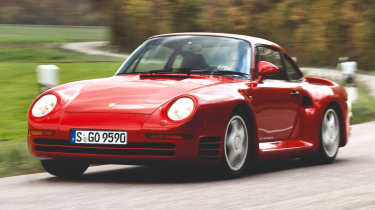
Each corner also featured two electronically adjustable dampers per wheel – one to control the firmness of the ride, the other to adjust the amount of ground clearance. Tthe driver could choose from three settings for each, although the firmest and lowest settings would be selected automatically at speed. The 17-inch wheels were hollow-spoked magnesium alloy items fitted with Dunlop Denloc run-flat tyres – 235/45 VR17 up front and 255/40 VR17 at the rear – and a tyre-pressure monitoring system.
While the 959 might have obviously been derived from the 911 its familiar-looking panels were in different, lighter materials – the doors were aluminium rather than steel, as was the front boot lid, while the rest of the bodywork was Kevlar. Flared arches, linked on each side of the car by wide sill extensions, housed the Gruppe B’s wider track, while a more aerodynamic nose helped reduce drag and an adjustable rear wing controlled downforce.
While the 959’s interior might have had a reassuringly familiar feel for a Porsche owner, those coming to the brand for the first time might have felt it was a trifle sombre given the whopping price tag. There were no high-tech switches or instrumentation, drivers instead being greeted by a standard set of 911 instruments, albeit with a 340km/h (211mph) speedo and a rev counter red-lined at 7300rpm hinting at the 959’s performance potential.
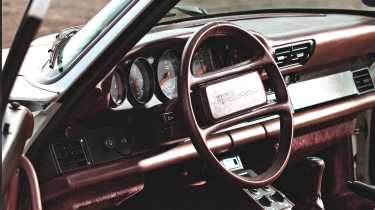
And while the 959’s interior might have been a little plain, there was nothing bland about its performance. Zero to 62mph in less than four seconds was pretty staggering back in the late 1980s, and its ability to put those numbers down no matter what the weather was hugely impressive, with the only other performance car of the time coming anywhere close in terms of all-weather usability being the Audi Quattro.
The 959, unlike the rest of the range, wasn’t assembled at Zuffenhausen, but was put together at Karosserie Baur, with Porsche inspectors keeping a close eye on quality control. Fewer than 340 examples were made.
For Porsche its value was represented not by profit – indeed Ferdinand Piëch, a major Porsche shareholder, went on record as saying that each 959 lost the firm just over £200,000 – but by the sheer learning accumulated during the car’s development. The 959 is talismanic for being the grandfather of every modern Porsche, and has rightfully earned its place among the great road cars of the 20th century.
Driving the Porsche 959 Sport – Henry Catchpole
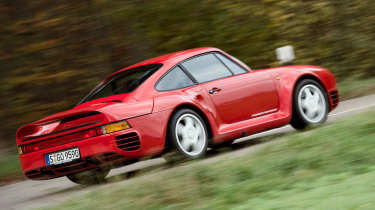
‘Swing the 959’s aluminium door open and the interior initially feels slightly disappointingly like a standard 911’s. As the gearknob has already alluded, however, the devil’s in the 959’s details.
‘An extra stalk sprouts from the right-hand side of the steering column. Nudge it up or down and you change which one of the four lights in the small dial directly above is illuminated, indicating which mode you have selected for the Porsche-Steuer Kupplung (PSK) four-wheel-drive system. Your options are Sunshine, Rain, Ice and fully locked, and there are small needles showing the torque distributed to the front and rear diffs. There is no centre diff as such: the torque split is instead managed by a multi-plate clutch (PSK literally translates as Porsche control clutch), itself controlled by computer.
‘Down on the transmission tunnel just ahead of the gearlever is a single switch that controls the adjustable damping. If you know your 959s then this will make your ears prick up because most 959s would have two switches here, the other one controlling the adjustable ride height. However, this is a rare 959 S that, among other weight-saving measures, lost that provision, while gaining an extra 64bhp.
‘Twist the key and the engine starts slightly lazily, almost reluctantly. Towards you and back for first gear, then a healthy number of revs as you bring the clutch up through its relatively high biting point… and we’re off. The stop-start traffic outside the museum on this cold but dry November day reveals that the 959 is really no more difficult to drive than a normal 911 of similar vintage. You’ve got the same airy feeling in the cabin, with great visibility all round, and despite the greater breadth of the Kevlar bodywork, it feels positively small amongst modern traffic.
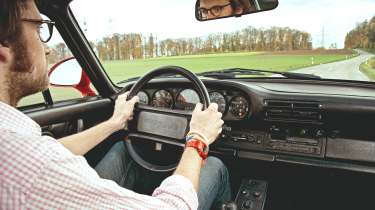
‘Initially it doesn’t really feel any more potent than a normal 911, either. Below 3000rpm the 959 doesn’t exactly feel imbued with oomph. Things sound better as you go through 3000rpm, the engine suddenly taking on a more recognisable flat-six timbre, but the pace still isn’t particularly brisk. The gaps in the traffic are fleeting during the first few crowded miles. Even holding on to second gear in the 959, there doesn’t feel like there’s ever enough room to do more than tickle the underbelly of its performance.
‘Thankfully, we soon turn off the trunk road and the traffic melts away. This looks better: second gear, revs building smoothly through the note change at 3000rpm, then continuing until about 4500rpm, where there’s a slight hesitation.
'It’s like a mapping glitch as the car pauses just momentarily, its progress stalled for a fraction of a second as though it’s stumbled. Then everything changes. The noise switches completely to something much louder, deeper and all-consuming, the roar filling the cabin and resonating in your head. It’s physical even before you consider the acceleration…
‘If you don’t immediately lift off the throttle in sheer bewilderment and you’re above 4500rpm then you’re launched down the road at a mind-boggling rate. I don’t say that lightly either, given that I’ve spent the rest of the week back in the UK being battered by the performance of the latest 911 Turbo. I’d heard that the 959 was meant to deliver its power progressively thanks to its sequential turbocharging, but the kick at 4500rpm is anything but seamless. (If you’re wondering how the sequential turbocharging works, it means that initially only the smaller KKK turbo kicks in – while the flow of exhaust gases is too feeble to run two turbos – bypassing the larger KKK until 4200rpm.)
‘Snatch the gearlever straight back into third and the 959 continues charging like the Light Brigade until the first corners appear and there’s a need to lean into the relatively reassuring brake pedal. The steering is slightly uncommunicative around the straight-ahead and you don’t get the lovely talkative sensations you feel in the best Porsche helms, but as soon as you turn into the corner and load up the surprisingly soft suspension, you get more feedback.
'This may be the lighter variant of the 959, but it still feels like quite a weighty car that needs a bit of effort from your arms to get it turned in. But fundamentally, there’s a huge amount of grip available and after a while you find yourself slinging it at corners and getting on the power much earlier than you’d ever dare to in a 911 from the same period.
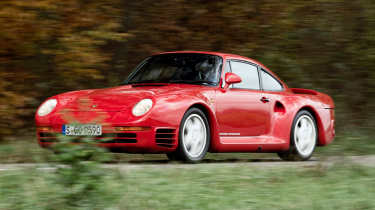
‘As confidence increases, so you can feel the nose pushing a fraction if you’re aggressive on the way into a turn, but it’s a surprise just how fast you’re going when this starts to happen. A little lift will tuck the front wheels back on line, or if you’ve got more room then you can simply open the steering a bit and keep feeding the power on until it drives the rear round more. In tighter corners you can more easily sense that there’s still a 911-type balance underneath the 959’s grip and there’s quite a bit of roll to work with too.
‘Although the chassis’ grip and sway are interesting, it’s undoubtedly the 959’s monster power delivery that makes the biggest impression. You’re always looking for a stretch of road that’s open enough to stir that number two turbo, because once the second snail’s lit and chuffing there’s the slightly uncomfortable feeling of everything running away from you, like you’ve just snagged a passing Eurostar and are now trying to hang on and steer it down a small road.
‘Admittedly, thanks mostly to the 959’s traction, there’s not the feeling of loopy lightweight craziness you get when an F40’s engine comes on boost and tries to kill you, but the 959 Sport’s roaring 508bhp feels like it’s almost unstoppable and too much for it to cope with as the rear squats, the nose rises and the A-pillars start to look very spindly indeed…’
Porsche 959 values
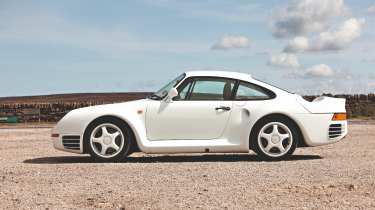
The Porsche 959 is the original Porsche supercar and is easily one of the rarest models in its storied history. Fewer than 340 959s are thought to have been built. For reference, Porsche built 918 examples of its 918 Spyder hybrid hypercar and over 1270 Carrera GTs.
That 959 values are now well over £1million and upwards of £2million for rarer specs, Sport models and low-miles examples, shouldn’t come as a surprise then. Values were suppressed for a long time, the 959 only really breaking into seven figures in the last decade or so. Buyers feared scarce tyre availability and maintenance of its early-generation technology and bespoke componentry.
There’s also the US market to consider. It’s the car behind the creation of the ‘Show or Display’ law in 1999, which allowed importation of significant cars that were not homologated for the US market if driven fewer than 2500 miles a year. Microsoft founder Bill Gates was a key lobbyist, frustrated at being unable to take delivery of his 959 in the US. He reportedly paid a $28 daily fine for storage of his impounded supercar for 13 years, until after ‘Show or Display’ was passed and he could legally take possession of the car in 2001.
Specs
| Porsche 959 Komfort | Porsche 959 Sport | |
|---|---|---|
| Engine | Flat-six, 2849cc, turbocharged | Flat-six, 2849cc, turbocharged |
| Power | 444bhp @ 6500rpm | 508bhp @ 6500rpm |
| Torque | 369lb ft @ 5000rpm | 369lb ft @ 5000rpm |
| Weight | 1450kg (311bhp/ton) | 1350kg |
| 0-62mph | 3.7sec (claimed) | 3.7sec (claimed) |
| Top speed | 197mph (claimed) | 211mph (claimed) |
| Price | £145,000 (1987) | £150,000 (1987) |
| Value now | £1million+ | £2million+ |