Ferrari 849 Testarossa review – can the SF90 successor challenge Lamborghini's Revuelto?
Ferrari has resurfaced a legendary name for its SF90 supercar replacement. Here's how the 849 Testarossa stacks up
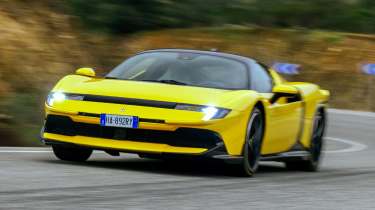
Testarossa. Of all the names in Ferrari’s lexicon of legendary models, this is surely the most evocative. Originally two separate words, Testa Rossa was first applied to Ferrari’s formidable sports racers of the mid-’50s and early ’60s. The name was then benched until 1984, when the company revived it for the dramatically side-straked supercar. Like its ’80s namesake, the new £407,617 849 Testarossa (£442,467 for the Spider) takes its place at the top of Ferrari’s series-production range. Suffice to say it has its work cut out.
As successor to the unloved SF90, it needs to win over those customers who were left nonplussed by that model, while the stern internecine battle to substantively surpass its junior stablemate, the 819bhp, 205mph 296, is far from a given. Especially now there’s a Speciale in the mix. There’s also the small matter of the Lamborghini Revuelto, which masterfully managed the transition to hybrid by retaining a V12, and therefore the wildness of a flagship Lambo, while deploying the complex powertrain and dynamic system integration to add sensational capability previously thought beyond the reach of Sant’Agata’s big beasts.
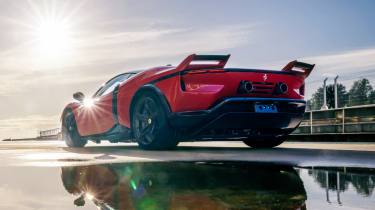
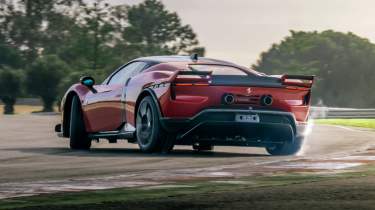
The 849 is more extrovert than the model it replaces, yet deliberately – perhaps wisely – resists the obvious nostalgia trip of slats and strakes. Instead, it’s more a curated mash-up of F80-inspired front-end with a dash of SP3 Daytona around the rear haunches and echoes of the epic ’70s 512 sports prototypes (and therefore the much later FXX‑K) in the distinctive ‘twin-tail’ winglets.
Heavily sculpted flanks are very much its own, the deeply scalloped door-tops requiring a new forming process to make, and acting as a chute to feed rear intakes with air. It has plenty of presence and dials up the swagger compared with the 296, but it looks a bit stubby compared with the longer, lower, leaner F80 from which it draws obvious inspiration. Whichever way you slice it, there’s a lot going on.
> Ferrari 296 Speciale review – does it live up to its legendary name?
The 849’s styling might be divisive, but there’s no question it puts a smile on your face when you swing open the door and drop into the driver’s seat. The interior is calmer than the exterior but still impressive. The curved spar that loops from the dashboard to delineate driver and passenger zones is a nice touch, while the new HMI complete with physical switches is easier to operate, navigate and read on the move. And, of course, the red anodised manettino remains the perfect driving mode switch, even if it has swapped its pebble-smooth contours for a sharper-edged shape.
The view out is typically Ferrari, with decent visibility thanks to a low scuttle that frames the peaks of the front wheelarches between the A-pillars. The mirrors offer a great view down the halfpipe channels running along the upper surface of the doors into the hungry ducts behind, with rearward vision completed by a letterbox view through the engine compartment to the road in your wake.
You turn the Testarossa on rather than start it up, the powertrain coming to life in electric mode and requiring you to turn the ICE on via the eManettino. When it starts, the V8 is vocal, but mechanical rather than musical. Still, it’s good to hear it’s more present than in the SF90.
First impressions are dominated by steering that’s light and free but has a little more heft than the Revuelto’s, which is much lighter than you expect. Unless you’re in Wet mode the ride never feels less than firm, and it doesn’t take long to remember how useful the bumpy road mode is. In the 849 it immediately takes the edge off whenever the road feels lumpy, and it’s a cinch to use.
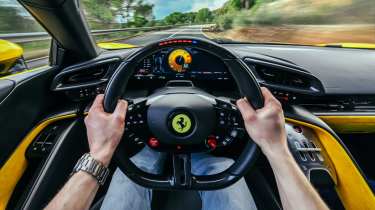
The Testarossa is a big car, but it feels compact and wieldy, even on the sinuous roads that characterise this region of Andalucia. You quickly find a natural rhythm, modest steering inputs enabling you to carve through corners with one input and little need for small adjustments. It’s intuitive, alert and communicative, albeit in the triple-distilled manner of today’s by-wire supercars.
Sport feels like a good place to start on the regular manettino, with the eManettino initially set to Hybrid. The nature of the roads means the V8 rarely shuts off, but the division of labour between ICE and battery is slick, the early surge of hybrid torque doing much of the work on small throttle openings and the V8 simmering in the background.
> Ferrari F80 review – hybrid V6 hypercar is a worthy successor to the LaFerrari
Switching the manettinos to Race and Performance injects the Testarossa with considerably more vim, the chassis (with semi-active MagneRide suspension) clenching itself tighter and the powertrain responding more sharply.
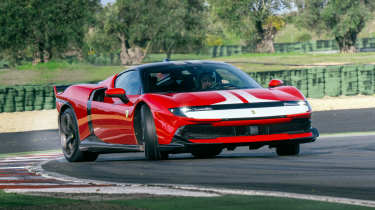
It feels like the optimum combination for fast road driving; more than enough to attack but with the reassurance of steadying electronics to keep things tidy. The V8 is a real powerhouse, with virtually imperceptible lag and genuinely fabulous part-throttle response.
It’s in these moments, where you’re working between 25 and 75 per cent throttle, that the precision of the power delivery is most impressive. How Ferrari manages to meld ICE and electric so seamlessly and with such consistent, proportionate response is really impressive.
It’s here too that we discover the lengths to which Ferrari has gone to transform the SF90 into the Testarossa, and where we feel the cascade of technology from F80. Central to this are bigger turbos, the largest ever fitted to a production Ferrari. They provide more boost with no increase in lag, thanks to low-friction bearings, redesigned compressor wheels and turbine housing, a new calibration strategy and improved heat management.
Beyond the larger pair of snails, the cylinder heads, engine block, exhaust manifolds, intake plenums, titanium fasteners, valvetrain system and fuel rail are all new. In addition, weight has been saved by aggressive machining of the engine castings along with the use of titanium fastenings throughout and Inconel for the redesigned exhaust manifold.
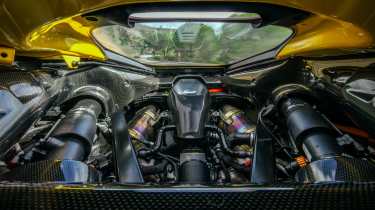
The upside is clear; an increase of 50bhp, lifting peak ICE output to 819bhp for a combined powertrain output of 1036bhp. That’s 35bhp up on the Revuelto, in case you’re wondering. The top speed claim is ‘>205mph’, some 12mph down on the rampant Lamborghini’s claim of ‘>217mph’, but the Testarossa is quicker out of the blocks, taking 2.3sec to hit 62mph and 6.35 to 124mph compared with 2.5 and 7.1 respectively for the heavier Revuelto, which weighs 1772kg dry compared with 1570kg for the Ferrari (with lightweight options selected).
Changes to the hybrid system – which contributes a total power figure of 217bhp – are confined to extensive calibration work, but the wide suite of dynamic control systems has been expanded to incorporate Ferrari’s latest and most significant advances. Of these it’s the powerful combination of FIVE – Ferrari Intelligent Vehicle Estimator (which somewhat confusingly is Ferrari’s 6D system) – and ABS Evo that elevates the Testarossa to an impressive new plane of dynamic capability.
At the same time, larger brake discs and pads front and rear have optimised cooling for greater performance and consistency; essential to support ABS Evo’s ability to accurately deliver braking force proportionate to pedal effort in this brake-by-wire system.
The suspension geometry has been tweaked, taking learnings if not the exact settings from the SF90 XX Stradale. There’s a suite of new tyres developed specifically for the car and depending on precise specification. Michelin Pilot Sport Cup 2s are standard on Assetto Fiorano, with Cup 2 Rs upon request. The regular car comes on a Pirelli P Zero R or Bridgestone Potenza Sport.
While no one ever steps out of a 296 GTB craving more go (at least not on the road), the Testarossa needs to be an emphatic step on. Though the opportunities to explore the upper reaches of its performance are few and far between, when you get the chance to unleash the Testarossa it does feel more immediately muscular, explosive, and ultimately a bigger-league supercar. In terms of raw pace, it’s every inch the flagship.
Character-wise it’s less clear cut. The 849’s V8 is more vocal more of the time than the SF90’s, with a pleasingly cammy note reminiscent of older naturally aspirated Ferrari V8s when working hard, but its soundtrack isn’t as sweet or stimulating as the 296’s V6.
It’s not so much the hard tone as its uniformity, with little of the respiratory cackles and whooshes that make the 296’s powertrain so exciting. One saving grace is the gearbox, which delivers the same delicious gunshot-like upshifts as the F80.
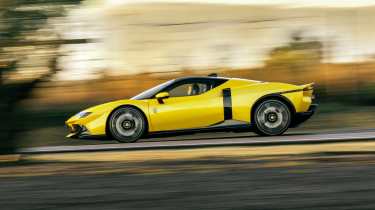
The rain-affected road driving makes the Monteblanco circuit session especially important. As usual the lapping exercise is short but sweet. With two sets of five laps (out-lap, three flyers and an in-lap) we start in Race to avoid wasting time, but also to feel the progression of the dynamic systems. Race is where things get interesting, and most likely where you’d spend most of your time on the road. At least when it’s not river-deep in rain.

Race allows a small amount of lateral slip so you can get the 849 working nicely within clear but softly enforced limits. Overreach and the electronics begin to quietly mediate between throttle opening, steering input, available traction and lateral grip. It’s a quick, neat, flattering and ultimately safe way to attack Monteblanco, but you know there’s a lot more to explore.
CT Off is transformative, noticeably relaxing the rotational limits so you can brake deep and late, trailing the brake into the corner and using that turning energy to generate useful yaw. Initially you apply a small amount of steering correction and wait half a beat before chasing the throttle.
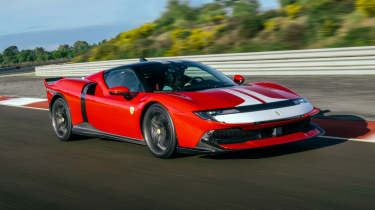
You feel the 849’s willingness to slide, but then sense the front axle – which is home to two of the car’s three electric motors – working to straighten things up. With confidence you learn to merge those inputs and lose the pause, at which point the 849 feels more like a rear-wheel-drive car; albeit one that manages to slide and still find immense forward propulsion.
In fast, medium or slow corners, the 849 responds to broadly the same inputs with amazing consistency, which in turn serves to build your confidence and enjoyment. At this stage you could be fooled into thinking the 849’s systems are all but switched off, but making the final turn of the manettino to ESC Off shows they are busier than your ego wants to accept.
You do the same things behind the wheel, but with nothing to rein-in all that power and torque your throttle inputs need to be more measured and your steering inputs quicker and more decisive. You feel your work‑rate increase, the act of balancing the car requiring more focus and precision. It’s a challenge – as it should be in a car of this potency – but it’s also highly rewarding.
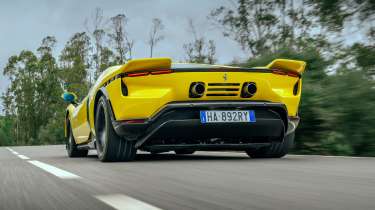
The Assetto Fiorano configuration certainly helps in this regard. At least when fitted with the Mutimatic dampers, which are fixed at a stiffness that’s slightly firmer than the MagneRide adaptive dampers when set to Race. The Circuito Monteblanco is generally smooth, but you feel this added stiffness over the few bumps there are, especially on corner exit when the car is working at or beyond its limits of lateral grip and traction.
I’d be curious to do some laps with an Assetto Fiorano car fitted with MagneRide (an option to preserve nose lift), likewise a Multimatic-equipped car on the road. My hunch is the former would be the sweet spot, at least if your use case is majority road driving with occasional track use.
Whatever the spec, it’s clear the 849 Testarossa is a blisteringly quick and naturally gifted track car. Given its power and position in the range that’s only to be expected. The surprise, at least to me, is that from this admittedly brief drive the 849 feels like the 296 Speciale’s big brother, at least so far as how it balances on-road refinement with intense on-track ability.
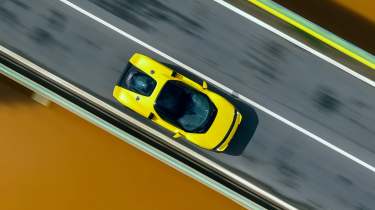
Assetto Fiorano pack or not, I’m unsure how often a Testarossa customer is likely to take their car around a circuit. But if they do, they’ll find they have a truly formidable machine. One that laps Fiorano in 1:17.5. For context that’s just 0.2sec slower than the SF90 XX Stradale and 1.5sec faster than its direct predecessor, the SF90 Assetto Fiorano, not to mention the new 296 Speciale. As for the previous Testarossa, how does a 1:40.6 grab you?
Make no mistake, the 849 is a hugely impressive car – one that should lay to rest the ghost of the early SF90 and pose a serious threat to the Lamborghini Revuelto. But extreme capability doesn’t always equal huge desirability. Despite transforming its dynamics and making considerable efforts to amplify its character along with its performance, the turbocharged flat-plane-crank 4-litre V8 doesn’t match the emotion and drama of a 6.5-litre naturally aspirated V12.
Herein lies the Testarossa’s biggest problem. We all know the laudable reasons why Ferrari designed the SF90 around a hybridised V8 powertrain. Yet we also know that for as long as it resists building a flagship production supercar with a V12, it will have a job convincing some people that they should own anything less.
Price, rivals and specs
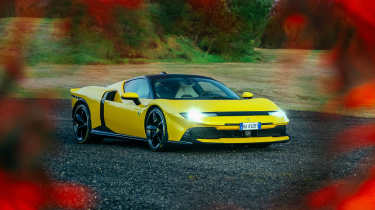
The Ferrari 849 Testarossa picks up where the SF90 left off, as Ferrari's flagship supercar, to fill the void between the 12 Cilindri super GT and F80 hypercar. It faces the 1001bhp Lamborghini Revuelto head on, though its V8 is no match for the Sant'Agatan's voluminous V12 in terms of character.
Coming on stream soon is Aston Martin's Valhalla, which like the Ferrari utilises a heavily hybridised twin-turbo V8 but like the Lamborghini, utilises a carbonfibre tub. One advantage the Ferrari has? It undercuts the Lamborghini on price, with the standard 849 Testarossa starting from £407,617 – some £50k less than the point of entry for the Revuelto.
| Engine | V8, 3990cc, twin-turbo, plus 3 e-motors |
|---|---|
| Power | 1036bhp @ 7500rpm (combined) |
| Torque | 621lb ft @ 6500rpm (ICE only) |
| Weight | 1570kg (dry, with lightweight options) (670bhp/ton) |
| Tyres | Pirelli P Zero R (standard), Michelin Pilot Sport Cup 2 (Assetto Fiorano) |
| Top speed | >205mph |
| Basic price | £407,617 |