A month with a Toyota GR Yaris: frustrating seats & an air ambulance
Barker and the Yaris pay a visit to the air ambulance and team that came to our man’s rescue

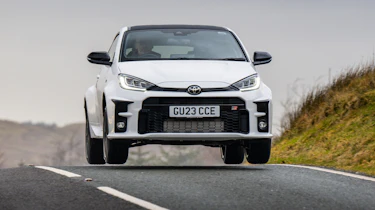
A couple of airport runs and quite a bit of commuting have seen the economy climb to previously only hoped-for heights – over 35mpg – the figure barely dented by the occasional enthusiastic run, which is, of course, irresistible. I adore the mid-range torque of the Yaris’s in-line triple, which feels oversized for a 1.6 and comes with an equally oversized and purposeful offbeat growl. It’s especially satisfying if you allow boost to build from low revs on full throttle.
The Yaris’s other control weights match its beefy delivery, especially the steering and the heft of the six-speed manual. It takes a bit of consideration to finesse the shift from cold, but I wouldn’t swap it for the Gen 2 GR’s new eight-speed auto because it’s such a key part of the car’s character. Also, autos are programmed to find the best engine response to the throttle demand, while I want to enjoy the feeling of the motor building up, a slow burn igniting into a controlled explosion of full torque.
> Toyota GRMN Corolla is a Nürburgring-ready two-seater hot hatch we’re still not allowed to buy
I collected the BBR MX-5 from Brackley and was immediately struck by the stark contrast. While the Mazda and Toyota proved remarkably well-matched for outright pace, they couldn’t have been more different in feel, the Mazda so much lower, lighter and more delicate. Swapping back a few days and hundreds of miles later, the Yaris felt good right away, proof that I’m definitely conditioned to its lofty driving position, while day-to-day the lack of front and rear locking diffs makes little difference to the enjoyment.
More reviews
Group tests
In-depth reviews
Reviews
- Toyota GR Yaris Aero Performance review – one of the best hot hatches just got better
- Toyota Yaris GRMN (2017 - 2018) review – the forgotten Ford Fiesta ST killer?
- Toyota GR Yaris Gen 2 prototype 2024 review – rally‑bred hatch turned up to 11
- Litchfield Toyota GR Yaris 2021 review – superstar hatchback picks up expert UK-tuning
One mild irritation is the tilt-n-slide mechanism for getting into the back seat. I know the GR is a homologation special so Toyota didn’t waste money developing a memory mechanism but, boy, it’s a faff to use. And even small folk find it a struggle to get through the gap between seat and door frame.
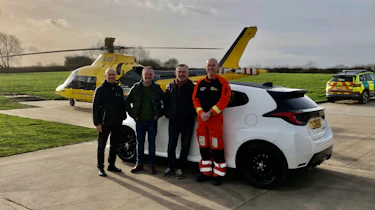
I was pleased to finally meet Keith Rutherford again. I last met him on August 28, 2022, after my Sunday-morning mountain-bike ride went awry. I found a 10ft drop where I expected a slope and landed on my back, breaking quite a few bits, including two vertebrae. The bike was fine. I tried to walk out of the woods but after about 100 yards had to give up. My mate, Nick, called 999 and after initially being told an ambulance would be six hours arriving, he turned and said, ‘The air ambulance will be here in 15 minutes.’ Wonderful words. Keith (pictured above, on the right, with colleagues Dave Hart and Nick Bould, plus yours truly) was part of the crew that attended and whisked me to the nearest musculoskeletal trauma centre, University Hospital, Coventry & Warwickshire.
Luckily for me, on the day of my visit to the base of the Derbyshire, Leicestershire & Rutland Air Ambulance near Nottingham both Keith and a helicopter were available. Some of his colleagues wondered why I’d turned up in a little Toyota, but Keith, a critical care paramedic, immediately recognised it was a GR.
‘Most people assume we just get people to hospital faster but we have many more specialist skills than regular paramedics,’ Keith explained. This means that they can do much more at the scene, including anaesthetising and even amputations. Motorway pile-ups are the most common calls but they rescue people from the hills of the Peak District too and provide a Critical Care Car service when flying is not possible. Each mission costs around £2300, all funded by charitable donations as they are a service which operates to support the NHS and receives no funding from them or the government. For info on their work or to make a donation, visit theairambulanceservice.org.uk
| Total mileage | 4226 |
| Mileage this month | 1455 |
| mpg this month | 35.2 |
| Costs this month | £0 |
| Price when new | £30,020 |
| Price today (2026) | From £20k |
This story was first featured in evo issue 323.