BMW M5 (F90, 2017 - 2023) review – a 600bhp saloon for £35k
The F90 BMW M5 added polish and all-wheel drive to Munich’s super saloon formula, making it quicker than even its 2026 successor

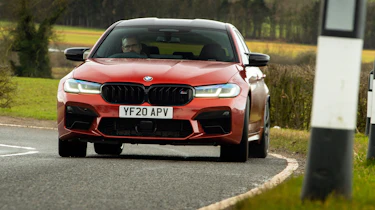
By the time the F90 BMW M5 Competition arrived, the BMW M Competition recipe was pretty well refined. Simply take an existing M-car, add a touch more power and treat the suspension to a few well-chosen tweaks aimed at sharpening the driving experience, add a discrete ‘Competition’ badge and there you have it. It’s an approach that has been applied to the M2, M3, M4 and M8 and was also applied to the F90 M5 Competition, which sat alongside the evo Car of the Year winning M5 CS. The F90 M5 was replaced with the V8 hybrid G90 in 2024.
For the Competition upgrade, BMW breathed on the F90’s twin-turbocharged 4.4-litre V8, raising power to 616bhp from 596bhp with torque unchanged at 553lb ft. Performance gains were minimal, but the optional M Driver’s pack did raise the top speed from a limited 155mph to 190mph. Of more interest were the changes aimed at sharpening the handling, with a 7mm lower ride height, 10 per cent stiffer springs, recalibrated dampers and altered geometry. It culminated in a car that was more involving and agile than before, yet with barely any reduction in comfort. What the updates didn’t do, however, was shrink the size of the BMW, so it still feels vast, even if its replacement dwarfs it…
More reviews
> BMW M5 review – it’s more powerful but is the extra weight a problem?
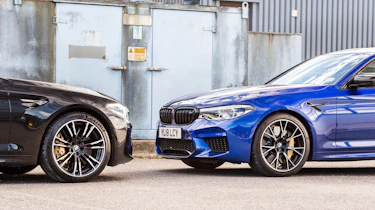
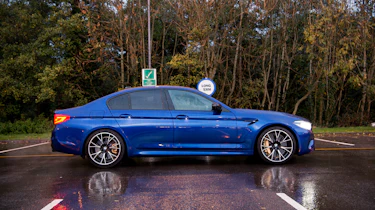
External changes over the standard M5 are small but worthwhile, particularly that ride height drop, which gives the car more of a hunkered and aggressive stance. A new 20-inch forged alloy wheel was also designed for the Competition and a subtle gloss black finish for the trim and the badges. Inside it’s business (class) as usual, with only the red-finish starter button giving the Competition game away.
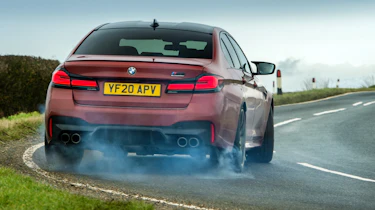
While the BMW M5 Competition was certainly a lot of money at £111,425 when new, it was also a lot of car, and today with prices starting at £35,000 for higher mileage examples this is the most M car for your buck. Even with the G90 now a regular sight on the road the F90 doesn't look or feel dated, if anything, it’s the more contemporary and elegant of the two.
For the first time in the history of the iconic supersaloon, BMW released an M5 CS variant in 2021, with a 626bhp output making it the most powerful M5 ever produced. With a 70kg reduction in weight and a much more focused chassis, it even took the title of evo Car of the Year 2021.
Which engine is fitted to the F90 M5 Competition?
- 616bhp 4-litre twin-turbo V8
- All-wheel drive, eight-speed automatic
- Explosive acceleration, refined exhaust
Powering the F90 M5 Competition was BMW’s familiar S63 twin-turbocharged V8 producing 616bhp (an increase of 24bhp over the previous ‘standard’ M5), while torque remained unchanged at a rippling 553lb ft. Drive is sent through an eight-speed torque-converter automatic gearbox, which is connected to BMW’s trick M xDrive four-wheel-drive transmission. This specific engine, gearbox and all-wheel-drive set-up appeared in the M5 before spreading to the BMW M8 and X5 M/X6 M twins.
Turbo lag is only hinted at with BMW's S63 V8, and once engaged and under full throttle it felt good for every one of its 616bhp when new and today still has enough firepower to keep a more modern super saloon honest. The flat torque curve barely recedes at high revs either, keeping the engine's urgency strong even if you don't really need to keep it in that low gear for the performance.
The transmission only accentuates the almost endless-performance delivery of the engine, with its short ratios and super slick changes delivering a good impression of DCT-quick changes. Keep your foot buried for more than a moment and you'll be quickly exceeding UK speed limits to an alarming rate though, making it a sometimes frustrating car to drive on challenging roads.
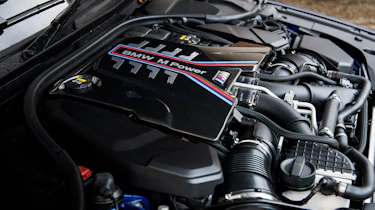
Its 0-62mph time was 3.3sec, however, by the time the F90 M5 Competition hits 124mph it’s three-tenths ahead of its less powerful non-Competition sibling, which is useful to know. That 0-62mph time also happens to be quicker than the claimed 3.5sec of its much more powerful (and expensive) 717bhp G90 successor, which just goes to show how much weight matters.
In all honesty, any performance gains are hard to detect, the Competition accelerating with the same deranged intensity that puts it toe-to-toe with some seriously exotic sports cars. What the Competition did add is a little extra spice in the form of a new Sports exhaust. This set-up allows the V8 to find the full baritone bark of its voice, and while it’s not as bombastically loud as the Mercedes-AMG E63 S, the M5’s more restrained soundtrack is more in keeping with the Q-car character of a true supersaloon.
Does the F90 M5 Competition drive differently to an M5?
- Stiffer chassis improves handling and agility
- Rear-biased four-wheel-drive allows selectable drift modes
- Impressive dynamics but lacks steering feedback
Many of the F90 M5’s Competition’s upgrades were concentrated on the chassis, with the aforementioned 7mm lower ride height over the standard M5, which in combination with the 20-inch forged alloys gives the Competition a much more purposeful stance. Its 10 per cent stiffer suspension springs were paired to recalibrated adaptive dampers with firmer anti-roll bar mounts front and rear also fitted. There were also new ball-joints for the rear toe links and more negative camber for the front wheels. Finally, the engine mounts were changed for 50 per cent stiffer ones.
Elsewhere the Competition was the same as the standard M5, which meant you got the same M xDrive four-wheel-drive system. This allows you to run with all four wheels driven, or to disengage the front axle for some good old-fashioned M-car rear-driven fun, although you need to also disengage the stability control to engage this function, so you’ll need to be on high alert behind the wheel. Happily, it has a rear-biased feel even in its standard mode, so you can have fun without fear of taking up the whole width of the road on the exit of a corner.
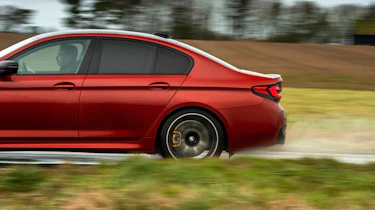
The BMW M5’s reputation as the most dynamic of supersaloons hasn’t quite been the foregone conclusion it might have once been over the last couple of generations. As its physical size and spread of capability has expanded, so too has its interaction been dulled. This is only heightened by rivals from the same era such as the Mercedes-AMG E63 S, which seemed to have swapped roles with the BMW by feeling more dynamic and less polished as an everyday car.
The Competition’s upgrades over the standard 2017 F90 M5 2017 were welcome when new and are still a positive today, and obvious the moment you move away. The M5 Competition rides with a little more stiffness than a standard M5 of the same generation, even in its Comfort mode, yet it’s still fairly supple and once you’ve upped the pace any small loss in compliance is easily offset by even tighter control.
Seek out some corners and you’ll quickly find the M5 Competition responds with greater alacrity to the (still too mute) steering, the front tyres biting harder on turn-in. It helps give the Competition a remarkable sense of agility for such a big machine, a sensation that’s enhanced by remapped dampers (Sport is best for hard road driving, Sport Plus best reserved for the track, where the Competition performs rather better than you’d expect for a 1865kg saloon) and those tougher springs, which keep the BMW planted and poised over twisted and torn stretches of tarmac. It would be stretching the truth to say the Competition ‘shrinks around you’ because on tighter sections of road the M5’s girth causes a sharp intake of breath as you squeeze past oncoming traffic, but it feels more nimble than its predecessor and far lighter on its feet than most rivals both of the time and today.
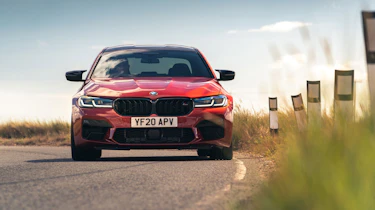
Its trick M xDrive transmission plays its part here, delivering both rear-drive adjustability to keep things entertaining and assured traction when it gets slippery. Like the standard M5 you can also shortcut your favourite driver settings using the M1 and M2 buttons on the dash, including the hooligan 2WD mode, which delivers the sort of lazy drifts you’d expect from such a long and stable machine.
The problem with the M5 Competition is that while the package was arguably one of the most complete of any supersaloon in the 2020s, its anodyne soundtrack and distant steering make it somewhat less satisfying to drive on the road in comparison to its AMG rival. It’s an undoubtedly talented performance car, but one that doesn’t elicit the sense of drama or fun that you might expect.
How much does an F90 M5 cost to run?
- V8 is thirsty, achieving 26-28mpg
- Hard driving easily drops fuel economy into the teens
- Heavy weight accelerates component and tyre wear
Hot-Vee V8 engines have a reputation of quite astonishing fuel consumption when being worked and BMW’s is no different. During our time with the non-Competition M5 on our Fast Fleet we averaged between 26 and 28mpg, but given enough space would easily drop into the teens when digging into its performance.
The near-two-ton kerb weight has other compromises such as an appetite for tyres, brake pads and suspension components. BMW’s standard-fit Michelin Pilot 4 S tyres aren’t as aggressive as some, but the 275- and 285-section front and rear tyres to fit the Competition’s standard 20-inch wheels will cost around £1200 a set to replace.
Inside the BMW F90 M5
- Excellent interface with familiar physical controls
- Driver-focused upgrades make for a special feel
- Supportive seats
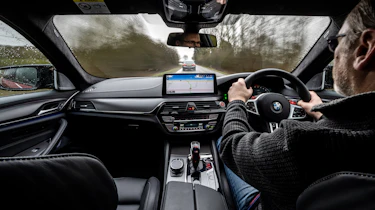
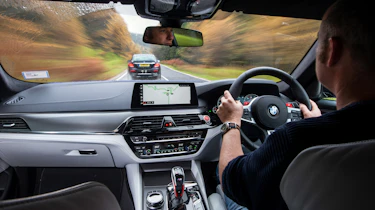
The F90 M5’s interior is one based on an aesthetic that has since been replaced by newer designs in BMW's current models, but that’s no bad thing. The M5’s cabin is beautifully constructed and features better materials than many rivals. Despite the slightly more old-fashioned layout compared to those of the Audi’s RS6 and Mercedes-AMG’s E63, the M5’s digital interfaces are still crisp and up to date (better than today’s current offerings, in fact), while the traditional click wheel and physical HVAC controls are reassuring and familiar in a good way.
The M5’s upgrades over the standard 5-series models were both subtle and not so subtle. BMW’s then new M Drive buttons sat on red prongs on the still-too-thick steering wheel, but worked really well in giving you access to the configurable M modes. The gear selector is also bespoke to the F90 M5, with a different operating system to that of standard BMW models, instead mimicking the older SMG selector pattern. While this seems like a needless complexity over standard models, it does make the M5 feel more special than its lesser siblings, even if the change is purely semantic as the transmission underneath is still a standard automatic.
Elsewhere, the huge seats are supportive and comfortable, covered in high-quality leather and even feature an illuminated M5 badge when you unlock the car from outside, if that’s your sort of thing. For those after a more subtle interior, traditional leather colours and optional timber trim can replace the copious gloss carbonfibre elements if specified.
Our verdict on the F90 BMW M5
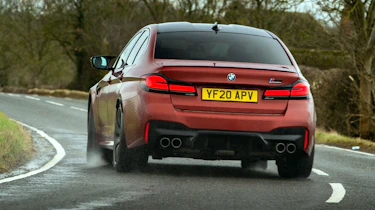
The BMW M5 might have supercar-toppling performance, but it certainly ranks as one of the more subtle supersaloons on the aesthetic scale. The standard 5-series it was based on was a restrained design, but the M5’s relative lack of bespoke body addenda outside of its mildly widened front wings and quad exhaust pipes is far more subtle than an RS6’s cartoonishly wide body or the E63 S’s bespoke nose.
The Competition model did include a few extra inclusions when launched, including those forged 20-inch wheels, darkened tail lights and a black rear diffuser section, but with that comes a blackened grille which although increasingly popular, is a jarring element.
For some, the M5’s understated approach will still be preferable, but whether you’re a fan of a more outlandish aesthetic or not, it does struggle to feel as special or bespoke as its rivals.
Driving 15,000 miles in a BMW F90 BMW M5
evo’s Editor-in-Chief, Stuart Gallagher, ran an F90 BMW M5 on its long term test fleet for nine months, covering 15,000 miles, this was his verdict.
'The M5 or the Alfa Giulia?’ If I had a pound for every time I was asked that question during my nine months of running evo’s F90 BMW M5 it would possibly stretch to paying for a tank of super unleaded in its belly.
The answer? For pure thrills the Giulia Quadrifoglio was – is – ahead of the M5. Still ahead of pretty much any supersaloon you care to mention. It’s such a singly focused device, one that doesn’t pretend to offer anything but the purest, richest and highest-octane thrills this side of a supercar. Which led many to believe that having the BMW replace the Alfa as my long-termer must have been a crushing disappointment. Far from it.
From the off the M5 lets you know exactly what it’s all about. It has no pretence of being a highly strung track thug or a lap-time-chasing addict. Rather it is the closest reinterpretation of the original M5 recipe that I think I have experienced since the first V8-engined version, the E39 from 1999.
Before the F90 arrived there had been a sense that BMW M was chasing Mercedes-AMG so hard in the performance stakes that it had lost sight of what made the M5 so unique and iconic in the first place. But the F90 feels more mature than other recent M5s, less pent up with aggression and as if it’s trying to prove something, and it’s all the better for it. Despite the power increase, the torque hike and performance gains, this M5 proved itself to be a better, more rounded car, offering greater duality than previously seen from M and other modern supersaloons.
So while it lacked the nailed-down 100-per-cent-focus approach of an E63 S, the M5 perfectly melded comfort when you needed it with the performance you expected. Much of this was down to its balanced driver modes. Knock it all back to Comfort and it felt like a M550i that had completed a few more reps in the gym, but switch to Sport and the M5’s true character appeared. It’s the setting it felt at its most natural in and which got the best from the car. Given the opportunity to ask an M5 engineer what their optimal setting is, I suspect they’d say this.
Why so? In Sport the engine is mapped to respond as you’d expect an M-badged 4.4-litre twin-turbo V8 to. It wasn’t snappy, and unlike many of its ilk it wasn’t all about torque, either. You could reach into its power curve and meter out the performance exactly as required, enabling you to trim entry and exit speeds with far more precision than either an M3 or 4 has allowed since they adopted a pair of blowers. It was like stepping back in time, remembering how great both the E39 and the E34 before it were – and how dominant the M5 once was, too.
And all this despite the F90 being the first four-wheel-drive M5. The reality is the adaptive system is so intuitive and quick to react that the car never really felt four-wheel drive. Like AMG’s 4Matic system it steps in when it needs to rather than nannying you at every opportunity. One of my ploys to hang on to KNP for longer was a suggestion that I should run it through the winter months to really try out the all-wheel-drive capabilities. I’ve never heard the BMW press office use language like that before…
As you would hope with a car that arrived commanding a six-figure price tag, the M5 was a paragon of reliability. Well, almost. Other long-term-test M5s had thrown up a few issues – namely a fuel-pump failure and a dodgy front diff – but evo’s only required a trip to the workshop to rectify a roof rail that had worked itself loose.
An issue I did have was with the Pirelli P Zero tyres the car came fitted with. BMW homologated two tyres for the M5: the Pirelli and Michelin’s Pilot Sport 4 S, with the former fitted to the press cars because they are deemed by the engineers to be the quicker tyre. That as may be, but in the wet they struggled from new and when the wear dropped below 3mm the M5’s chassis became a bit wayward and unpredictable just when you didn’t want it to be. A switch to the Michelins eradicated this as well as adding a touch of sharpness to the chassis overall, allowing me to push it harder than previously. If it was me I’d sacrifice some speed for the increased feedback the French rubber offered.
Of course, the M5 Competition, came along soon after and was a car that polished the performance further: a little sharper, more responsive and agile. All marginal-gains stuff, but still noticeable. So where did this leave the regular car? As one of best all-round supersaloons – if not the very best – on the market at that time. AMG’s still rule if you want a wagon, but the F90 M5 was BMW M back to its best.’ – Stuart Gallagher, Editor-in-Chief, evo, issue 257
| Date acquired | March 2018 |
| Duration of test | 9 months |
| Total mileage | 14,231 |
| Overall mpg | 24.6 |
| Total costs | £1115 (four tyres) |
| Purchase price | £103,210 |
| Value today | c£40,000 (2026) |