Double wishbone suspension explained: is it better than a MacPherson strut?
What do double wishbone set ups offer over a more traditional MacPherson strut system?
We’ve all heard the terms bandied about – MacPherson struts, double wishbones, multi-link – and will be aware that they’re to do with the back art of suspension design, but do we really know the difference and what they’re meant to achieve. Here we’re going to have a look at double wishbones and try to get to the bottom of whether the accepted wisdom that they’re the best set up for a performance car is actually the case.
The double wishbone set up was first used in the 1930s by Citroen and it was adopted by Packard on some of its models in the mid-1930s. These early systems generally used equal length wishbones which did lead to some problems but the set up was refined over the years and has now become relatively commonplace with the general rule of thumb being that the more expensive and more sporting machinery would be likely to feature a double wishbone set up.
However, a car doesn’t have to have double wishbones to be a great driver’s car. Countless generations of Porsche 911 have ‘made do’ with MacPherson struts until the latest 911 GT3 and all BMW M3s have utilised the MacPherson strut, too. At the other end of the equation is the Mazda MX-5 that’s used double wishbones to very good effect, and that’s always been a rather decent drive.
What is a double wishbone suspension?
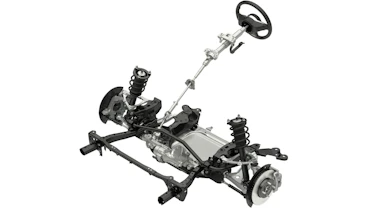
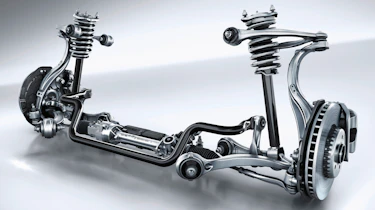
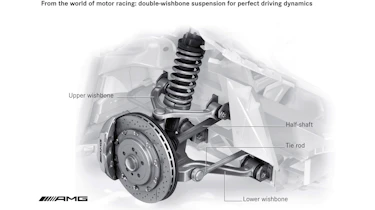
The double wishbone suspension is an independent suspension that employs – as its name would suggest – a pair of wishbone shaped arms to connect the wheel assembly to the vehicle’s chassis. The arms usually sit one above the other with the top one mounted to the top of the hub and the bottom one sitting where its name would suggest.
The wider end of the wishbone attaches to the vehicle’s chassis with two mounting points while the narrow end attaches to the wheel hub. The top of the coilover style spring and damper are attached to the chassis while the bottom of the damper attaching to the wheel end of the lower wishbone.
What are the benefits?
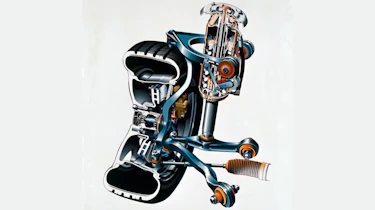
Any suspension set up’s job is to control wheel movement whether that’s bump or rebound, lateral, longitudinal or its camber. With a double wishbone set up the greater number of fixed points makes it easier to control these movements when compared to a MacPherson strut set up.
Additionally, the fixed nature and more predictable movement of the double wishbone set up makes it easier for precise geometry settings to be incorporated into the design. As such, the roll centre height, camber and caster angles can be fine-tuned for the best results. Perhaps the most important aspect of a double wishbone set-up is that it allows for better camber control during cornering, maintaining optimal tyre contact with the road. Obviously maintaining a greater contact patch with the road is good for roadholding and handling while it also reduces tyre wear.
A double wishbone set up also allows suspension engineers to more precisely calculate the forces that the components will have to cope with so they can be designed more precisely to optimise their strength and mass. Lastly, generally speaking vehicles with a double wishbone set-up tend to offer a better degree of ride comfort than those that use MacPherson struts.
What are the drawbacks of double wishbone suspension?
The most obvious downside is complexity and cost. A double wishbone system is a more complex design with more parts so it tends to be more expensive to manufacture which is why they tend to be fitted to cars at the higher end of the market. With more moving parts and bushes maintenance costs for owners will likely be higher too.
As well as keeping the company accountants up at night a double wishbone suspension can also give automotive designers headaches when it comes to packaging. When compared to a MacPherson strut where the damper unit tends to be mounted more vertically a double wishbone system takes up more space as not only do you need to have the space for the wishbones themselves, but the damper assembly is generally mounted at more of an angle which eats up space. This can lead to packaging issues on smaller cars, especially those with driven front wheels.